
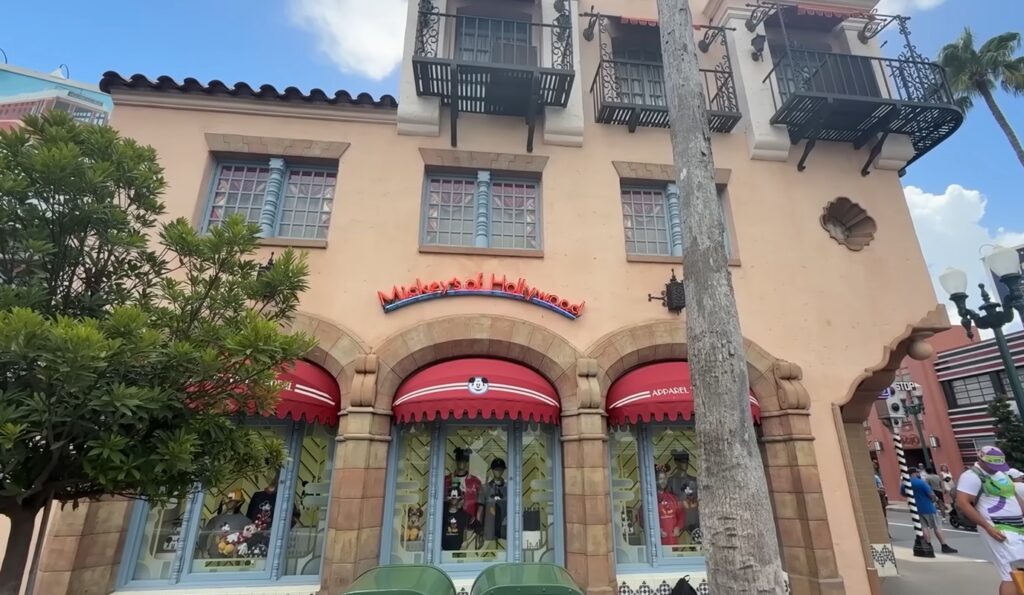
Mickey’s of Hollywood is the flagship merchandise location at Disney’s Hollywood Studios, occupying much of the first block on the left side of Hollywood Boulevard after guests enter the park. Often described as the Hollywood Studios equivalent of the Emporium at Magic Kingdom, the store has been part of the park since May 1, 1989, when Disney-MGM Studios first opened to the public. Over the decades, its interior has changed substantially, but its elaborate collection of Hollywood-inspired façades remains an important piece of the park’s original architectural storytelling.
Today, Mickey’s of Hollywood carries a broad assortment of Disney merchandise rather than specializing in a single character or franchise. Apparel, accessories, Mickey and Minnie ears, toys, plush characters, housewares, collectibles, park souvenirs, seasonal collections, and other Walt Disney World merchandise rotate through the store. Disney describes the current concept as allowing guests to “time-travel with Mickey” through the period from the 1920s to the 1940s, tying the merchandise location directly to Hollywood Boulevard’s romanticized depiction of Southern California during the golden age of the motion-picture industry.
That setting is especially important to understanding Mickey’s of Hollywood. When Disney-MGM Studios opened, Hollywood Boulevard was designed not as a literal reconstruction of one particular street but as a carefully assembled collection of buildings inspired by real Southern California architecture. Imagineers borrowed recognizable elements from historic structures in Hollywood and along Los Angeles’ Wilshire Boulevard, creating a streetscape that feels authentic even though the buildings were gathered together from different locations and periods.
Mickey’s of Hollywood stretches behind multiple apparently independent storefronts, a classic Disney technique that prevents the exterior from looking like one enormous department store. From outside, guests appear to be walking past a collection of separate Hollywood businesses. Inside, however, the spaces connect into a single large retail environment.
The main corner section is rendered in Spanish Colonial Revival architecture, with stucco walls, decorative tile, balconies, arched openings, and wrought-iron details. Its design was inspired in part by the historic Baine Building on Hollywood Boulevard near Whitley Avenue in California. Constructed during the 1920s, the real Baine Building exemplified the Spanish-influenced architecture that helped define Hollywood as it developed during the film industry’s formative decades.
Farther along the block, the architectural vocabulary changes dramatically. A black-and-gold façade incorporates the bold geometric decoration of the Zigzag Moderne and Art Deco movements, drawing inspiration from a 1929 Security-First National Bank building on Los Angeles’ Wilshire Boulevard. Another section historically known as Pluto’s Toy Palace features one of Hollywood Boulevard’s most memorable pieces of neon: Pluto perched above the storefront with his illuminated tail appearing to wag back and forth. The visual reference was inspired by an actual Hollywood veterinary building that once featured a large dog figure above its roofline.
Another storefront, Disney & Co., continues the architectural collage. Its exterior drew inspiration from the former Agfa Ansco Building on Wilshire Boulevard, a structure associated with photographic equipment during Hollywood’s golden age and later converted into the famous Slapsy Maxie’s nightclub. That real-world photographic connection was particularly appropriate for the original Disney-MGM Studios, a park built around filmmaking, animation, television production, and the machinery used to create entertainment.
Even the store’s name contains a piece of Hollywood wordplay. Mickey’s of Hollywood has long been understood as a playful Disney variation on Frederick’s of Hollywood, the famous Los Angeles retailer whose name became synonymous with Hollywood Boulevard. That sort of reference was typical of the original Disney-MGM Studios, where shops, restaurants, street names, props, and advertisements frequently mixed genuine Hollywood history with Disney humor.
The original interior was considerably more compartmentalized than the store guests encounter today. Different portions of the building felt like individual boutiques, each with its own merchandise and decorative personality. Mickey Mouse himself played an important role in connecting those environments.
One of the most fondly remembered elements was the use of large displays inspired by classic Mickey Mouse animated shorts. In one section, Steamboat Willie imagery referenced Mickey’s landmark 1928 screen appearance. Elsewhere, Mickey appeared as the energetic orchestra conductor from the 1935 short The Band Concert, standing on a tambourine while his increasingly chaotic orchestra surrounded him overhead. Other areas featured Mickey in additional famous screen roles.
These details fit the original mission of the park exceptionally well. Mickey’s of Hollywood was not simply selling Disney characters inside a Hollywood-themed building; the décor emphasized Mickey Mouse as a movie star with a career stretching back to the earliest years of synchronized-sound animation. Guests buying plush toys and T-shirts were simultaneously surrounded by references to Disney film history.
Over time, however, the retail environment became less segmented. Disney gradually removed or simplified some of the individual boutique qualities in favor of an easier-to-navigate store with broader merchandise selections. By the 2010s, Mickey’s of Hollywood still contained recognizable character displays and architectural details, but its function as the park’s high-capacity general merchandise location had become increasingly important.
The most dramatic change came in 2019, during a period when Disney’s Hollywood Studios was undergoing one of the largest transformations in its history. Toy Story Land had recently opened, Star Wars: Galaxy’s Edge was preparing for its debut, Mickey & Minnie’s Runaway Railway was being built inside the Chinese Theatre, and Disney was simultaneously refurbishing several of Hollywood Boulevard’s major retail locations.
Mickey’s of Hollywood closed on May 14, 2019, for an extensive interior overhaul. The refurbishment followed similar work at nearby Keystone Clothiers and Legends of Hollywood and lasted for more than four months. The store reopened on September 25, 2019 with an almost completely redesigned interior.
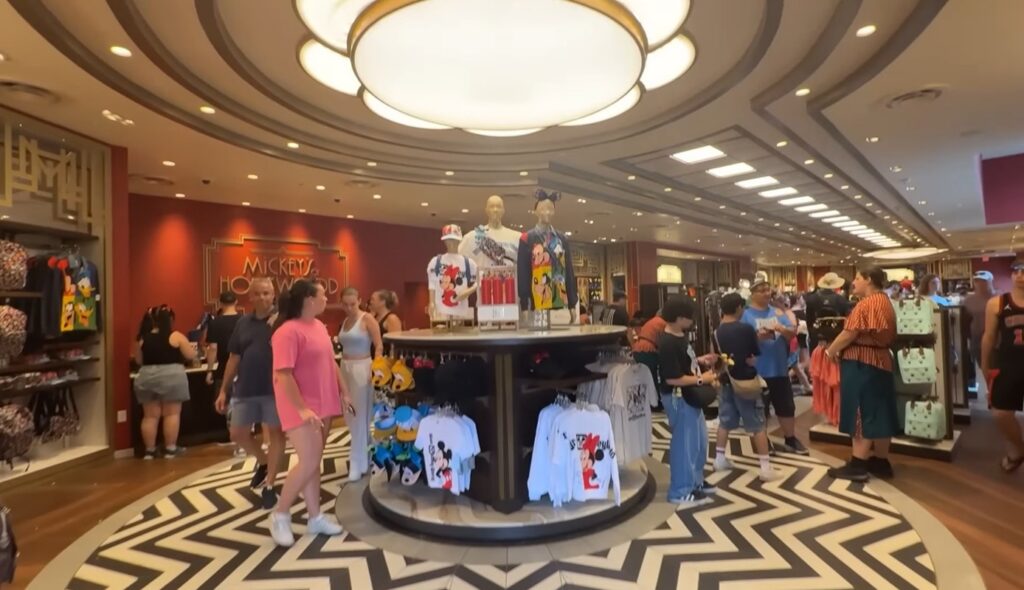
The transformation emphasized 1930s Hollywood glamour and Art Deco design. Gone was much of the heavily compartmentalized layout. The remodeled shop became noticeably more open, allowing guests to see across larger portions of the store and improving pedestrian circulation through what can be one of the busiest retail environments in the park.
Red became a dominant interior color, accompanied by dark woods, gold accents, marble elements, patterned flooring, geometric ceiling treatments, and illuminated merchandise marquees. Individual sections were identified with stylized signs for merchandise categories such as toys, headwear, apparel, and seasonal products rather than relying as heavily on separate shop identities.
Disney also introduced a redesigned Mickey’s of Hollywood logo. The new identity incorporates elongated lettering and geometric elements that complement the Art Deco surroundings. Decorative “M” motifs appear throughout the interior, including above merchandise displays and register areas. Some of the design elements deliberately recall the ornamental ironwork that had previously divided sections of the older store, providing a subtle connection between the new environment and what had existed before it.
The renovation was not universally welcomed by longtime park enthusiasts. The previous version contained more obvious references to classic Mickey animation and more individualized rooms, making the store itself something worth exploring even for guests who had little intention of shopping. The 2019 design placed greater emphasis on merchandise visibility, traffic flow, and retail flexibility. At the same time, Disney avoided turning the location into an entirely generic contemporary shop, retaining the red-and-gold palette, geometric details, decorative ceilings, and period-inspired typography needed to connect it visually with Hollywood Boulevard.
That distinction matters because Mickey’s of Hollywood occupies some of the most prominent real estate in the park. Guests see its storefronts almost immediately after entering Disney’s Hollywood Studios, and many pass the building again while leaving at the end of the night. The shop therefore has to function both as an efficient retail operation and as part of the park’s introductory scene.
The exterior remains arguably as important as the merchandise inside. Hollywood Boulevard is particularly effective after sunset, when its layers of neon signs illuminate the street. Mickey’s of Hollywood contributes substantially to that atmosphere through its glowing signage, the animated Pluto display, storefront lighting, marquees, and architectural ornamentation. At night, these details help transform the entrance corridor from a collection of theme-park shops into Disney’s stylized vision of Hollywood nightlife.

The store continued receiving smaller operational updates after the major 2019 transformation. In early 2024, Disney refurbished portions of the interior register area, adding a new cash-wrap station designed to match the existing dark wood, gold, and Art Deco visual language rather than introducing another redesign.
As of 2026, Mickey’s of Hollywood remains one of the most useful general shopping locations in Disney’s Hollywood Studios. Disney lists merchandise categories including apparel and accessories, camera and media items, gifts and housewares, Mickey ears, MagicBand+ products, pins, toys, and plush. Because of the store’s size, it frequently carries major Walt Disney World merchandise collections and seasonal products that may be represented only in smaller quantities elsewhere in the park.
Its historical importance, however, goes considerably beyond merchandise. Mickey’s of Hollywood is one of the relatively few businesses on Hollywood Boulevard that has retained essentially the same identity since Disney-MGM Studios opened in 1989. Attractions have disappeared, the park has changed names, the working-studio concept has largely vanished, and entire lands have been reconstructed, yet Mickey’s of Hollywood continues to occupy its original prominent position near the front gate.
That longevity also makes the shop a useful illustration of how Disney’s Hollywood Studios itself has evolved. The original store emphasized a collection of small Hollywood boutiques, elaborate Disney-animation displays, and individual themed rooms. The modern version favors a large, flexible flagship retail environment while maintaining an exterior rooted in detailed recreations of historic Los Angeles architecture.
For guests rushing toward Rise of the Resistance, Tower of Terror, or Toy Story Land, Mickey’s of Hollywood can easily register as simply another place to buy a souvenir. Looking more closely reveals considerably more. The Spanish Colonial balconies, black-and-gold Art Deco façade, vintage neon, Pluto’s wagging tail, Hollywood-inspired typography, and architectural references trace directly back to the park’s original effort to recreate an idealized version of Hollywood.
More than 35 years after opening, Mickey’s of Hollywood remains both Disney’s Hollywood Studios’ primary souvenir shop and one of Hollywood Boulevard’s most enduring pieces of environmental storytelling-a store that has changed dramatically inside while continuing to help establish the illusion that guests have stepped onto a glamorous Southern California street during Hollywood’s golden age.