
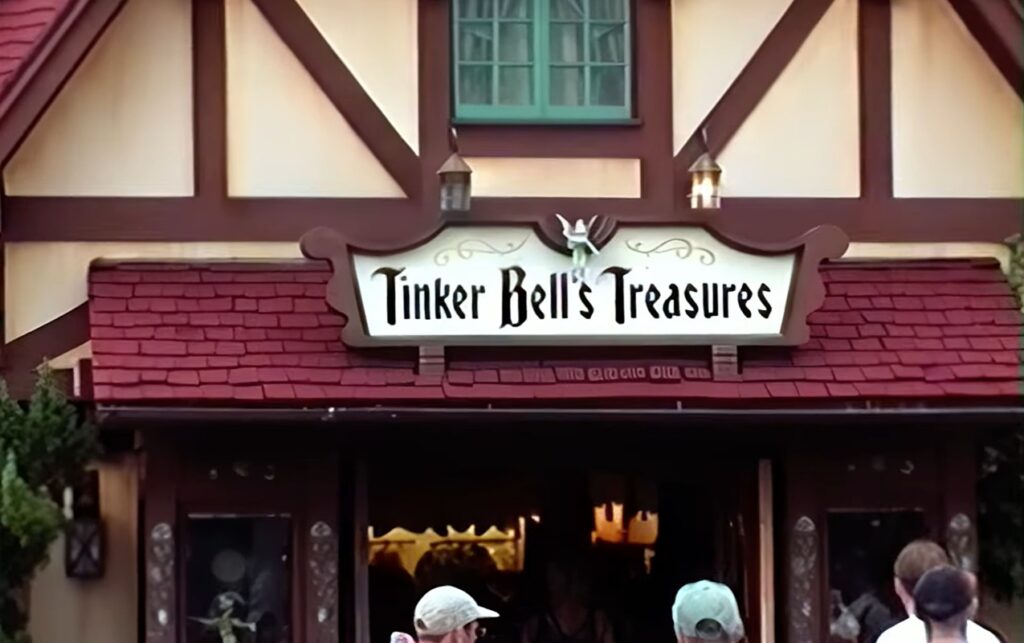
Tinker Bell’s Treasures was a longtime Fantasyland merchandise shop at Magic Kingdom located just behind Cinderella Castle, near Cinderella Fountain and Mickey’s PhilharMagic. The store operated under the Tinker Bell’s Treasures name from December 6, 1992 until a major transformation beginning in 2008, but its history stretched all the way back to the park’s first months in 1971.
For generations of Walt Disney World visitors, however, the merchandise was only part of the attraction.
Tinker Bell herself was supposedly hiding inside.
Guests who knew where to look could find signs of the tiny fairy moving through the shop, and for a period the first child to arrive each morning could participate in the memorable tradition of “waking up Tinker Bell.”
That little piece of interactive Disney magic ultimately made Tinker Bell’s Treasures far more memorable than an ordinary souvenir store.
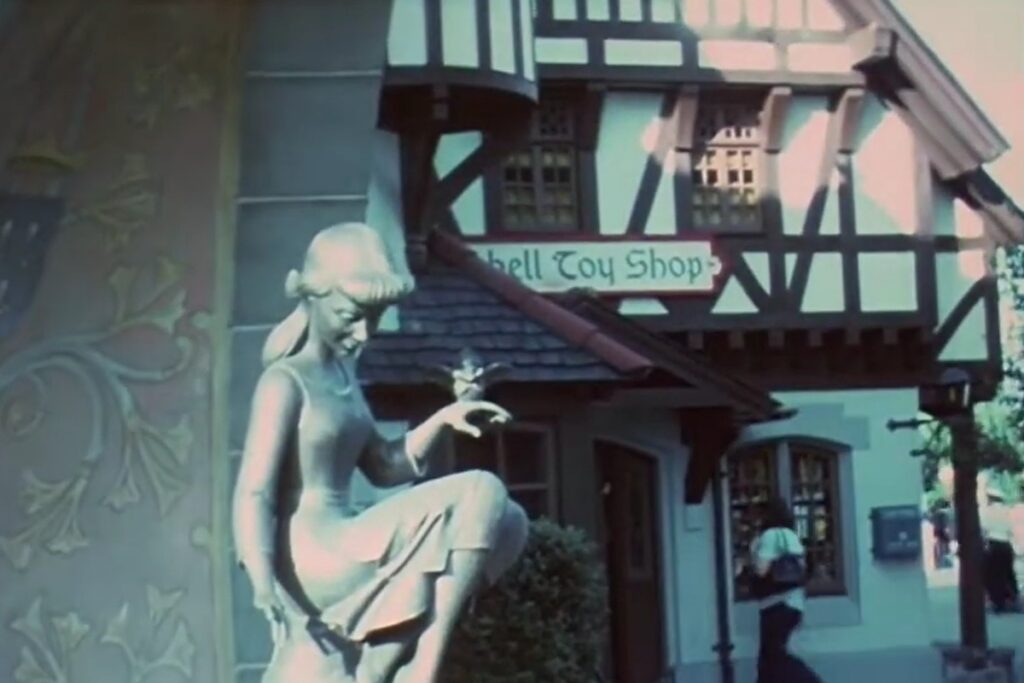
The shop began as the Tinker Bell Toy Shop.
Disney officially dates that original store to November 1971, only a short time after Magic Kingdom opened on October 1.
That timing is worth noting because the Tinker Bell Toy Shop is sometimes described casually as an opening-day location. Disney’s own historical records place its debut in November, making it one of several shops and facilities added during the park’s first weeks of operation rather than on October 1 itself.
The concept had a clear Disneyland precedent.
Disneyland had opened a Tinker Bell Toy Shop in Fantasyland in 1957. Walt Disney World adopted the same basic idea for its new Fantasyland.
The Florida store occupied a particularly prominent location near Cinderella Castle.
Unlike many Magic Kingdom shops positioned primarily at ride exits, the Tinker Bell Toy Shop was a general Fantasyland merchandise location. Guests could enter without experiencing an attraction first, browse toys and Disney character merchandise, and continue directly into the surrounding Fantasyland courtyard.
Tinker Bell was an especially appropriate mascot for the shop.
The character had debuted in Disney’s 1953 animated version of Peter Pan and had developed an identity considerably larger than her role in the film.
By the time Walt Disney World opened, Tinker Bell had become closely associated with Disney itself.
Her appearances in Walt Disney television programs frequently involved flying across the screen and spreading pixie dust over the Disney castle. Disneyland had also featured a live Tinker Bell flying above Sleeping Beauty Castle during fireworks beginning in 1961.
At Walt Disney World, she eventually performed a similar nightly flight from Cinderella Castle.
A Tinker Bell shop beside the castle therefore felt almost like an extension of the park icon itself.
The store sold much more than Tinker Bell merchandise.
Historical records documenting Disney’s use of the Tinker Bell name identify products sold through the theme-park shops including toys, figurines, View-Masters, dolls, jewelry, watches, clothing, ornaments, wands, pixie dust, pens, pencils, magnets, and bags.
Over time, the Fantasyland store also carried broader Disney character merchandise and an increasing assortment of princess products.
The biggest naming change arrived on December 6, 1992.
Tinker Bell Toy Shop became Tinker Bell’s Treasures.
The new name sounded slightly more sophisticated than “Toy Shop” and better reflected the increasingly broad range of merchandise sold inside.
The location continued carrying toys, but it was no longer primarily presented as a children’s toy store.
By the 2000s, princess dresses, accessories, dolls, tea sets, fairy merchandise, and similar Fantasyland souvenirs had become prominent.
A 2007 description of the store, for example, highlighted princess tea sets, reversible princess dolls, fairy drawing books, costumes, and accessories.
The evolution paralleled Fantasyland itself.
During Magic Kingdom’s first decades, Fantasyland shops often sold broad assortments of Disney merchandise.
By the 1990s and 2000s, Disney increasingly organized stores around recognizable characters and product categories, especially Disney Princess merchandise.
Tinker Bell’s Treasures naturally became part of that trend.
What made the shop exceptional was the additional storytelling hidden inside.
For years, guests could search for Tinker Bell inside a small piece of furniture—often described as a dresser, desk, or jewelry box.
Looking through the appropriate keyhole or opening revealed flashes of light accompanied by the familiar tinkling sound associated with the fairy.
Guests never received a full conventional character appearance.
That was the point.
Tinker Bell was supposed to be only inches tall.
Rather than presenting a human-sized character inside the shop, Disney suggested that the real tiny fairy was darting around inside the furniture.
The illusion was extremely simple compared with a major attraction.
A little light.
A bell-like sound.
A carefully placed viewing opening.
But it encouraged guests to participate in the fantasy instead of merely purchasing something.
The effect eventually developed into one of Magic Kingdom’s best-known unofficial morning rituals.
Families learned that the first child to reach Tinker Bell’s Treasures after park opening could ask whether Tinker Bell had been awakened.
If she had not, a Cast Member could invite the child to help wake her.
Accounts of the experience vary somewhat depending on the year, but one version involved tapping Tinker Bell’s jewelry box or drawer with a wand while calling for her to wake up.
Tinkling sounds would then travel through the shop as lights suggested the fairy was flying around.
The child had essentially started Tinker Bell’s day.
There was no major advertising campaign for the experience.
It spread largely through repeat visitors, guidebooks, online Disney communities, and word of mouth.
That obscurity made it feel even more special.
Families who knew about the tradition would sometimes head directly to the shop when Magic Kingdom opened in hopes of being first.
Even guests who missed the morning ceremony could still search for Tinker Bell during the day.
The store also featured several pressed-penny machines during its later years. Designs included Tinker Bell, Peter Pan, Captain Hook, several of the Seven Dwarfs, and other Disney characters, giving collectors another reason to stop inside.
Major changes began in 2008.
Tinker Bell’s Treasures closed for an extensive refurbishment beginning January 6, with work originally scheduled into March.
The timing coincided with Disney dramatically expanding Tinker Bell from a supporting Peter Pan character into the centerpiece of the Disney Fairies franchise.
The first direct-to-video Tinker Bell film was released in October 2008, introducing Pixie Hollow and a larger group of fairy characters.
Disney subsequently divided the former Tinker Bell’s Treasures space into two concepts.
One portion became Castle Couture, which officially opened on November 22, 2008 and concentrated primarily on Disney Princess costumes, accessories, portraits, and royal merchandise.
Another portion continued the fairy concept as Tinker Bell’s Fairy Treasures.
The traditional Tinker Bell effect was also updated.
Instead of simply looking into the old furniture to detect a flashing fairy light, children could ring a bell and call for Tinker Bell.
Tinkling sounds and small lights moved through decorative plants overhead before Tinker Bell briefly appeared inside a cabinet behind the sales counter.
For the first time, guests could actually see a miniature representation of the fairy rather than merely seeing evidence that she was present.
The effect was charming but short-lived.
Disney was simultaneously expanding Tinker Bell’s physical character presence elsewhere in Magic Kingdom. The Disney Fairies began meeting guests in Pixie Hollow at Mickey’s Toontown Fair, giving visitors an opportunity to interact directly with Tinker Bell and her friends.
As a result, the tiny hidden Tinker Bell inside the old Fantasyland shop was no longer her primary in-park experience.
Tinker Bell’s Fairy Treasures disappeared in February 2010.
Its remaining space was incorporated into Castle Couture, completing the transition away from the Tinker Bell retail identity that had occupied the location in various forms since 1971.
The original “wake up Tink” experience disappeared with it.
Castle Couture continued operating as a Disney Princess merchandise and photography location for nearly another decade. One of its best-known effects featured Sleeping Beauty’s dress repeatedly changing between pink and blue, recreating Flora and Merryweather’s argument over the proper color of Aurora’s gown.
On May 20, 2019, Disney changed the space again.
Castle Couture ceased functioning as a conventional merchandise store, and the area transitioned into the check-in location for the neighboring Bibbidi Bobbidi Boutique.
The building therefore remains part of Fantasyland’s princess experience, but the Tinker Bell shop that occupied it for decades is gone.
Its history is unusually layered:
Tinker Bell Toy Shop opened in November 1971.
It became Tinker Bell’s Treasures on December 6, 1992.
Beginning in 2008, the shop was divided between Castle Couture and Tinker Bell’s Fairy Treasures.
The final Tinker Bell retail component disappeared in 2010.
Castle Couture itself transitioned to a Bibbidi Bobbidi Boutique support space in 2019.
Among all those identities, Tinker Bell’s Treasures remains especially memorable because it blurred the line between retail and attraction.
A guest could certainly walk inside, buy a princess dress or Tinker Bell souvenir, and leave.
But someone who knew the shop’s secret might instead crouch beside a tiny piece of furniture and listen.
A faint bell would ring.
A light would flash.
And for a moment, the store suggested that Tinker Bell really was hiding somewhere inside.
That was classic Magic Kingdom storytelling on an extremely small scale.
No ride vehicle was necessary.
No elaborate Audio-Animatronics figure was required.
Disney simply gave an ordinary Fantasyland shop a secret.
For thousands of children who raced behind Cinderella Castle first thing in the morning hoping to wake a sleeping fairy, that secret turned Tinker Bell’s Treasures into an attraction all its own.