
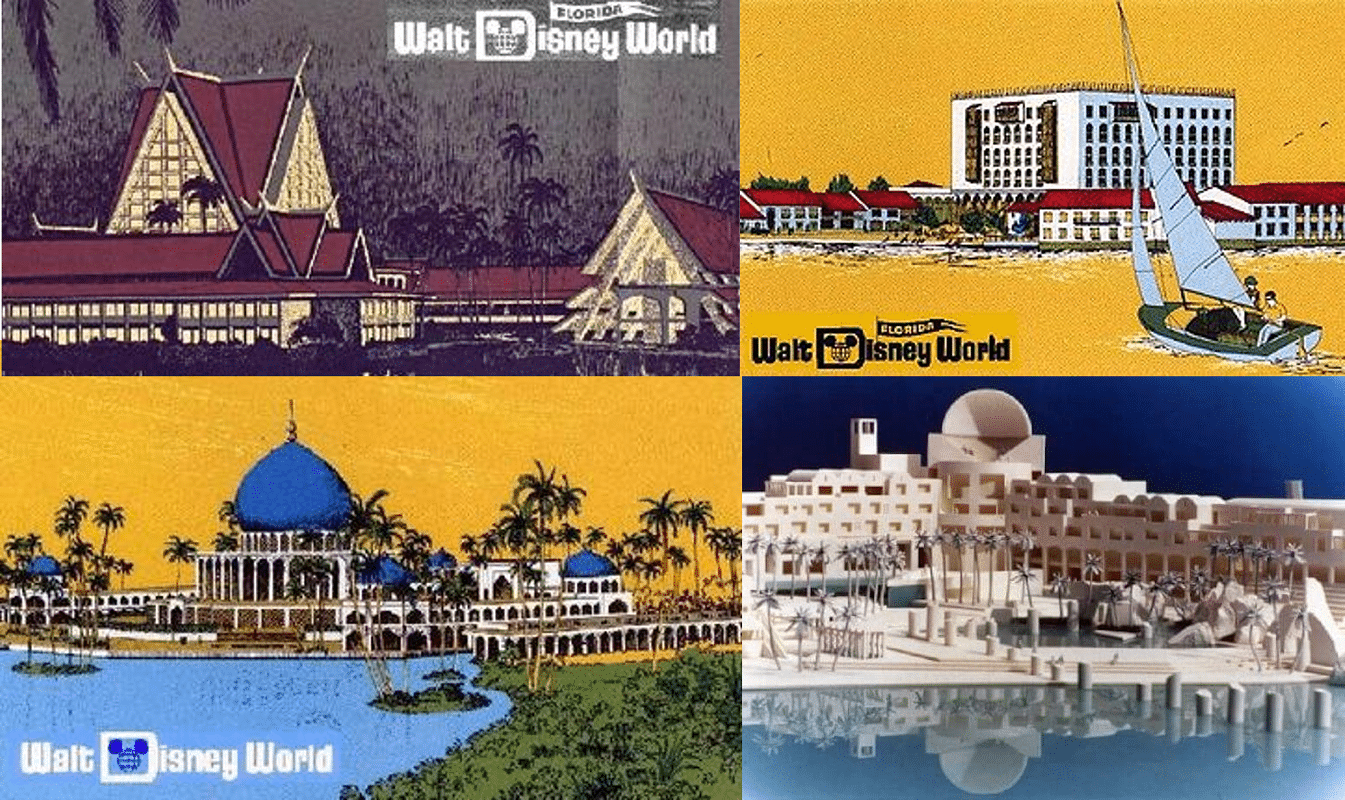
The Walt Disney World Resort is filled with hotels that have become attractions in their own right, from the Polynesian Village Resort and Contemporary Resort to Wilderness Lodge, Animal Kingdom Lodge, and the Grand Floridian.
But the hotels Disney actually built tell only part of the story.
Since Walt Disney World was first being planned in the 1960s, Disney Imagineers, architects, and executives have developed an extraordinary collection of resort concepts that never opened in their original form. Some disappeared after economic downturns. Others ran into difficult construction sites or changing corporate priorities. A few got far enough that land was prepared or buildings were partially constructed before Disney changed direction.
Several also left behind a surprising legacy.
The site prepared for Disney’s Asian Resort eventually became Disney’s Grand Floridian Resort & Spa. The unfinished Legendary Years section of Pop Century became Disney’s Art of Animation Resort. Cypress Point Lodge shared both a location and some thematic DNA with the Wilderness Lodge that eventually opened nearby. And Reflections – A Disney Lakeside Lodge has now become an especially fascinating case because Disney is once again building a nature-focused resort on the same Bay Lake property.
Looking at these abandoned and reimagined hotels offers a rare glimpse at a Walt Disney World that almost existed—and at how drastically the resort’s development plans have changed over more than five decades.
Disney World Resorts That Were Never Built
In this article:
- The Venetian Resort
- Disney’s Asian Resort
- Disney’s Persian Resort
- Disney’s Mediterranean Resort
- Cypress Point Lodge
- Fort Wilderness Junction / Buffalo Junction
- The Legendary Years at Disney’s Pop Century Resort
- Reflections – A Disney Lakeside Lodge
The Original Walt Disney World Resort Master Plan
To understand these unbuilt hotels, it helps to go back to the beginning.
When Walt Disney World was being developed during the late 1960s, Disney did not envision Magic Kingdom surrounded only by the Contemporary and Polynesian Village Resort.
Early promotional material showed five major themed hotels around Seven Seas Lagoon and Bay Lake.
The Contemporary and Polynesian would be ready for the resort’s 1971 opening. Three additional international resorts—the Asian, Venetian, and Persian—were publicly identified as future additions.
Disney even displayed them on maps distributed to guests during Walt Disney World’s early years.
The philosophy was already recognizably Disney. Each resort would have its own architectural identity, food, furnishings, landscaping, entertainment, and atmosphere. The hotels were intended to be destinations rather than generic lodging placed near a theme park.
That philosophy survived.
The specific hotels did not.
Disney World Unbuilt Resorts at a Glance
| Resort | Era | Planned Location | What Happened? |
|---|---|---|---|
| Venetian Resort | Late 1960s–1970s | Seven Seas Lagoon between TTC and Contemporary | Deferred during 1970s slowdown; site later considered for Mediterranean concepts |
| Asian Resort | Late 1960s–1970s | Northwestern Seven Seas Lagoon | Deferred; Grand Floridian later built on the site |
| Persian Resort | Late 1960s–1970s | Bay Lake area | Deferred with other early resort expansion |
| Mediterranean Resort | Early 1980s and later | Between TTC and Contemporary | Planning stopped amid financial and site-development challenges |
| Cypress Point Lodge | Early 1980s | Bay Lake near Fort Wilderness | Dropped as EPCOT construction consumed capital |
| Fort Wilderness Junction | Early 1990s | Between Wilderness Lodge and Fort Wilderness | Disney Decade project postponed during recession |
| Pop Century – Legendary Years | Late 1990s–2000s | Across Hourglass Lake from Pop Century | Partially built; site became Art of Animation Resort |
| Reflections – A Disney Lakeside Lodge | 2018–2020 | Former River Country site | Original project stalled; Disney Lakeshore Lodge now being built on the site |
1. The Venetian Resort
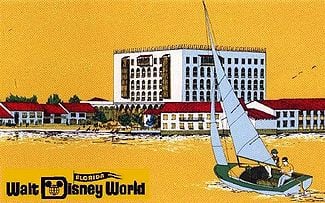
The Venetian Resort was not merely a vague Imagineering idea dreamed up after Walt Disney World opened. It belonged to the resort’s original generation of planned hotels.
Disney was publicly promoting the Venetian concept before Walt Disney World opened in 1971.
The planned location was along the eastern portion of Seven Seas Lagoon, between the Transportation and Ticket Center and Disney’s Contemporary Resort.
Early descriptions called for approximately 500 rooms in a setting inspired by Venice and St. Mark’s Square.
One of its most striking proposed features was a roughly 120-foot campanile, or bell tower, which would have served as a visual landmark.
But the real centerpiece was water.
The resort would have included canals winding through and around the hotel, with bridges and gondolas reinforcing the illusion that guests had left Central Florida for Venice. Plans described a glass-covered lobby and an interior waterway that could accommodate small boats.
In other words, the Venetian would have taken the water-based atmosphere of the Polynesian and Contemporary resort area and turned it into the hotel’s central storytelling device.
Why Was the Venetian Resort Never Built?
The biggest change to Walt Disney World’s early hotel expansion came after the 1973 oil embargo and energy crisis.
Tourism declined, travel became more expensive, and Disney suddenly had much less need to rapidly add thousands of additional hotel rooms.
Instead of opening new international resorts around Seven Seas Lagoon on the schedule Disney had once envisioned, hotel development slowed dramatically.
The Venetian disappeared from the immediate expansion program.
The proposed property also became associated with difficult soil and foundation conditions—an issue that would come up again when Disney examined the site for future resorts.
Interestingly, the concept was not completely forgotten. Variations on the Venetian idea were reconsidered decades later, including a much more elaborate concept sometimes referred to as Grande Venezia.
None progressed to construction.
2. Disney’s Asian Resort
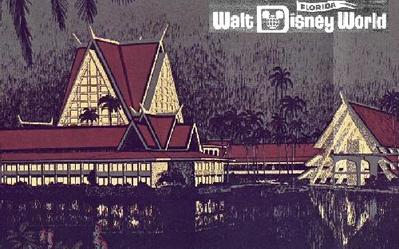
Of the three original unbuilt international resorts, Disney’s Asian Resort may have come closest to becoming reality.
The hotel was designed around a predominantly Thai theme.
Early plans described approximately 600 rooms, including 50 elaborate suites inspired by Thai royalty.
Its defining architectural element would have been a dramatic central tower rising approximately 160 feet. A restaurant and cocktail lounge at the top would have offered nighttime entertainment and views across Seven Seas Lagoon.
Disney’s plans were remarkably detailed.
About two-thirds of the guest rooms were intended to sit in garden settings, while the rest would be housed in the tower. Convention facilities were planned beneath the main public areas, and every guest room was supposed to face either the lagoon or a central recreation area.
The resort was initially expected to arrive during the first major expansion period after Walt Disney World’s opening, with 1974 frequently cited as its intended opening year.
The Site Was Actually Prepared
Disney did more than draw pictures.
During construction of Seven Seas Lagoon, land was set aside on the lagoon’s northwestern shore for the future Asian Resort.
The access road was even known as Asian Way.
Then the economic environment changed.
Following the 1973 energy crisis, Disney postponed major hotel expansion. The Asian Resort remained on planning documents for years but never moved into full construction.
What Happened to the Asian Resort Site?
The property eventually gained a very different hotel.
Disney renamed Asian Way Floridian Way, and on June 28, 1988, Disney’s Grand Floridian Resort & Spa opened on the land originally earmarked for the Asian Resort.
That makes the Asian Resort particularly interesting among Disney’s abandoned hotels: guests still stay on its intended site every night, just inside an entirely different resort.
3. Disney’s Persian Resort
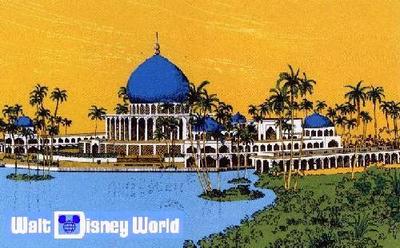
Disney’s Persian Resort is frequently described incorrectly.
It was not a hotel conceived in response to the international politics of the late 1970s. The Persian Resort was already part of Walt Disney World’s publicly promoted future development before the resort opened in 1971.
Disney’s original concept called for an exotic Persian-inspired hotel around the Bay Lake area.
Architecture would have drawn from Persian mosques and palaces, with columns, landscaped courtyards, terraced decks, and a prominent central dome.
Historical descriptions call for approximately 500 rooms.
The Persian Resort also appears on early maps as part of a much broader transportation plan surrounding Magic Kingdom, and some early concepts envisioned a monorail connection serving the property.
Why Didn’t Disney Build the Persian Resort?
The Persian Resort suffered the same fundamental problem as the Venetian and Asian concepts: Walt Disney World did not need the additional hotel capacity as quickly as Disney had anticipated after the 1973 energy crisis changed travel patterns.
The resort was deferred along with the rest of the aggressive early expansion plan.
A frequently repeated Disney-history story says that Shah Mohammad Reza Pahlavi later showed interest in helping finance a Persian-themed resort and that the 1979 Iranian Revolution finally killed the concept.
That story has circulated for years, but it should not be confused with the reason the original Persian Resort failed to open. Disney had already delayed its first wave of international hotels years earlier.
The safer historical conclusion is that the Persian Resort was part of an ambitious opening-era master plan that never regained enough momentum to reach construction.
4. Disney’s Mediterranean Resort
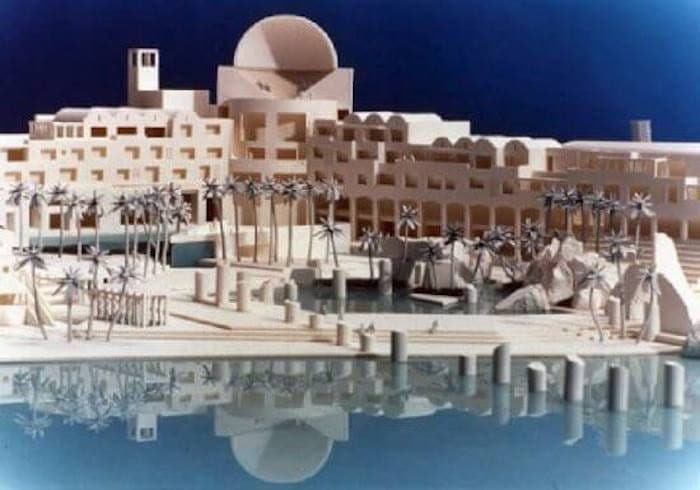
Disney’s Mediterranean Resort belonged to a different generation of Walt Disney World planning.
By the beginning of the 1980s, EPCOT Center was approaching completion and Disney once again expected the Florida resort to need significantly more hotel capacity.
In May 1982, Disney executive Dick Nunis told Cast Members that the company had three hotels in design: the Grand Floridian, Cypress Point Lodge, and a Mediterranean Resort planned between the Transportation and Ticket Center and Contemporary Resort.
That placed it on essentially the same difficult eastern Seven Seas Lagoon property previously associated with the Venetian concept.
The Mediterranean Resort was envisioned as an upscale destination inspired heavily by the Greek islands and broader Mediterranean architecture.
Concept work showed whitewashed and earth-toned buildings, courtyards, waterfront spaces, Mediterranean landscaping, and an architectural style designed to compete at the luxury end of Disney’s hotel portfolio.
Had it been built, it likely would have become another deluxe Magic Kingdom-area resort with convenient access to the existing transportation network.
Why Didn’t the Mediterranean Resort Happen?
The early 1980s were financially demanding for Disney.
EPCOT Center became an enormously expensive project, and capital priorities shifted as the company worked to complete and stabilize its second Florida theme park.
The Mediterranean Resort disappeared from Disney’s near-term development program.
The planned site also had notoriously difficult subsurface conditions. Historical accounts of the project describe poor soil that would have required unusually deep and expensive foundations.
Disney revisited Mediterranean and Venetian-style resort ideas at different points afterward, but no resort has ever been built on that portion of Seven Seas Lagoon.
5. Cypress Point Lodge
One significant unbuilt resort was missing from the previous version of this article: Cypress Point Lodge.
Unlike some obscure concepts known primarily through artwork, Cypress Point Lodge was openly discussed by Disney management in the early 1980s.
The proposed resort would have occupied the south shore of Bay Lake near Fort Wilderness.
Disney described Cypress Point Lodge as a medium-sized hotel designed to evoke a turn-of-the-century hunting lodge hidden in a forest.
Plans called for:
- 550 hotel rooms
- 50 log cabins along the beach
- Two restaurants
- A swimming pool
- An extensive beach
- A lake dock
- Watercraft transportation
The emphasis was on blending architecture into the woods rather than creating one enormous hotel dominating the landscape.
Why Was Cypress Point Lodge Cancelled?
Cypress Point Lodge was being discussed while Disney was pouring enormous resources into EPCOT Center.
By 1983, references to the lodge effectively disappeared as the company tightened spending and redirected capital.
But the idea of a dramatic wilderness lodge on Bay Lake was not dead.
A decade later, Disney developed a substantially different resort for the same general area.
Disney’s Wilderness Lodge opened on May 28, 1994, inspired by the great National Park lodges of the American West.
Wilderness Lodge should not simply be described as Cypress Point Lodge with a new name—the architecture, scale, story, and creative development were different—but the conceptual connection is obvious: both placed a rustic, heavily wooded lodge destination along Bay Lake near Fort Wilderness.
6. Fort Wilderness Junction / Buffalo Junction
The next major unbuilt resort concept arrived during Michael Eisner’s ambitious Disney Decade.
In 1990, Disney unveiled sweeping plans for Walt Disney World expansion that included new attractions, hotels, entertainment districts, and eventually another theme park.
One proposed resort was generally known as Fort Wilderness Junction or Buffalo Junction.
The approximately 600-room hotel would have been positioned between Fort Wilderness and the new Wilderness Lodge area.
The concept extended beyond an ordinary hotel.
Imagine a Disney version of an Old West town, with rustic streets, restaurants, shops, horses, entertainment, and lodging integrated into one destination.
Historical descriptions have also connected the project with a version of the Buffalo Bill Wild West Show and a revived rail connection linking the resort area.
In some respects, the plan sounds less like a conventional Disney hotel and more like the resort-entertainment districts Disney would later develop elsewhere.
The Recession Changes the Disney Decade
The early 1990s recession forced Disney to reconsider the pace and scale of its enormous development program.
By 1992, Fort Wilderness Junction was among the projects postponed indefinitely.
Wilderness Lodge still opened in 1994, but its Old West neighbor never followed.
Some of the broader idea—creating a hotel surrounded by restaurants, entertainment, and a walkable themed district—would appear elsewhere at Walt Disney World, most notably with Disney’s BoardWalk during the second half of the decade.
7. The Legendary Years: The Unbuilt Half of Disney’s Pop Century Resort
Unlike most of the resorts on this list, guests could once physically see the unfinished remains of The Legendary Years.
The original Disney’s Pop Century Resort was enormous.
Disney planned a total of 5,760 rooms divided into two 2,880-room halves:
- The Classic Years: 1950s through the 1990s
- The Legendary Years: 1900s through the 1940s
Hourglass Lake would separate the two, with the Generation Gap Bridge connecting them.
The Legendary Years would celebrate the first half of the 20th century through the same oversized pop-culture approach guests know from the existing Pop Century Resort.
And this was not simply concept art.
Construction had actually begun.
September 11 Changes the Project
The tourism downturn following the September 11, 2001 terrorist attacks caused Disney to reconsider hotel expansion.
Pop Century’s opening was delayed and the Legendary Years phase was halted.
The Classic Years eventually opened on December 14, 2003.
Across Hourglass Lake, partially built structures from the Legendary Years remained conspicuously unfinished for years.
Legendary Years Becomes Art of Animation
Disney ultimately decided not to complete the original century-spanning concept.
Instead, the abandoned property was redesigned around Disney and Pixar animation.
Disney’s Art of Animation Resort began opening in 2012 with sections themed to Finding Nemo, Cars, The Lion King, and The Little Mermaid.
That makes Legendary Years one of the most tangible examples of Disney reusing an abandoned resort project rather than starting completely from scratch.
8. Reflections – A Disney Lakeside Lodge
The most recent entry on this list now requires an important qualification.
Reflections – A Disney Lakeside Lodge was announced in 2018 for the former River Country property along Bay Lake between Fort Wilderness and Wilderness Lodge.
The nature-inspired deluxe resort was expected to include more than 900 hotel rooms and proposed Disney Vacation Club villas.
Disney began site preparation and construction work, and the remains of River Country were demolished as the new resort moved forward.
Reflections was originally expected to open in 2022.
Then COVID-19 arrived.
Disney halted major construction projects in 2020, and Reflections effectively disappeared from the company’s public development schedule.
For several years, the partially prepared site sat dormant.
Reflections Returns—But as Disney Lakeshore Lodge
In November 2024, Disney announced a new nature-inspired Disney Vacation Club resort for the same site: Disney’s Lakeshore Lodge.
As construction progressed, it became increasingly clear that the history of the two projects is closely connected.
Both occupy the former River Country property. Both center their design around Disney stories inspired by nature. And elements visible in the newer resort’s architecture and planning strongly echo work that had been developed for Reflections.
Disney, however, presents Lakeshore Lodge as a new resort rather than simply calling it a renamed Reflections.
That distinction is useful.
Reflections as originally announced was never built, but the land, nature-centered philosophy, and portions of its design lineage ultimately survived into another project.
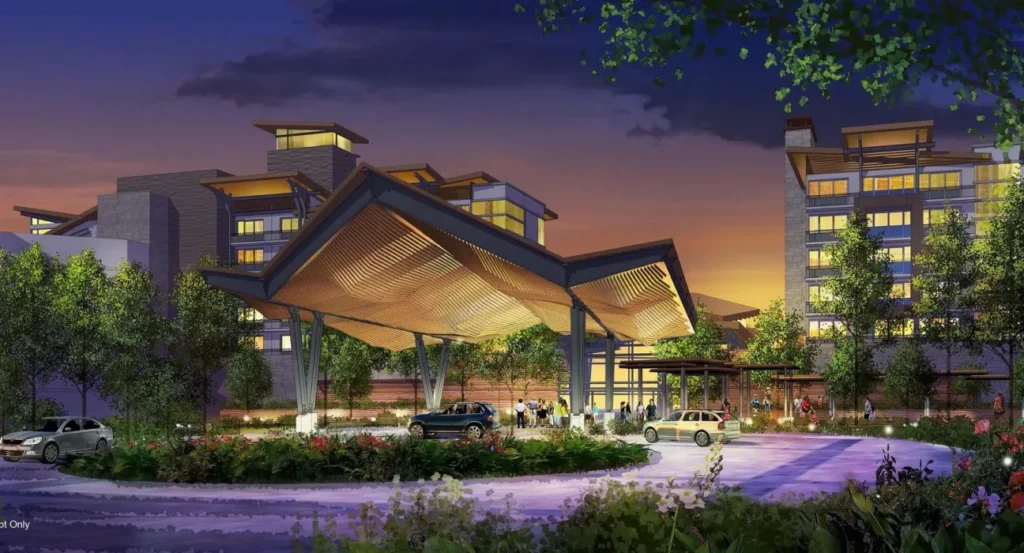
Disney Lakeshore Lodge Is Now Opening July 1, 2027
As of August 2026, this is no longer a vague future proposal.
Disney has announced that Disney’s Lakeshore Lodge will officially open July 1, 2027.
The new resort will contain 967 accommodations, including:
- Pocahontas-inspired Resort Studios
- Encanto-inspired Duo Studios
- Bambi-inspired Deluxe Studios and Villas
- Fantasia-inspired three-bedroom Grand Villas
- One- and two-bedroom waterfront Lake Houses inspired by Brother Bear
- The Hidden Willow Presidential Suite
Recreation will include a feature pool, the Daydream River lazy river, play areas, outdoor recreation, and Magic Kingdom fireworks viewing.
Dining will include Moonglade, Paint Out Point Bar & Grill, and Bay Lake Provisions.
Boat transportation will connect the resort with Magic Kingdom.
Reservations begin opening in October 2026:
- October 6: Disney Vacation Club Members
- October 7: Walt Disney World Annual Passholders
- October 8: All other guests
So Reflections deserves to remain in an article about unbuilt Disney resorts—but no longer as the end of the story.
It is now the missing chapter between River Country and Disney’s newest Magic Kingdom-area resort.
Which Disney Resort Came Closest to Being Built?
That depends on what counts as “closest.”
Disney’s Asian Resort was unusually advanced for an opening-era project. Disney prepared its future site, built access infrastructure, produced detailed plans, and publicly discussed a mid-1970s opening.
The Legendary Years went much further: actual buildings were partially constructed before Disney stopped the project.
Reflections also reached physical site preparation and construction before work halted in 2020.
In purely physical terms, Legendary Years and Reflections came much closer to completion than the earlier concept-art resorts.
Why Did Disney Cancel So Many Resorts?
There is no single explanation.
Economic Downturns
The 1973 energy crisis sharply reduced the need for rapid expansion after Walt Disney World’s opening.
The early 1990s recession caused Disney to scale back portions of its ambitious Disney Decade.
The tourism collapse following September 11 delayed Pop Century and effectively ended Legendary Years.
The COVID-19 pandemic halted Reflections.
Capital Priorities
Theme parks are extraordinarily expensive.
EPCOT Center consumed enormous capital during the early 1980s, helping push projects such as Cypress Point Lodge and the Mediterranean Resort further down the priority list.
When Disney has to choose between hotels, parks, infrastructure, and attractions, even sophisticated resort concepts can disappear.
Difficult Construction Sites
Walt Disney World may have thousands of acres, but not every acre is equally easy to develop.
The eastern Seven Seas Lagoon property associated with the Venetian and Mediterranean concepts has long been connected with difficult soil and foundation conditions.
A hotel can technically be possible while still being financially impractical.
Disney’s Strategy Changes
Sometimes demand still exists, but Disney decides a different concept will work better.
The Asian Resort site became the Grand Floridian.
Legendary Years became Art of Animation.
Cypress Point Lodge gave way to a substantially different wilderness-themed hotel concept.
Reflections was followed by Lakeshore Lodge.
Disney rarely throws every idea away. Pieces often resurface years or decades later in an entirely different form.
What These Unbuilt Resorts Tell Us About Walt Disney World
The most interesting lesson is that Walt Disney World has never had one fixed master plan.
Even the resort Disney presented to the public before opening was only one possible version of what Florida might become.
Had circumstances been different, guests arriving at Magic Kingdom in the 1970s might have passed Thai architecture, Venetian canals, and Persian domes on the monorail.
By the 1980s, Disney imagined Greek-island architecture and a secluded hunting lodge along Bay Lake.
In the 1990s, it considered building an entire Old West resort district.
In the 2000s, Pop Century might have stretched across Hourglass Lake as a complete architectural history of the 20th century.
And only a few years ago, guests expected a resort named Reflections to open where Disney Lakeshore Lodge now rises.
Those changes are not anomalies.
They are how Walt Disney World has always developed.
Quick Answer: Which Disney World Resorts Were Never Built?
The best-known Walt Disney World resort concepts that were never completed in their original form include Disney’s Venetian Resort, Asian Resort, Persian Resort, Mediterranean Resort, Cypress Point Lodge, Fort Wilderness Junction, Pop Century’s Legendary Years, and Reflections – A Disney Lakeside Lodge.
Several of their planned sites or concepts were later reused. The Grand Floridian occupies the Asian Resort site, Art of Animation replaced Legendary Years, Wilderness Lodge eventually opened near the proposed Cypress Point property, and Disney Lakeshore Lodge is currently under construction on the former Reflections site.
FAQ About Disney World Resorts That Were Never Built
What Disney World resort was partially built but never opened?
The Legendary Years section of Disney’s Pop Century Resort was partially constructed but never opened under its original concept. The property was eventually redeveloped into Disney’s Art of Animation Resort.
Where was Disney’s Asian Resort supposed to be built?
Disney’s Asian Resort was planned for the northwestern shore of Seven Seas Lagoon on the property where Disney’s Grand Floridian Resort & Spa eventually opened in 1988.
Was Reflections – A Disney Lakeside Lodge cancelled?
The original Reflections project stalled in 2020. Disney later announced Disney Lakeshore Lodge for the same former River Country property. Lakeshore Lodge is now under construction and is scheduled to open July 1, 2027.
Is Disney Lakeshore Lodge the same hotel as Reflections?
Not exactly. Lakeshore Lodge occupies the same site and shares a nature-focused philosophy with Reflections, with clear similarities between some of the concepts. Disney is nevertheless marketing Lakeshore Lodge as a new resort, so Reflections is better described as an earlier version or predecessor rather than simply the same hotel with a different name.
What was Cypress Point Lodge?
Cypress Point Lodge was an early-1980s resort planned for Bay Lake near Fort Wilderness. Disney described a 550-room lodge with 50 beachside log cabins, restaurants, a swimming pool, beach, dock, and water transportation.
Why were the original Asian, Venetian, and Persian resorts never built?
Disney publicly promoted all three before Walt Disney World opened, but the 1973 energy crisis and resulting tourism slowdown dramatically reduced the need for rapid hotel expansion. The projects were postponed and eventually superseded by later resort plans.
Did Disney ever build anything on the Asian Resort site?
Yes. Disney’s Grand Floridian Resort & Spa opened on the former Asian Resort site in 1988.
What happened to Pop Century’s Legendary Years?
The 1900s-through-1940s half of Pop Century was halted following the early-2000s tourism downturn. Its property and partially developed structures were eventually redeveloped into Disney’s Art of Animation Resort, which opened in 2012.
A Walt Disney World That Almost Existed
Unbuilt Disney resorts are fascinating because they reveal just how different Walt Disney World might have looked.
Imagine riding the monorail around Seven Seas Lagoon past a Thai tower, Venetian campanile, and Persian dome.
Imagine staying in a log cabin at Cypress Point Lodge or walking through an Old West town between Wilderness Lodge and Fort Wilderness.
Imagine crossing Hourglass Lake from the 1990s section of Pop Century into a resort celebrating the 1900s.
None of those exact versions of Walt Disney World happened.
But their stories did not entirely disappear.
Their sites, themes, architecture, and ideas repeatedly resurfaced in the resorts Disney eventually built—and that may be the most Disney thing about them.
Watch also: