
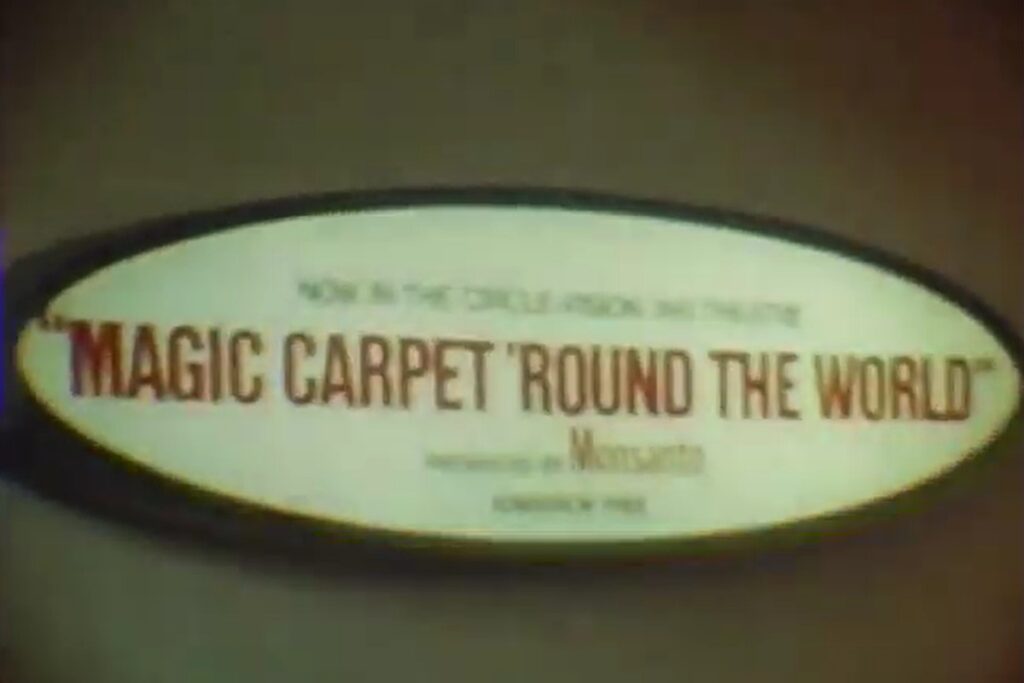
Magic Carpet ’Round the World was a Circle-Vision 360 film attraction presented in Tomorrowland at Magic Kingdom, using Disney’s panoramic theater format to send guests on a simulated tour across the globe. Rather than focusing on fantasy characters, thrill mechanics, or a single narrative, the film surrounded standing audiences with nine synchronized screens, creating the sensation of being carried from country to country by an invisible flying carpet. It was part of the same Tomorrowland theater lineage that also included America the Beautiful, American Journeys, and eventually The Timekeeper.
The film opened at Walt Disney World on March 16, 1974, replacing America the Beautiful in the Monsanto-sponsored Circle-Vision attraction. D23 identifies its initial Magic Kingdom run as lasting until March 14, 1975, after which a revised version of America the Beautiful returned in connection with the upcoming United States Bicentennial. The film was later shown at Tokyo Disneyland from April 15, 1983, to May 16, 1986, with added footage of Europe and the United States.
As an attraction, Magic Carpet ’Round the World fit neatly between early Tomorrowland’s optimistic futurism and EPCOT Center’s later educational travelogue style. The presentation showcased international landscapes, cities, monuments, and cultural scenes, using the wraparound Circle-Vision format to make guests feel as if they were gliding through real environments rather than watching a conventional travel film. Extinct Disney notes that the production was edited from more than 37 hours of footage into a 21-minute experience and included locations such as London, Paris, Copenhagen, Egypt, India, Japan, Kenya, Greece, Austria, and Venice.
The attraction’s history is slightly more layered than its short initial run suggests. Park-history sources track a later Magic Kingdom return from 1979 to 1984, before American Journeys replaced it. The same source also notes that the film used nine synchronized projectors, 12-track stereo sound, a 24-voice chorus, and a 56-piece orchestra, giving the presentation a scale that was ambitious for a theater attraction of its era.
Today, Magic Carpet ’Round the World is not widely remembered by casual Walt Disney World fans, partly because it was a film attraction without characters, vehicles, or obvious surviving iconography. Its importance lies in what it represented: Disney using immersive screen technology not just for spectacle, but to inspire curiosity about the wider world. In that sense, it feels like a direct bridge between Tomorrowland’s original educational ambitions and the global, cinematic sensibility later associated with EPCOT’s World Showcase and attractions like Soarin’ Around the World.