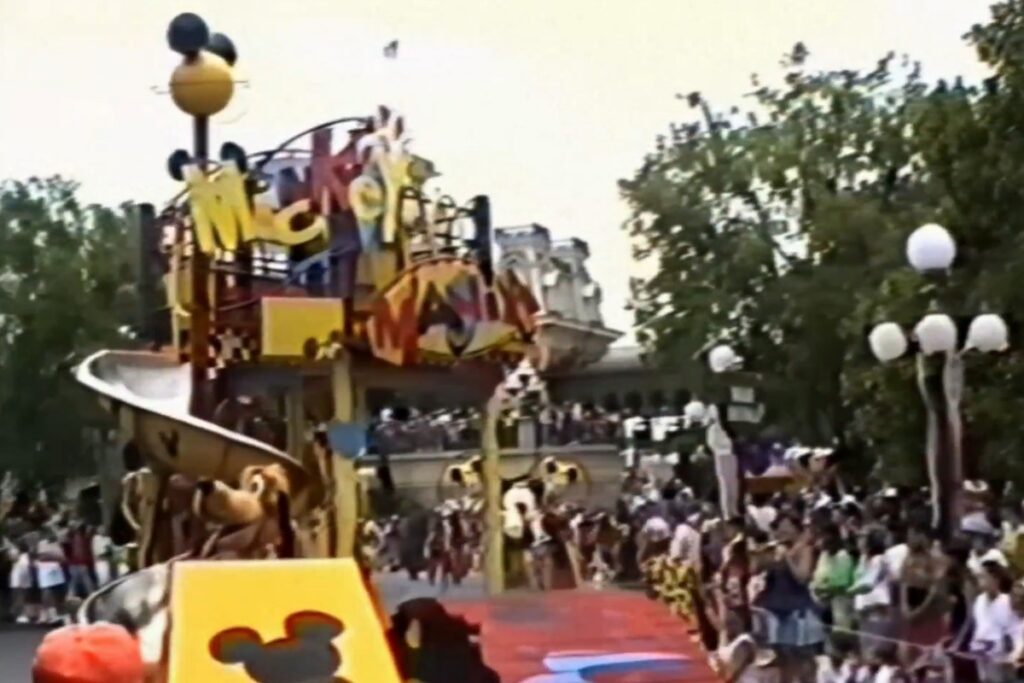

Mickey Mania Parade was a wildly colorful daytime parade performed at Magic Kingdom during the mid-1990s. It debuted on June 1, 1994, replacing the Surprise Celebration Parade, and ran through September 1996 before giving way to Walt Disney World’s 25th Anniversary “Remember the Magic” Parade. Unlike many Magic Kingdom parades that celebrated a broad library of Disney films, Mickey Mania focused almost entirely on Mickey Mouse as an icon, using his silhouette, gloves, shoes, ears, colors, and cartoon history as the organizing theme.
The production was unmistakably a product of its era. It featured more than 100 performers, including singers, dancers, stilt walkers, skateboarders, rollerbladers, BMX-style riders, and musicians, all arranged around oversized interpretations of Mickey imagery. Early units included a beach-themed float with Donald Duck, Pluto, and Roger Rabbit, followed by performers in mouse-ear top hats, rolling Mickey silhouettes, inflatable Mickey figures, hop balls, and floats built around giant Mickey balloons.

As the parade continued, it became even more surreal. Peter Pan, Alice, the Mad Hatter, Pinocchio, Geppetto, and Wendy rode bright yellow tricycles, while Winnie the Pooh appeared on a float surrounded by Mickey plush toys. Other units played with Mickey-shaped television sets, camera equipment, clocks, gears, and oversized toy-like props. Minnie Mouse performed with dancing musicians, while Chip and Dale appeared inside a large Mickey-themed clock. The parade did not simply present Mickey Mouse; it broke him into graphic design elements and rebuilt an entire procession around them.
The show’s finale brought the concept closer to what many guests might have expected from a Mickey tribute, with references to different versions of Mickey across his screen history. Still, the parade’s overall personality was more energetic and eccentric than reverent. Its music, color palette, inflatable costumes, pop-culture attitude, and “extreme” performer style placed it firmly in the visual language of the 1990s.
Today, Mickey Mania Parade is remembered as one of Magic Kingdom’s strangest and most distinctive daytime productions. It was not tied to a major anniversary, nor did it tell a conventional Disney story. Instead, it turned Mickey Mouse himself into a kinetic design experiment—part tribute, part street party, and part time capsule of mid-1990s Walt Disney World entertainment.