
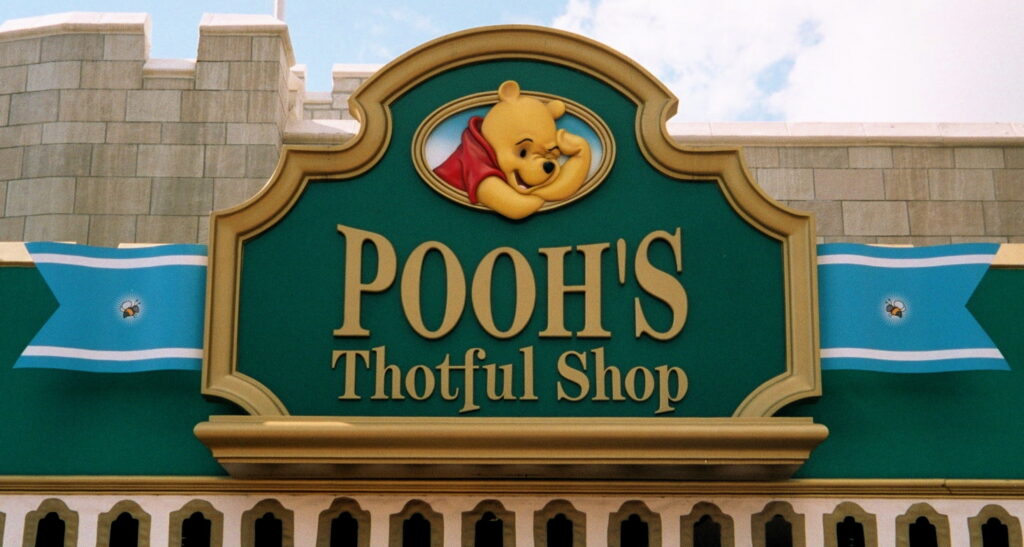
Pooh’s Thotful Shop was the original Winnie the Pooh merchandise location attached to The Many Adventures of Winnie the Pooh in Magic Kingdom’s Fantasyland. Operating from 1999 until 2010, the small shop served as the retail epilogue to the attraction, surrounding guests with Pooh, Piglet, Tigger, Eeyore, and the rest of the Hundred Acre Wood immediately after their Hunny Pot journey came to an end. Although the store eventually received a new name and updated presentation, Pooh’s Thotful Shop remains memorable because it represented an era when Disney’s attraction gift shops were often given unusually specific names and personalities rather than simply functioning as generic merchandise outlets.
The shop arrived as part of one of the more controversial changes to the original Fantasyland. The Many Adventures of Winnie the Pooh opened in 1999 in the former home of Mr. Toad’s Wild Ride, which had closed the previous September. Mr. Toad had been a Magic Kingdom opening-day attraction and developed a particularly devoted following, so replacing it with Winnie the Pooh generated considerable resistance among longtime fans. Disney nevertheless moved forward with the new dark ride, adapting several sequences from the classic Winnie the Pooh animated featurettes and placing guests aboard oversized Hunny Pot vehicles capable of bouncing, rocking, and moving in ways that enhanced scenes such as Tigger’s forest.
Pooh’s Thotful Shop was positioned directly at the attraction’s exit, making it part of the guest flow rather than merely a nearby Fantasyland store. Riders moved from the storybook environments of the attraction directly into a retail space devoted almost exclusively to Winnie the Pooh and his friends. Plush toys were particularly prominent, but the shop also carried apparel, children’s merchandise, toys, collectibles, mugs, and other Pooh-themed souvenirs. At a time when Winnie the Pooh was one of Disney’s strongest consumer-product franchises, the location gave the characters a dedicated retail presence in the heart of Magic Kingdom.
The unusual spelling of “Thotful” was one of the store’s most distinctive characteristics. Rather than using the conventional word “thoughtful,” Disney adopted the intentionally imperfect language associated with the literary and animated world of Winnie the Pooh. The name felt as though it could have been written by Pooh himself: sweet, slightly muddled, and immediately recognizable to anyone familiar with the character’s personality. It was exactly the sort of small linguistic detail that helped a relatively ordinary merchandise shop feel connected to the fiction surrounding it.
Its original exterior also reflected the Fantasyland aesthetic of the period. The storefront sat beneath the castle-like architectural shell shared with the attraction, with colorful teal, blue, cream, and gold detailing and a prominent sign featuring Pooh leaning over the shop’s name. Display racks frequently extended toward the entrance, placing plush characters, children’s clothing, and brightly colored merchandise directly in the path of departing attraction guests. Compared with the more elaborate environmental storytelling that would characterize the Fantasyland expansion of the following decade, Pooh’s Thotful Shop was relatively straightforward, but it provided a visual bridge between the medieval-fair styling of the original Fantasyland and the storybook imagery inside the Pooh attraction.
The shop’s connection to The Many Adventures of Winnie the Pooh was particularly effective because the attraction itself ends on a celebratory note. After surviving the Blustery Day, Pooh and his friends gather for a party, and Pooh finally receives the honey he has spent much of the adventure pursuing. Guests then pass the final storybook page and return to the loading area. Entering a room filled with Pooh merchandise immediately afterward effectively extended that experience by a few more minutes, especially for younger visitors who had just encountered those same characters throughout the ride.
Pooh’s Thotful Shop disappeared as part of a larger round of changes to the attraction in 2010. Disney was then preparing for the enormous New Fantasyland redevelopment and began upgrading the Pooh area to better integrate it with the increasingly immersive environments planned around it. The attraction received a substantially redesigned interactive queue featuring Rabbit’s garden, Eeyore’s shelter, Tigger-themed play elements, and interactive honey screens. Pooh’s familiar tree—previously used in the nearby Pooh’s Playful Spot playground—was also incorporated into the redesigned entrance area after that playground closed.
As part of those changes, Pooh’s Thotful Shop was officially replaced by Hundred Acre Goods on November 15, 2010. The basic retail function remained much the same, and the location continued specializing in merchandise featuring Winnie the Pooh and his friends, but the new name and exterior treatment better matched the developing visual identity of the surrounding Fantasyland. Storybook pages and Pooh imagery continued to tie the shop directly to the attraction, allowing the transition from ride to merchandise location to remain relatively seamless.
Hundred Acre Goods continues to operate beside The Many Adventures of Winnie the Pooh today, meaning the physical role of Pooh’s Thotful Shop has never truly disappeared. Guests still emerge from their Hunny Pots into a store dominated by Pooh merchandise, and the space remains one of the most reliable places in Magic Kingdom to find items devoted specifically to the Hundred Acre Wood characters. What changed was primarily the identity wrapped around that retail experience.
For longtime Walt Disney World visitors, however, “Pooh’s Thotful Shop” carries a degree of nostalgia that Hundred Acre Goods cannot entirely replicate. The deliberately misspelled name was quirky, character-specific, and unmistakably rooted in Pooh’s peculiar way of looking at the world. It was a minor Fantasyland location compared with the attraction beside it, yet it illustrates how even a small gift shop can become part of Disney World history when its name, merchandise, architecture, and placement all reinforce the story guests have just experienced.