
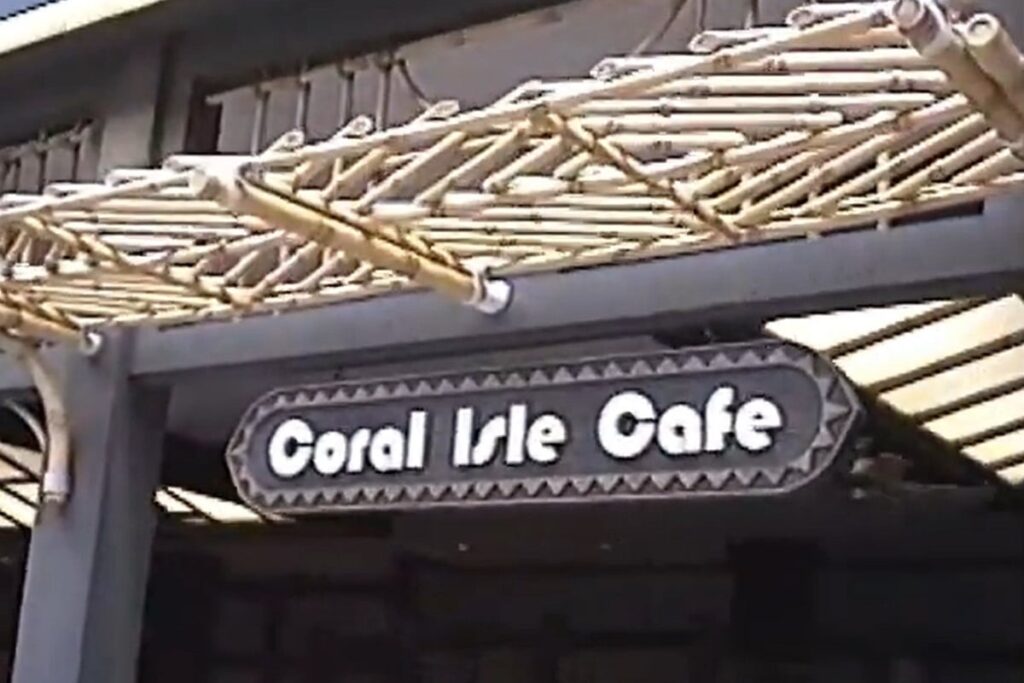
Coral Isle Café was an opening-day restaurant at Disney’s Polynesian Village Resort, located on the second floor of the Great Ceremonial House overlooking the resort’s lobby. It opened with Walt Disney World on October 1, 1971, when the Polynesian was one of the resort’s original two hotels and still carried the full “Polynesian Village” identity. The restaurant operated for nearly 27 years before closing on July 25, 1998, and reopening later that year as Kona Café on November 23, 1998. (d23.com)
The restaurant’s appeal came from its relaxed, tropical setting inside one of Walt Disney World’s most atmospheric resort buildings. The Great Ceremonial House has always been the heart of the Polynesian, with its dramatic lobby, island-inspired architecture, tropical landscaping, and easy monorail access. Coral Isle Café occupied a prime position within that environment, giving guests a casual sit-down meal without the greater formality or show-dining personality of other Polynesian venues.
Its menu reflected the broad, sometimes eclectic dining style of early Walt Disney World resort restaurants. In its earlier years, Coral Isle Café offered a wide variety of dishes, reportedly ranging from corned beef and spaghetti and meatballs to teriyaki steak. Later menus became somewhat more focused, with items such as stir-fry vegetables, Polynesian-style barbecue ribs, coconut shrimp, fruit plates, and other resort-friendly fare that better matched the hotel’s South Seas atmosphere. (wdwradio.com)
Historically, Coral Isle Café is important because it represents the Polynesian’s original dining personality before the resort’s restaurant lineup became defined by names like ‘Ohana, Kona Café, Trader Sam’s, and Pineapple Lanai. The Polynesian has always been one of Walt Disney World’s most beloved resorts, but its dining identity has changed repeatedly over time. Coral Isle Café belonged to the earlier era when resort restaurants were often more flexible, less brand-forward, and more directly tied to the practical needs of hotel guests moving between the Magic Kingdom, the monorail, the pool, and the resort lobby.
Its replacement by Kona Café marked a shift toward a more clearly defined Pacific Rim and Asian-influenced concept. Kona retained the same general second-floor Great Ceremonial House placement, but gave the space a stronger modern identity, including the onstage pastry kitchen and a menu that would become closely associated with dishes like Tonga Toast, sushi, noodles, and island-inspired entrées.
Today, Coral Isle Café is remembered as a quiet but meaningful part of Polynesian Village Resort history. It was not as theatrical as ‘Ohana or as iconic as the resort’s lobby, but for longtime guests it represents an older version of the Polynesian: relaxed, tropical, understated, and deeply connected to the early decades of Walt Disney World resort dining.