
The long-awaited return of a moving Yeti to Expedition Everest may involve a much bigger change than Disney originally let on.
Former Walt Disney Imagineer and Disney Legend Joe Rohde says Walt Disney World plans to replace the existing Yeti figure inside Expedition Everest rather than repair it, offering an important new detail about one of the most anticipated attraction projects at Disney’s Animal Kingdom.

Rohde discussed the project during an appearance on the Welcome Home Podcast while promoting his new book, Floating Mountains: The Art of Imagining the Impossible.
His comments add considerable context to Disney’s announcement earlier this year that it had finally found a way to bring the Yeti “back to life.”
Disney has not publicly described the project as a replacement, however, so there is an important distinction to make.
Rohde retired from Walt Disney Imagineering in 2021 and is not publicly identified as a member of the team currently working on Expedition Everest. His comments therefore represent information from the Imagineer most closely associated with the attraction rather than an official Walt Disney World announcement detailing the engineering work.
Still, Rohde was remarkably direct about what he says Disney intends to do.
According to Rohde, the company is not planning to repair the famous figure that has been standing inside the Forbidden Mountain since Expedition Everest opened in 2006.
It is planning to replace it.
Rohde explained that if repairing the existing Yeti were practical, Disney would have done so. Instead, he says the current team believes it has finally developed another solution capable of restoring the essential story beat: guests need to believe the Yeti is alive.
Exactly what the replacement will do remains unknown.
Rohde said he does not know what motions Disney has designed for the new figure, and Walt Disney World has not released technical specifications, concept art or other details showing how the new Yeti will operate.
That means fans should not automatically expect an exact recreation of the original “A-mode” performance.
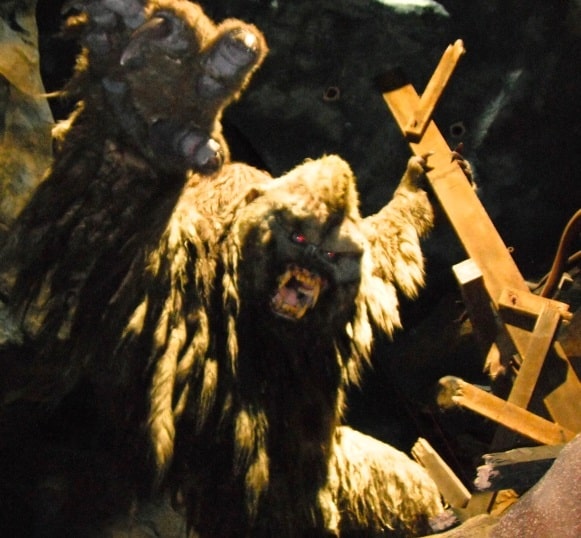
When Expedition Everest opened on April 7, 2006, its enormous Yeti Audio-Animatronic was one of the attraction’s signature technological achievements.
During the climactic encounter near the end of the coaster, the figure moved rapidly toward passing trains, sweeping an arm downward as riders escaped through the mountain.
The effect did not last.
The Yeti stopped operating in its full-motion configuration relatively early in the attraction’s history and has remained largely stationary for most of the past two decades.
Disney subsequently used dramatic lighting and a strobe effect to create the illusion of movement as trains pass the figure.
Fans eventually nicknamed the static version the “Disco Yeti.”
The problem has never been as simple as replacing a motor or repairing a conventional Audio-Animatronic.
Expedition Everest was constructed with the roller coaster, mountain structure and Yeti system functioning as interconnected but structurally independent components.
Any major work on the figure therefore has to contend with an enormous piece of machinery buried deep inside one of Walt Disney World’s most complicated attraction structures.
Rohde has discussed the challenge for years.
Even before his retirement, he repeatedly acknowledged that Imagineering continued looking for solutions. The obstacles included engineering, finances, operational considerations and the difficulty of taking a highly popular attraction out of service long enough to perform substantial work.
His latest comments suggest that those discussions eventually led somewhere unexpected.
Rather than finding a way to restore the original Yeti, Disney apparently developed a replacement that it believes can accomplish the same storytelling objective.
Rohde emphasized that the precise motion is less important than the effect it creates.
The Yeti needs to appear alive.
That philosophy potentially gives current Imagineers considerably more flexibility than attempting to reproduce the original mechanism exactly.
A replacement could theoretically use different technology, different movements or a different mechanical configuration while still delivering the aggressive encounter riders were supposed to experience.
Disney has not confirmed any of those possibilities, and there is currently no reliable information showing what the new figure will look like or how it will move.
There is another major unanswered question: when will the work happen?
Walt Disney World has not announced a refurbishment date for Expedition Everest – Legend of the Forbidden Mountain or said how long the attraction will need to close.
That scheduling issue is particularly interesting because Disney’s Animal Kingdom is already undergoing one of the largest transformations in its history.
DinoLand U.S.A. closed earlier this year and is being rebuilt as Tropical Americas, leaving the park with reduced attraction capacity during construction.
Disney may therefore have considerable incentive to coordinate any extended Expedition Everest closure with the opening of new attractions elsewhere in the park, although Disney has not said that is its plan.
The original Yeti’s fate is equally unknown.
If Rohde’s information is accurate and the figure is physically removed, Disney has not said whether it would be preserved, dismantled, placed into storage or potentially displayed elsewhere.
For an Audio-Animatronic that has become part of modern Disney theme park lore, that question will undoubtedly attract attention of its own.
For now, the fundamental promise Disney made earlier this year has not changed.
The Yeti is going to move again.
What has changed is our understanding of how Disney apparently plans to make that happen.
After roughly two decades of fans waiting for Imagineers to “fix the Yeti,” the eventual solution may be something much more dramatic:
a completely different Yeti.