
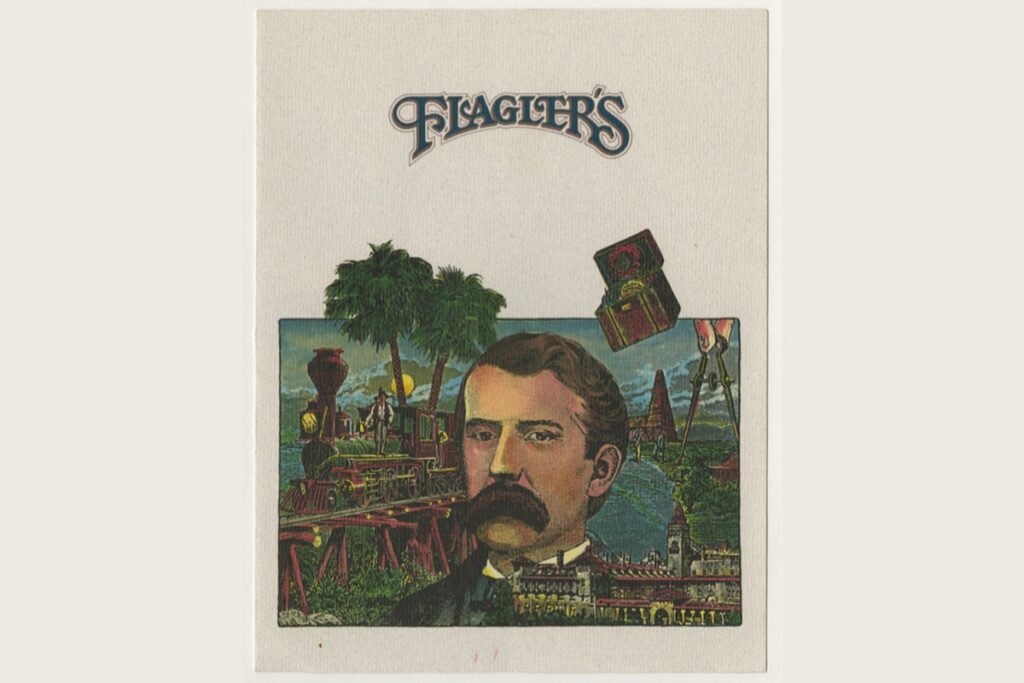
Flagler’s was an upscale Italian and continental restaurant located on the second floor of Disney’s Grand Floridian Beach Resort at Walt Disney World. Opening on June 28, 1988, alongside the resort itself, the restaurant offered elegant breakfasts, Italian-inspired dinners, and live musical entertainment in a setting that complemented the Grand Floridian’s turn-of-the-century Victorian atmosphere. Named for Henry Morrison Flagler, the railroad magnate and hotel developer who played a central role in transforming Florida into a major tourist destination, Flagler’s was part of the resort’s original collection of dining establishments.
During its nine years of operation, Flagler’s developed a reputation for traditional Italian cuisine, attentive service, and a distinctive entertainment program featuring strolling musicians and singing waiters. Its combination of fine dining and informal musical performances differentiated it from the Grand Floridian’s more formal restaurants.
Flagler’s closed on July 6, 1997, and was replaced by Cítricos later that year. Although the original restaurant disappeared, its location remains an important part of the Grand Floridian’s dining operations.
Origins and Opening
Disney’s Grand Floridian Beach Resort opened on June 28, 1988, as Walt Disney World’s third monorail resort, joining Disney’s Contemporary Resort and Disney’s Polynesian Village Resort.
The property was designed to evoke the luxurious seaside resort hotels that flourished in Florida during the late 19th and early 20th centuries. Its Victorian architectural influences, white exterior walls, red roofs, elaborate lobby, and waterfront setting reflected an era when wealthy travelers journeyed south by railroad to spend their winters in Florida.
The Grand Floridian was conceived as Walt Disney World’s premier luxury hotel, offering a level of sophistication beyond the resort’s existing accommodations.
Dining was an important component of this identity.
The original restaurant lineup included Victoria & Albert’s, Narcoossee’s, 1900 Park Fare, the Grand Floridian Café, and Flagler’s. These restaurants offered guests a range of experiences, from character dining and casual meals to elaborate gourmet dinners.
Flagler’s occupied a position between the resort’s everyday dining establishments and its most exclusive restaurant, Victoria & Albert’s.
Its menu emphasized traditional Italian and continental cuisine, while its atmosphere was intended to be upscale without the formality associated with the resort’s premier fine-dining establishment.
The restaurant was located on the second floor of the main building, near the Grand Floridian’s imposing central lobby. This location placed it among the hotel’s most prominent public spaces and made it accessible to both overnight guests and visitors arriving by monorail.
The Henry Flagler Connection
The restaurant’s name honored Henry Morrison Flagler, one of the most important figures in Florida’s development as a major vacation destination.
Born in 1830, Flagler became wealthy as a co-founder of Standard Oil before turning his attention to railroad development and luxury hotels in Florida.
During the late 19th century, he invested heavily in the state’s Atlantic coast, constructing hotels and extending railroad service southward.
Among his most famous projects was the Hotel Ponce de Leon in St. Augustine, which opened in 1888, exactly 100 years before the Grand Floridian.
Flagler subsequently developed luxury hotels in Palm Beach and other Florida communities, including the Royal Poinciana Hotel and The Breakers.
His Florida East Coast Railway helped connect previously isolated communities with northern population centers, making large-scale tourism and real estate development possible.
By the early 20th century, Flagler’s railroad extended to Key West.
Naming a restaurant after Flagler was therefore particularly appropriate for the Grand Floridian.
The hotel’s architecture and atmosphere drew inspiration from the same golden age of Florida tourism that Flagler helped create. His luxury hotels established precedents for the type of destination resort Disney sought to recreate along the shores of the Seven Seas Lagoon.
The restaurant also incorporated this historical connection into its printed materials.
An original 1988 Flagler’s breakfast menu included an illustrated cover and a brief history of Henry Flagler’s contributions to Florida.
This small detail demonstrated how Disney incorporated historical references into the guest experience, extending the Grand Floridian’s theme beyond its architecture and interior design.
Breakfast at Flagler’s
Although Flagler’s was best remembered for its Italian dinners, it also served an upscale breakfast during its early years.
A surviving opening-year breakfast menu, preserved by RetroWDW, offers a detailed look at the restaurant’s original morning offerings.
Rather than emphasizing a large buffet or character appearances, Flagler’s provided traditional table-service breakfast dishes with a more refined presentation.
Among the offerings were fresh muesli, broiled grapefruit, veal sausages, and elevated versions of familiar American breakfast favorites.
One particularly distinctive item was the Floridian Sunrise, a specialty breakfast beverage combining orange juice, lime juice, honey, nutmeg, and a whipped egg.
The drink reflected the restaurant’s emphasis on traditional hospitality and an era when freshly prepared breakfast beverages and elaborate morning meals were associated with luxury hotels.
Flagler’s also offered an alternative to the more energetic breakfast experience at nearby 1900 Park Fare.
At 1900 Park Fare, families could enjoy character dining in a setting designed around Disney entertainment. Flagler’s provided a quieter environment for guests interested in a leisurely breakfast without character appearances.
Its table-service format was consistent with the Grand Floridian’s original goal of offering a broad selection of dining experiences, rather than concentrating primarily on buffets and quick-service meals.
Italian and Continental Dinner Menu
Dinner was the centerpiece of Flagler’s culinary identity.
The restaurant specialized in Italian and continental cuisine, emphasizing familiar European dishes, pasta, seafood, and carefully prepared meats.
Surviving menus from the late 1980s and early 1990s document offerings that included osso buco, filet of beef, pasta dishes, and a selection of seafood.
Osso buco, a traditional Italian preparation of braised veal shanks, was particularly representative of the restaurant’s approach to upscale Italian dining.
Seafood was also an important part of the menu, with several selections listed at market price rather than a fixed amount.
This practice reflected the restaurant’s emphasis on fresh seafood and the pricing conventions of higher-end dining establishments during the period.
Pasta selections provided more familiar Italian options for guests who preferred traditional dishes.
Unlike contemporary Disney signature restaurants, where menu descriptions can emphasize extensive ingredient lists, preparation techniques, and carefully composed presentations, Flagler’s menus were comparatively straightforward.
Historical menu collectors have observed that the descriptions were often brief, identifying the dish and its principal components without lengthy explanations.
The menu represented the style of fine dining popular during the late 1980s and early 1990s, when traditional continental cuisine and Italian specialties were common features of upscale American restaurants.
Children’s Dining and the Pinocchio Menu
One of Flagler’s more interesting features was its elaborate children’s menu.
Rather than providing a simple printed list of smaller entrées, Disney created a coloring-book-style menu featuring Pinocchio and Geppetto.
The 1988 children’s menu depicted the characters traveling by train to Flagler’s for dinner.
The railroad journey was an appropriate reference to the restaurant’s namesake, Henry Flagler, and his role in developing Florida’s railroad transportation network.
The menu also included spaces for children to personalize their experience.
One page allowed children to record their visit to Flagler’s, while another introduced a fictional waiter named Antonio and encouraged young diners to write the name of their own server.
This approach turned the children’s menu into a souvenir and activity book, giving younger guests something to enjoy while waiting for their meals.
Surviving menu documentation provides a useful snapshot of children’s dining prices in 1988.
A petit filet was priced at $10.95, while a half chicken breast served with vegetables cost $8.95.
A hamburger or cheeseburger accompanied by french fries was available for $4.95.
Other options included spaghetti and meatballs and a make-your-own pizza.
The selection illustrates how Flagler’s accommodated families while maintaining its upscale Italian restaurant identity.
Parents could enjoy more elaborate dinners while children selected familiar foods and participated in the themed coloring-book activities.
Singing Waiters and Strolling Musicians
One of the most distinctive aspects of Flagler’s was its live musical entertainment.
The restaurant featured strolling musicians who moved through the dining room performing traditional Italian songs.
Historical accounts also describe singing waiters, who contributed to the restaurant’s lively atmosphere.
Rather than presenting a formal stage show, Flagler’s incorporated music directly into the dining experience.
Musicians could serenade individual tables, adding a personal element to the evening.
Italian love songs were a particular feature of the entertainment.
This approach was consistent with the theatrical style of Disney restaurants during the period, when dining experiences frequently incorporated live performers, themed service, or other forms of entertainment.
However, Flagler’s musical program was different from the large-scale dinner shows available elsewhere at Walt Disney World.
The performances were intimate and intended to enhance the meal rather than dominate it.
The combination of traditional Italian food and strolling entertainment gave Flagler’s a character that differed from both Victoria & Albert’s and Narcoossee’s.
Victoria & Albert’s emphasized elaborate gourmet dining and refined service, while Narcoossee’s specialized in seafood in a waterfront setting.
Flagler’s offered a more sociable Italian dining experience, balancing an elegant atmosphere with the warmth of live music.
Closing and Transformation into Cítricos
Flagler’s operated for slightly more than nine years before Disney decided to replace it.
According to Disney’s official D23 historical encyclopedia, Flagler’s closed on July 6, 1997. Some secondary histories identify July 7, but Disney’s official date is July 6.
The closure was part of a significant change in the Grand Floridian’s dining program.
Rather than simply renaming Flagler’s, Disney reworked the restaurant into a new dining concept.
Cítricos opened in the former Flagler’s location on November 8, 1997.
The new restaurant shifted away from the traditional Italian dining and entertainment format that had characterized its predecessor.
Instead, Cítricos emphasized Mediterranean and Florida-inspired cuisine, with a more contemporary approach to fine dining.
The restaurant’s design was developed by the Martin Dorf firm, which was also associated with the designs of the California Grill at Disney’s Contemporary Resort and Flying Fish Café at Disney’s BoardWalk.
Cítricos incorporated an exhibition kitchen, allowing guests to observe elements of the culinary preparation.
The restaurant’s new identity reflected changing tastes in upscale dining during the 1990s, when many restaurants were moving toward more contemporary menus, open kitchens, and regionally inspired cuisine.
The strolling musicians and singing waiters that had distinguished Flagler’s were not retained as defining elements of the new concept.
Cítricos became one of the Grand Floridian’s signature dining establishments and continued occupying the original Flagler’s space.
Later Changes to the Restaurant Space
Although Flagler’s closed in 1997, the restaurant space continued to evolve through subsequent decades.
Cítricos remained in operation as a Mediterranean-inspired restaurant, establishing an identity separate from its predecessor.
In 2021, the restaurant reopened following a major redesign inspired by the 2018 Disney film Mary Poppins Returns.
The updated dining room incorporated decorative elements inspired by the film’s animated fantasy sequence, including floral motifs, butterflies, and design details suggesting an elegant garden setting beneath the London sky.
The reimagining retained the restaurant’s sophisticated dining identity while introducing a stronger connection to a Disney film.
By 2026, Cítricos continued serving Florida cuisine with Mediterranean influences.
The current restaurant includes menu offerings such as guava-barbecued short ribs, butter-poached Florida cobia, and other contemporary dishes.
These changes illustrate how dramatically the dining experience occupying the original Flagler’s location has evolved since 1988.
The space transitioned from a traditional Italian restaurant with strolling entertainment to an upscale Mediterranean establishment, and subsequently to a redesigned restaurant incorporating Mary Poppins-inspired decorative elements.
Despite these transformations, the location remains one of the Grand Floridian’s principal dining venues.
Historical Significance
Flagler’s represents an important chapter in the development of Walt Disney World’s luxury resort dining.
When the Grand Floridian opened in 1988, Disney was attempting to establish a new standard for resort hospitality, combining elaborate historical theming with restaurants that could compete with upscale hotels outside the theme park industry.
Flagler’s contributed to that identity through its Italian cuisine, formal table service, historical references, and live entertainment.
Its connection to Henry Flagler was particularly meaningful because the restaurant’s namesake helped establish the luxury Florida resort tradition that inspired the Grand Floridian itself.
The restaurant also demonstrated Disney’s attention to smaller themed details, from the historical material printed on its breakfast menus to the Pinocchio coloring book that connected children’s dining with the story of railroad travel.
The transition from Flagler’s to Cítricos in 1997 reflected an important change in Disney’s approach to signature restaurants, as traditional continental dining concepts gradually gave way to contemporary regional cuisines and more modern restaurant environments.
Although Flagler’s is no longer operating, its original space remains in use, and its history is closely connected to the Grand Floridian’s development from a newly opened luxury hotel in 1988 into one of Walt Disney World’s best-known resorts.
For guests who experienced the original restaurant, Flagler’s is remembered for its Italian dinners, strolling musicians, singing waiters, and the distinctive atmosphere of the Grand Floridian during its first decade.