
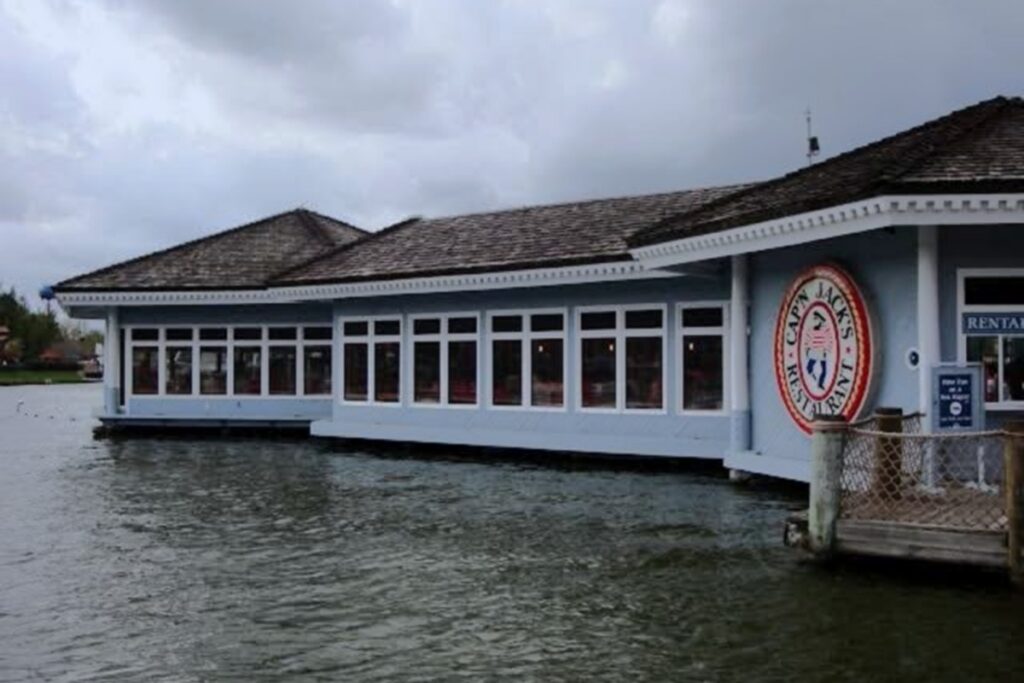
Cap’n Jack’s Oyster Bar was an original waterfront restaurant and lounge at the Lake Buena Vista Shopping Village, the shopping and dining complex that eventually became Disney Springs. Opening on March 22, 1975, the same day as the shopping village itself, the establishment specialized in fresh seafood, oysters, clams, and frozen strawberry margaritas. Originally designed as a relatively intimate nautical tavern extending over the waters of Buena Vista Lagoon, it developed into a larger table-service restaurant and was officially renamed Cap’n Jack’s Restaurant on February 20, 2000. The restaurant remained in operation until August 17, 2013, when it closed permanently to make way for the redevelopment of Downtown Disney into Disney Springs.
For nearly four decades, Cap’n Jack’s occupied one of the most distinctive dining locations at Walt Disney World. The restaurant stood at the end of a waterfront structure extending into Buena Vista Lagoon, near the original shopping village marina.
Its unusual position allowed diners to look directly out across the water, watching boats traveling between the marina and surrounding resort facilities.
Unlike most restaurants at Walt Disney World, Cap’n Jack’s did not have a theme based on a Disney movie or character. Its identity was rooted in the nautical traditions of a New England waterfront tavern, complemented by the relaxed atmosphere of the original shopping village.
The restaurant’s history begins with Disney’s ambitious plans for Lake Buena Vista.
When Walt Disney World opened on October 1, 1971, the resort consisted primarily of Magic Kingdom, two resort hotels, transportation facilities, recreational amenities, and considerable undeveloped property.
Disney envisioned Lake Buena Vista as a larger resort community incorporating vacation accommodations, shopping, dining, recreation, and other services.
The Lake Buena Vista Shopping Village was intended to become the commercial center of that community.
Rather than building a conventional shopping mall, Disney created a landscaped pedestrian district inspired by traditional waterfront villages.
The complex featured specialty retailers, artisan workshops, restaurants, and shops selling merchandise not ordinarily associated with theme parks.
Guests could browse pottery, handmade candles, clothing, gourmet foods, and other specialty products while exploring pathways surrounded by gardens and waterways.
Cap’n Jack’s was one of the original businesses.
Its location reflected the shopping village’s emphasis on a relaxed waterfront atmosphere.
The restaurant was constructed as part of a three-section building extending into the lagoon.
The first section housed the Windjammer Dock Shop, a nautical-themed retail store specializing in swimwear and related merchandise.
A connecting passageway and porch extended toward the water, eventually leading to the oyster bar at the far end.
The arrangement made the restaurant feel somewhat secluded from the main shopping paths.
Guests originally passed through the Windjammer area before reaching the dining location.
The building’s unusual arrangement was not accidental.
Early plans for the Windjammer shop included live swimsuit modeling, with models walking along the connecting dock and porch.
A contemporary November 1974 description of the development explained that the walkway would serve as a place to display the latest swimwear.
This was a particularly unusual idea for Walt Disney World, reflecting the upscale retail ambitions of the original shopping village.
Cap’n Jack’s itself occupied a six-sided, glass-enclosed structure extending over the lagoon.
The interior featured a central hexagonal bar surrounded by seating and windows.
The arrangement emphasized the waterfront setting, with diners enjoying views in nearly every direction.
On one side, guests could watch activity at the Village Marina.
On the other, they could look across the water toward the Lake Buena Vista residential and recreational areas.
During the restaurant’s earliest years, much of the surrounding landscape remained undeveloped.
The views included cypress trees, natural Florida vegetation, and small boats moving through the waterways.
This created a considerably different atmosphere from the busy Disney Springs waterfront of later decades.
The name Cap’n Jack’s was also rooted in actual Disney history.
The restaurant was named in honor of Jack Olsen, a Disney executive associated with the development of the company’s merchandise operations.
Olsen served as head of Disneyland’s merchandise department from 1964 to 1970 and played an important role in establishing the distinctive specialty-shopping approach used at Disney theme parks.
He was known for his interest in sailing and fishing, making a nautical restaurant an appropriate tribute.
Olsen subsequently helped shape merchandise operations at Walt Disney World before retiring in 1977.
Despite the similarity in names, Cap’n Jack’s had no relationship to Captain Jack Sparrow from the Pirates of the Caribbean films.
The restaurant opened nearly three decades before the first Pirates of the Caribbean movie was released in 2003.
The original Cap’n Jack’s Oyster Bar was intended primarily as a lounge serving seafood appetizers and alcoholic beverages.
It was one of the few places at the resort where adults could enjoy cocktails and light food late into the evening.
This made the restaurant particularly appealing during Walt Disney World’s early years, when nightlife options outside the theme parks were relatively limited.
The nearby Village Chummery, later known as the Village Lounge, also provided evening entertainment.
Together, these establishments helped establish Lake Buena Vista Shopping Village as a destination for adults as well as families.
Cap’n Jack’s original menu emphasized fresh seafood.
Oysters on the half shell were among its specialties, along with steamed clams, crab dishes, seafood marinara, and other appetizers.
The menu reflected the restaurant’s location and nautical identity rather than attempting to recreate the elaborate meals offered at the resort’s larger hotel restaurants.
A particularly important part of the early menu was the frozen strawberry margarita.
Shortly after the shopping village opened, Disney began promoting the drink as one of Cap’n Jack’s signature offerings.
It was prepared using strawberry-flavored tequila, other spirits, citrus flavors, and fruit.
The colorful cocktail became closely associated with the restaurant and remained a familiar menu item throughout its history.
At a time when frozen strawberry margaritas were not nearly as common as they are today, the drink helped distinguish Cap’n Jack’s from conventional lounges.
Its popularity was significant enough that the shopping village promoted the cocktail in its own publications.
By January 1981, Cap’n Jack’s offered a surprisingly varied seafood menu.
A surviving official Walt Disney World menu from that month documents its selections and prices.
The Strawberry Margarita was priced at $3.25.
Hot appetizers included New England Clam Chowder, Seafood Marinara, Stuffed Clams, and Deviled Crab Cakes.
The Seafood Marinara combined shrimp, mussels, and mushrooms in marinara sauce.
Stuffed Clams were priced at $2.25, while Deviled Crab Cakes cost $3.50.
The Captain Jack’s Combination Plate was available for $5.95.
That selection combined deviled crab, stuffed clam, crab claws, and seafood marinara, allowing guests to sample several of the restaurant’s specialties in a single order.
Cold appetizers included ceviche prepared with marinated grouper, vegetables, and lime juice.
A cheese-and-cracker platter provided an alternative for guests uninterested in seafood.
The menu also featured oysters, clams, and other fresh seafood offerings.
These dishes were considerably more distinctive than the generic appetizers associated with many later theme park lounges.
Cap’n Jack’s occupied an unusual position between a traditional oyster bar and a casual seafood restaurant.
Although it was officially considered a lounge, visitors could assemble a substantial meal from its appetizers and seafood selections.
The atmosphere also contributed greatly to its appeal.
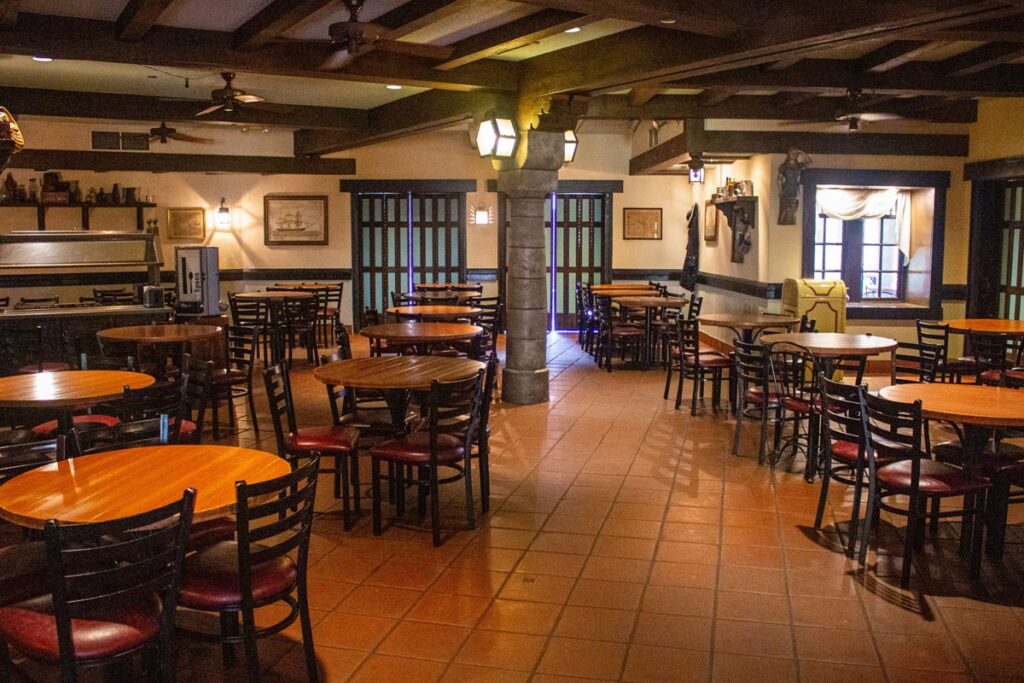
Guests sat near the windows overlooking the water, surrounded by wood furnishings, nautical details, and the central bar.
The interior had a relatively intimate scale, particularly compared with the enormous restaurants that would eventually populate Downtown Disney.
During the late 1970s, the surrounding shopping village began evolving.
The Empress Lilly riverboat restaurant opened on May 1, 1977, introducing a much larger and more elaborate waterfront dining destination.
Its enormous paddlewheel-style structure became one of the shopping village’s principal landmarks.
The arrival of the riverboat changed the views from Cap’n Jack’s, adding a major dining attraction to the previously quiet lagoon.
That same year, Lake Buena Vista Shopping Village was renamed Walt Disney World Village.
The renamed complex continued offering specialty shopping, entertainment, and dining, but the number and variety of businesses gradually expanded.
Cap’n Jack’s remained an established part of the waterfront.
By the early 1980s, its reputation extended beyond oysters and cocktails.
Contemporary restaurant guides praised its seafood selections and views of the lagoon, describing it as a place suitable for a light lunch, dinner, or afternoon drink.
The combination of relatively modest prices, waterfront seating, and distinctive appetizers helped maintain its popularity.
However, the shopping village was changing again by the end of the decade.
Pleasure Island opened on May 1, 1989, introducing a large entertainment district devoted to nightclubs, restaurants, and nightlife.
This shifted much of Walt Disney World’s evening activity away from the original Village shopping area.
Cap’n Jack’s was no longer one of the resort’s few established late-night destinations.
Disney responded by adapting the restaurant to serve a broader dining audience.
During the late 1980s and early 1990s, the building underwent physical expansion.
The original connecting porch and portions of the neighboring Windjammer Dock Shop area were incorporated into additional restaurant space.
A larger kitchen was installed, allowing Cap’n Jack’s to prepare a more extensive selection of meals.
The work also increased the available dining capacity.
Portions of the former open-air porches were enclosed with glass, changing the building’s original appearance.
Although the expansion was practical, it made the once-symmetrical waterfront structure considerably less distinctive architecturally.
The original hexagonal bar remained an important feature, but the surrounding dining rooms expanded beyond the compact oyster-bar configuration.
By the 1990s, the restaurant offered a broader menu that included seafood entrées, pasta, meat dishes, and additional appetizers.
The transition reflected the growing number of families visiting the shopping district.
Rather than functioning primarily as an adults-oriented oyster bar, Cap’n Jack’s increasingly operated as a conventional waterfront restaurant.
Further changes occurred during the middle of the decade.
The original Windjammer Dock Shop disappeared as Disney redeveloped the surrounding Marketplace.
Its former retail space became part of the restaurant’s entrance and waiting area.
The building also received an updated exterior color scheme emphasizing blue and white, reinforcing its New England nautical character.
Nearby, World of Disney opened in 1996, transforming the shopping district with a much larger Disney merchandise location.
The former Empress Lilly became Fulton’s Crab House, while the surrounding waterfront grew increasingly commercial.
Despite these changes, Cap’n Jack’s continued operating in its original general location.
On February 20, 2000, the establishment officially adopted the name Cap’n Jack’s Restaurant.
Disney’s historical encyclopedia confirms this date.
The change formalized a transition that had already been underway for several years.
By then, Cap’n Jack’s was functioning as a full-service restaurant rather than primarily as an oyster bar and cocktail lounge.
Its menu featured a wider variety of dishes, with an emphasis on seafood but also selections for guests who preferred chicken, beef, or pasta.
The restaurant continued serving lunch and dinner, with advance dining reservations available.
It also participated in the Disney Dining Plan and Tables in Wonderland discount program during its later years.
The menu continued evolving throughout the 2000s.
By the early 2010s, recognizable selections included New England Clam Chowder, Crab Cakes, Baked Salmon, and Seafood Pasta.
A beef pot roast and roast chicken were available for guests who did not want seafood.
The restaurant also offered children’s meals, making it more suitable for families than the original oyster bar had been.
Its Strawberry Margarita remained a signature beverage.
The central bar continued providing a place for guests to enjoy drinks without ordering a full meal.
A firsthand dining account from March 2013 documents the restaurant’s final operating period.
The interior still featured wooden floors, low ceilings, nautical decorations, and seating overlooking the waterfront.
Although the restaurant’s décor had been updated over the decades, it retained the atmosphere of an informal coastal seafood establishment.
The waterfront views remained its greatest distinction.
Guests seated near the windows could watch boats moving through the lagoon and observe activity at the nearby marina.
The restaurant’s setting was especially appealing during the afternoon and evening, when sunlight reflected across the water.
However, Cap’n Jack’s also developed a mixed reputation during its final years.
Some visitors appreciated the relaxed atmosphere, familiar menu, and ability to obtain reservations with relatively little notice.
Others considered its food and décor dated compared with the increasingly sophisticated restaurants available elsewhere at Walt Disney World.
The building’s unusual layout and multiple additions also made it look less cohesive than it had during its original years.
These factors contributed to its status as an overlooked dining location during the early 2010s.
Nevertheless, Cap’n Jack’s remained an important historical survivor.
Many of the original Walt Disney World Village restaurants and shops had already disappeared.
The Village Restaurant, Village Lounge, Gourmet Pantry, and numerous original specialty stores were gone.
Cap’n Jack’s was among the last surviving businesses that connected the modern Marketplace with the original 1975 shopping village.
That continuity ended when Disney announced plans to transform Downtown Disney into Disney Springs.
The redevelopment was formally announced in March 2013.
Disney planned to create a significantly larger shopping, dining, and entertainment district, with new waterfront walkways, restaurants, stores, parking facilities, and public spaces.
The project required substantial changes to the original Marketplace.
Cap’n Jack’s stood in an area where Disney intended to improve pedestrian circulation around Buena Vista Lagoon.
The restaurant’s overwater position, which had been one of its greatest attractions for nearly four decades, now conflicted with the redevelopment plans.
Its site was selected for a new pedestrian walkway across part of the waterfront.
Disney announced that Cap’n Jack’s would close during the summer of 2013.
The final operating date was subsequently confirmed as August 17, 2013.
The restaurant served its last guests that day, ending more than 38 years of waterfront dining.
The closure was permanent.
Disney did not announce plans to relocate the restaurant or preserve the original oyster-bar identity elsewhere at Walt Disney World.
Demolition began later in 2013.
By December, the former Cap’n Jack’s structure was being dismantled to make room for the new pedestrian connection.
The building’s distinctive hexagonal waterfront dining room, former Windjammer areas, and subsequent additions were removed.
Unlike restaurant conversions in which a new business occupies an existing structure, Cap’n Jack’s was physically demolished.
The redevelopment introduced a new Marketplace causeway crossing Buena Vista Lagoon.
The waterfront walkway provided an additional route between the Rainforest Café side of the Marketplace and the area near T-REX.
The project improved pedestrian circulation, allowing guests to move around the shopping district without relying entirely on the original land-based pathways.
It also changed the waterfront landscape that had defined Cap’n Jack’s original setting.
The restaurant was not replaced by another business occupying its former dining room.
Its former site became part of the public pedestrian infrastructure and waterfront redevelopment.
Although Disney Springs subsequently introduced numerous seafood restaurants, including The BOATHOUSE and Paddlefish, neither was a direct operational successor to Cap’n Jack’s.
Those restaurants occupy different locations and have their own culinary concepts and operating histories.
As of October 2026, Cap’n Jack’s Oyster Bar and Cap’n Jack’s Restaurant remain permanently closed.
The original building is gone, and the name is no longer used for any dining location at Disney Springs.
The Marketplace continues operating as one of the four major districts of Disney Springs, retaining portions of the original shopping village’s layout and waterfront character.
However, the quiet lagoon-side atmosphere that defined Cap’n Jack’s early years has changed considerably.
The surrounding area is now part of a much larger destination featuring extensive shopping, restaurants, entertainment, and waterfront transportation.
Cap’n Jack’s is particularly significant because it was one of the original dining establishments at Lake Buena Vista Shopping Village.
Its March 1975 opening places it among the earliest restaurants developed outside Magic Kingdom and the original resort hotels.
It also reflects an earlier period when Disney sought to establish Lake Buena Vista as a complete vacation community rather than simply an extension of the theme parks.
The restaurant’s original concept was unusual for its time.
Instead of emphasizing Disney characters or elaborate themed entertainment, Cap’n Jack’s offered a relatively sophisticated adults-oriented environment centered on seafood, cocktails, and waterfront views.
Its specialty strawberry margarita and late operating hours made it a distinctive destination during the resort’s formative years.
The later expansion into a family-friendly table-service restaurant illustrates how the shopping village evolved.
As Walt Disney World attracted more visitors and the surrounding entertainment district expanded, Cap’n Jack’s adapted its menu, physical layout, and operating identity.
The change from Oyster Bar to Restaurant in February 2000 was the formal culmination of that process.
The restaurant’s eventual demolition also illustrates the extent of the Disney Springs transformation.
Although the redevelopment preserved the general Marketplace identity, it removed several features associated with the original shopping village.
Cap’n Jack’s was one of the most historically significant losses because it had remained in essentially the same waterfront location for more than 38 years.
For visitors who remember the Walt Disney World Village during the 1970s and 1980s, Cap’n Jack’s was a place to enjoy seafood and frozen strawberry margaritas while overlooking a relatively quiet lagoon.
For later generations, it was a casual waterfront restaurant where families could dine while watching boats travel through Downtown Disney.
Its atmosphere, architecture, and menu changed over the decades, but the connection to the water remained central throughout its history.
Although the restaurant no longer exists, Cap’n Jack’s remains an important part of Walt Disney World dining history as an original Lake Buena Vista Shopping Village establishment that survived nearly four decades of growth, redevelopment, and changing guest expectations.