
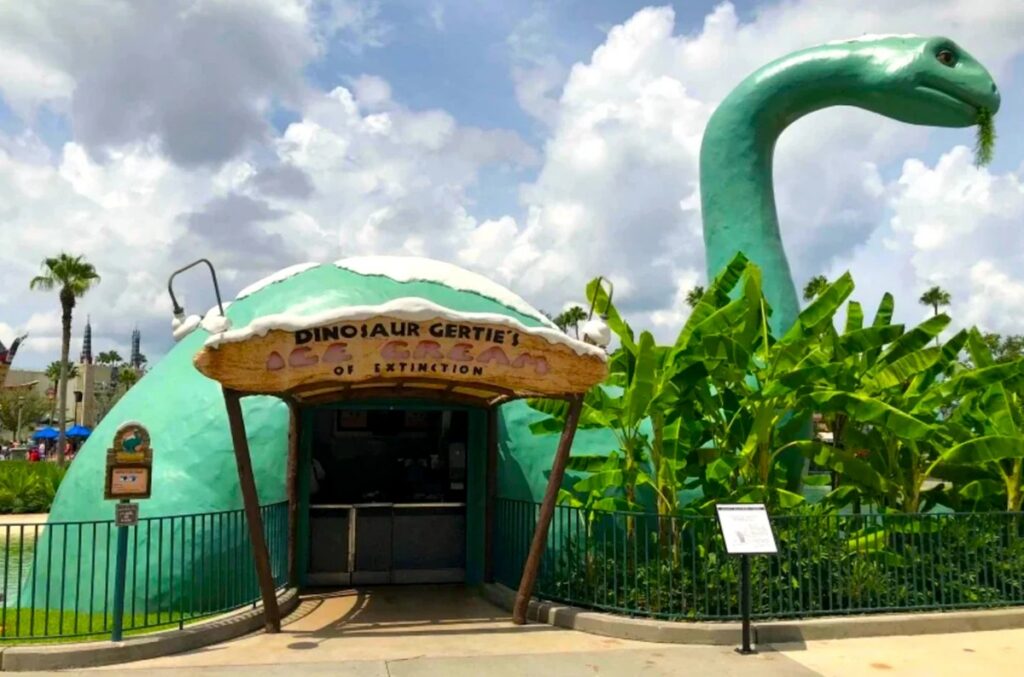
Dinosaur Gertie’s Ice Cream of Extinction is a quick-service ice cream stand located along Echo Lake at Disney’s Hollywood Studios. Opened on May 1, 1989, the same day as Disney-MGM Studios, the location is housed inside an enormous green dinosaur whose long neck and head tower above the surrounding landscaping. Although the menu is relatively simple, consisting primarily of soft-serve ice cream and frozen novelties, Dinosaur Gertie is one of the park’s most distinctive original structures. The building serves as a tribute to pioneering animator Winsor McCay and his groundbreaking 1914 animated film Gertie the Dinosaur, while its unusual architecture recalls the oversized roadside attractions that once dotted Southern California.
Unlike many of the original Disney-MGM Studios restaurants that have disappeared or undergone extensive transformations, Dinosaur Gertie has retained its original identity and location since the park opened. The dinosaur has become a recognizable landmark in the Echo Lake area, surviving substantial changes to the surrounding park.
The stand is situated along the southern edge of Echo Lake, near the Indiana Jones Epic Stunt Spectacular and the pedestrian pathways connecting Hollywood Boulevard with the park’s Echo Lake attractions. Nearby locations include Hollywood & Vine, the 50’s Prime Time Café, and the former Min and Bill’s Dockside Diner, now known as Dockside Diner.
Its position beside the lake is an essential part of the design. Gertie appears to be standing partially submerged in the water, with her enormous body extending into the lagoon and her long neck rising above the trees and nearby buildings.
The structure is recognizable from multiple vantage points around Echo Lake, making it as much a visual landmark as a food-service facility.
Disney-MGM Studios opened on May 1, 1989, as Walt Disney World’s third theme park. The original park celebrated the history and production of motion pictures and television, combining attractions about filmmaking with architecture inspired by Hollywood’s Golden Age.
Rather than simply recreating famous movie locations, Disney Imagineers incorporated references to the businesses, streets, restaurants, and architectural styles that characterized Los Angeles during the early decades of the entertainment industry.
Echo Lake was designed to evoke the atmosphere of Southern California during the 1930s and 1940s. Its architectural details drew inspiration from Los Angeles neighborhoods, particularly the Echo Park area, where historic buildings and a picturesque lake helped establish a distinctive urban setting.
The buildings surrounding Echo Lake reflected different aspects of Hollywood history, including streamlined commercial architecture, apartment buildings, entertainment venues, and casual restaurants.
Dinosaur Gertie represented one of the area’s most unusual architectural references.
The giant dinosaur is an example of a style commonly known as California Crazy architecture, sometimes referred to as programmatic architecture.
During the early twentieth century, particularly in Southern California, roadside businesses frequently adopted exaggerated shapes intended to attract the attention of passing motorists.
Restaurants, shops, and refreshment stands were constructed to resemble objects associated with the products they sold. Buildings shaped like oversized animals, food items, teapots, and other recognizable objects became memorable features of the roadside landscape.
The idea was straightforward: a distinctive building could function as its own advertisement.
These structures became especially popular during the automobile age, when businesses along highways and major roads competed for the attention of travelers.
Dinosaur Gertie brings that architectural tradition into Disney’s Hollywood Studios.
Rather than placing an ice cream stand inside a conventional building and decorating it with dinosaur artwork, Imagineers made the entire structure resemble a gigantic prehistoric creature.
Its exaggerated proportions and playful appearance are consistent with the roadside architecture found in Southern California during the period represented by the surrounding park.
The dinosaur’s body serves as the building itself, while the service counter is positioned along the side facing the pedestrian walkway.
The entrance features a rustic wooden sign identifying the location as Dinosaur Gertie’s Ice Cream of Extinction. The lettering and weathered appearance contribute to the impression of an old-fashioned roadside concession stand.
The structure’s green exterior, long neck, rounded body, and friendly facial expression distinguish it from the more realistic dinosaur figures found elsewhere at Walt Disney World.
Gertie was not intended to be a scientifically accurate reconstruction of a prehistoric animal. Her appearance reflects the cartoon character that inspired the building.
That character predates Mickey Mouse by fourteen years.
Gertie the Dinosaur was created by newspaper cartoonist and animation pioneer Winsor McCay, whose work helped establish many of the techniques and storytelling principles that later became central to animated filmmaking.
Before creating Gertie, McCay was already widely known for his illustrated newspaper comics, including Little Nemo in Slumberland.
He also experimented with animation at a time when motion pictures were still relatively new and the techniques required to create convincing animated movement were far from standardized.
In 1914, McCay introduced Gertie the Dinosaur as part of a vaudeville performance.
The act was particularly innovative because McCay appeared onstage and interacted with an animated character projected onto a screen.
Rather than presenting a series of disconnected visual gags, the animation gave Gertie a recognizable personality.
She appeared curious, stubborn, playful, and occasionally mischievous.
McCay would address the dinosaur and issue commands, carefully timing his live performance to correspond with the animated character’s movements.
Gertie appeared to respond to her creator, giving audiences the illusion that the cartoon creature was alive.
During the performance, she performed tricks, ate vegetation, interacted with a woolly mammoth, and eventually carried McCay on her back.
The character’s movements were carefully animated to create a sense of physical weight, personality, and emotional expression.
Gertie was not the first animated character or the first animated film, but the sophistication of McCay’s work represented an important advancement in the medium.
His emphasis on character personality and believable movement helped establish principles that later animators would continue developing.
The original performance premiered at the Palace Theatre in Chicago on February 2, 1914.
McCay subsequently presented the act in New York and other locations.
Later that year, a theatrical film version was produced, incorporating live-action scenes that explained the creation of Gertie and replaced the need for McCay to perform alongside the animation in person.
The surviving film is an important artifact of early American animation history.
Gertie the Dinosaur was selected for preservation in the United States National Film Registry in 1991, recognizing its cultural, historical, and artistic significance.
Walt Disney was among the later animators who admired McCay’s contributions to the medium.
Although Walt Disney and his animators would introduce numerous innovations of their own, McCay had demonstrated the potential for animation to create believable characters with recognizable personalities.
The Gertie tribute at Disney-MGM Studios acknowledges that earlier generation of animation pioneers.
This connection is particularly appropriate for a park that originally included The Magic of Disney Animation, an attraction designed to explain how animated films were developed and produced.
The dinosaur-shaped ice cream stand therefore served a broader historical purpose than its simple menu might suggest.
It commemorated an important figure in animation history while simultaneously contributing to the park’s visual recreation of early Hollywood.
Imagineers incorporated another detail that reinforces the illusion that Gertie is a living creature.
In the pavement near the stand, guests can find enormous dinosaur footprints.
These impressions suggest that Gertie walked across the surrounding area before settling into Echo Lake.
Some footprints are accompanied by cracks in the concrete, implying that the dinosaur’s enormous weight damaged the walkway.
The effect is easy to overlook because guests frequently concentrate on the large dinosaur itself.
However, the footprints extend the environmental storytelling beyond the building.
Instead of appearing as an isolated oversized sculpture, Gertie becomes part of a small visual narrative about a prehistoric creature that has wandered into the Hollywood neighborhood.
Another distinctive feature is the dinosaur’s relationship with the surrounding vegetation.
Gertie’s long neck rises above tropical plants, and her head appears to be chewing on leaves.
This detail reflects the character’s behavior in McCay’s original animation, where Gertie’s appetite and interaction with her environment contributed to her personality.
The building’s playful design is particularly effective because it works on two levels.
Guests unfamiliar with the history of animation simply encounter a large, friendly dinosaur selling ice cream.
Visitors who recognize Winsor McCay’s character can appreciate the historical reference and the connection between the structure and early animated filmmaking.
A historical plaque near the stand explains the significance of Gertie and the California Crazy architectural style.
The plaque identifies the building as a tribute to one of animation’s first widely recognized characters and describes the oversized commercial architecture that inspired its design.
This interpretive element helps preserve the educational dimension of the original Disney-MGM Studios concept.
The building is not merely decorative. It introduces guests to a particular period of animation and architectural history.
The restaurant’s name incorporates a playful reference to prehistoric extinction.
The phrase Ice Cream of Extinction combines the familiar ice cream-shop format with a joke about dinosaurs disappearing from the Earth.
The snow-like decorative treatment around the roofline and the dinosaur’s back adds another visual element associated with cold desserts.
These details help connect the oversized dinosaur structure with its actual function as an ice cream stand.
Dinosaur Gertie’s original menu was relatively limited, and the location has never operated as a full-service restaurant.
Instead, it specializes in frozen treats suitable for guests exploring the park.
Soft-serve ice cream has been the principal offering throughout much of its history.
Guests can typically choose vanilla, chocolate, or a combination of the two flavors.
The ice cream is served in cups or cones, with waffle cones among the most recognizable options.
The stand has also offered packaged Disney ice cream novelties, including Mickey Mouse-shaped ice cream bars and sandwiches.
A documented menu from February 2009 provides an example of the prices and products available during that period.
Sugar cones and ice cream cups were listed at $2.89, while waffle cones cost $3.79.
A Nestlé Crunch King Size Ice Cream Bar and a Mickey’s Cookies ‘n Cream Ice Cream Sandwich were each priced at $2.59.
These prices illustrate how the kiosk functioned as an inexpensive snack stop rather than a major dining destination.
By April 2013, the menu still emphasized chocolate and vanilla soft serve, including swirled combinations.
Historical descriptions also identify sugar cones, waffle cones, premium ice cream bars, fresh fruit, and trail mix among the location’s offerings during this period.
The availability of additional snacks varied, but the fundamental ice cream concept remained consistent.
Another distinctive aspect of Dinosaur Gertie’s operating history is its irregular schedule.
Despite being a permanent building and an opening-day park landmark, the stand has not always operated daily.
During various periods, it has opened primarily on busier days, during holidays, or when park attendance justified additional food-service capacity.
As a result, guests could encounter Gertie standing beside Echo Lake with the service window closed.
This occasionally caused confusion because the kiosk appeared to be a fully operational restaurant even when it was not serving guests.
The building itself remained accessible as a visual landmark regardless of whether the ice cream stand was open.
Its role in the park’s atmosphere therefore continued even during periods of limited food-service operations.
The distinction between the structure’s continued presence and the kiosk’s variable operating schedule is important when assessing its history.
Dinosaur Gertie has remained a recognizable part of Echo Lake since 1989, but that does not mean the service counter has operated continuously every day.
The location has also become closely associated with the Christmas season.
During Walt Disney World’s holiday celebrations, Gertie receives an oversized red Santa hat.
A large decorative ornament hangs from her mouth, while the surrounding Echo Lake area is decorated with traditional holiday displays.
The dinosaur’s holiday appearance has become one of Disney’s Hollywood Studios’ most recognizable seasonal details.
The Santa hat is especially effective because of Gertie’s enormous size and prominent location.
Guests can see the festive dinosaur from different points around Echo Lake, with the surrounding decorations reinforcing the nostalgic holiday atmosphere of the area.
The ornament hanging from her mouth is another characteristic detail, making it appear as though Gertie has become curious about the decorations.
Echo Lake itself is traditionally decorated with floating ornaments and a large Christmas tree positioned in the water.
Together, these features create a holiday setting that complements the Hollywood-inspired architecture surrounding the lake.
The seasonal presentation has contributed to Gertie’s popularity among guests who enjoy the park’s original details and nostalgic atmosphere.
Although the dinosaur is already an unusually memorable building, the holiday decorations give it an additional identity during November and December.
The character’s popularity eventually led to merchandise celebrating the ice cream stand itself.
In November 2024, Disney introduced a Dinosaur Gertie-themed tumbler at Celebrity 5 & 10 on Hollywood Boulevard.
The turquoise tumbler featured artwork inspired by the restaurant’s wooden sign, including an illustration of Gertie licking an ice cream treat.
The reverse side incorporated dinosaur footprints similar to those found in the pavement near the original structure.
The tumbler was priced at $24.99.
A matching ceramic mug followed in December 2024, priced at $16.99.
The merchandise was noteworthy because Gertie is an original park landmark rather than a character from a modern Disney animated franchise.
Producing merchandise based on the ice cream stand acknowledged the dinosaur’s popularity among visitors familiar with the park’s history.
Additional Gertie merchandise appeared in March 2025, including a T-shirt featuring the dinosaur and the Ice Cream of Extinction branding.
The shirt depicted Gertie with her snow-covered back and an ice cream treat, reinforcing the visual identity of the original stand.
These products helped turn a small quick-service location into a recognizable piece of Disney’s Hollywood Studios merchandise history.
The structure has also required periodic maintenance.
During the summer of 2024, Gertie received refurbishment work that included attention to her tail and exterior appearance.
The work was completed in time for the subsequent holiday season, allowing the dinosaur to resume her familiar Christmas appearance.
More substantial maintenance concerns became apparent during 2026.
In February 2026, a large crack was observed near the base of Gertie’s tail.
The damage became particularly visible after colder weather reduced some of the surrounding vegetation, exposing portions of the dinosaur’s structure that were normally more difficult to see.
The crack extended across the upper portion of the tail and continued toward the waterline.
Disney initially attempted to repair the damaged area, and photographs taken on February 16 showed the crack had been patched and painted.
However, the repair did not hold completely.
By February 27, the crack had reopened.
The situation subsequently became more serious when part of Gertie’s tail separated from the structure.
Disney lowered the water level around the dinosaur and covered portions of the damaged area while repair work was undertaken.
By March 6, the tail had been reattached.
The work was a useful reminder that Gertie is not merely a decorative statue. The dinosaur is an enormous themed structure exposed to Florida’s heat, humidity, rainfall, and seasonal weather changes.
Maintaining the figure requires attention to the building’s exterior surfaces as well as its structural components.
Importantly, the tail repairs did not result in the permanent closure of the ice cream stand.
The location continued operating during the work.
Another major refurbishment affected the surrounding Echo Lake area later in 2026.
In August, Disney drained much of Echo Lake to allow maintenance and refurbishment work.
Construction signage informed visitors that the lake was being refurbished, while the reduced water level exposed portions of the dinosaur and surrounding structures that are normally submerged.
The project also affected the appearance of the nearby Dockside Diner and other elements positioned along the water.
Gertie remained in place throughout the work.
By October 14, 2026, the dinosaur had received a substantial exterior repaint.
Her green surface appeared freshly painted, with particular improvements visible along the lower portions of the body and tail.
The repaint also refreshed the decorative snow-like areas on her back and head.
The work preserved Gertie’s established color scheme rather than introducing a substantially different appearance.
This was an important distinction because the dinosaur’s familiar green coloring and overall silhouette have remained central to its identity since 1989.
As of October 2026, Dinosaur Gertie’s Ice Cream of Extinction remains open and operational at Disney’s Hollywood Studios.
The restaurant continues serving soft-serve ice cream and packaged frozen novelties from its original Echo Lake location.
A menu verified in August 2026 listed vanilla, chocolate, and swirl soft serve in waffle cones for $6.29 and cups for $5.79.
Mickey’s Premium Ice Cream Bars were priced at $6.29, while Mickey’s Premium Ice Cream Sandwiches cost $6.49.
The kiosk remains categorized as a quick-service snack location.
Its operating hours can vary, and the stand has a history of closing during slower periods even while remaining a permanent part of the park.
The 2026 menu lists service beginning around 10 a.m., although operating schedules are subject to change.
There is no documented plan to permanently close or replace the building as of October 2026.
The original dinosaur-shaped structure remains standing, having survived the park’s transformation from Disney-MGM Studios into Disney’s Hollywood Studios.
That survival is particularly noteworthy when considering how extensively the park has changed.
Many original attractions and facilities associated with the working-movie-studio concept have disappeared.
The Studio Backlot Tour closed in 2014, The Great Movie Ride closed in 2017, and several original production-themed areas were demolished to accommodate Toy Story Land and Star Wars: Galaxy’s Edge.
Even within Echo Lake, restaurants, entertainment offerings, and surrounding facilities have undergone changes.
Dinosaur Gertie, however, remains one of the park’s most recognizable opening-day landmarks.
Its continued presence also preserves an aspect of Disney-MGM Studios’ original educational philosophy.
The park was created not only to entertain guests with popular movies but also to celebrate the people, techniques, and creative developments that shaped the entertainment industry.
Winsor McCay’s work was fundamental to the development of character animation, and Gertie helped demonstrate that animated figures could possess recognizable personalities and interact convincingly with their environments.
By honoring McCay through a whimsical roadside-style ice cream stand, Imagineers incorporated that history into an accessible part of the park’s everyday environment.
The building’s architectural style provides another layer of historical significance.
California Crazy architecture represents a distinctive period in American commercial design, when businesses used oversized, theatrical buildings to capture the attention of motorists.
The dinosaur combines that roadside tradition with a tribute to early animation, creating a structure that is appropriate to both the park’s Hollywood setting and its emphasis on filmmaking history.
Few Walt Disney World dining locations combine these two historical references so directly.
Unlike extinct restaurants that were replaced by new attractions or absorbed into larger redevelopment projects, Dinosaur Gertie continues serving essentially the same purpose for which it was constructed.
Its menu has changed relatively little, its location remains the same, and its physical identity is immediately recognizable.
The 2026 refurbishment demonstrates Disney’s continued investment in maintaining the structure rather than replacing it.
Dinosaur Gertie may serve nothing more elaborate than soft-serve ice cream, but the building represents a much larger story.
It connects one of the earliest animated characters with the history of Southern California roadside architecture and the original vision for Disney-MGM Studios.
More than thirty-seven years after opening, Dinosaur Gertie’s Ice Cream of Extinction remains a small but important reminder of the park’s original identity, when even a simple snack stand could celebrate a significant chapter in the history of motion pictures.