

Cinderella Castle is the architectural and emotional centerpiece of Magic Kingdom, standing at the far end of Main Street, U.S.A. as the visual gateway to Fantasyland and the most recognizable symbol of Walt Disney World. Opening with Magic Kingdom on October 1, 1971, the 189-foot structure was inspired by Disney’s 1950 animated film Cinderella, but it was never intended to be a literal recreation of the castle seen onscreen. Walt Disney Imagineering instead combined the film’s romantic fantasy with centuries of European architecture, creating an idealized palace that looks simultaneously medieval, Renaissance, Gothic, and unmistakably Disney.
The castle’s importance begins well before guests actually reach it. After passing beneath the Walt Disney World Railroad station and entering Town Square, visitors can see Cinderella Castle at the opposite end of Main Street. The carefully framed view turns the structure into a visual destination, drawing guests forward while establishing immediately that the ordinary-looking American town they have entered leads somewhere fantastic.
At the hub, that relationship changes again. Main Street’s turn-of-the-century architecture gives way to lawns, gardens, waterways, bridges, and the increasingly elaborate stonework of the castle. Passing beneath Cinderella Castle marks the transition into Fantasyland, making the structure both a park icon and a literal threshold between two themed environments.
Disney’s designers did not base the castle on one real building. Imagineers at WED Enterprises studied major European palaces and châteaux, including Fontainebleau, Versailles, Chenonceau, Chambord, and Chaumont, while also examining artwork developed for Disney’s animated Cinderella. The resulting structure was described during construction as a romanticized composite of European royal architecture.
Disney Legend Herbert Ryman, who had previously contributed to the design of Disneyland’s Sleeping Beauty Castle, served as Cinderella Castle’s chief designer. Rather than reproducing the much smaller California castle at a larger scale, Ryman and the Florida design team created a new landmark suited to the vastly larger Walt Disney World property.
Architecturally, Cinderella Castle is deliberately divided into two visual personalities. The lower portion has the weight and solidity of a medieval Romanesque fortress, with substantial stone-looking walls, narrow openings, battlements, and heavy round towers. As the structure rises, the architecture becomes more delicate and vertical, shifting toward the pointed arches, narrow towers, elaborate pinnacles, and soaring forms associated with Gothic architecture.
That transition is one reason the castle appears both strong and graceful. The base feels capable of supporting a genuine fortress, while the upper towers become increasingly fanciful until the tallest golden spire seems almost impossibly thin.
Despite the appearance of centuries-old masonry, Cinderella Castle is a thoroughly modern structure. It took approximately 18 months to build and was essentially complete by July 1971. Rather than being constructed from traditional stone and brick, it uses steel, concrete, cement, plaster, fiberglass, and other modern materials. Disney’s historical records note that approximately 276 tons of steel were incorporated into the structure.
Many ornamental components were prefabricated and delivered to the Magic Kingdom construction site before being lifted into place by cranes. Towers, decorative stonework, gargoyles, and other architectural elements were therefore designed to provide the visual richness of a European palace without requiring the traditional building techniques that would have made a genuine masonry castle impractical.
The finished castle contains 18 towers and spires as well as 13 exterior gargoyles. The structure rises 189 feet-tall enough to dominate Magic Kingdom while remaining below the height at which Federal Aviation Administration lighting requirements would have complicated its fairy-tale silhouette.
Its location also reflects one of the most unusual pieces of Magic Kingdom engineering. Cinderella Castle is effectively constructed above portions of the park’s extensive backstage utilidor network. Because much of Magic Kingdom’s public level sits above these service corridors, guests are already elevated above the original natural grade when they approach the castle. Construction photographs show the enormous infrastructure built beneath Fantasyland and the castle long before the finished park landscape hid it from view.
Some of Cinderella Castle’s most impressive artwork is actually found at ground level.
Guests walking through the central passageway encounter five large mosaic murals that retell Cinderella’s transformation from mistreated stepdaughter to princess. Each Gothic-arched panel measures roughly 15 feet high by 10 feet wide. Disney Legend Dorothea Redmond designed the murals, while renowned mosaicist Hanns-Joachim Scharff translated the artwork into hundreds of thousands of individual pieces of glass.
The mosaics required roughly 22 months of work and use hundreds of colors. Some pieces incorporate sterling silver and 14-karat gold, while individual tiles can be as small as the head of a tack. The result is unusually sophisticated for a space that many guests simply walk through on their way between the hub and Fantasyland.
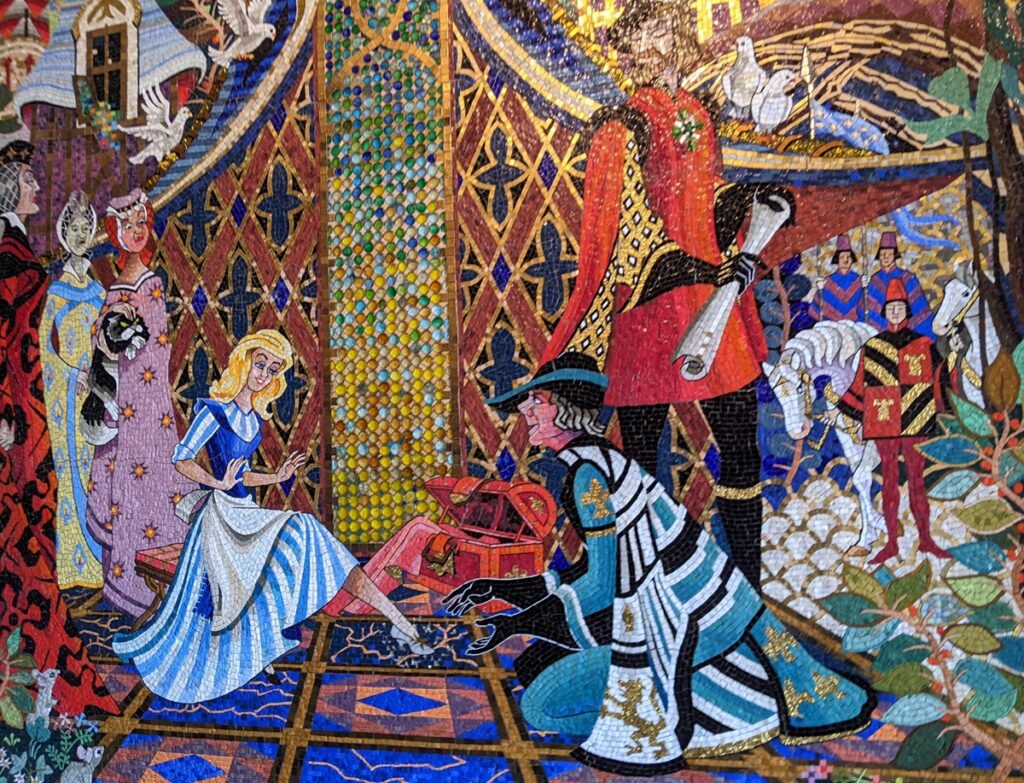
The murals also reward close inspection. Cinderella’s stepsisters display subtle visual jokes: one appears red with anger while another has a greenish complexion suggesting envy. Imagineers Herb Ryman and John Hench were also incorporated into the scene involving Cinderella’s glass slipper, placing members of the castle’s creative team permanently inside the fairy tale they helped realize.
Above that passageway is one of Magic Kingdom’s most famous restaurants.
The dining room now known as Cinderella’s Royal Table opened with the park in 1971 as King Stefan’s Banquet Hall. The name created an odd piece of Disney mythology because King Stefan is actually Princess Aurora’s father in Sleeping Beauty, not Cinderella’s father. Disney eventually corrected the mismatch, renaming the restaurant Cinderella’s Royal Table in 1997.
Today the dining experience begins in the castle’s Grand Hall, where guests typically meet Cinderella before traveling upstairs to the banquet room. The upper dining chamber uses stone arches, medieval banners, stained-glass windows, and views toward Fantasyland to create the impression of dining within a royal palace. Disney Princesses visit diners during meals, turning the restaurant into one of Walt Disney World’s signature character-dining experiences.
Another major guest space inside the castle is Bibbidi Bobbidi Boutique, where children ages 3 through 12 can receive princess- or knight-inspired transformations from Disney’s Fairy Godmother’s Apprentices. The Magic Kingdom boutique opened inside Cinderella Castle in 2007, taking over space formerly used by The King’s Gallery merchandise shop. Its presence gives the interior a second public function beyond dining and the passageway itself.
Far less accessible is the legendary Cinderella Castle Suite.
When the castle was originally constructed, unfinished space existed within its upper levels. During Disney’s Year of a Million Dreams celebration, that area was transformed into an extraordinarily elaborate royal guest suite. The suite opened in January 2007 and was created as a prize rather than a conventional hotel room.
The design was based loosely on late-17th-century French royal interiors, appropriate to the period associated with Charles Perrault’s version of the Cinderella story. The space includes richly carved wood, ornate fabrics, stained glass, a fireplace, royal furnishings, and elaborate Cinderella references. During the promotion, randomly selected guests and their families were given the extraordinary opportunity to spend the night inside Magic Kingdom after other visitors had left.
The suite has never operated as a normally bookable Walt Disney World hotel room, which has only added to its mystique.
Outside, Cinderella Castle has repeatedly served as Magic Kingdom’s principal entertainment canvas.
The Castle Forecourt Stage hosts live productions such as Mickey’s Magical Friendship Faire and seasonal entertainment during events including Mickey’s Not-So-Scary Halloween Party. Because the structure towers directly behind the stage, performances can use the castle almost like an enormous theatrical set.
At night, the role becomes even more dramatic. Modern projection-mapping technology allows Disney to transform nearly the entire front surface into animated environments during Happily Ever After, while fireworks, lasers, lighting, and music extend the show above and around the castle. Earlier projection spectaculars such as The Magic, The Memories and You!, Celebrate the Magic, and Once Upon a Time helped establish the castle as an enormous projection surface rather than simply a static backdrop.
Its appearance has also changed repeatedly for major celebrations.
Perhaps no transformation was more dramatic than Walt Disney World’s 25th anniversary in 1996, when Cinderella Castle was temporarily converted into an enormous pink birthday cake. The structure was covered in three shades of pink paint and decorated with gigantic candles, gumdrops, lollipops, candy pieces, and frosting-like elements. More than 400 gallons of pink paint were involved. The overlay became one of the most polarizing visual changes in Walt Disney World history, but it remains instantly recognizable decades later.
In 2005, Disney decorated Cinderella Castle for the Happiest Celebration on Earth, commemorating Disneyland’s 50th anniversary. Golden character sculptures and ornate decorations covered portions of the façade, while an enormous stained-glass-style Magic Mirror above the entrance displayed images of Disney castles around the world.
During the late 2000s, another beloved seasonal transformation arrived with the Castle Dream Lights, which covered the structure in more than 200,000 tiny white lights during the Christmas season and made the castle appear to be coated in ice.
A much more permanent visual change arrived in 2020, ahead of Walt Disney World’s 50th anniversary. Disney repainted the castle in warmer rose and pink tones, deepened the blue of its rooftops, and introduced extensive gold accents. Additional EARidescent anniversary decorations, including a large 50th-anniversary crest, were added for the resort’s celebration beginning in 2021. Most of the temporary anniversary decorations were removed when the celebration ended in 2023, but the warmer paint scheme initially remained.
That changed again in 2026.
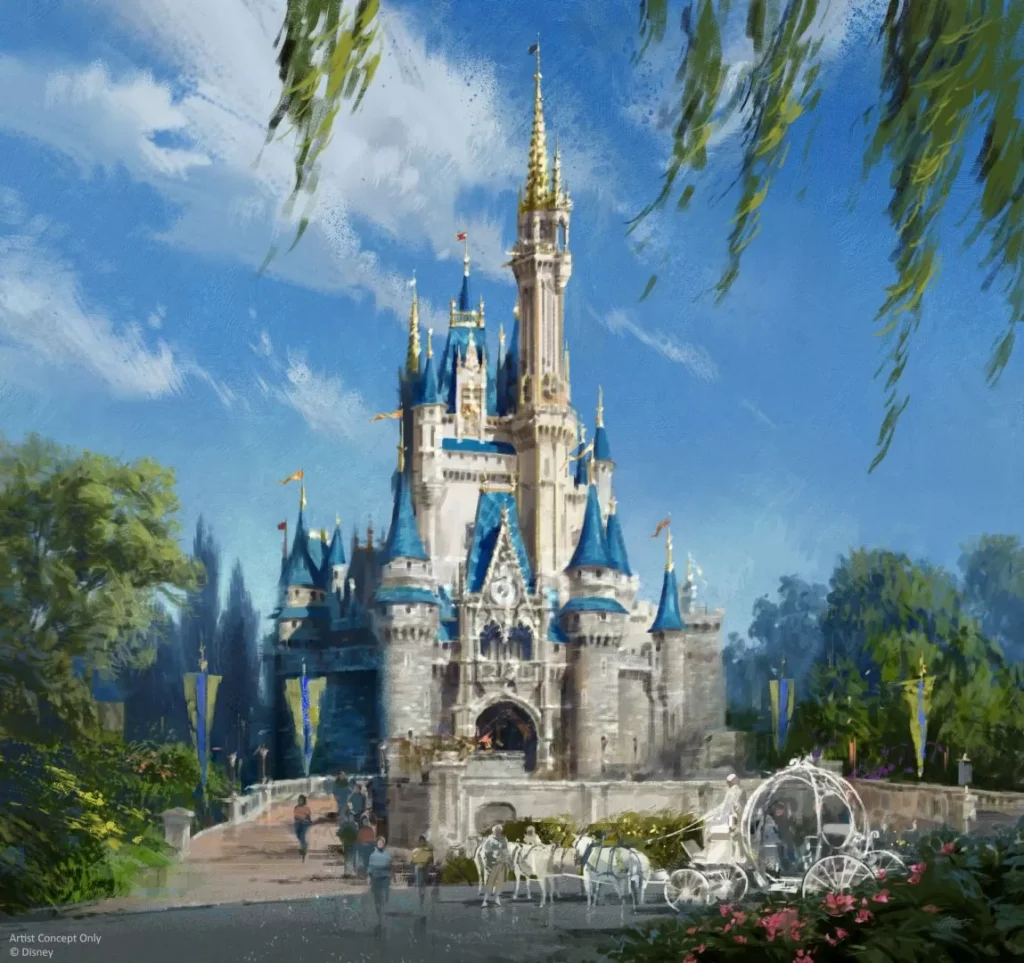
Disney undertook a major repainting project that intentionally returned Cinderella Castle closer to its 1971-inspired appearance. Walt Disney Imagineering selected a new palette emphasizing cooler stonework, deep blue roofs, and refined gold details. The work required draining portions of the surrounding moat and using large boom lifts to reach the castle’s highest surfaces. Crews spent several months working across the structure before the project was completed in spring 2026.
The current version therefore looks deliberately familiar without being an exact duplication of the 1971 paint job. The cooler gray stone and blue roofs restore much of the classic contrast visible in early photographs, while carefully placed gold accents emphasize architectural details in a way that responds well to Florida sunlight.
The moat itself is another essential component of the composition. Water surrounds much of the castle, helping separate it visually from the surrounding park and reinforcing the sense that guests are approaching a real fortified palace. Bridges and walkways connect the hub with Fantasyland, while landscaped areas around the castle include gardens and Cinderella’s Wishing Well, a quieter detail tucked along the walkway toward Tomorrowland.
Cinderella Castle also influenced Disney theme-park architecture far beyond Florida. When Tokyo Disneyland opened in 1983, its central castle was built with an exterior closely based on Magic Kingdom’s Cinderella Castle, although its interior experiences differed. The Florida structure consequently became not just Walt Disney World’s icon, but one of the defining architectural templates for Disney’s growing international theme-park empire.
Its cultural role has expanded even further through branding. Castle imagery has become inseparable from The Walt Disney Company itself, appearing in countless logos, television presentations, merchandise designs, promotional campaigns, and vacation advertisements. Although Disney’s modern studio castle logo is not a literal rendering of Cinderella Castle, the association between the company and its fairy-tale castles is so strong that the silhouette immediately communicates “Disney” to audiences around the world.
What makes Cinderella Castle particularly successful is that its importance does not depend on a conventional ride. Guests can dine inside it, receive a royal makeover, walk beneath its mosaics, watch stage shows in front of it, and see it transformed through fireworks and projection effects, but the castle’s primary purpose is simply to exist at the center of the park.
It organizes Magic Kingdom visually and emotionally.
For a first-time visitor, the initial view down Main Street is often the moment Walt Disney World becomes tangible. For returning visitors, that same sight can function almost like a ritual confirmation that they are back. It appears in family photographs across generations, while every new anniversary, entertainment production, repainting, and holiday season adds another visual layer to its history.
More than 55 years after its completion, Cinderella Castle remains the defining icon of Magic Kingdom and arguably of Walt Disney World itself. It is simultaneously a sophisticated piece of Imagineering, a functioning building, a restaurant, a boutique, a hidden royal suite, an entertainment stage, a projection surface, a gateway to Fantasyland, and one of the most photographed structures in the world.
Yet its greatest accomplishment may be simpler than any of those individual functions.
Cinderella Castle makes the promise at the end of Main Street visible: walk a little farther, pass beneath those towers, and the ordinary world gives way to fantasy.