
Delta Dreamflight was a whimsical aviation-themed dark ride in Tomorrowland at Magic Kingdom that carried guests through the history, romance, and imagined future of flight. Sponsored by Delta Air Lines, the attraction officially opened on June 26, 1989, replacing the short-lived If You Could Fly and substantially reinventing a show building that had been devoted to airline-sponsored travel since 1972. Dreamflight operated under Delta sponsorship through the end of 1995, continued in modified sponsor-free form until January 5, 1998, and was ultimately replaced later that year by Buzz Lightyear’s Space Ranger Spin.
Although Delta Dreamflight existed for less than a decade, it developed a remarkably strong following among Walt Disney World visitors. Its appeal came from an unusual combination of old-fashioned Disney dark-ride design, elaborate miniature environments, theatrical projection effects, stylized figures, a relentlessly cheerful soundtrack, and the comforting continuous movement of an Omnimover ride system. Rather than presenting aviation as a technical subject, Dreamflight treated flying as something romantic, adventurous, glamorous, and almost magical.
The attraction’s history actually began more than 17 years before Dreamflight opened.
On June 5, 1972, Magic Kingdom debuted If You Had Wings, sponsored by Eastern Air Lines. Guests boarded continuously moving Omnimover vehicles and traveled through colorful scenes depicting destinations served by Eastern, including Mexico, the Caribbean, and other vacation locales. Film projections, mirrors, speed effects, music, and travel imagery combined to sell the fantasy that Eastern Air Lines could provide visitors with their own “wings.”
If You Had Wings became one of Tomorrowland’s most recognizable attractions despite lacking the scale of Space Mountain. It also benefited from an important operational advantage: because Eastern sponsored the attraction, admission initially did not require one of Magic Kingdom’s attraction tickets.
Eastern’s relationship with Disney ended in 1987. The attraction closed briefly, Eastern references were removed, and it reopened on June 6, 1987 as If You Could Fly. Delta had become the new sponsor, but the renamed attraction was essentially a temporary solution while Walt Disney Imagineering and Delta developed something much more ambitious.
If You Could Fly closed permanently in January 1989. Imagineers then stripped out most of the old show while retaining the building, Omnimover system, track layout, and several useful theatrical spaces.
What emerged was Delta Dreamflight.
Instead of sending riders to specific airline destinations, Dreamflight told a broader story about humanity’s fascination with flying. The tone was deliberately playful rather than documentary. Aviation history unfolded like an enormous three-dimensional storybook, with highly stylized environments rather than the realistic museum displays that might have accompanied a serious historical exhibition.
The experience began before guests ever entered a ride vehicle.
Dreamflight’s queue was designed like a futuristic airport terminal. One of its most memorable features was the forward section of a Delta Boeing 767, presented as though guests were walking into an actual aircraft. The jet carried the name The Spirit of Delta, a particularly meaningful reference because the real Spirit of Delta was a Boeing 767 purchased for the airline in 1982 through voluntary contributions from Delta employees, retirees, and friends during a difficult period for the company.
Destination posters, airline graphics, bright lighting, and Delta branding reinforced the airport atmosphere. Guests eventually moved through a colorful mirrored passage before reaching the Omnimover loading area.
The ride vehicles themselves were compact continuous-motion cars similar in principle to the Haunted Mansion’s Doom Buggies. Unlike Buzz Lightyear’s later vehicles, they did not rotate at the guest’s command. Instead, the ride system automatically oriented passengers toward the scenes Imagineers wanted them to see.
Almost immediately, riders entered a wonderfully theatrical interpretation of aviation’s earliest dreams.
The opening portion resembled an enormous pop-up book. Hot-air balloons, primitive aircraft, whimsical flying machines, illustrated scenery, and exaggerated figures introduced the idea that people had been dreaming about flight long before modern airliners existed. The attraction’s infectious theme music established the mood, treating aviation history less like a timeline and more like a musical adventure.
Dreamflight then moved into the age of barnstorming.
Guests passed an idealized American countryside populated by eccentric pilots, biplanes, daredevils, and air-show performers. The scenery intentionally resembled dimensional illustrations rather than literal reality. Flat painted figures, dimensional props, forced perspective, theatrical lighting, and mechanical movement created the sense that riders had entered a vintage aviation poster.
One comic scene depicted the unpredictable world of early pilots, where daring aviators performed stunts for crowds and offered airplane rides at traveling fairs. Another incorporated film footage of barnstorming aircraft, giving the sequence a sense of movement that static scenery alone could not provide.
The tone was affectionate rather than reverential. These early pilots were adventurers, entertainers, and occasionally fools willing to climb into remarkably fragile-looking machines simply because flight was irresistible.
The next major chapter celebrated the arrival of commercial aviation.
Riders encountered an enormous flying boat reminiscent of the great Pan American Clippers that opened international air routes during the 1930s. The aircraft appeared near a waterfront setting, evoking the era when enormous flying boats departed from harbors rather than conventional airports.
From there, Dreamflight celebrated the glamour of international travel.
A luxurious aircraft interior suggested an era when flying was marketed as an elegant experience rather than simply transportation. Tables, carefully dressed passengers, airline staff, and refined furnishings recalled the romanticized “golden age” of commercial aviation.
The attraction then moved geographically as well as historically.
Guests encountered Tokyo, represented through a stylized Japanese garden and scenes of international travelers arriving in a very different culture. Nearby, the rooftops and architecture of Paris suggested another glamorous global destination.
These environments reflected Delta’s international aspirations while remaining broad enough to support the attraction’s larger story. Dreamflight was selling the idea that aviation had made the world smaller-that places once reachable only through lengthy journeys were now accessible within hours.
Eventually, the attraction arrived at the Jet Age.
The transition was one of Delta Dreamflight’s most memorable theatrical sequences.
A rotating sign announced the Jet Age while narration prepared guests for a “supersonic takeoff.” Ahead, lights, fog, sound effects, and forced perspective created the illusion that the Omnimover vehicles were approaching an enormous operating jet engine.
Instead of sensibly avoiding the turbine, the ride appeared to travel directly into it.
Bright beams rotated like massive fan blades. Fog obscured the boundaries of the room. Mechanical sounds grew louder. The slow-moving Omnimover suddenly seemed considerably more dynamic than its actual speed would suggest.
The attraction then entered its famous speed room.
Film imagery of a runway and rapidly moving clouds surrounded the vehicles while fans and visual effects created the sensation of accelerating down a runway and becoming airborne. The ride vehicle itself had not suddenly become fast, but the environment convinced the eye that the passenger was moving at enormous speed.
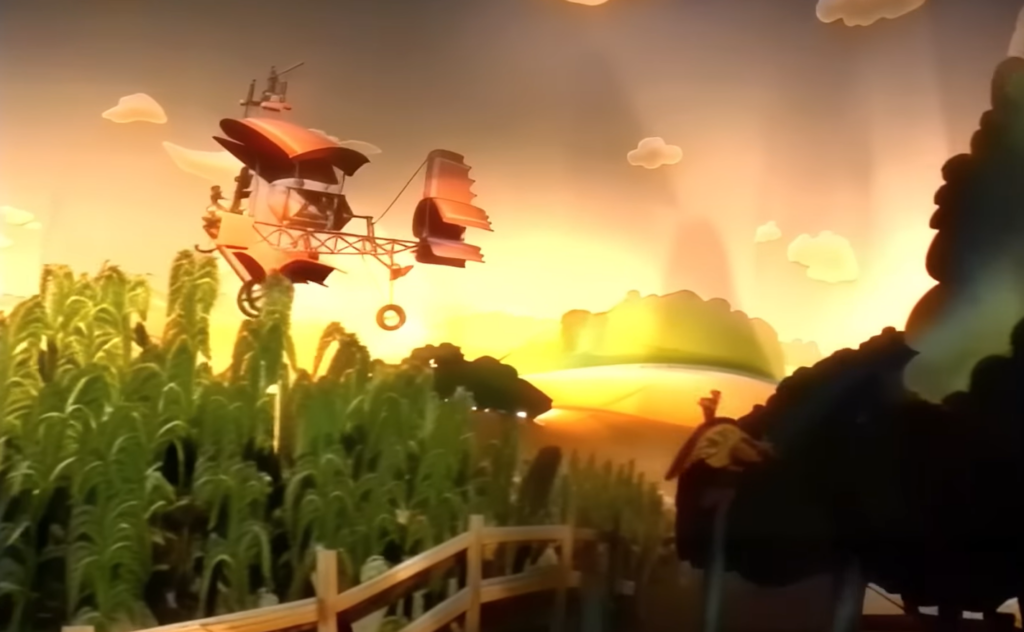
The technique was inherited in part from If You Had Wings, which had used similar projection-based effects, but Dreamflight updated the concept to fit its new aviation narrative.
For many riders, this was the attraction’s defining moment.
After spending much of the ride traveling slowly through charming theatrical scenes, Dreamflight suddenly made the Omnimover feel like an aircraft accelerating toward the sky.
The illusion continued as riders entered another projection environment depicting the future of aviation.
Computer-generated imagery sent the audience soaring above landscapes, through canyons, over water, and into a gleaming futuristic city. Sleek structures and advanced transportation suggested that aviation’s story was far from complete. The attraction had begun with impossible-looking flying contraptions and barnstormers; now it imagined a future in which air travel might become faster, cleaner, and even more deeply integrated into daily life.
That optimistic conclusion was unmistakably Tomorrowland.
Dreamflight was not interested in discussing congestion, fuel costs, airline consolidation, security procedures, or any of the less romantic realities of commercial aviation. It saw flight through the same optimistic lens that had shaped much of classic Tomorrowland: human ingenuity had conquered the sky, and whatever came next would surely be even more extraordinary.
A final storybook-style sequence brought the journey toward its conclusion, connecting the global destinations and futuristic possibilities riders had just experienced.
Music was essential to the attraction’s personality.
Delta Dreamflight featured an extraordinarily catchy musical score, including the repeated Dreamflight theme that accompanied major portions of the journey. Historical sources associate composer Bob Moline, known to EPCOT fans for music including “Listen to the Land” and “Golden Dream,” with the attraction’s songs; other documentation also connects Edo Guidotti with Dreamflight’s music. The exact division of songwriting credit is not consistently documented, but there is little doubt that the soundtrack was one of the attraction’s strongest assets.
The music helped unify scenes that otherwise could have felt disconnected. Barnstormers, flying boats, international cities, jet engines, and futuristic aircraft became chapters of the same upbeat celebration.
Dreamflight was also notable for what it did not contain.
There were no established Disney characters. Mickey Mouse did not explain aviation history. Donald Duck did not pilot the barnstorming aircraft. No film franchise supplied the story.
Instead, the attraction relied entirely on an original theme.
That makes it particularly interesting in retrospect. By the late 1990s and especially during the decades that followed, Disney increasingly built attractions around recognizable intellectual properties. Delta Dreamflight belonged to an older design tradition in which the subject itself-aviation-was enough to justify an attraction.
Its corporate sponsorship was certainly prominent, but sponsorship was part of the storytelling structure rather than merely signage attached afterward.
That relationship eventually brought Dreamflight to an end.
Delta discontinued its sponsorship effective January 1, 1996. Delta logos and references were gradually removed, and the attraction briefly existed during the transition without its original corporate identity before being relaunched under the sponsor-free name Take Flight during 1996.
Take Flight retained almost all of Dreamflight’s ride system, sets, and fundamental storyline. The most obvious changes involved removing Delta-specific branding and adjusting portions of the soundtrack and narration so the attraction no longer sounded like an airline advertisement.
For a casual guest, it remained recognizably the same ride.
The problem was that Disney now had to operate a large attraction without a corporate partner helping to support it, while Tomorrowland itself was rapidly changing.
The land had undergone a major redesign beginning in 1994, becoming the retro-futuristic New Tomorrowland. Alien Encounter, the reimagined PeopleMover presentation, Astro Orbiter, and elaborate metallic architecture created a much more theatrical science-fiction environment.
Dreamflight’s cheerful aviation-history storyline increasingly felt disconnected from that direction.
At the same time, Pixar’s Toy Story, released in 1995, had introduced Buzz Lightyear, whose exaggerated science-fiction world fit the new Tomorrowland unusually well.
Take Flight closed permanently on January 5, 1998.
Disney once again preserved the underlying ride system rather than demolishing the building.
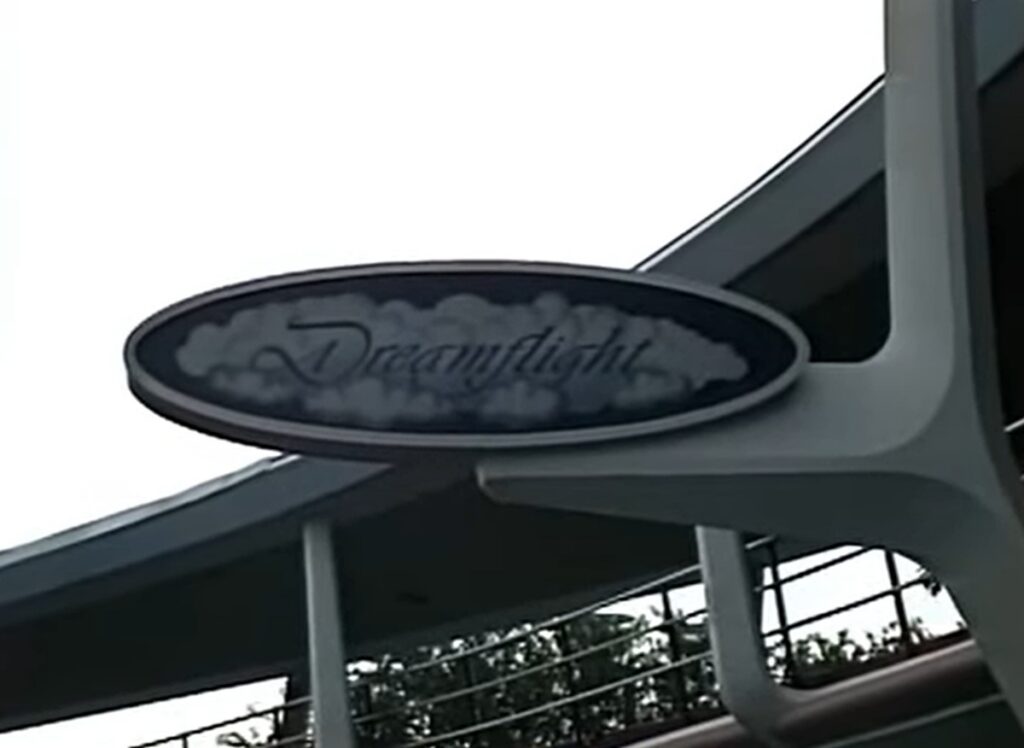

On October 7, 1998, the space reopened as Buzz Lightyear’s Space Ranger Spin.
Much of Dreamflight disappeared beneath the new attraction, but the physical lineage remained. Buzz Lightyear still travels through essentially the same building and follows the same basic Omnimover route established for If You Had Wings in 1972.
Experienced Disney-history fans can even identify locations where Dreamflight effects once existed. The large projection spaces and the former speed-tunnel area were repurposed rather than erased completely. The attraction standing there today is therefore the latest layer in a ride system that has spent more than half a century carrying Magic Kingdom visitors through entirely different stories.
Delta Dreamflight’s relatively short lifespan has only strengthened its nostalgic reputation.
It was never Magic Kingdom’s most technologically revolutionary attraction. Its sets could be charmingly simple. Many characters were closer to dimensional cutouts and stylized figures than sophisticated Audio-Animatronics. The Omnimover moved at a leisurely pace. The story was unabashedly optimistic, and the theme song had the kind of melody capable of remaining lodged in someone’s head for decades.
But those apparent limitations were part of its personality.
Dreamflight felt like an enormous illustrated book about the romance of aviation. One moment guests were watching barnstormers tumble through an American air show; the next they were passing an elegant flying boat, visiting Tokyo and Paris, entering a roaring jet engine, and speeding into a chrome-plated future.
It accomplished all of this without a height requirement, without thrill-ride machinery, and without relying on a famous Disney character.
For guests who experienced it during the late 1980s and 1990s, Delta Dreamflight remains one of Tomorrowland’s quintessential lost attractions-a cheerful, slightly strange, highly musical celebration of a period when flying itself could still be presented as one of humanity’s great adventures.
Its physical scenery is gone, Delta’s cloud-shaped logo has disappeared, and Buzz Lightyear has occupied the building for far longer than Dreamflight ever did.
Yet the old attraction survives in an unexpected way every time a Space Ranger vehicle follows that familiar track through Tomorrowland.
Before guests were blasting Emperor Zurg, that same path carried them through barnstorming fields, across Paris rooftops, into a jet engine, and toward an optimistic future in the sky.