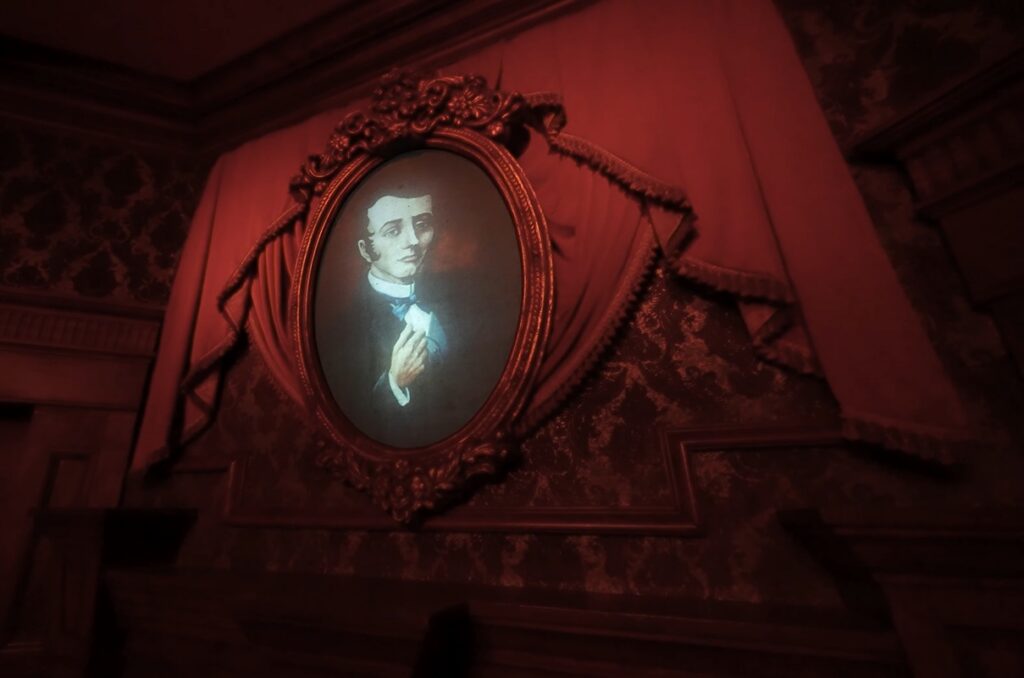
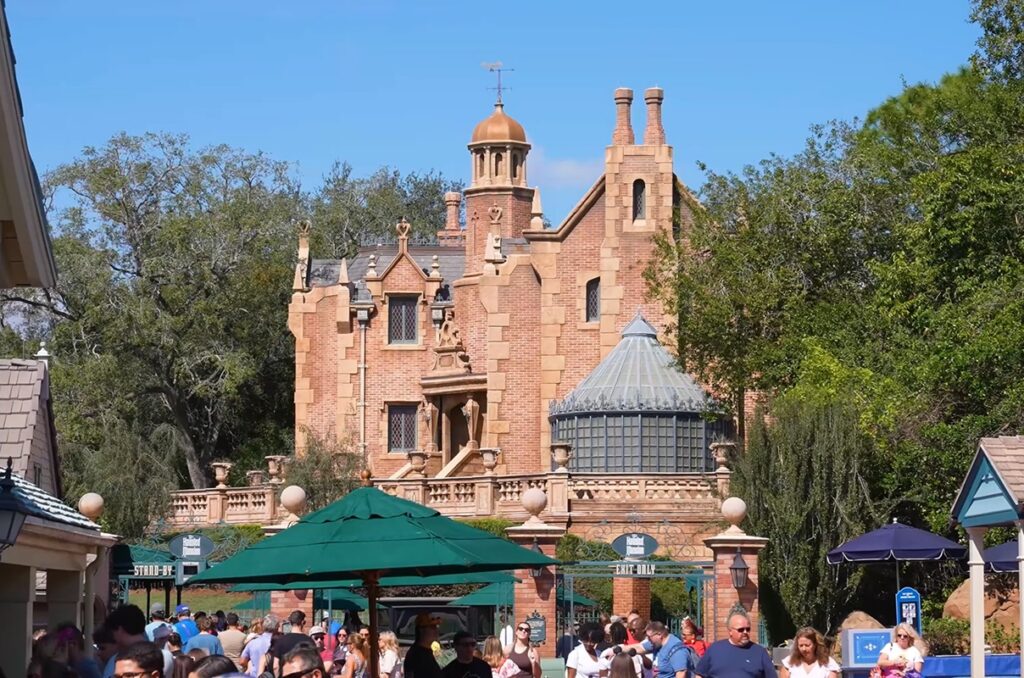
The Haunted Mansion is an opening-day Liberty Square attraction at Magic Kingdom and one of Walt Disney Imagineering’s most enduring achievements. Since October 1, 1971, guests have entered a seemingly well-kept but deeply haunted estate inhabited by 999 happy haunts, boarded continuously moving “Doom Buggies,” and traveled through portrait galleries, impossible hallways, a supernatural séance, a ghost-filled ballroom, a murderous bride’s attic, and one of Disney’s liveliest cemeteries.
Unlike a conventional haunted-house attraction built around sudden scares, the Haunted Mansion balances eerie atmosphere with elaborate illusion, dark comedy, music, and character. Disney’s ghosts are supernatural but rarely threatening. By the second half of the experience, they are not trying to frighten visitors away-they are celebrating, dancing, singing, and inviting mortals to join them.
That unusual mixture of spooky and funny is central to why the attraction has endured for more than half a century.
Magic Kingdom’s Mansion stands on a hill at the western edge of Liberty Square, overlooking the Rivers of America area. Although the attraction shares many interior scenes with Disneyland’s earlier Haunted Mansion, its exterior was redesigned specifically for Florida.
Disneyland’s mansion belongs architecturally to New Orleans Square. That style would have looked out of place beside Liberty Square’s colonial and early-American buildings, so Imagineers gave the Florida version an imposing red-brick manor influenced by the Harry Packer Mansion in Jim Thorpe, Pennsylvania.
Gothic arches, tall chimneys, stone foundations, steep roofs, decorative ironwork, and Tudor-influenced brickwork give the building a darker personality than its California counterpart. It still appears maintained rather than abandoned, however-a reflection of Walt Disney’s famous direction that Disney would take care of the outside while the ghosts could take care of the inside.
The approach begins through wrought-iron gates and a cemetery filled with deliberately humorous epitaphs. Many names honor the Imagineers responsible for creating the attraction. Master Gracey references illusion designer Yale Gracey; Grandpa Marc honors Marc Davis; and other tombstones pay tribute to figures including X Atencio, Claude Coats, and Rolly Crump.
The tributes are appropriate because Haunted Mansion was never the work of one designer.
Its development stretched across more than a decade and involved some of the most important creative figures in Disney theme-park history.
The idea of a haunted house appeared in Disneyland planning even before the park opened. By 1957, Walt Disney had asked story artist Ken Anderson to develop a full haunted-house concept. Anderson created several storylines involving doomed families, mysterious sea captains, murder, hidden passages, and cursed estates.
One early challenge was fundamental: should Disney’s haunted house be genuinely frightening or primarily funny?
Imagineer Claude Coats excelled at atmospheric environments-dark corridors, decaying architecture, mysterious lighting, and ominous spaces. Marc Davis, coming from Disney animation, specialized in strong visual characters and instantly readable comedy. His concepts included elderly ghosts, ridiculous aristocrats, frightened caretakers, and supernatural sight gags.
Rather than choosing entirely between horror and comedy, the finished attraction ultimately incorporated both.
Another key figure was Yale Gracey, whose experiments with light, projection, mirrors, and optical effects created many of the Mansion’s supernatural illusions. Gracey and designer Rolly Crump famously experimented with ghost effects after hours, sometimes filling their workspace with such strange moving objects and apparitions that other Disney employees were reluctant to enter.
Crump also developed the extraordinary Museum of the Weird, a collection of surreal supernatural concepts that Walt considered as a possible companion attraction. Although the museum itself was never constructed, traces of Crump’s unusual aesthetic survived in Haunted Mansion imagery, including portions of its wallpaper and decorative vocabulary.
The project took years to reach its final form.
Disneyland’s Mansion exterior was completed well before the ride inside it. Work was interrupted while Imagineers concentrated on Disney’s attractions for the 1964–1965 New York World’s Fair, and Walt Disney died in December 1966 before the Mansion finally opened.
The breakthrough that helped make the attraction practical was Disney’s Omnimover ride system. Rather than sending small groups through a walk-through haunted house, continuously moving vehicles could carry large numbers of guests while controlling exactly where they looked.
For Haunted Mansion, those vehicles became Doom Buggies.
 Disneyland’s Haunted Mansion finally opened on August 9, 1969. Because Walt Disney World was already under construction, Imagineers produced many figures, props, and show elements for Disneyland and Florida at essentially the same time. Only a little more than two years later, Magic Kingdom’s version opened with the park.
The Florida attraction therefore should not be considered simply a later copy. It was part of the same creative generation and benefited from lessons learned during the California project.
Guests first enter the famous Portrait Chamber, more commonly called the stretching room.
Four seemingly ordinary portraits hang around the circular room. As the chamber mysteriously grows taller, each picture reveals increasingly unfortunate circumstances hidden below its original frame: a woman balancing over an alligator, a man standing on explosives, a widow seated above her murdered husband’s gravestone, and three men sinking into quicksand.
The disembodied Ghost Host, voiced by Paul Frees, welcomes the group and quickly establishes the attraction’s macabre sense of humor.
At Disneyland, the stretching room is a genuine elevator used to move visitors beneath the railroad tracks toward the main show building. Magic Kingdom had enough physical space that no such elevator was necessary. Instead, the Florida version achieves the illusion primarily by raising the room’s ceiling while the floor remains stationary.
At the conclusion, the lights go out and lightning reveals the Ghost Host’s skeletal remains hanging above the room-an unexpectedly grim gag immediately followed by instructions to continue deeper into the Mansion.
Guests then pass through a portrait-filled gallery before boarding their Doom Buggies.
The ride begins quietly.
A seemingly endless hallway stretches into the distance beneath floating candelabras. A suit of armor stands watch. Doors breathe, knock, rattle, and bulge as though supernatural forces are trying to escape. A coffin lid repeatedly rises in a conservatory as its occupant struggles to get out.
Portraits change, eyes appear to follow passing guests, and apparently solid architectural spaces refuse to behave normally.
The supernatural activity escalates as the Doom Buggies reach the Séance Circle.
At its center floats Madame Leota, a disembodied head inside a crystal ball who attempts to summon the Mansion’s spirits.
The character combines the work of two notable Disney women. Imagineer Leota Toombs provided Madame Leota’s face, while actress Eleanor Audley-also the voice of Lady Tremaine in Cinderella and Maleficent in Sleeping Beauty-performed her voice.
Leota calls for spirits to materialize, and the house finally responds.
The next scene provides one of the great theatrical reveals in Disney attraction history.
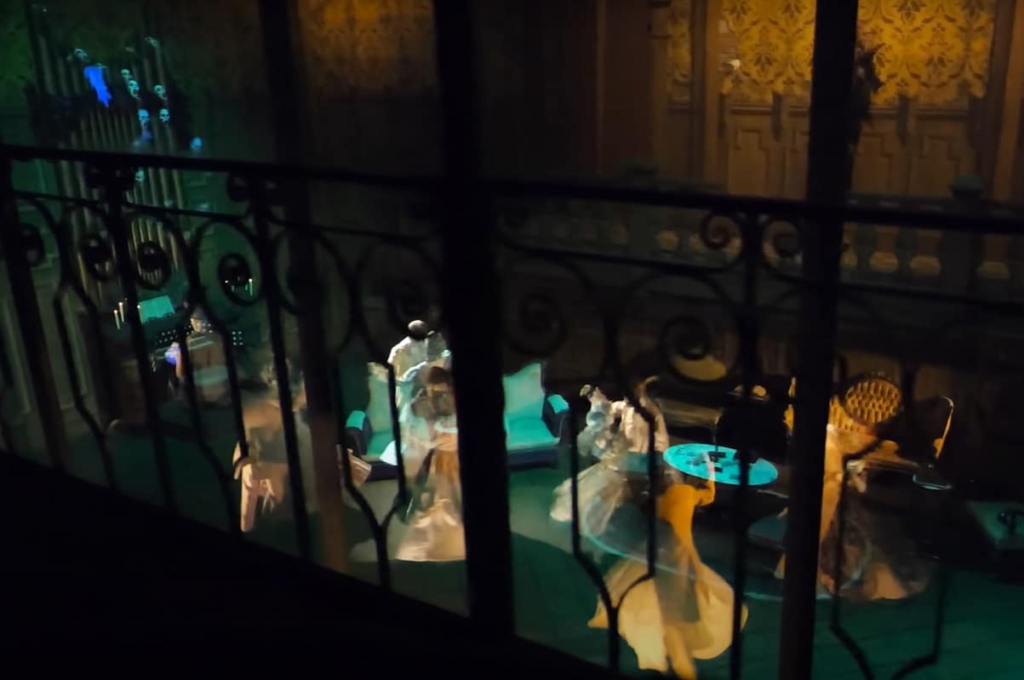
From an elevated balcony, guests look down into the Grand Ballroom, where transparent ghosts have suddenly appeared in force. Spirits sit around a banquet table, dancers waltz across the floor, figures emerge from paintings, and a ghost plays a massive pipe organ while apparitions rise from its pipes.
The illusion looks sophisticated even today, yet its underlying principle predates Disney by more than a century.
The ballroom uses a variation of Pepper’s Ghost, a theatrical technique involving carefully positioned glass and illuminated figures. The ghosts seen in the ballroom exist physically as figures hidden from the guests’ direct view. Their reflections appear in large panes of glass separating the riders from the scene, making the spirits seem transparent and three-dimensional.
Disney uses the effect so effectively that many visitors never realize they are essentially looking at reflections.
After the party, guests enter the Mansion’s attic.
The central character here is Constance Hatchaway, the attraction’s murderous bride. Wedding portraits reveal that Constance married repeatedly, becoming wealthier with each husband while every groom mysteriously lost his head.
Her smiling figure eventually appears among the wedding gifts and possessions, an axe materializing in her hands as she recites distorted versions of traditional marriage vows.
The current bride storyline dates primarily to the attraction’s major 2007 refurbishment, when the attic was extensively redesigned. Earlier versions had featured different bride effects and pop-up ghosts. The new interpretation transformed a previously ambiguous figure into a specific character with a darkly comic history.
The Doom Buggy then turns backward and descends toward the cemetery.
A frightened caretaker and his equally terrified dog stand outside the gates-the only living characters who appear genuinely alarmed by what is happening.
Beyond them, the Mansion’s tone changes completely.
The ghosts are no longer mysterious apparitions glimpsed through hallways and mirrors. They have fully materialized for a “swinging wake.”
A band plays among crypts and tombstones. Spirits rise from graves. Opera singers perform. A mummy joins the festivities. A king and queen balance on a seesaw. A group of singing busts leads the attraction’s signature song, “Grim Grinning Ghosts.”
The song was written by X Atencio, who provided the lyrics, with music by Buddy Baker. Atencio also wrote much of the attraction’s script and helped establish the central idea that these ghosts primarily want to “come out to socialize.”
That single phrase explains much of Haunted Mansion’s unusual tone.
The attraction begins like a traditional haunted house but gradually reveals that its residents are less interested in attacking visitors than recruiting them.
Near the end, three particularly persistent residents attempt to do exactly that.
Phineas, Ezra, and Gus, the Hitchhiking Ghosts, stand beside the track with their thumbs extended. In the following mirror sequence, one appears to join each group of riders.
Magic Kingdom modernized this effect in 2011, replacing the traditional reflected-figure illusion with a digital system capable of making the ghosts interact more specifically with individual ride vehicles. The characters can move around riders, swap heads, or perform other tricks before guests escape.
A tiny spectral figure commonly called Little Leota then encourages departing visitors to hurry back-and to remember to bring their death certificates.
The Mansion’s ride experience has received several important upgrades without losing its fundamental structure.
The 2007 refurbishment was especially significant. In addition to creating the modern Constance Hatchaway attic storyline, Imagineering introduced the surreal Endless Staircase scene, improved lighting and audio throughout the attraction, updated Madame Leota so her crystal ball could appear to float more convincingly, refreshed numerous figures and effects, and restored details that had degraded over decades of operation.
Another major enhancement arrived in 2011, when Disney created an elaborate interactive queue unique to the Magic Kingdom version.
Rather than simply waiting along a conventional path, guests can encounter a series of supernatural memorials.
A musical crypt allows visitors to activate strange instruments. A watery tomb leaks as guests interact with it. Books and inscriptions respond to nearby visitors. A ghostly poet needs assistance completing her unfinished work. Busts and headstones provide additional pieces of Mansion mythology and wordplay.
The interactive section is optional enough that guests primarily interested in reaching the ride can continue through the queue, but it substantially expands the Mansion’s storytelling beyond the building itself.
The same period brought the modernized Hitchhiking Ghost finale.
Another famous resident finally arrived much later.
On November 30, 2023, the Hatbox Ghost made his Magic Kingdom debut.
The character originated at Disneyland when Haunted Mansion opened in 1969. His famous illusion caused his head to disappear from his shoulders and appear inside a nearby hatbox. The original effect did not function reliably under the lighting conditions of the attraction and the figure disappeared shortly after opening.
Disneyland successfully restored the character in 2015 using modern technology.
Magic Kingdom had never had its own Hatbox Ghost until 2023.
Rather than placing him after the attic as at Disneyland, Imagineers positioned Florida’s version near the Endless Hallway, comparatively early in the attraction. He appears through a cobalt-blue doorway with luggage and a cart full of hatboxes, repeatedly demonstrating his signature disappearing-head trick.
His addition was accompanied by lighting and paint enhancements throughout portions of the Mansion.
As of 2026, Hatbox Ghost remains one of the newest major additions to an attraction otherwise rooted in design work from the 1960s and early 1970s.
That balance between old and new is one of Haunted Mansion’s greatest strengths.
Many of its most convincing illusions do not depend on cutting-edge digital technology. The ballroom still relies on a Victorian-era stage principle. Busts that appear to follow guests use reverse molds. The stretching room depends on physical architecture. Lighting, mirrors, scrims, projection, carefully painted sets, forced perspective, and controlled sightlines accomplish much of what visitors see.
Even the attraction’s physical movement is relatively simple.
The continuously moving Doom Buggies rotate automatically to direct attention toward specific scenes. Riders do not steer them. The system allows Imagineering to control pacing and conceal portions of the attraction until the exact moment guests are supposed to see them.
That control makes Haunted Mansion almost cinematic despite being filled largely with physical scenery.
The attraction is also deliberately accessible to a broad audience. Walt Disney World lists it for any height, and the ride moves slowly without significant drops or high-speed movement. Disney describes its frightening content as mild and emphasizes that there is no gore.
Young children can certainly find the darkness, skeleton imagery, hanging figure, loud noises, or ghosts frightening, but the attraction continually undermines its own horror with humor.
The Mansion’s popularity has expanded far beyond Liberty Square.
It inspired feature films in 2003 and 2023, extensive merchandise collections, comics, books, collectibles, Disney Cruise Line experiences, and increasingly elaborate appearances during Mickey’s Not-So-Scary Halloween Party. The nearby Memento Mori shop is presented as the former home of Madame Leota and sells merchandise devoted almost entirely to the attraction.
Yet the original Magic Kingdom experience has never required a detailed official storyline explaining exactly who owned the house or why every ghost is there.
Fans have created elaborate theories around Master Gracey, Constance Hatchaway, Madame Leota, and other residents, but the attraction deliberately leaves many connections ambiguous. Master Gracey, for example, began as a humorous tombstone tribute to Yale Gracey rather than an explicitly identified canonical owner of the mansion.
That ambiguity helps the house feel larger than any one narrative.
The ghosts appear to come from different centuries and social classes. Pirates, aristocrats, musicians, ancient Romans, medieval figures, execution victims, opera singers, brides, duelists, and ordinary eccentrics somehow coexist under one roof.
The Mansion is less the story of one haunted family than a retirement home for the supernatural.
More than 55 years after its development and more than half a century after the Florida attraction opened, Haunted Mansion remains remarkable for another reason: it is almost impossible to assign its success to a single element.