
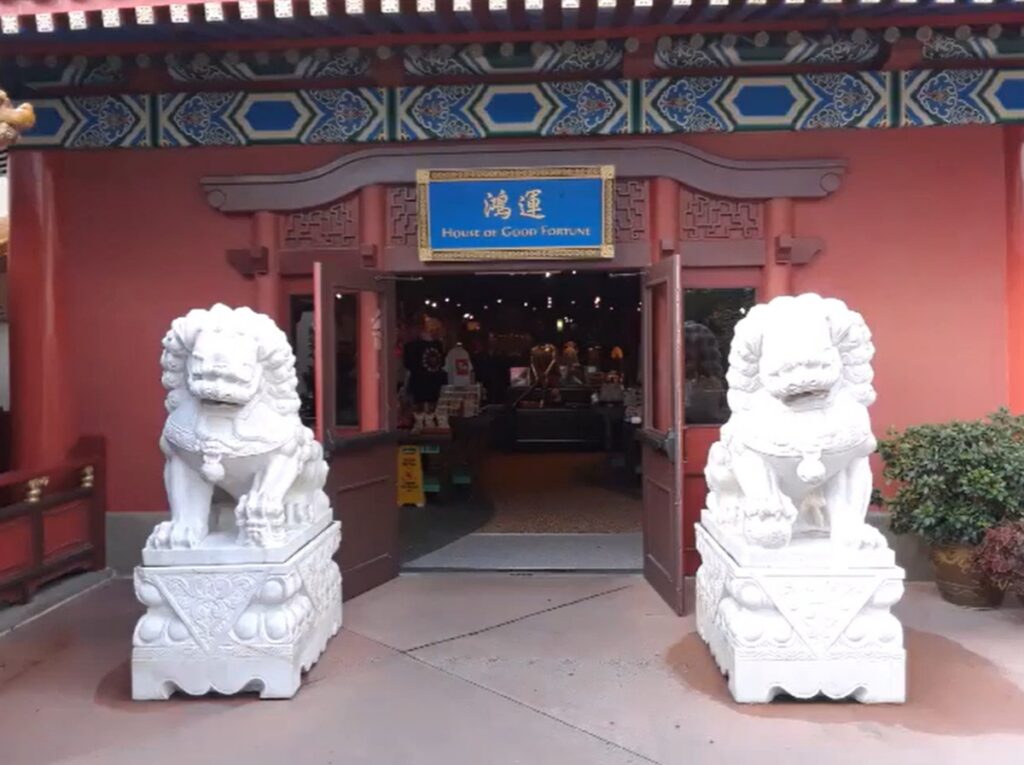
House of Good Fortune is the principal merchandise shop in the China pavilion at EPCOT’s World Showcase, offering one of the park’s more extensive collections of Chinese clothing, jewelry, decorative objects, housewares, toys, accessories, and imported snacks. Although the current name dates only to 2011, shopping has been an important part of this corner of the pavilion almost since EPCOT Center’s earliest months. House of Good Fortune is essentially the modern incarnation of Yong Feng Shangdian, the large shopping gallery that opened on April 3, 1983, roughly six months after EPCOT Center debuted.
The shop occupies the secondary streets and courtyards behind the China pavilion’s imposing ceremonial gateway and Temple of Heaven recreation. This is an important distinction because the pavilion was designed to become more intimate as guests move farther inside. The broad World Showcase promenade gives way to gateways, gardens, narrower passages, restaurants, shops, and architectural details intended to suggest that visitors have entered a more densely built Chinese neighborhood. House of Good Fortune is woven directly into that environment rather than standing apart from it as a conventional theme-park gift shop.
For nearly 28 years, the store operated as Yong Feng Shangdian, a name associated with prosperity or a bountiful harvest. The shopping gallery sold merchandise imported from China, including decorative pieces, clothing, scented products, artwork, and household items. Unlike shops primarily stocked with Walt Disney World-branded souvenirs, Yong Feng Shangdian followed one of World Showcase’s original retail principles: give guests access to products associated with the represented country that they might not commonly encounter at home.
That philosophy remained intact when Disney undertook a significant renovation of the location in early 2011. Yong Feng Shangdian closed for remodeling, and on April 4, 2011, the space reopened as House of Good Fortune. Disney did more than change the sign. The interior was reorganized, the merchandise assortment was broadened, and the shop was redesigned around a series of thematic “courtyards” intended to represent different aspects of traditional and contemporary China.
Disney described these sections as the Festive Courtyard, Natural Courtyard, and Relaxing Courtyard. Rather than filling one enormous room with rows of merchandise fixtures, the layout used changes in décor, lighting, colors, and product groupings to encourage guests to wander through a succession of smaller environments. The renovation also relocated the China pavilion’s Kidcot activity area into the store, further integrating House of Good Fortune into the everyday guest experience of the pavilion.

The result is one of World Showcase’s more substantial retail spaces. Dark wood cabinetry, carved decorative elements, richly colored walls, traditional patterns, hanging fixtures, and architectural details help keep the environment connected to the pavilion outside. Display tables are interspersed with permanent decorative elements rather than simply arranged in warehouse-like rows, which gives portions of the store the feel of a gallery or marketplace.
Two traditional Chinese guardian lions positioned near one of the entrances are among the shop’s most distinctive exterior features. Although the pair initially appears symmetrical, the sculptures contain different details. One lion rests a paw on an ornamental ball, while the other is depicted with a cub. Paired guardian lions have long been used outside important Chinese buildings, temples, residences, and businesses, making them more than decorative props added specifically for EPCOT. Their placement helps reinforce the transition from the pavilion’s public pathways into its interior commercial space.
House of Good Fortune’s merchandise has changed substantially over the years, but its distinguishing characteristic remains variety. Disney’s current EPCOT shopping material identifies the store particularly with traditional Chinese clothing, jewelry, and housewares. Over time, merchandise has included embroidered dresses and robes, jackets, shirts, handbags, fans, tea sets, chopsticks, porcelain, decorative figurines, artwork, jewelry, incense, home décor, toys, puppets, and panda-themed items.
Food and packaged snacks have become another popular part of the experience. The store has periodically stocked candies, cookies, teas, unusual potato-chip flavors, and other packaged foods imported from Asian markets. Those products can be particularly appealing because they make House of Good Fortune feel different from the increasingly standardized merchandise assortment found in some other Walt Disney World stores. Even guests who have no intention of purchasing an elaborate decorative piece can spend considerable time browsing foods and inexpensive souvenirs they are unlikely to encounter elsewhere in EPCOT.
That sense of discovery is central to why the shop has historically stood out. World Showcase was originally conceived not merely as a collection of architectural facades but as a place where food, entertainment, films, exhibitions, merchandise, and international Cast Members could collectively expose visitors to different cultures. Stores such as House of Good Fortune serve an important role in that formula. A tea set, piece of clothing, carving, or imported snack provides a tangible connection to the pavilion’s subject in a way that a generic EPCOT T-shirt would not.
The scale of House of Good Fortune also distinguishes it from Good Fortune Gifts, the smaller merchandise location near the front of the China pavilion. Good Fortune Gifts opened in spring 2010, about a year before the larger store received its current identity, and traditionally emphasizes smaller souvenirs such as parasols, puppets, toys, hats, and accessories. House of Good Fortune is the pavilion’s more expansive indoor marketplace, with a significantly wider product range and more elaborate presentation.
Longtime EPCOT visitors can still find traces of the earlier Yong Feng Shangdian identity around the complex. Architectural signage associated with the old shop survived the 2011 transformation, making the area another example of EPCOT layering new names and functions over existing details rather than completely erasing what came before. For guests interested in park history, that connection helps place the relatively modern House of Good Fortune within a retail lineage stretching back to 1983.
The shop is also closely connected with the larger architectural storytelling of the China pavilion. Whereas the pavilion’s monumental centerpiece—the recreation inspired by Beijing’s Temple of Heaven—communicates imperial grandeur, the shopping and dining streets create a more everyday atmosphere. Moving from the formal gateway and gardens into narrow retail passages gives the pavilion a change of scale that would be lost if every building faced directly onto World Showcase Lagoon.

This is why House of Good Fortune can be easy to underestimate. From the promenade, the China pavilion is dominated by the Temple of Heaven, its gardens, Reflections of China, and the ceremonial architecture at the entrance. Guests who venture farther into the side streets find a much larger retail environment than the exterior initially suggests. In that sense, browsing the store is part of exploring the pavilion rather than simply an activity reserved for guests looking to buy something.
House of Good Fortune also represents a category of EPCOT shopping that has become increasingly valuable to longtime park fans. As merchandise has become more centralized across Walt Disney World, World Showcase locations that retain distinctive country-specific inventories help preserve one of the park’s original pleasures: discovering something genuinely different in each pavilion. The exact products naturally rotate, and not everything is handcrafted or exclusive to China, but the store remains deliberately centered on Chinese and China-inspired goods rather than functioning as another general Disney merchandise outlet.
More than four decades after Yong Feng Shangdian first opened, the underlying purpose of the location is therefore remarkably consistent. The name, interior arrangement, and merchandise have evolved, but the space continues to invite guests to explore a broad assortment of goods tied to the culture represented around them.
Today, House of Good Fortune remains one of EPCOT’s largest and most distinctive World Showcase shops, particularly worthwhile for visitors who enjoy browsing international merchandise rather than standard park souvenirs. Its combination of traditional architectural details, imported and culturally themed products, an unusually deep retail history, and a location embedded within the China pavilion’s quieter interior passages makes it more than simply the shop guests encounter after exploring the pavilion. It is a surviving piece of the original World Showcase idea: that shopping itself could become another way to experience the culture, atmosphere, and personality of a country.