

Keystone Clothiers is a long-running merchandise location on Hollywood Boulevard at Disney’s Hollywood Studios, occupying the prominent corner where the park’s idealized golden-age Hollywood begins to transition toward Echo Lake. An opening-day shop dating to May 1, 1989, Keystone Clothiers originally specialized in adult Disney fashions, accessories, and jewelry. More than three decades later, the store remains in essentially the same location, although both its interior and merchandise have changed dramatically. Today, Disney categorizes Keystone primarily as an apparel and accessories shop, with merchandise inspired by properties including Star Wars, Marvel, Disney’s Hollywood Studios, and other rotating Disney collections.
The “Keystone” name is particularly appropriate for the store’s location. It references Mack Sennett’s Keystone Studios, one of the most important early film studios in Southern California. Founded in 1912 in the Edendale area near Los Angeles’ Echo Park, Keystone became famous for silent-film slapstick, especially the chaotic Keystone Cops, and helped launch or advance the careers of performers including Charlie Chaplin. Disney positioned Keystone Clothiers at the transition into its own Echo Lake area as a subtle acknowledgment of that early chapter in Los Angeles filmmaking.
This kind of historical layering was central to the original Disney-MGM Studios. Hollywood Boulevard was never intended to reproduce one actual street block-for-block. Instead, Imagineers assembled recognizable pieces of historic Los Angeles architecture into a romanticized movie version of Hollywood. Keystone Clothiers is one of the best examples because what appears to be a single store actually hides behind a collection of dramatically different façades inspired by several real Southern California buildings.
The most recognizable section is the narrow Streamline Moderne tower facing the intersection near Hollywood & Vine. Its design was inspired by the long-demolished Wilshire Bowl, a restaurant and nightclub that opened on Wilshire Boulevard in 1933. Despite the name, the Wilshire Bowl was not a bowling alley. It became a fashionable dining and entertainment venue and was later transformed into Slapsy Maxie’s nightclub before eventually becoming a Van de Kamp’s coffee shop. Disney adapted the building’s distinctive vertical tower into the turquoise-colored centerpiece of Keystone Clothiers.
Other sections of the sprawling storefront draw from additional Los Angeles landmarks. The façade historically identified as The Fashion Spot was inspired by the Max Factor Building in Hollywood, the famous cosmetics headquarters redesigned in the 1930s by architect S. Charles Lee. Max Factor’s association with movie makeup made the reference especially suitable for a theme park originally built around the filmmaking industry.
Another section, labeled Tailors to the Stars, takes inspiration from an Art Deco Los Angeles Department of Water and Power building in Lincoln Heights. The Disney version incorporates bold vertical forms and decorative glass-style lettering that evoke the municipal building’s distinctive period architecture while adapting it to the fictional fashion district created along Hollywood Boulevard.
At the opposite end of the complex, the Hollywood Fashions façade incorporates elements inspired by the former Owl Drug Company building at Hollywood Boulevard and Cahuenga Boulevard. Built in the early 1930s, the actual structure was an example of the Streamline Moderne movement that spread throughout Southern California during the period Disney’s version of Hollywood celebrates.
Perhaps the most unexpected architectural reference appears around a side entrance facing the Echo Lake area. Its elaborate Mesoamerican Revival decoration was inspired not simply by the exterior of Los Angeles’ 1927 Mayan Theatre, but particularly by the theater’s ornate interior lobby. Carved-looking geometric forms and pre-Columbian motifs make the entrance dramatically different from the streamlined façades only a short distance away. The entrance was later closed and converted into an ATM location before Disney reopened it as part of the store during the 2019 renovation.
Together, these façades make Keystone Clothiers much more architecturally complicated than its function as a merchandise shop would suggest. Walking around the building can give the impression of passing several different Hollywood businesses erected at different moments in the city’s development. Inside, however, those storefronts belong to one interconnected retail operation.
When Disney-MGM Studios opened, Keystone Clothiers was positioned as a relatively upscale fashion boutique. Adult Disney clothing, watches, jewelry, accessories, handbags, and other fashion-oriented merchandise differentiated it from more general souvenir locations such as Mickey’s of Hollywood. Over the years, the selection expanded to include brands and collections such as Dooney & Bourke handbags and Alex and Ani jewelry.
The old interior also contained significantly more overt Disney character theming than the current shop. Among its most memorable decorations was Sorcerer Mickey, referencing Mickey’s role in Fantasia, accompanied by the enchanted broomsticks associated with “The Sorcerer’s Apprentice.” Those theatrical elements helped connect the shop’s fashion focus with the park’s broader celebration of movies and Disney animation.
By the late 2010s, however, Disney was preparing Hollywood Studios for an enormous influx of guests associated with the opening of Star Wars: Galaxy’s Edge. At the same time, the company undertook major renovations of several prominent retail locations around Hollywood Boulevard and Sunset Boulevard.
Keystone Clothiers closed on March 1, 2019, for an extensive refurbishment. When it reopened on August 29, 2019-the same day Star Wars: Galaxy’s Edge officially opened at Walt Disney World-the difference was dramatic.
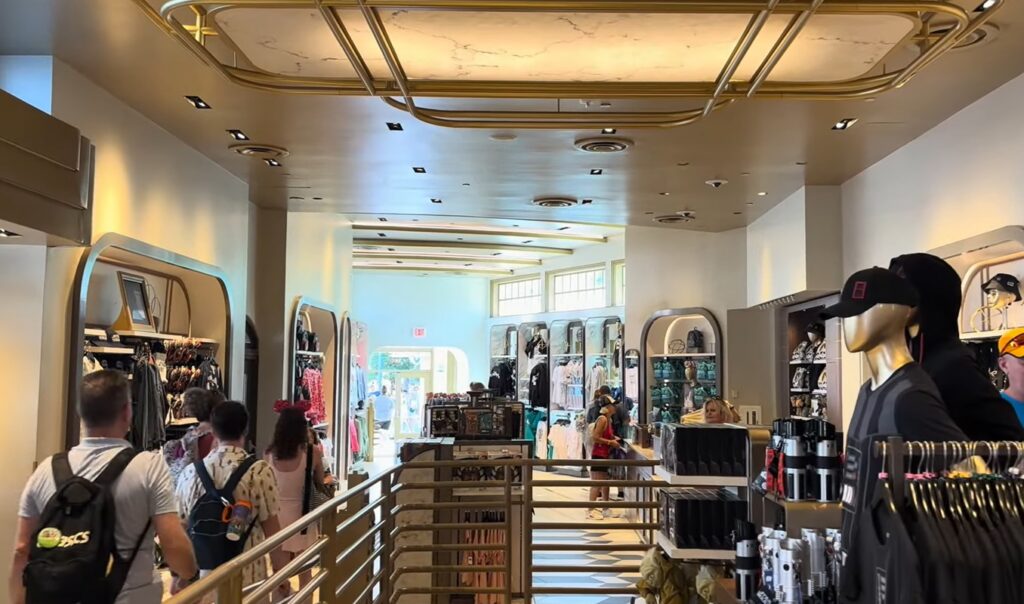
The darker, relatively intimate fashion-shop interior had been replaced with a much brighter and more open retail environment. New tile flooring, modern merchandise fixtures, improved lighting, gold-toned details, new registers, and redesigned circulation substantially increased the shop’s capacity. A previously closed entrance was restored, while an accessibility ramp improved movement through the multilevel space.
Although the building retained an Art Deco influence, the new design was deliberately less tied to the old upscale-clothing concept. Fixtures and signage were designed with enough flexibility that different merchandise franchises could occupy the space without requiring another complete reconstruction.
At reopening, that franchise was unmistakably Star Wars.
Keystone Clothiers became one of Hollywood Studios’ most important Star Wars merchandise locations outside Galaxy’s Edge. Guests could find Black Spire Outpost apparel, Jedi robes and tunics, Resistance and First Order merchandise, lightsabers, toys, pins, mugs, hats, Droid Depot items, and other products associated with Batuu. This served an important operational purpose during Galaxy’s Edge’s debut period by allowing guests to purchase many Star Wars items without navigating the crowded land itself.
Over subsequent years, however, Keystone’s merchandise selection became more fluid. Marvel products joined the assortment, and the store was periodically used for major releases and limited-edition collections. By early 2025, much of the permanent Star Wars assortment had temporarily been reduced as Disney introduced more general fashion merchandise, Loungefly bags, activewear, and Disney-style apparel. Star Wars continued returning prominently for special releases, including merchandise celebrating major film anniversaries around May the 4th.
That flexibility remains visible today. Disney’s own current description advertises souvenirs inspired by “Star Wars, Marvel and more,” but the store is no longer simply a static Star Wars gift shop. Hollywood Studios-specific apparel, character-inspired fashion, accessories, jewelry, seasonal merchandise, and special collections can appear alongside franchise products. In September 2026, for example, Keystone became a location for newly released Little Words Project Disney jewelry, while Disney’s current shopping directory broadly categorizes the store under apparel and accessories.

The building itself has also required preservation work. In September 2022, a portion of one of Keystone Clothiers’ decorative side façades was damaged when part of the doorway surround and an associated vintage-style light fixture collapsed. The affected entrance remained behind temporary treatment for an extended period. Disney eventually undertook more substantial reconstruction beginning in early 2025, rebuilding the window and doorway surrounds and restoring the green marble-style architectural treatment. That work was completed later that spring, preserving a façade whose decorative importance extends far beyond the retail space inside.
Keystone Clothiers is therefore particularly interesting when viewed as part of Hollywood Studios history. The merchandise reflects what the park has become-Star Wars, Marvel, contemporary Disney fashion, limited releases, and intellectual-property-driven collections-but the exterior remains rooted in what Disney-MGM Studios was originally designed to celebrate.
The store’s walls reference early Hollywood restaurants, nightclubs, cosmetics companies, municipal buildings, drugstores, and theaters. Its name points toward Mack Sennett and the silent-film era. Its location marks the transition toward an Echo Lake environment whose name itself recalls one of Los Angeles’ early filmmaking neighborhoods. Even after the park’s working-studio concept disappeared, those layers of architectural storytelling remained.
For many guests, Keystone Clothiers is simply a convenient stop for a shirt, bag, piece of jewelry, or Star Wars souvenir. Looking closely at the building reveals something much richer. Few retail stores at Walt Disney World incorporate references to so many separate pieces of genuine Los Angeles architectural and film history within a single footprint.
More than 35 years after opening, Keystone Clothiers remains both an active merchandise location and one of Disney’s Hollywood Studios’ strongest surviving examples of original Disney-MGM Studios placemaking. The inventory may continually reinvent itself to match the park around it, but the collection of streamlined towers, elaborate entrances, Hollywood signage, and architectural echoes of Los Angeles continues telling essentially the same story it did in 1989: before Hollywood became a legend, it was a real city filled with studios, shops, theaters, restaurants, and dreamers trying to make it in the movies.