
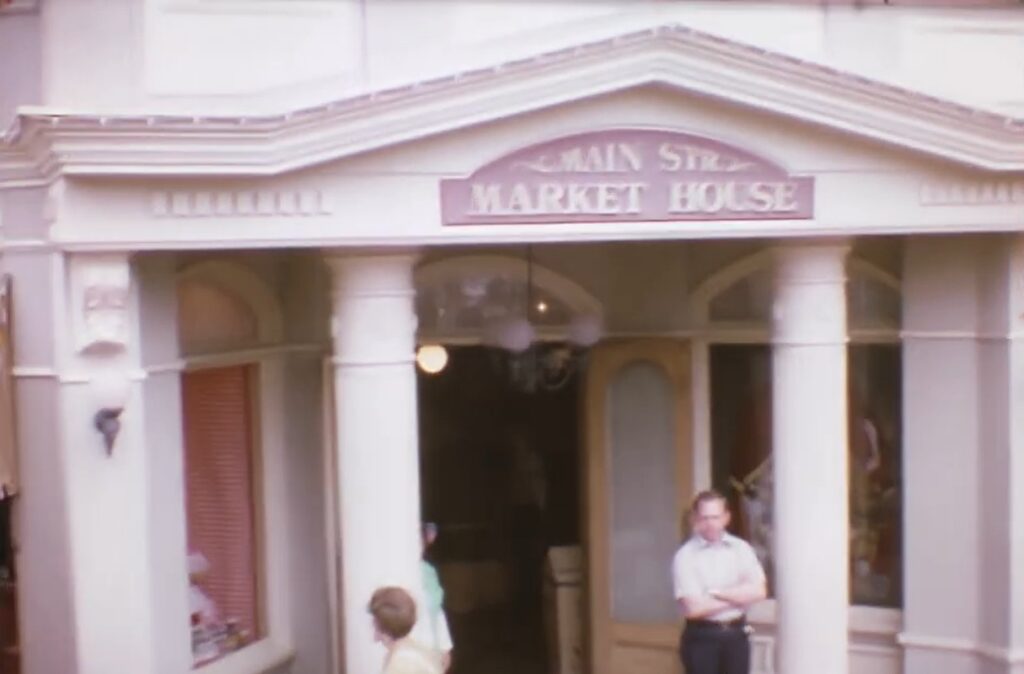
Market House brought the pleasures of an old-fashioned general store to Magic Kingdom’s Main Street, U.S.A. Opening with the park on October 1, 1971, it offered sweets, preserves, and other packaged foods in surroundings designed to suggest an earlier American shopping experience. Located at Main Street and East Center Street, the shop gave guests another reason to explore the neighborhood before continuing toward Cinderella Castle.
Its general-store identity was particularly well suited to Main Street’s turn-of-the-century setting. A community needed somewhere to purchase everyday provisions, and Market House supplied that familiar business within the park’s fictional town. Its assortment also distinguished it from the larger souvenir stores nearby. Here, a vacation purchase might be a jar of jelly or a bag of old-fashioned candy—something to enjoy during the visit or bring back to the kitchen at home.
The early interior reinforced that identity with a potbellied stove and wooden barrels filled with treats. The selection included peppermint sticks, licorice, saltwater taffy, rock candy, cookies, and savory snacks. A candy case allowed customers to choose individual pieces from an assortment of sweets. These displays encouraged the kind of browsing that suited the store: looking closely, comparing flavors, and deciding whether one more small purchase could fit into the day.
Food-company partnerships helped shape the original experience. Smucker’s supplied jams, jellies, and preserves, while Savannah Sugar’s Dixie Crystals brand contributed to the candy offering. One especially distinctive early display was a model of Cinderella Castle constructed from sugar cubes. Antique sugar servers added another connection between the merchandise and the historical setting. Market House made ordinary pantry goods part of the show, presenting familiar products within a setting that invited curiosity.
The shop’s best-known entertainment required no purchase at all. Old-fashioned wall telephones allowed guests to listen to recorded conversations presented as exchanges on a shared telephone line. Picking up a receiver revealed that this apparently decorative object had a function. The discovery rewarded visitors who paused to investigate the room instead of treating it simply as somewhere to buy a snack.
The conversations drew their humor from small-town life. One featured a mother and her daughter Annie, who was shopping at Mr. Dinglinger’s General Store. Their exchange touched on grocery prices and questionable household advice. Another recording involved a police sergeant, a feed merchant, and interruptions from other townspeople. Together, these voices suggested a larger community beyond the shop’s walls, populated by residents with errands, worries, and an enthusiasm for listening to someone else’s business.
That combination gave Market House an appeal beyond its food selection. The store sold real products while letting guests participate in a little scene from Main Street life. A telephone receiver became an invitation to linger, and a simple shopping stop could produce a discovery that visitors remembered long after the sweets were gone.
The business continued to evolve over its decades of operation. A 1993 park guide described its offering as hard candy and specialties. In 2007, Market House closed, and its space was remodeled for Crystal Arts, allowing the Arribas Brothers glass shop to relocate and expand. One of the party-line telephones was subsequently preserved in The Chapeau, carrying a piece of the former store’s entertainment into another Main Street business.
Market House’s character came from the way its details worked together. The provisions established its purpose, the furnishings supported its setting, and the recorded voices supplied a sense of neighborhood life. For guests who took time to look around—and pick up the telephone—it offered a particularly personal encounter with Main Street’s imagined past.