
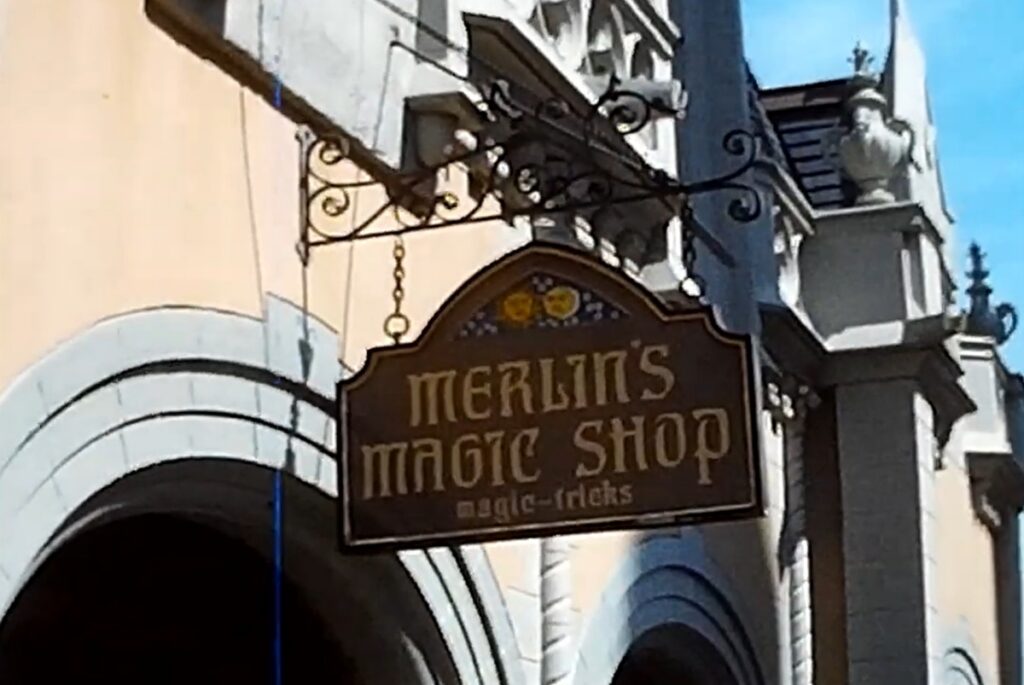
Merlin’s Magic Shop was a specialty retail store in Fantasyland at Magic Kingdom that operated from March 1972 until May 1986. Located immediately behind Cinderella Castle—on the right as guests passed through the castle into Fantasyland—the shop sold magic tricks, puzzles, books, novelty items, monster masks, games, and other magician-oriented merchandise while Cast Members demonstrated selected tricks for guests.
Today, the former Merlin’s space is incorporated into Sir Mickey’s.
Merlin’s Magic Shop was not an opening-day Magic Kingdom store.
Walt Disney World debuted on October 1, 1971, but Disney’s official historical records date the Fantasyland shop to March 1972. It was therefore part of the rapid expansion and refinement that took place during the resort’s first year, when additional stores, restaurants, and guest facilities were added to the young park.
By the time Disney published its 1972 Walt Disney World information guide, Merlin’s Magic Shop was firmly established.
That guide described the merchandise succinctly:
“Magic tricks, puzzles, demonstrations.”
Those three words capture what made Merlin’s different from most Fantasyland stores.
It was not simply a souvenir shop carrying Mickey Mouse shirts and plush characters.
It sold actual magic tricks.
And the demonstrations were an important part of the experience.
Cast Members could show guests how selected tricks worked—or at least demonstrate the effect without necessarily revealing the secret—turning the store into a miniature entertainment venue as well as a place to shop.
A guest might walk inside simply to browse and find someone behind the counter making an object disappear, performing a card trick, or showing off another piece of merchandise.
If the effect was convincing enough, the trick could then be purchased and taken home.
That sales model had a long history at Disney.
Magic shops were already part of Disneyland before Walt Disney World was built.
Disneyland’s own Merlin’s Magic Shop opened with the California park on July 17, 1955 and operated in Fantasyland until 1983.
It became particularly famous because a young Steve Martin worked there during the early years of his entertainment career, demonstrating magic tricks, juggling, making balloon animals, and learning how to perform for an audience.
That was the Disneyland store.
Steve Martin did not work at the Walt Disney World Merlin’s Magic Shop.
The two locations are sometimes confused because they shared the same name and basic concept.
Magic Kingdom actually had two magic shops operating simultaneously for much of the 1970s and 1980s.
Merlin’s Magic Shop was in Fantasyland.
The House of Magic was on Main Street, U.S.A.
The House of Magic opened with Magic Kingdom on October 1, 1971 and lasted until March 19, 1995.
Having two stores selling similar merchandise might seem excessive today, but their settings gave them different personalities.
The Main Street shop presented magic as something that might have been found in an old-fashioned turn-of-the-century novelty store.
Merlin’s placed the same general type of merchandise inside Fantasyland, where wizards, castles, fairy tales, and enchantment were already part of the surrounding environment.
Its name naturally evoked Merlin, the legendary wizard who had been introduced to a generation of Disney fans through the studio’s 1963 animated film The Sword in the Stone.
That made a magic store named for Merlin particularly appropriate only a few steps from Cinderella Castle.
The building itself also fit the concept exceptionally well.
This section of the original Fantasyland used stone-textured walls, timber details, small towers, steeply pitched roofs, and other exaggerated medieval architecture to create the impression of a European fairy-tale village.
Merlin’s did not need a modern storefront announcing that magic supplies were available inside.
The shop already looked as though a wizard might reasonably have occupied it.
Its merchandise strengthened that impression.
In addition to conventional packaged magic tricks and puzzles, historical accounts remember the store carrying monster masks, books, games, ventriloquist-related items, novelty products, and practical jokes.
Some of the masks were surprisingly elaborate.
In a response preserved by the Walt Disney Archives, a former guest specifically remembered purchasing a Gorn mask from Star Trek as well as a Wolfman mask and matching hands from Merlin’s.
That recollection provides an important glimpse into how varied early Walt Disney World merchandise could be.
A shop inside Magic Kingdom did not necessarily sell only Disney-branded products.
Specialty retailers could carry merchandise that matched the theme of the store even if it came from outside Disney’s own character library.
If something was strange, magical, monstrous, or theatrical enough to belong in a wizard’s shop, Merlin’s could potentially sell it.
The shop also existed during a period when Walt Disney World retail was much more specialized than it would later become.
Adventureland had stores devoted to imported merchandise from Africa, Asia, Polynesia, and the Middle East.
Liberty Square offered antiques, perfumes, silverwork, and patriotic souvenirs.
Main Street had separate locations for books, clocks, magic tricks, tobacco, cameras, and sporting goods.
Fantasyland had dedicated stores for hats, toys, artwork, character merchandise, and magic.
Merlin’s Magic Shop was part of that philosophy.
The idea was not that every store should carry the same assortment of Disney souvenirs.
The idea was that walking into a different shop should provide a different experience.
Merlin’s sat beside another longstanding Fantasyland retailer, The AristoCats.
The two stores occupied neighboring portions of the building that ultimately became Sir Mickey’s.
The AristoCats had opened in 1971 and carried more traditional Disney character merchandise, including toys, apparel, figurines, household items, bags, and other souvenirs.
The combination gave guests two very different shopping experiences under essentially the same storybook roof.
One doorway led toward Disney character merchandise.
The other led toward magic tricks and monster masks.
Merlin’s remained remarkably stable for approximately 14 years.
Unlike an attraction that underwent major show revisions or a restaurant whose menu changed with new sponsors, the fundamental concept required little updating.
Magic tricks remained magic tricks.
Children still enjoyed puzzles and practical jokes.
And the shop’s location inside Fantasyland never stopped making thematic sense.
Its closure in May 1986 therefore appears to have been driven less by the concept becoming inappropriate and more by Disney’s changing retail priorities.
The replacement could hardly have been more different.
Later in 1986, the former Merlin’s space became Mickey’s Christmas Carol.
The new store took its name from Disney’s 1983 animated adaptation of Charles Dickens’ A Christmas Carol and specialized in year-round holiday merchandise.
Where Merlin’s had sold tricks, masks, puzzles, and books, Mickey’s Christmas Carol sold Christmas ornaments, holiday accessories, decorations, and wax creations.
The physical shop survived.
The wizard disappeared.
Mickey’s Christmas Carol remained there for approximately another decade.
In early 1996, Disney closed both Mickey’s Christmas Carol and the neighboring AristoCats store and combined their spaces into a single larger retail location.
That new shop became Sir Mickey’s.
Rather than simply creating a generic souvenir store, Imagineers developed an unusually detailed environment inspired primarily by the 1938 Mickey Mouse short The Brave Little Tailor, with additional visual references to Mickey and the Beanstalk from the 1947 film Fun and Fancy Free.
A giant beanstalk twists through the building.
Mickey appears in his medieval tailor role.
Willie the Giant peers through the roof.
Scissors, thread, armor, fabrics, and other props reinforce the story.
Sir Mickey’s continues operating in 2026.
Disney currently describes it as a storybook shop inspired by The Brave Little Tailor and sells costumes, apparel, and accessories there.
That means guests walking through Sir Mickey’s today are still occupying the same general retail footprint used by Merlin’s Magic Shop more than half a century ago.
The merchandise is completely different, but the building’s Fantasyland role has remained remarkably consistent.
There is even an appropriate circularity to the history.
Merlin’s Magic Shop was built around the idea of medieval fantasy and magic.
Mickey’s Christmas Carol temporarily replaced that identity with Christmas.
Sir Mickey’s then returned the building to an elaborate medieval-fantasy environment, albeit through Mickey Mouse rather than Merlin.
Merlin himself would later become a visible Fantasyland character through an entirely separate experience.
Beginning in the 1990s, Magic Kingdom presented a Sword in the Stone ceremony near Cinderella’s Golden Carrousel in which Merlin invited children to attempt to pull the sword from the famous stone.
That entertainment should not be confused with the earlier store, but it reinforced how naturally the character fit the land.
What has not returned is the dedicated magic shop.
The House of Magic on Main Street closed in 1995, nine years after Merlin’s disappeared.
With that closure, Magic Kingdom lost the last of the two specialty magic stores that had once operated simultaneously.
For guests accustomed to modern Walt Disney World retail, the idea of two separate stores devoted to magic tricks inside one theme park may seem remarkable.
For early Magic Kingdom, it was simply part of the experience.
Stores were not merely places to buy souvenirs after visiting the attractions.
They could be experiences in themselves.
Merlin’s Magic Shop embodied that philosophy particularly well.
A child could enter a medieval-looking shop behind Cinderella Castle, watch a Cast Member perform an impossible trick, inspect a wall filled with mysterious masks and puzzles, and leave with the supplies needed to attempt a little magic at home.
No ride vehicle was required.
No elaborate show building was necessary.
For fourteen years, Fantasyland had its own wizard’s shop—and the magic inside was actually for sale.