
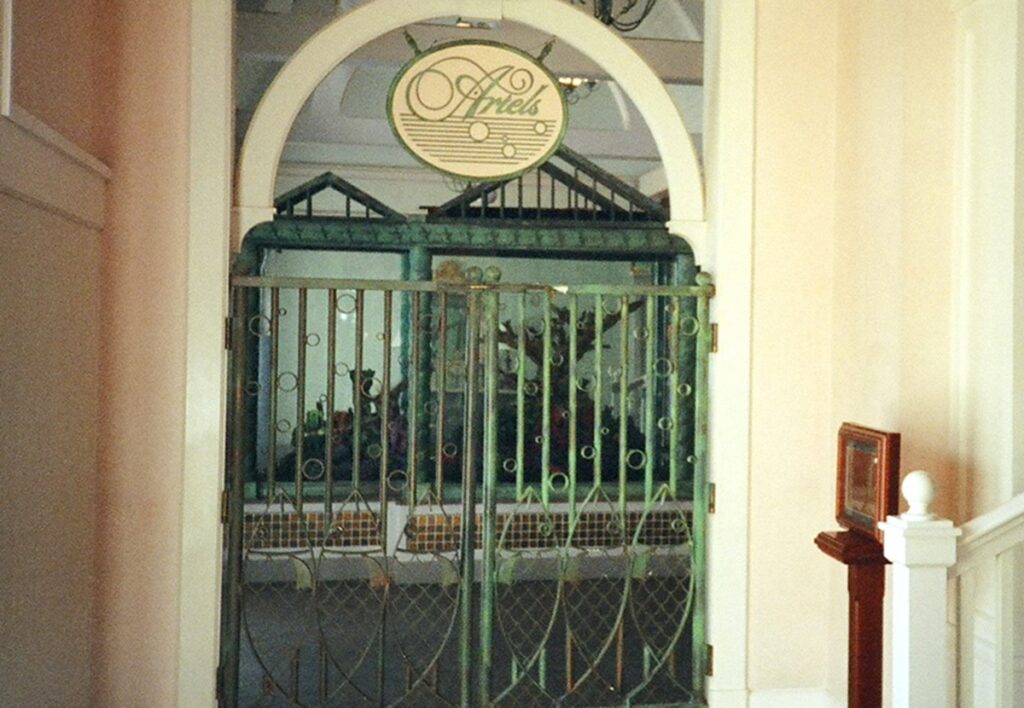
Ariel’s was an upscale seafood restaurant located at Disney’s Beach Club Resort at Walt Disney World. Opening on November 19, 1990, the restaurant specialized in lobster, fresh seafood, and other elaborate entrées served in an elegant dining room inspired by the ocean and Disney’s The Little Mermaid. Its distinctive interior featured aquariums, pastel colors, nautical decorations, and elaborate lighting fixtures incorporating fish and other aquatic imagery. Ariel’s served as the Beach Club’s signature seafood restaurant, complementing Yachtsman Steakhouse at the adjoining Yacht Club Resort. Despite its ambitious concept, Ariel’s closed permanently as a regular restaurant on May 3, 1997. The space subsequently became a private dining and special-events venue, although it temporarily returned to public restaurant use in 2017 and 2019.
Unlike the character dining experiences that later became associated with many Disney resort restaurants, Ariel’s was designed primarily for adults and families seeking a sophisticated meal. Although its name referenced the heroine of Disney’s 1989 animated film The Little Mermaid, the restaurant did not operate as an Ariel character dining experience.
Instead, Disney incorporated the film’s underwater imagery into the restaurant’s surroundings while maintaining a more traditional fine-dining atmosphere.
Opening at Disney’s Beach Club Resort
Disney’s Beach Club Resort opened on November 19, 1990, alongside the adjacent Yacht Club Resort.
The two hotels formed part of a major expansion of Walt Disney World’s accommodations around Crescent Lake, near the International Gateway entrance to EPCOT Center.
The resorts were designed by architect Robert A. M. Stern, whose work drew inspiration from late nineteenth- and early twentieth-century American seaside resorts.
The Beach Club emphasized the relaxed character of a New England coastal hotel, with pastel-colored architecture, white trim, porches, and nautical decorations.
The Yacht Club adopted a somewhat more formal maritime appearance.
Both properties shared recreational facilities, including Stormalong Bay, an elaborate pool complex featuring a sand-bottom pool, water slides, and a shipwreck-inspired structure.
The resorts also introduced several restaurants.
At the Yacht Club, Yachtsman Steakhouse concentrated on steaks and traditional American fine dining.
The Beach Club offered Cape May Café, Beaches & Cream Soda Shop, and Ariel’s.
Ariel’s was intended to provide a more upscale seafood experience than the Beach Club’s other dining options.
The restaurant opened the same day as the hotel, November 19, 1990.
The Little Mermaid connection
The restaurant’s name referenced Ariel, the central character of The Little Mermaid, released in November 1989.
The film had become an enormous success for Disney and helped launch the period commonly known as the Disney Renaissance.
Ariel was therefore a particularly recognizable character when the Beach Club opened one year later.
However, the restaurant’s approach to the character was relatively restrained.
Instead of featuring character appearances, oversized film props, or a children’s entertainment program, Ariel’s incorporated underwater imagery into a sophisticated dining environment.
The name worked on two levels.
It connected the restaurant to a popular Disney film while also supporting the coastal theme of the Beach Club Resort.
The ocean-inspired setting made the restaurant a natural counterpart to the maritime architecture of the surrounding hotel.
Guests unfamiliar with the film could appreciate Ariel’s as a nautical seafood restaurant, while Disney fans would recognize the reference.
This approach distinguished the restaurant from a conventional character meal.
Interior design and atmosphere
Ariel’s was among the more elaborate resort restaurants introduced during the early 1990s.
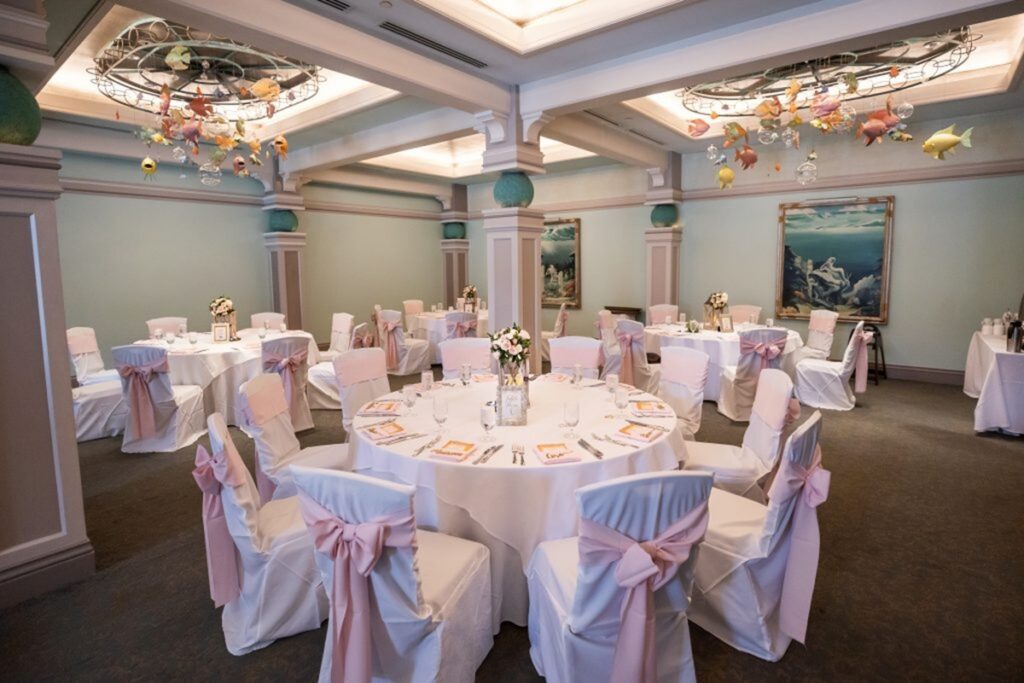
The dining room featured soft pastel colors, decorative columns, and an assortment of aquatic details.
Large aquariums were prominent features of the space.
Former guests recall fish tanks incorporated into the dining room, including a substantial aquarium that occupied a significant portion of a wall.
The decorations also included fish-themed lighting fixtures and ornamental elements suggesting an underwater environment.
Pastel blue, teal, pink, and cream-colored finishes complemented the Beach Club’s seaside architectural identity.
Decorative chandeliers incorporated suspended fish and bubble-like details.
These features created an atmosphere that was whimsical without abandoning the restaurant’s upscale identity.
The room also included nautical objects and decorative pieces associated with boats and maritime life.
Unlike EPCOT’s Coral Reef Restaurant, which offers views into a large aquarium habitat, Ariel’s used smaller aquatic displays and ornamental details to establish its theme.
The restaurant was designed to feel like an elegant seaside dining room rather than an underwater attraction.
Its distinctive surroundings would become important to the building’s later history, particularly after the space was converted for private events.
The original seafood menu
Seafood was the principal focus of Ariel’s.
Contemporary reporting from 1991 documents several unusually elaborate preparations.
One featured entrée was baked Maine lobster stuffed with crabmeat.
The dish was priced at $29.50.
Another selection consisted of lobster sautéed in lemon-garlic butter and served in a pasta nest.
That entrée cost $26.50.
These prices positioned Ariel’s among Walt Disney World’s more expensive restaurants during the early 1990s.
The menu emphasized substantial seafood preparations rather than conventional fried fish or simple sandwiches.
The baked lobster reflected traditional American seafood dining, while the lobster pasta incorporated Italian-inspired ingredients and presentation.
Both dishes were consistent with the restaurant’s positioning as the Beach Club’s signature dining destination.
Although surviving visitor accounts describe additional seafood offerings and elaborate service, a complete original menu has not been reliably documented.
It would therefore be inappropriate to assign a full list of appetizers, entrées, desserts, or beverage prices without further contemporary evidence.
The documented lobster selections nevertheless establish the restaurant’s culinary identity and approximate price level.
An upscale dining experience
Ariel’s was intended to provide a distinctive dining experience within the Beach Club Resort.
While Cape May Café offered a more informal dining option and Beaches & Cream specialized in hamburgers, sandwiches, and ice cream desserts, Ariel’s emphasized more elaborate meals.
The restaurant’s sophisticated atmosphere was particularly appropriate for adults celebrating special occasions.
Former guests recall attentive table service, elegant food presentations, and an environment that felt more formal than the nearby casual restaurants.
One visitor who dined there in approximately 1996 remembered seafood-focused meals, a large aquarium, and butter presented in decorative shapes resembling shells or stars.
Another former guest recalled dining at Ariel’s several times and considered its quality comparable to later signature seafood restaurants in the EPCOT resort area.
These recollections are valuable for understanding the guest experience, although they represent personal memories rather than independently verified operating records.
The restaurant did not feature regular Disney character appearances.
This distinction is important because its name sometimes leads to confusion with character dining experiences based on The Little Mermaid.
Ariel’s was a conventional table-service seafood restaurant with Disney-inspired theming, not a character breakfast or princess dining location.
Competition from Flying Fish
The opening of Disney’s BoardWalk resort area in 1996 introduced additional dining competition near the Yacht and Beach Club.
One of the new restaurants was Flying Fish Café, which specialized in seafood and contemporary American cuisine.
Flying Fish opened at Disney’s BoardWalk in July 1996.
The restaurant developed a reputation for fresh seafood and sophisticated preparations.
Its proximity to Ariel’s created two upscale seafood restaurants within easy walking distance of one another.
Historical accounts suggest that Disney ultimately determined there was insufficient demand to maintain both concepts in the immediate area.
This explanation is plausible given the restaurants’ overlapping menus and clientele, but it should be treated as a reported business rationale rather than a fully documented internal Disney decision.
The company did not publish detailed financial figures establishing why Ariel’s closed.
Nevertheless, the timing is significant.
Flying Fish opened in 1996, and Ariel’s closed the following May.
The Beach Club retained its other dining establishments, while Flying Fish became the principal signature seafood restaurant in the Crescent Lake area.
Closure on May 3, 1997
Ariel’s permanently closed as a regular restaurant on May 3, 1997.
The date is confirmed by Disney’s official historical encyclopedia.
Its original operating period lasted approximately six years and five months.
Unlike some extinct Walt Disney World restaurants, Ariel’s was not immediately demolished or converted into another permanently operating restaurant.
Instead, Disney retained the space.
The former dining room began serving as a location for private events, meetings, banquets, and wedding-related functions.
This was possible because the room already offered an elaborate decorative environment and suitable space for group dining.
The nautical setting remained appropriate for receptions and other celebrations.
For many years, guests walking through the Beach Club could still see the Ariel’s entrance and portions of its original decorations.
Although it was no longer open for regular dining, the space remained recognizable as the former restaurant.
Ariel’s as a private-events venue
After the closure, Ariel’s became available for special functions.
The room was used for wedding receptions, rehearsal dinners, private celebrations, and other catered events.
Disney’s Fairy Tale Weddings eventually incorporated Ariel’s into its collection of event venues.
The official wedding venue listing emphasizes the room’s ocean-themed decorations and proximity to Crescent Lake, Disney’s BoardWalk, and EPCOT.
Photographs show decorative columns, aquatic lighting fixtures, and a spacious interior suitable for group dining.
The preserved environment makes Ariel’s unusual among extinct Walt Disney World restaurants.
Many former dining locations disappear completely when their buildings are remodeled.
Ariel’s retained much of its recognizable identity after regular restaurant operations ended.
Although the original menu and service model disappeared, the setting continued to accommodate special meals and celebrations.
For visitors who remembered dining there during the 1990s, this offered a rare opportunity to return to the former restaurant.
Captain’s Grille temporarily returns in 2017
Ariel’s briefly returned to public restaurant use in 2017.
Disney was undertaking a substantial refurbishment of Captain’s Grille at the adjoining Yacht Club Resort.
Captain’s Grille had originally opened as the Yacht Club Galley in November 1990.
It received its Captain’s Grille name in 2008.
During the 2017 renovation, Disney needed an alternative location where guests could continue enjoying the restaurant’s menu.
The former Ariel’s dining room provided a suitable temporary space.
Captain’s Grille ended operations at its regular location on May 24, 2017, and reopened in Ariel’s on May 26.
The relocation continued for several months.
During this period, the restaurant offered à la carte breakfast selections rather than its usual breakfast buffet.
Lunch and dinner service were also available.
The temporary arrangement allowed Disney to maintain a table-service dining option while work continued at the Yacht Club.
The important distinction is that Ariel’s did not reopen under its original name or restore its seafood menu.
The space temporarily housed Captain’s Grille.
When construction was completed, the Yacht Club restaurant reopened on November 4, 2017, as Ale & Compass Restaurant.
Ariel’s returned to its private-event function.
Beaches & Cream moves into Ariel’s in 2019
The former Ariel’s space was used again in 2019 during the refurbishment of Beaches & Cream Soda Shop.
Beaches & Cream had operated at the Beach Club since 1990.
Its small dining room had become extremely popular, particularly for its elaborate ice cream sundaes and the Kitchen Sink dessert.
Disney announced plans to enlarge the restaurant and improve its capacity.
Beaches & Cream closed for renovations on August 26, 2019.
During the project, Disney introduced a temporary service location inside Ariel’s.
The temporary operation offered a limited version of the regular menu.
Some signature items, including milkshakes and the Kitchen Sink, were unavailable.
The former Ariel’s room provided seating and space for the temporary restaurant.
However, the renovation also permanently altered part of the original Ariel’s layout.
Construction photographs from September 2019 documented a new partition separating part of the former event space from the expanded Beaches & Cream area.
The work incorporated portions of the surrounding arcade and dining spaces into the enlarged soda shop.
This was an important physical change because it reduced the amount of space remaining from the former Ariel’s restaurant.
Beaches & Cream reopened in January 2020 following the extensive renovation.
The expanded restaurant continued operating independently, while the remaining Ariel’s space retained its special-events identity.
Ariel’s today
As of November 2026, Ariel’s is no longer a public restaurant.
The original seafood dining concept has not returned to Walt Disney World.
However, the name and remaining venue continue to exist within Disney’s Beach Club Resort.
Disney’s Fairy Tale Weddings maintains an official listing for Ariel’s as a private-event location.
The venue is promoted for receptions, rehearsal dinners, and farewell brunches.
Its ocean-themed decor remains one of its principal attractions.
The surviving room retains elements of the original aquatic design, including pastel finishes, decorative columns, and fish-inspired chandeliers.
Guests cannot simply make an ordinary dining reservation for Ariel’s as they could between 1990 and 1997.
Use of the space is associated with private arrangements and events.
The nearby Beaches & Cream Soda Shop occupies some space that was incorporated into the 2019 renovation, while the remainder of Ariel’s continues to serve special-event purposes.
Historical significance
Ariel’s represents an interesting period in Walt Disney World’s resort dining history.
Opening on November 19, 1990, it was part of the original dining lineup at Disney’s Beach Club Resort.
Its seafood-focused menu complemented the steakhouse concept at the adjoining Yacht Club.
The restaurant also reflected Disney’s effort to incorporate animated-film storytelling into relatively sophisticated dining environments.
Although named for the heroine of The Little Mermaid, Ariel’s was not a character restaurant.
Instead, its design used aquariums, aquatic decorations, and pastel colors to create an elegant nautical atmosphere.
The menu emphasized elaborate seafood preparations, including baked Maine lobster stuffed with crabmeat and lobster served in a lemon-garlic butter pasta dish.
These specialties positioned Ariel’s as one of the resort’s upscale dining experiences.
Its closure in May 1997 came shortly after the opening of Flying Fish at Disney’s BoardWalk, which introduced another signature seafood restaurant to the Crescent Lake area.
Although the precise business rationale remains undocumented, the nearby competition provides important context.
The building’s subsequent history is equally distinctive.
Instead of disappearing completely, Ariel’s survived as a special-events venue.
Its temporary use for Captain’s Grille in 2017 and Beaches & Cream in 2019 demonstrated that the former dining room remained functional decades after the original restaurant closed.
The 2019 expansion of Beaches & Cream altered part of the space, but much of Ariel’s visual identity survived.
As of November 2026, Ariel’s remains permanently closed as a public restaurant, with its original operating dates firmly established as November 19, 1990, through May 3, 1997.
However, the venue itself remains part of Disney’s Beach Club Resort.
For longtime Walt Disney World visitors, Ariel’s is an unusual example of an extinct restaurant whose name, setting, and portions of its original interior have survived long after regular dining service ended.
Its history connects the opening of Disney’s Yacht and Beach Club Resorts, the rise of upscale dining around Crescent Lake, and the continued adaptation of resort restaurant spaces for new purposes.