Catwalk Bar was a small, elevated cocktail lounge located above the Soundstage Restaurant at Disney-MGM Studios, now Disney’s Hollywood Studios. Opened during the park’s early years, the bar offered alcoholic beverages, appetizers, and light snacks in one of Walt Disney World’s most unusual dining environments. Rather than occupying a conventional restaurant space, Catwalk Bar was situated along the upper-level catwalks of a simulated movie soundstage, allowing guests to look down on the restaurant and its elaborate movie sets below. The lounge closed in the late 1990s following the conversion of Soundstage Restaurant into a live entertainment venue. Nearly two decades later, its former space was redeveloped for a private Club 33 lounge.
Catwalk Bar was located in the original Animation Courtyard area of Disney-MGM Studios, within the same interconnected building complex as Soundstage Restaurant and The Hollywood Brown Derby. Although its physical relationship with both restaurants sometimes creates confusion, Catwalk Bar was a separately identified lounge with its own entrance arrangements and menu.
Its unusual location was fundamental to its appeal.
Disney-MGM Studios opened on May 1, 1989, as Walt Disney World’s third theme park. The park’s original concept combined the atmosphere of Hollywood’s Golden Age with actual film and television production facilities. Guests could explore the process of filmmaking through backstage tours, special-effects demonstrations, animation exhibits, and attractions celebrating the motion picture industry.
The restaurants were designed to complement that concept.
The Hollywood Brown Derby recreated the atmosphere of the famous Los Angeles restaurant associated with Hollywood celebrities. The 50’s Prime Time Café presented a nostalgic American family dining experience, while Hollywood & Vine drew inspiration from the cafeterias that once served actors and studio employees.
Soundstage Restaurant offered a particularly inventive approach to the movie-production theme.
Instead of recreating a familiar restaurant from Hollywood history, Disney designed the facility to resemble an active movie soundstage temporarily converted into a dining area.
The restaurant was surrounded by theatrical scenery, film props, lighting equipment, rigging, and other objects associated with movie production.
Cast Members wore costumes resembling those used by catering personnel working on a film set, reinforcing the idea that guests were attending a meal during a break in production.
The original restaurant included scenery and props from the 1988 Touchstone Pictures comedy Big Business, starring Bette Midler and Lily Tomlin.
Rather than simply displaying these objects as museum pieces, Disney incorporated them into the dining environment.
The arrangement gave guests the impression that they were eating among the sets of an actual Hollywood production.
This was especially appropriate for Disney-MGM Studios, where the distinction between working production facilities and themed entertainment environments was deliberately blurred.
Catwalk Bar extended the concept into the upper reaches of the soundstage.
In a real film studio, elevated catwalks provide access to theatrical lighting, electrical equipment, scenery, and other technical installations suspended above the production floor.
These narrow, elevated structures allow technicians to adjust equipment without interfering with activity below.
At Soundstage Restaurant, Disney transformed part of that overhead environment into a cocktail lounge.
Guests seated in Catwalk Bar could look down into the restaurant, observing the dining area, decorative sets, and equipment from an elevated perspective.
The arrangement created a distinctive experience that was quite different from the conventional lounges found elsewhere at Walt Disney World.
The bar’s surroundings emphasized the backstage theme rather than attempting to conceal it.
Photographs show exposed structural elements, theatrical rigging, lighting equipment, and an industrial-looking environment that resembled a working production space.
The setting was not designed to be elegant in the manner of the Hollywood Brown Derby. Its appeal came from the opportunity to occupy an area normally associated with the technical side of filmmaking.
Guests could relax with a drink while surrounded by the equipment and architecture of a simulated studio production.
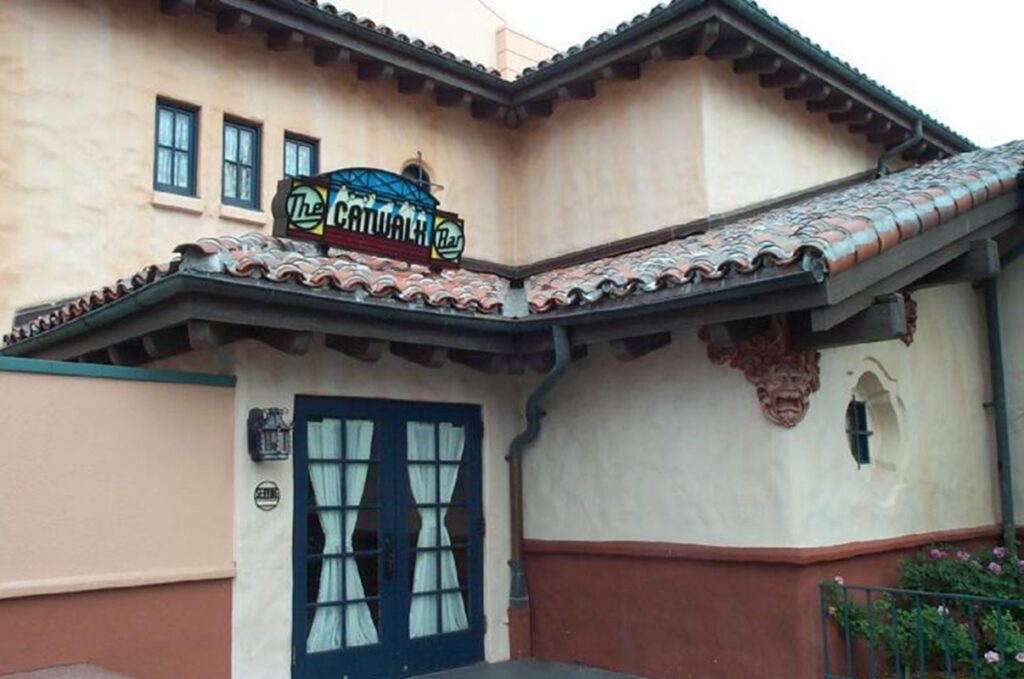
The lounge was accessible through a staircase associated with Soundstage Restaurant.
Historical photographs show a sign identifying the upstairs area as a cocktail lounge, providing a relatively understated indication that guests could venture above the restaurant.
A second entrance was located near The Hollywood Brown Derby.
This entrance incorporated a staircase and elevator connecting the lower level with Catwalk Bar.
The relationship between the two entrances became particularly important during the lounge’s final years.
While Soundstage Restaurant was operating, the lounge could be reached from the restaurant area. Guests could move upstairs and enjoy refreshments while overlooking the activity below.
The entrance near the Brown Derby provided another access route, allowing visitors to reach the upper level without necessarily passing through the restaurant’s main dining space.
This unusual arrangement reflected the interconnected nature of the original building complex.
It also helped make Catwalk Bar somewhat difficult to find.
Unlike lounges with prominent exterior entrances and large signs, Catwalk Bar was tucked away above a themed restaurant, accessible through staircases that could easily be overlooked.
Its relative obscurity became part of its appeal to guests who discovered it.
The precise opening date of Catwalk Bar has not been established in the available documentation.
The lounge is associated with Disney-MGM Studios’ original dining facilities, and contemporary material confirms that it was operating by 1991.
A Disney-MGM Studios dining guide from that year includes a photograph of Catwalk Bar alongside other park restaurants.
A November 1996 official Disney-MGM Studios guide map also identifies it as a separate dining location in Animation Courtyard.
These records establish that Catwalk Bar was operating during the park’s early years, but they do not conclusively confirm that the lounge opened on May 1, 1989.
It is therefore appropriate to identify the lounge as an early Disney-MGM Studios establishment while treating its exact opening date as unverified.
The November 1996 park guide provides particularly useful documentation of the lounge’s purpose.
It identifies Catwalk Bar separately from Soundstage Restaurant and describes it as a place where guests could enjoy drinks and snacks while looking down into the restaurant from the catwalk.
This contemporary description confirms that the elevated view was an intentional part of the guest experience rather than an incidental feature of the building.
The same guide identifies Soundstage Restaurant as a character buffet serving breakfast and lunch.
Catwalk Bar therefore provided a different dining experience within the same general facility.
While families downstairs could enjoy a buffet meal and interact with Disney characters, guests upstairs could purchase drinks and lighter refreshments in a quieter setting.
The bar offered cocktails, appetizers, and snacks.
Historical descriptions also mention light meals and the availability of sporting events on a large television.
This combination made Catwalk Bar suitable for adults looking for a break from the surrounding attractions without committing to a substantial restaurant meal.
The television also distinguished the lounge from the carefully controlled entertainment environments typical of Disney theme park restaurants.
Guests could relax, watch a sporting event, and enjoy a drink while remaining inside a setting connected to the park’s filmmaking theme.
Unfortunately, a complete contemporary beverage and appetizer menu has not been recovered.
The surviving official guide confirms drinks and snacks, while historical accounts establish that cocktails and appetizers were available.
However, individual cocktail names, menu prices, and specific food preparations cannot be reliably reconstructed from the available evidence.
It would also be speculative to assign the lounge a particular corporate sponsor or beverage supplier without additional documentation.
Catwalk Bar’s historical importance lies primarily in its distinctive physical environment and its relationship with Soundstage Restaurant.
The restaurant below evolved considerably during the 1990s.
After opening with scenery associated with Big Business, Soundstage Restaurant incorporated decorative elements connected to other Disney and Touchstone productions.
The restaurant’s evolving film-set theme included references to Beauty and the Beast and Aladdin.
These changes helped the restaurant remain connected to Disney’s contemporary movie releases while preserving the broader idea of dining on a Hollywood soundstage.
Catwalk Bar continued overlooking the restaurant as these changes occurred.
Its elevated position allowed guests to observe the production-themed environment from a perspective unavailable to diners seated below.
That relationship was essential to the lounge’s original concept.
The space was not simply a second-floor bar that happened to be located above a restaurant. Its identity depended on the surrounding soundstage environment.
By the late 1990s, however, Disney-MGM Studios was changing.
The park had gradually moved away from its original emphasis on working film and television production facilities and toward attractions based on popular Disney movies, television programs, and characters.
Soundstage Restaurant became part of that transition.
The restaurant closed permanently on November 14, 1998, ending its nearly ten-year history as one of the park’s original dining establishments.
Disney planned to convert the former restaurant into a live entertainment venue featuring Bear in the Big Blue House, the popular preschool television series that had debuted on Disney Channel in 1997.
The transformation required substantial changes to the dining area.
The restaurant’s tables, food-service facilities, and decorative sets were removed or altered to accommodate a stage, audience space, lighting, and other theatrical equipment.
The new attraction, Bear in the Big Blue House – Live on Stage, opened in June 1999.
For Catwalk Bar, the conversion created an unusual operational problem.
The lounge had originally been designed to overlook a restaurant, where guests could eat, talk, and move around throughout the day.
The new theater required a controlled performance environment.
Guests could no longer casually enter the upper catwalk area during a live show without potentially disrupting the performance.
Historical accounts indicate that Catwalk Bar initially remained open after Soundstage Restaurant closed, but its operating hours were restricted.
During this transitional period, the lounge reportedly opened only after the final daily performance of the Bear in the Big Blue House show.
The original entrance through the former restaurant was no longer available, leaving the entrance associated with The Hollywood Brown Derby as the principal means of reaching the bar.
This significantly reduced the lounge’s accessibility.
Guests who had previously found Catwalk Bar while dining at Soundstage Restaurant could no longer reach it through the same route.
Instead, visitors needed to locate the comparatively obscure entrance near the Brown Derby and visit during the limited periods when the lounge was operating.
The arrangement was difficult to sustain.
Catwalk Bar eventually closed permanently during the late 1990s, shortly after the conversion of Soundstage Restaurant into the Bear in the Big Blue House theater.
The exact final operating date has not been established.
Some historical accounts place the closure in 1998, coinciding with the restaurant’s disappearance, while others indicate that the lounge continued operating for a limited period afterward.
The latter interpretation is supported by recollections describing its restricted post-show operating schedule.
For historical database purposes, the most defensible conclusion is that Catwalk Bar closed around 1998–1999, with a brief period of limited operation possibly continuing after Soundstage Restaurant’s November 1998 closure.
An exact final day should not be assigned without additional contemporary evidence.
The former Soundstage Restaurant continued evolving as an entertainment venue.
Bear in the Big Blue House – Live on Stage eventually gave way to Playhouse Disney – Live on Stage, which incorporated characters and music from several Disney preschool television programs.
The attraction later became Disney Junior – Live on Stage, followed by Disney Junior Dance Party and Disney Junior Play and Dance.
These successive entertainment experiences retained the building’s role as a family-oriented theater.
The theatrical conversion also preserved some elements of the original soundstage architecture.
Rather than concealing the building’s overhead structures completely, the designers incorporated exposed catwalks and theatrical equipment into the new performance environment.
Technical accounts from the Playhouse Disney production describe brightly colored catwalks and lighting arrangements that emphasized the existing structural features.
This created an interesting connection between the original restaurant concept and its theatrical successors.
Soundstage Restaurant had been designed to resemble a movie production environment, and the converted building eventually became an actual performance space.
Although Catwalk Bar no longer operated, parts of the overhead structure associated with its former setting remained visible.
During the 2000s, visitors could still find traces of the lounge’s original entrance near The Hollywood Brown Derby.
The staircase had been blocked off, and the former access route was no longer available to ordinary guests.
Nevertheless, the remaining architectural details became a point of interest for enthusiasts exploring the history of Disney-MGM Studios.
By the early 2010s, the former entrance was one of the most recognizable surviving reminders of Catwalk Bar.
Historical photographs document the staircase and its location within the Brown Derby building complex.
The physical survival of the entrance was significant because many other elements of the original Soundstage Restaurant had disappeared during the theater conversion.
A new chapter began in 2017.
Disney announced plans to introduce Club 33 locations at Walt Disney World’s four theme parks.
Club 33 originated at Disneyland in California, where Walt Disney had envisioned a private hospitality facility for corporate guests and other invited visitors. The original Disneyland Club 33 opened in 1967, several months after Walt’s death.
The Walt Disney World version would introduce exclusive lounges reserved for members and their guests.
During 2017, construction activity appeared around the former Catwalk Bar entrance near The Hollywood Brown Derby.
Walls and barriers surrounded portions of the staircase and elevator area.
The work generated considerable interest because the location’s elevated position and relative privacy made it a plausible site for a Club 33 lounge.
Its proximity to the Brown Derby also provided access to existing restaurant infrastructure.
In March 2018, the connection became much clearer.
A new doorbell and access equipment appeared at the former Catwalk Bar entrance.
The installation included Club 33 branding, confirming the intended use of the area as part of Disney’s exclusive membership program.
Additional photographs documented the refurbished staircase and entrance.
By April 2018, observers reported seeing guests use membership cards to access the facility.
These developments established that the former Catwalk Bar space was being returned to hospitality use, although under a very different operating model.
Rather than reopening as a public cocktail lounge, the renovated upper-level area became associated with Disney’s Hollywood Studios Club 33.
The transformation is especially interesting because the original Catwalk Bar had been a publicly accessible lounge whose primary appeal was its unusual setting.
Club 33 retained the idea of an exclusive, elevated hospitality environment but restricted access to members and invited guests.
The relationship between the two spaces is therefore both physical and historical.
Club 33 occupies the former Catwalk Bar area, but it is not a conventional reopening of the original lounge.
Its membership requirements, interior design, and operating arrangements differ substantially from the original Disney-MGM Studios experience.
Because Disney does not publicly disclose extensive details about its Club 33 lounges, the exact modern interior configuration and the extent to which original Catwalk Bar architectural elements remain are not fully documented.
It would be misleading to suggest that the 1980s or 1990s bar has been preserved intact.
The former public lounge space underwent substantial alterations during its conversion into a private facility.
Meanwhile, the theater below continued serving Disney Junior audiences.
In 2026, Disney introduced another updated entertainment experience in the former Soundstage Restaurant building.
Disney Jr. Mickey Mouse Clubhouse Live! debuted on May 26, 2026, as part of the transformation of Animation Courtyard into The Walt Disney Studios area.
Inspired by Mickey Mouse Clubhouse and Mickey Mouse Clubhouse+, the show features Mickey Mouse, Minnie Mouse, Goofy, Daisy Duck, and Pluto in an interactive musical adventure.
The new attraction continues the building’s long history as a family-oriented performance venue.
As of October 2026, the former Soundstage Restaurant theater remains in use for Disney Jr. Mickey Mouse Clubhouse Live!, while the upper-level area associated with Catwalk Bar is part of the private Club 33 facility.
The original Catwalk Bar no longer operates as a public lounge.
The building itself survives, but its interior has been substantially reconfigured since the days when guests could purchase cocktails and look down on a movie-themed restaurant.
The historical progression of the site is unusually complex.
Soundstage Restaurant opened with Disney-MGM Studios on May 1, 1989, and served guests until November 14, 1998.
Catwalk Bar operated above the restaurant during the park’s early years and apparently continued briefly after the lower-level dining facility closed.
The former restaurant became Bear in the Big Blue House – Live on Stage in 1999, eventually evolving into several Playhouse Disney and Disney Junior attractions.
The upper lounge remained closed to ordinary guests for nearly two decades before being redeveloped for Club 33 around 2018.
In 2026, the lower theater began presenting Disney Jr. Mickey Mouse Clubhouse Live!, continuing the building’s entertainment function.
This sequence distinguishes Catwalk Bar from many other extinct Walt Disney World lounges.
Its disappearance did not result in the immediate demolition of the original building.
Instead, the surrounding space was converted into a theater, leaving portions of the former bar inaccessible but physically present.
The later Club 33 project returned the upper level to a hospitality function while fundamentally changing who could visit.
Catwalk Bar is also significant because it was one of the clearest expressions of Disney-MGM Studios’ original working-studio identity.
The lounge placed guests in an environment normally reserved for film technicians, allowing them to experience the backstage architecture of a soundstage from an unusual perspective.
Its appeal did not depend on elaborate character interactions or an expensive menu.
Instead, it offered a relatively simple experience built around one clever idea: letting guests enjoy a drink from the catwalks above a movie set.
That concept complemented Soundstage Restaurant’s original theme and reinforced the larger philosophy of Disney-MGM Studios.
The park was intended to reveal the techniques and environments behind the entertainment industry, and Catwalk Bar transformed a normally inaccessible production area into a public gathering place.
Although the lounge operated for only about a decade, it remains memorable because of its distinctive setting and the unusual survival of its former location.
The building’s subsequent conversion into theatrical and private hospitality spaces also reflects the changing priorities of Disney’s Hollywood Studios.
What began as a park celebrating the process of filmmaking gradually became a destination emphasizing recognizable entertainment properties and immersive experiences.
Catwalk Bar belonged firmly to the original era.
Its disappearance marked the end of one of the park’s more inventive dining concepts, while its eventual reuse for Club 33 demonstrated that the elevated space still possessed qualities valuable to a modern hospitality operation.
Today, guests cannot simply walk upstairs from The Hollywood Brown Derby and order a drink at Catwalk Bar.
Nevertheless, the former lounge remains an important part of the building’s history, linking Soundstage Restaurant, Disney Junior entertainment, and the park’s private Club 33 facility.
Few extinct Walt Disney World lounges have experienced such an unusual progression from public cocktail bar to inaccessible former attraction space and finally to an exclusive membership venue.
That history makes Catwalk Bar one of the more distinctive lost dining locations from the original Disney-MGM Studios.