
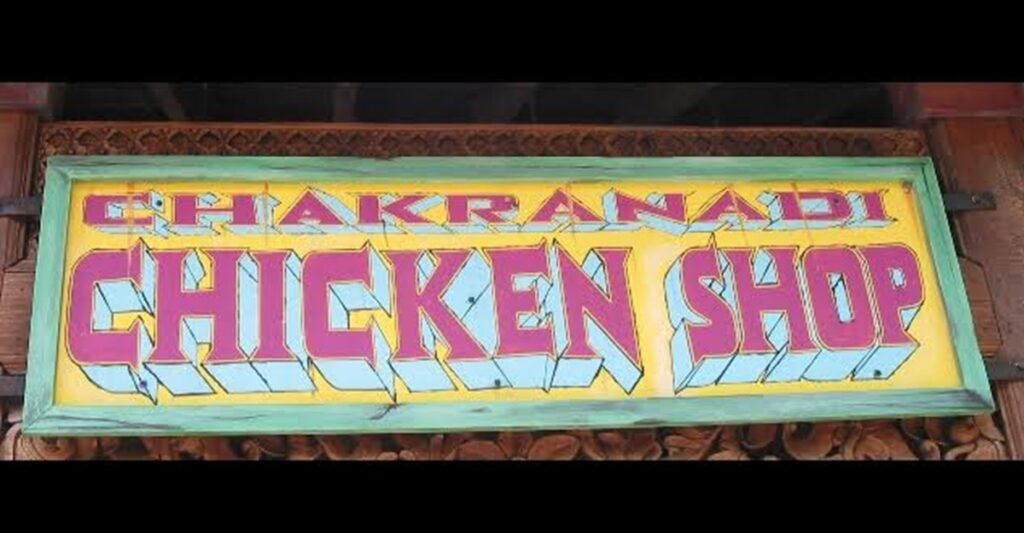
Chakranadi Chicken Shop was a counter-service restaurant located in the Asia section of Disney’s Animal Kingdom. Operating from approximately 2000 until June 2006, the small food-service location specialized in Asian-inspired chicken dishes and other inexpensive snacks. It was situated in the fictional village of Anandapur, near Kali River Rapids and Maharajah Jungle Trek, in an area that was subsequently redeveloped for Yak & Yeti Restaurant. Although Chakranadi Chicken Shop operated for only a relatively short period, its menu was an early example of Disney’s effort to incorporate regional food influences into Animal Kingdom’s themed environments.
The restaurant was located along the pedestrian pathways of Anandapur, the fictional Southeast Asian village that forms the principal setting of Animal Kingdom’s Asia section.
Anandapur was developed as a carefully imagined community incorporating architectural and cultural influences from Nepal, India, Indonesia, Thailand, and other parts of Asia.
Rather than presenting a single real-world city, Disney’s Imagineers created a fictional settlement that appeared to have evolved over generations.
Its buildings, religious shrines, faded advertisements, signs, market stalls, and everyday commercial structures were designed to suggest a community with a history extending far beyond the arrival of theme park visitors.
The name Anandapur is often translated as “place of delight.”
In Disney’s fictional history, the village is associated with the Maharajah Jungle Trek, Kali River Rapids, and the surrounding landscape of temples, waterways, and wildlife habitats.
Chakranadi Chicken Shop was integrated into this environment as a modest neighborhood food business.
It was not presented as an elaborate destination restaurant or an upscale dining experience.
Instead, the small counter offered relatively inexpensive dishes that guests could purchase while exploring the village.
This approach was consistent with Animal Kingdom’s original philosophy of using ordinary businesses and architectural details to make its themed environments feel inhabited.
Disney’s Animal Kingdom opened on April 22, 1998, but the Asia section developed in stages.
Maharajah Jungle Trek opened in March 1999, followed by Kali River Rapids in August of the same year.
Additional shops and food-service locations appeared as the village expanded.
Historical restaurant chronologies identify approximately 2000 as the opening year for Chakranadi Chicken Shop.
However, a contemporary Disney announcement confirming the precise first operating day has not been established.
The restaurant therefore should not be classified as an Animal Kingdom opening-day location.
Its documented history belongs to the period following the initial development of Asia.
The restaurant’s name was particularly appropriate to the surrounding setting.
Chakranadi is associated with the fictional river system and geography of Anandapur, including the waterways explored by guests on Kali River Rapids.
The name was also used elsewhere in Animal Kingdom’s Asia-themed entertainment and dining environment.
By using a locally inspired name rather than a generic description such as Chicken Stand, Disney gave the restaurant an identity consistent with the village.
The word Chicken Shop also communicated its practical purpose.
Visitors approaching the counter could quickly identify the general type of food available without needing to understand the fictional geography.
That balance between environmental storytelling and operational convenience was typical of Animal Kingdom’s smaller food locations.
The restaurant’s menu was unusually distinctive for a small Walt Disney World snack stand during the early 2000s.
A contemporary dining report published on June 3, 2001, documented three particularly notable items.
Chicken satay with peanut sauce was available for $3.95.
The dish offered a recognizable Southeast Asian preparation in which chicken is served with a peanut-based dipping sauce.
Pot stickers with spicy broth were also priced at $3.95.
These dumplings introduced another Asian-inspired option that differed from the hamburgers, hot dogs, and chicken strips commonly associated with American theme park counter service.
Guests could also purchase an ear of corn for $2.25.
These prices provide a rare contemporary snapshot of the restaurant’s offerings rather than relying entirely on retrospective descriptions.
The selection was modest, but the dishes had a stronger connection to the surrounding Asian village theme than a conventional American snack menu would have provided.
Chicken satay was especially appropriate to the setting because variations of the dish are popular in Indonesia, Thailand, Malaysia, and other Southeast Asian countries.
The peanut sauce contributed a distinctive flavor profile while remaining approachable for visitors unfamiliar with regional Asian cooking.
Pot stickers provided another accessible option.
Although commonly associated with Chinese culinary traditions, dumplings of various kinds are found throughout Asia.
The spicy broth gave the dish a more substantial character than a conventional packaged snack.
The ear of corn offered a straightforward vegetable option for guests seeking something inexpensive and easy to eat.
Together, the three documented items demonstrate the restaurant’s early menu philosophy: small portions, recognizable ingredients, and flavors that reflected the broader Asian setting.
Chakranadi Chicken Shop was not a full-service restaurant.
Guests ordered at the counter rather than receiving table service, and the location was categorized in historical dining records as serving lunch and snacks.
Its menu was suited to visitors who wanted something smaller than a complete restaurant meal.
The restaurant’s modest scale was particularly appropriate to Animal Kingdom’s operating environment during the early 2000s.
At that time, the park had fewer table-service restaurants than it does today, and many of its dining options consisted of quick-service restaurants and small snack stands.
Nearby locations included counter-service businesses offering familiar American food as well as selections inspired by Asian cooking.
One of the closest operations was Sunaulo Toren Fries.
This small food stand was located beside Chakranadi Chicken Shop and specialized in quick-service snacks.
The two facilities occupied neighboring spaces in the area later selected for Yak & Yeti.
Their proximity is important because the subsequent redevelopment involved both locations rather than replacing only the chicken shop.
The surrounding village also contained attractions that drew substantial numbers of guests.
Kali River Rapids had become one of Animal Kingdom’s most popular rides, particularly during warm weather.
The attraction takes visitors on a rafting expedition through a tropical forest threatened by illegal logging.
Its queue incorporates references to the fictional Kali Rapids Expeditions company and the environmental issues affecting the surrounding landscape.
Maharajah Jungle Trek offered a quieter experience, allowing guests to explore animal habitats, architectural ruins, aviaries, and landscaped environments inspired by South Asian traditions.
Chakranadi Chicken Shop occupied a convenient position between these attractions and the broader Anandapur village.
Guests could purchase a small meal or snack while moving through the area without making reservations or entering a larger restaurant.
The introduction of Expedition Everest in 2006 substantially increased the importance of Asia within Disney’s Animal Kingdom.
The attraction officially opened on April 7, 2006, following preview operations.
Its enormous mountain structure and high-speed roller coaster brought additional crowds into the surrounding village.
The expansion also extended the fictional geography of Anandapur toward the mountain settlement of Serka Zong.
The new attraction increased demand for dining, shopping, and other guest facilities.
Disney had already begun planning a substantial new restaurant for the area.
In February 2006, news emerged that Landry’s Restaurants, the company associated with Rainforest Café, would develop a new Asian-themed dining facility at Disney’s Animal Kingdom.
The project would combine table-service dining with a separate quick-service operation.
The selected site included the existing Chakranadi Chicken Shop and neighboring Sunaulo Toren Fries.
The proposed restaurant represented a major departure from the small food stands previously occupying the location.
Instead of offering a limited menu from a modest counter, the development would introduce a large two-story restaurant with extensive interior dining rooms, a themed marketplace, and outdoor seating.
Construction required the removal of the existing food-service facilities.
By spring 2006, the impending closure of Chakranadi Chicken Shop was being discussed among park visitors and employees.
A contemporary April 2006 discussion noted that the new restaurant was expected to occupy the site of both the chicken shop and the adjacent snack stand.
The same discussion referenced a recently published park map that no longer identified the two locations, although the restaurant had not yet been removed.
The closure was confirmed shortly afterward.
A June 2, 2006, discussion reported that Chakranadi Chicken Shop would close permanently on June 4 to make way for construction.
The report indicated that construction walls were expected to appear during the second week of June, extending across the affected portion of Anandapur.
Historical sources disagree slightly about the precise closing date.
AllEars’ archived restaurant directory identifies June 1, 2006, as the closure date.
The contemporary June 2 report instead identifies June 4 as the final day.
The discrepancy may reflect differences between the date of regular operations, the final scheduled service day, or the recording of the closure in restaurant directories.
No definitive Disney operating notice has been identified resolving the difference.
For historical purposes, early June 2006 is firmly supported as the closing period, with June 4 frequently reported as the final day.
The restaurant did not undergo a simple name change or menu adjustment.
Its original facility was removed as part of the larger construction project.
The development also eliminated Sunaulo Toren Fries.
Over the following year, the site was transformed into Yak & Yeti Restaurant.
The new complex was considerably larger and more elaborate than either of its predecessors.
It was designed to resemble a collection of buildings assembled over generations by a prosperous merchant family living in Anandapur.
According to the fictional history, the family had traveled throughout Asia, collecting furniture, artwork, textiles, and other decorative objects.
Their home eventually became a place where travelers could gather for food and hospitality.
The building’s architectural details reflected this story.
Its exterior incorporated weathered walls, carved wooden elements, balconies, and decorative signs consistent with the surrounding village.
Inside, the restaurant featured numerous rooms filled with Asian artwork, furniture, statues, and historical-style objects.
The dining areas were arranged across two levels, creating a more intimate environment than a conventional large restaurant dining hall.
The upper floor offered views toward the surrounding pathways and the village.
The development also included Yak & Yeti Local Food Cafés, a separate counter-service operation offering Asian-inspired meals.
This arrangement continued the tradition of casual food service at the site, although on a much larger scale.
Yak & Yeti Restaurant officially opened on November 14, 2007.
The opening was documented in a contemporary press release from Landry’s Restaurants and confirmed in Disney’s official historical encyclopedia.
The restaurant accommodated approximately 250 guests indoors, while the adjacent quick-service courtyard provided seating for approximately 350.
The complex offered Asian-inspired dishes in a more extensive format than the original chicken shop.
Its menu included pot stickers, fried rice, noodles, chicken dishes, seafood, and other entrées influenced by cuisines throughout Asia.
The inclusion of pot stickers is an interesting point of continuity with Chakranadi Chicken Shop.
The earlier restaurant had offered pot stickers with spicy broth in 2001, while the new Yak & Yeti introduced dumplings as part of its broader pan-Asian menu.
However, there is no evidence that the original Chakranadi recipe was carried over to the new restaurant.
The similarity reflects the general culinary theme rather than a documented transfer of specific menu items.
The opening of Yak & Yeti was significant for Disney’s Animal Kingdom because it introduced a major new table-service restaurant within the park’s Asia section.
Its combination of full-service dining, counter-service food, and retail space provided a much more substantial commercial facility than the two snack stands it replaced.
The new restaurant also complemented Expedition Everest, giving the growing Anandapur area another major destination.
Chakranadi Chicken Shop’s disappearance therefore formed part of the broader expansion of Animal Kingdom during the mid-2000s.
The park was moving beyond its initial collection of attractions and small food-service facilities, introducing larger restaurants and more elaborate themed environments to accommodate growing attendance.
One additional distinction is important when tracing the history of the Chakranadi name.
In December 2015, Disney renamed several smaller food and beverage kiosks throughout Animal Kingdom.
The Maharajah Pretzel stand in Asia became Chakranadi.
The renamed kiosk was located near Kali River Rapids and continued selling pretzels, drinks, and other snacks.
This later Chakranadi location was not a reopening of Chakranadi Chicken Shop.
It occupied a different site, featured a different menu, and had a separate operating history.
Likewise, the name Chakranadi has been used for a musical entertainment act at Disney’s Animal Kingdom.
That act featured traditional Asian instruments and was unrelated to the original chicken restaurant.
These distinctions are important because searching for Chakranadi in modern dining directories can produce results for the newer snack kiosk rather than the extinct chicken shop.
As of October 2026, Chakranadi Chicken Shop remains permanently closed.
Its former location is part of the Yak & Yeti restaurant complex, which continues operating in the Asia section of Disney’s Animal Kingdom.
The original small counter-service building no longer exists, and its documented menu of chicken satay, pot stickers, and corn has not returned under the Chakranadi Chicken Shop name.
The later Chakranadi snack kiosk should be maintained as a separate restaurant entry rather than treated as a continuation of the original business.
Chakranadi Chicken Shop is particularly interesting because it represents the earlier food-service character of Animal Kingdom’s Asia section.
The original Anandapur development included relatively modest restaurants and snack stands that resembled the kinds of small businesses found in a functioning village.
These facilities helped establish the setting without requiring elaborate dining experiences.
Chakranadi’s menu also demonstrated an early commitment to offering foods inspired by the region represented in the surrounding architecture.
Chicken satay and pot stickers were not especially adventurous by international culinary standards, but they gave guests accessible alternatives to conventional American theme park food.
That made the restaurant a small but meaningful part of Animal Kingdom’s approach to environmental storytelling.
Its replacement by Yak & Yeti illustrates how Disney adapted the park’s facilities as attendance increased and the surrounding attractions expanded.
The opening of Expedition Everest made Asia an even more important destination, while the arrival of Yak & Yeti introduced a substantial new dining experience suited to larger numbers of visitors.
The change did not eliminate Asian-inspired dining from the site.
Instead, the relatively simple menu of Chakranadi Chicken Shop gave way to a much broader selection of dishes served in a more elaborate setting.
For guests who visited Disney’s Animal Kingdom during the early 2000s, Chakranadi Chicken Shop was a convenient place to purchase an inexpensive Asian-inspired snack while exploring Anandapur.
Its location near Kali River Rapids and Maharajah Jungle Trek made it part of the everyday experience of the original Asia development.
Although it operated for only approximately six years, the restaurant has a clearly identifiable place in the park’s history as one of the two small food-service locations removed for the construction of Yak & Yeti.
Its documented menu, early June 2006 closure, and relationship to the subsequent restaurant development make it a noteworthy extinct dining location from Disney’s Animal Kingdom’s formative years.