
Coconino Cove, also referred to as Coconino Grove in some historical Disney publications, was a cocktail lounge, oyster bar, and live entertainment venue located on the fourth-floor Grand Canyon Concourse at Disney’s Contemporary Resort at Walt Disney World. Opening in the spring of 1977, the lounge occupied a newly constructed glass-enclosed atrium at the southern end of the Contemporary’s main tower. Its distinctive setting featured floor-to-ceiling windows overlooking Bay Lake, triangular skylights, tropical plants, and views of monorails passing through the hotel. The menu emphasized oysters, hot and cold appetizers, and specialty cocktails, while evening entertainment included live music and dancing. Coconino Cove also played a role in the early development of Disney character dining, hosting a Sunday morning character breakfast in 1977. The lounge continued operating through much of the 1980s before disappearing during the Contemporary Resort’s major restaurant renovations around 1988–1989. Its former space was eventually incorporated into Chef Mickey’s.
Coconino Cove was one of the Contemporary’s more unusual dining and entertainment establishments because it occupied space that had not existed when the resort first opened.
Rather than remodeling an existing restaurant, Disney constructed a new atrium extending outward from the hotel’s southern façade.
The addition created a bright, enclosed lounge that combined the resort’s futuristic architecture with the increasingly popular atmosphere of a hotel cocktail bar.
The Contemporary Resort’s original dining complex
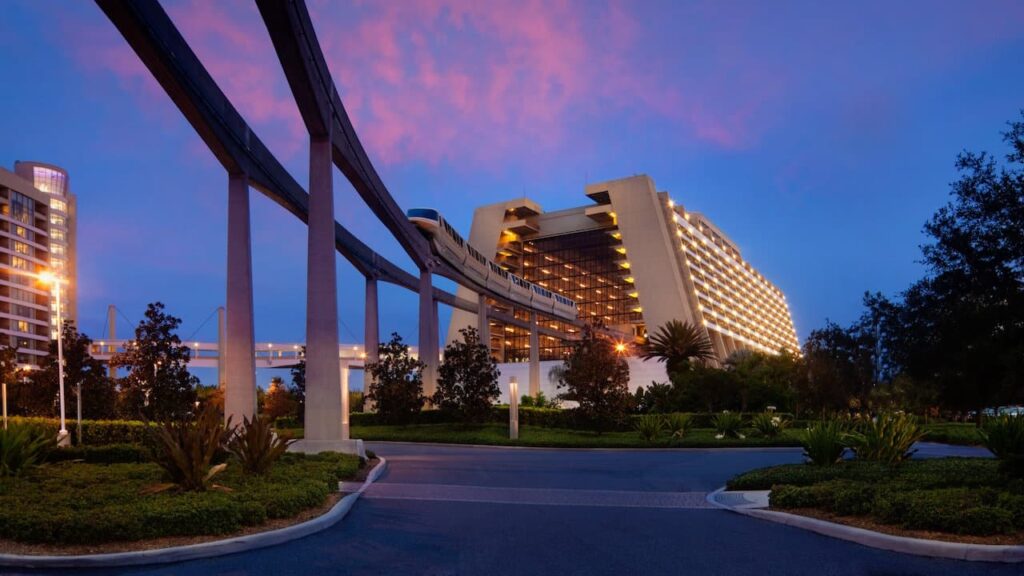
Disney’s Contemporary Resort opened on October 1, 1971, alongside Magic Kingdom and Disney’s Polynesian Village Resort.
The hotel was designed by Welton Becket and Associates and became one of Walt Disney World’s most recognizable architectural landmarks.
Its defining feature was the large A-frame tower, through which Disney monorails traveled on an elevated beam.
The fourth floor contained the Grand Canyon Concourse, an expansive public area featuring restaurants, shops, lounges, and the enormous ceramic mural designed by Mary Blair.
The original dining establishments included the Terrace Café, Pueblo Room, Gulf Coast Room, and Top of the World restaurant.
Additional lounges served guests seeking cocktails and evening entertainment.
The Contemporary’s dining lineup changed repeatedly during its earliest years.
Disney experimented with table service, buffets, cafeteria-style dining, cocktail lounges, and live entertainment.
By the middle of the 1970s, some original restaurant spaces had already been renamed or reorganized.
Coconino Cove was introduced during this period of expansion and experimentation.
Opening in the spring of 1977
Coconino Cove opened in the spring of 1977.
A contemporary article published in the April 1977 edition of Walt Disney World News described the new establishment and its architectural features.
The lounge was located at the far southern end of the Grand Canyon Concourse.
Its development followed the popularity of Cap’n Jack’s Oyster Bar at Lake Buena Vista Shopping Village, which had opened in March 1975.
Disney introduced a comparable oyster-and-cocktail concept at the Contemporary, providing another destination for guests seeking seafood appetizers and drinks.
The new lounge was not simply inserted into an existing interior area.
Disney expanded the building by constructing a glass-enclosed atrium beyond the original exterior wall.
Guests entered through doors installed in what had previously been the Contemporary’s southern window wall.
This construction gave Coconino Cove a distinctive position within the hotel.
It was physically connected to the Grand Canyon Concourse but extended toward Bay Lake.
Its windows allowed guests to enjoy views unavailable from most of the surrounding interior restaurants.
The glass atrium
The architecture was one of Coconino Cove’s defining attractions.
The new space featured a twelve-foot-high ceiling and extensive glazing.
The southern wall was composed largely of glass, providing views of Bay Lake and the wooded areas surrounding the resort.
Above the dining area, pointed triangular skylights admitted natural light.
During the day, sunlight entered through the roof and windows, creating a bright interior.
At night, the skylights and surrounding glass allowed guests to experience a different atmosphere.
The lounge also included an abundance of plants.
These contributed to the impression of an outdoor garden enclosed within the hotel’s structure.
The combination of glass, greenery, and natural light distinguished Coconino Cove from darker, more traditional cocktail lounges.
Its design was particularly striking because the Contemporary’s main concourse was otherwise dominated by concrete architecture, artificial trees, and the enormous interior volume of the A-frame.
Coconino Cove introduced a more intimate environment without completely separating guests from the surrounding hotel.
Interior decorations
The original lounge incorporated decorative elements associated with the Contemporary’s Southwestern-inspired Grand Canyon Concourse.
The April 1977 description identified Native American-inspired decorative motifs and deep interior colors.
These complemented the larger concourse’s architectural theme.
Guests sat at round tables with fruitwood-style finishes.
The arrangement was suitable for both casual conversation and live entertainment.
Although the lounge was enclosed by glass, it was designed to feel connected to the surrounding landscape.
The plants and skylights reinforced that impression.
Its seating also provided an unusual perspective on the Contemporary.
Guests could watch monorails traveling through the hotel at approximately eye level.
That combination of Bay Lake views, monorail activity, and natural light gave Coconino Cove a setting unlike a conventional resort bar.
Oysters and appetizers
Coconino Cove originally operated as an oyster bar and cocktail lounge.
Its food menu emphasized seafood and appetizers rather than full restaurant meals.
A surviving description from a 1979 Contemporary Resort guide identified the lounge as an oyster bar serving hot and cold appetizers.
This is the clearest available evidence of its principal food offerings.
The menu was appropriate for guests who wanted something lighter than dinner at one of the Contemporary’s full-service restaurants.
Visitors could order drinks and appetizers before attending another restaurant or spend an evening at the lounge itself.
The concept was particularly well suited to the resort’s extensive dining lineup.
The Contemporary already offered substantial meals through its restaurants, so Coconino Cove did not need to duplicate those menus.
Instead, it provided a setting for drinks, seafood, and entertainment.
Unfortunately, a complete dated Coconino Cove food menu with individual dishes and prices has not been located.
Although oysters were a defining specialty, the surviving sources do not establish every preparation, sauce, seafood combination, or appetizer offered.
Specific dishes from Cap’n Jack’s Oyster Bar should not automatically be attributed to Coconino Cove simply because the two establishments shared a similar concept.
The strawberry margarita
One specialty cocktail associated with Coconino Cove was the Strawberry Margarita.
The drink is preserved in historical Disney recipe collections.
The same preparation was associated with Cap’n Jack’s Oyster Bar at Walt Disney World Village.
This connection is particularly interesting because the two establishments shared an emphasis on seafood and cocktails.
The strawberry margarita was prepared using strawberry-flavored tequila, conventional tequila, orange liqueur, and citrus ingredients.
The drink reflected the popularity of flavored cocktails at Walt Disney World during the 1970s and 1980s.
Its appearance in a 1986 Disney cookbook also provides evidence that Coconino Cove remained part of the resort’s culinary identity well after its opening.
The 1986 publication used the name Coconino Grove, contributing to the alternate name associated with the lounge.
However, the surviving records do not establish a separate restaurant opening or formal relaunch under the Grove name.
It is more accurate to treat Coconino Grove as an alternative documented name for Coconino Cove.
Amos and Charles
Live entertainment was an important part of the original Coconino Cove experience.
The opening-period schedule featured a musical duo known as Amos and Charles.
The performers were Rick Amos and John Charles.
A contemporary Disney description identified their entertainment schedule as 8:30 p.m. until 1:30 a.m.
The long evening schedule made Coconino Cove a destination for guests who wanted to enjoy music and dancing after dinner.
Unlike the large theatrical performances presented at the Contemporary’s Top of the World Supper Club, the entertainment at Coconino Cove was designed for a lounge environment.
Guests could listen to music, socialize, or dance without attending a formal dinner show.
John Charles continued performing at Walt Disney World in later years and subsequently appeared aboard Disney Cruise Line ships.
The duo’s connection to Coconino Cove provides an interesting link to Walt Disney World’s early resort entertainment culture.
During the 1970s, Disney hotels frequently hosted resident musicians who developed followings among guests and Cast Members.
Coconino Cove was part of that tradition.
Early Disney character dining
One of Coconino Cove’s most historically significant roles was as an early location for Disney character dining.
In 1977, the lounge hosted a Sunday morning character breakfast buffet.
Guests could enjoy breakfast while meeting Disney characters.
This was an unusually early example of character dining at Walt Disney World.
Today, character meals are found throughout the resort and often require reservations made well in advance.
During the 1970s, however, character dining was still a developing concept.
The Coconino Cove breakfast provided a relatively informal experience.
Historical accounts indicate that advance reservations were not required.
The Sunday morning schedule also distinguished it from the daily character breakfasts that became common in later decades.
By 1978, the Contemporary’s Sunday character breakfast had moved to the nearby Terrace Café.
A contemporary Disney publication identified that restaurant as hosting characters from 8 a.m. until 10:30 a.m.
The move demonstrates that Coconino Cove’s character breakfast was part of an evolving resort dining program.
Although the character meal was short-lived at the lounge itself, the experiment contributed to a tradition that eventually became central to Walt Disney World dining.
Changes during the 1980s
Coconino Cove continued operating during the 1980s.
Its inclusion in Disney’s 1986 cookbook confirms that the establishment remained sufficiently prominent to be associated with an official beverage recipe.
However, the Contemporary’s dining facilities were changing.
The hotel underwent major renovations beginning in the middle of the decade.
Disney updated guest rooms, lobby areas, shops, restaurants, and lounges.
The Grand Canyon Concourse was particularly affected.
During 1988 and 1989, the restaurants at the southern end of the concourse underwent a substantial reorganization.
The Terrace Café and adjoining facilities were converted into the Contemporary Café.
Other portions became the Concourse Grill.
The Outer Rim lounge also changed as part of the renovation.
Historical photographs from the period show the Coconino Cove sign still visible behind the Contemporary Café.
However, the lounge’s windows had been obscured.
Contemporary resort guides stopped listing Coconino Cove around this period.
This suggests that its regular public operation ended during the late-1980s renovations.
The exact final operating day remains undocumented.
The transition to Chef Mickey’s
The Contemporary Café continued operating on the fourth-floor concourse after the 1989 renovation.
It offered breakfast and dinner, including Disney character dining.
The restaurant eventually became the new home of Chef Mickey’s.
Chef Mickey’s had originally operated at Disney Village Marketplace, in the former Village Restaurant building.
That location closed on September 30, 1995.
The restaurant reopened at Disney’s Contemporary Resort on December 22, 1995.
The new Chef Mickey’s incorporated several former dining spaces at the southern end of the Grand Canyon Concourse.
These included areas associated with the Contemporary Café, Pueblo Room, and Coconino Cove.
The former lounge’s glass-enclosed addition became part of the larger restaurant’s dining area.
This represents an important distinction in the history of the site.
Coconino Cove was not simply renamed Chef Mickey’s.
Its original function as an oyster bar and entertainment lounge had already ended.
The surrounding restaurant complex was subsequently reorganized, and its former space became part of a much larger character-dining establishment.
The location today
As of November 2026, Coconino Cove no longer operates as a separate lounge or restaurant.
Its former location is incorporated into Chef Mickey’s at Disney’s Contemporary Resort.
Chef Mickey’s occupies a substantial portion of the southern Grand Canyon Concourse and remains one of Walt Disney World’s best-known character-dining destinations.
The modern restaurant offers character meals featuring Mickey Mouse and other Disney characters.
Its operating concept bears little resemblance to the original oyster bar and cocktail lounge.
However, the location retains an interesting architectural connection to the Contemporary’s early history.
The space that once formed a separate glass-enclosed lounge became part of the larger restaurant.
Visitors dining near the southern end of Chef Mickey’s occupy the general area that Coconino Cove once used.
The original lounge’s entertainment program, seafood-focused menu, and name have disappeared.
Historical significance
Coconino Cove is noteworthy because it was one of the most distinctive additions to Disney’s Contemporary Resort during the 1970s.
Opening in the spring of 1977, it introduced an oyster bar and cocktail lounge within a newly constructed glass atrium overlooking Bay Lake.
Its architecture was particularly unusual.
Rather than relying exclusively on the Contemporary’s enormous interior concourse, Disney extended the building to create a more intimate space filled with natural light.
The twelve-foot ceiling, triangular skylights, glass walls, and extensive plants gave the lounge the atmosphere of an enclosed garden.
Guests could enjoy views of Bay Lake while watching monorails travel through the hotel.
The lounge also served a distinctive culinary purpose.
Its oysters, hot and cold appetizers, and specialty cocktails complemented the surrounding full-service restaurants.
The strawberry margarita associated with Coconino Cove provides one surviving example of its beverage program.
Live entertainment by Amos and Charles added another dimension.
The lounge offered music and dancing until approximately 1:30 a.m., making it one of the Contemporary’s nighttime gathering places.
Perhaps its most significant contribution was its role in the development of character dining.
The Sunday morning character breakfast hosted in 1977 was an early example of a concept that would eventually become one of Walt Disney World’s most recognizable dining experiences.
The subsequent move of that breakfast to the Terrace Café helped establish character dining elsewhere in the hotel.
Coconino Cove also illustrates how extensively the Contemporary’s original restaurant spaces changed during the resort’s first two decades.
The hotel’s fourth-floor dining complex underwent repeated expansions, renovations, and reconfigurations.
The lounge disappeared during the late-1980s changes, and its former space was later incorporated into Chef Mickey’s.
As of November 2026, Coconino Cove and Coconino Grove are extinct names.
The best-supported opening period is spring 1977, while the precise closing date remains uncertain. Available evidence suggests that the lounge ceased regular public operation around 1988–1989.
Its former space survives as part of Chef Mickey’s rather than as a separate establishment.
For visitors researching the early Contemporary Resort, Coconino Cove offers an unusual combination of architectural innovation, seafood dining, live entertainment, and character-dining history.
Its glass atrium and monorail views made it a memorable part of the original Grand Canyon Concourse, while its Sunday character breakfast connected it to a Walt Disney World tradition that continues today.