
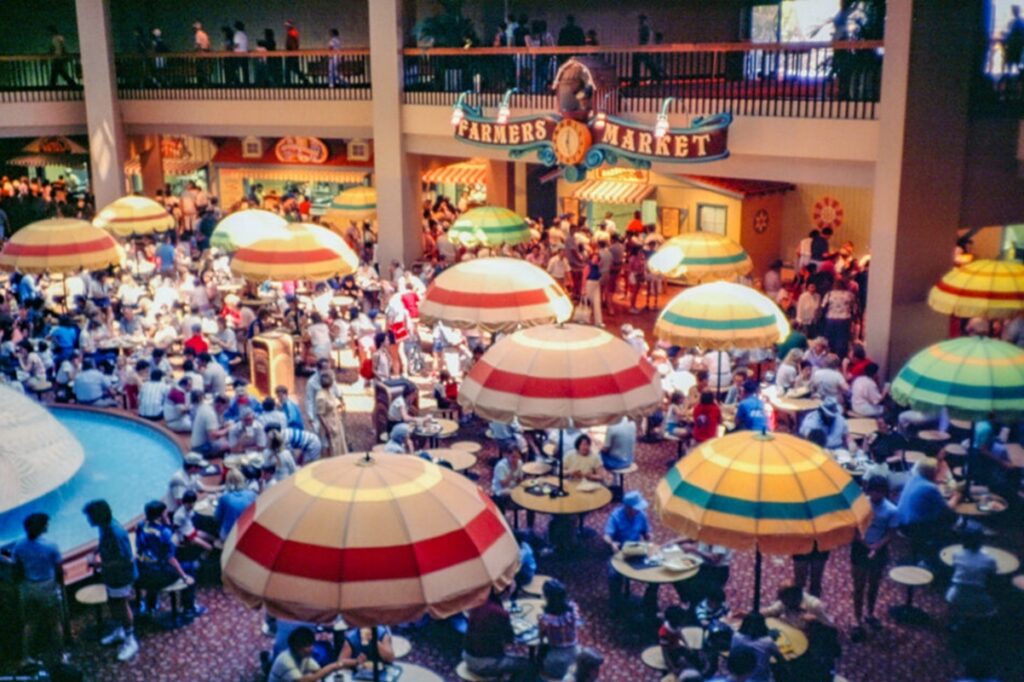
Farmer’s Market was the original quick-service food court inside The Land pavilion at EPCOT Center. Opening with the park on October 1, 1982, the restaurant featured eight specialized food counters offering barbecue, sandwiches, fresh baked goods, soups, salads, cheese dishes, baked potatoes, ice cream, and other refreshments. Its design resembled a cheerful indoor agricultural marketplace, with colorful hot-air balloons suspended overhead, umbrella-covered tables, a central fountain, and a distinctive rooster perched above a clock.
Operating for more than eleven years, Farmer’s Market was closely associated with Kraft, the original corporate sponsor of The Land pavilion. The restaurant’s menus emphasized familiar American ingredients and incorporated Kraft products, particularly cheese, into numerous dishes.
Farmer’s Market was one of EPCOT Center’s most ambitious original quick-service dining concepts. Rather than offering a conventional selection of hamburgers, hot dogs, and French fries, Disney created separate counters dedicated to different food groups and culinary specialties. The arrangement reinforced The Land pavilion’s educational focus on agriculture, nutrition, and food production.
The restaurant closed under its original name in November 1993, when the pavilion underwent renovations associated with its transition from Kraft to Nestlé sponsorship. It reopened November 9, 1993, as Sunshine Season Food Fair.
The location underwent another substantial transformation in 2005, becoming Sunshine Seasons, which continues occupying the same general area of The Land pavilion.
Origins of The Land Pavilion
The Land pavilion opened on October 1, 1982, as one of EPCOT Center’s original Future World attractions.
The pavilion explored humanity’s relationship with the natural environment, particularly agriculture, food production, nutrition, and the challenge of feeding an expanding global population.
Its original corporate sponsor was Kraft, a major American food manufacturer.
Kraft’s involvement influenced both the pavilion’s educational presentations and its dining establishments.
The Land combined three attractions with two dining locations.
Listen to the Land was a boat ride that examined the history of agriculture and demonstrated emerging food-production techniques, including hydroponics and other controlled-environment growing methods.
Kitchen Kabaret was an Audio-Animatronics musical presentation about nutrition and the importance of eating a balanced diet.
Symbiosis was a film exploring the complex relationship between humans and the natural environment.
The pavilion also featured the Good Turn Restaurant, a rotating table-service restaurant overlooking portions of the agricultural boat ride.
Farmer’s Market occupied the lower level of the pavilion’s large central atrium.
The food court provided an opportunity for guests to enjoy meals while surrounded by decorations reinforcing the pavilion’s agricultural and nutritional themes.
Location and Original Layout
Farmer’s Market was located on the lower level of The Land pavilion, beneath the large skylit atrium.
Guests entering the pavilion descended toward a central gathering space surrounded by attractions, restaurants, and retail facilities.
The food court occupied a substantial portion of this area.
Its eight specialty food stations were arranged along the back of the dining space.
Rather than operating as a single service counter, the restaurant encouraged guests to visit different locations depending on their preferred meal.
The design resembled a traditional marketplace, with separate establishments offering specific categories of food.
Guests could purchase barbecue at one counter, bakery items at another, and potatoes or cheese specialties elsewhere.
Tables were arranged throughout the central dining area.
The layout was particularly useful for families and groups because individual diners could select foods from different stations before gathering at a shared table.
This flexibility distinguished Farmer’s Market from many conventional theme park restaurants of the early 1980s.
The Original Eight Food Stations
Historical restaurant guides and photographs identify eight original food stations.
The exact names and menu configurations changed somewhat during the restaurant’s history, but the principal counters included:
- Barbecue: Pork and beef barbecue selections.
- Bakery Shop: Fresh breads, muffins, cookies, cakes, and pastries.
- Cheese Shoppe: Cheese-focused dishes and specialty preparations featuring Kraft products.
- Potato Store: Baked potatoes and other potato-based dishes.
- Sandwiches or Picnic Fare: Prepared sandwiches and lighter meal options.
- Soup and Salad: Soups, salads, and combination meals.
- Ice Cream: Frozen desserts and related treats.
- Beverage House: Beverages and refreshments.
The Disney Handwich also appeared among the restaurant’s offerings and was associated with the food court during the 1980s.
The selection reflected the pavilion’s emphasis on food variety.
Rather than presenting a single regional cuisine, Farmer’s Market offered numerous examples of American dining, with particular attention to ingredients produced through agriculture.
The Disney Handwich
One of the most unusual foods associated with Farmer’s Market was the Disney Handwich.
Introduced at EPCOT Center during the 1980s, the Handwich was a portable sandwich served inside a cone-shaped piece of bread.
The bread functioned as an edible container.
Rather than placing sandwich ingredients between conventional slices of bread, the filling was inserted into the cone.
This allowed guests to hold the meal in one hand while walking through the park.
The concept was particularly appropriate for EPCOT Center, where visitors frequently moved between large attractions and educational exhibits.
Handwiches were offered with different fillings over the years.
Although the precise selection at Farmer’s Market varied, the overall concept became one of the more recognizable examples of EPCOT’s original experimental quick-service dining.
The Handwich was not exclusive to Farmer’s Market, but its presence at The Land complemented the pavilion’s emphasis on food preparation and innovation.
The product eventually disappeared from Walt Disney World’s regular menus.
Today, it remains one of the better-remembered culinary novelties associated with early EPCOT Center.
The Cheese Shoppe and Kraft Sponsorship
Cheese was especially prominent at Farmer’s Market because Kraft sponsored The Land pavilion.
The Cheese Shoppe featured dishes built around Kraft cheese products.
One of the most distinctive offerings was Pizza Quiche.
The dish combined elements of a conventional quiche with familiar pizza flavors.
It was specifically mentioned in the 1983 edition of Birnbaum’s Walt Disney World guide, which described the restaurant’s cheese counter and highlighted the popularity of the new preparation.
Historical menus also identify Cheese Bread as an offering at Farmer’s Market.
The dish was additionally served at the neighboring Land Grille Room, demonstrating how the pavilion’s two restaurants occasionally shared menu items.
The emphasis on cheese reflected Kraft’s prominent role in the pavilion.
Although Farmer’s Market was a functioning restaurant, its menu also helped connect the dining experience with the corporate sponsor’s products.
This integration of sponsorship, educational entertainment, and retail dining was characteristic of EPCOT Center’s original Future World philosophy.
The Bakery Shop
The bakery was one of Farmer’s Market’s most varied food stations.
Historical menus identify several distinctive baked goods.
Offerings included sticky buns, Anadama bread, blueberry muffins, bran muffins, corn muffins, and chocolate chip cookies.
Anadama bread is a traditional New England bread prepared with cornmeal and molasses.
Its inclusion was consistent with the restaurant’s emphasis on regional American foods.
Another unusual offering was Hermits, a type of spiced cookie traditionally prepared with raisins and nuts.
The Farmer’s Market version incorporated raisins and pecans.
The bakery also offered cakes and pies.
Historical selections included Dark Chocolate Cake, Strawberry Cheesecake, New York-Style Cheesecake, Lime Chiffon Pie, Lemon Meringue Pie, and Deep Dish Apple Pie.
Several desserts were also available at The Land’s adjacent table-service restaurant.
The bakery contributed substantially to Farmer’s Market’s identity.
Rather than concentrating exclusively on packaged desserts, the station offered a broad range of traditional American baked goods.
Soups, Salads, and Other Savory Offerings
Farmer’s Market also offered several dishes designed for guests seeking lighter meals.
The Soup and Salad counter provided prepared salads and soup combinations.
Historical menus identify Chicken Gumbo among the restaurant’s offerings.
Farmer’s Market Tuna Salad was another documented selection.
Baked potatoes were available from the Potato Store.
These offerings were particularly appropriate for a pavilion emphasizing agriculture and nutrition.
The variety of food stations also supported the original EPCOT Center philosophy of presenting familiar subjects through educational and entertaining experiences.
Guests could enjoy foods associated with different agricultural products while exploring exhibits examining how those ingredients were grown and processed.
Although the restaurant was primarily a commercial dining establishment, its organization reflected The Land pavilion’s larger educational purpose.
The Rooster Clock
One of Farmer’s Market’s most memorable decorative features was a clock topped by a rooster.
The clock was positioned above the main food-service area.
At intervals, the rooster would crow, providing an animated element within the marketplace.
The detail reinforced the restaurant’s agricultural theme.
Roosters have long been associated with farms and the beginning of the day, making the bird an appropriate symbol for a food court celebrating agricultural traditions.
The crowing rooster also added an element of entertainment to an otherwise conventional quick-service dining area.
Historical photographs show the clock and rooster positioned above the marketplace signage.
The feature disappeared during the early 1990s renovation.
For guests who visited EPCOT Center during its first decade, the rooster remains one of the most recognizable memories of the original Farmer’s Market.
Hot-Air Balloons and Central Fountain
Farmer’s Market occupied one of the most visually distinctive dining environments at early EPCOT Center.
Above the tables hung three colorful hot-air balloons.
The balloons were suspended from the pavilion’s high ceiling rather than being actual floating aircraft.
Each originally represented a different food group.
Their presence connected the restaurant’s colorful atmosphere with the pavilion’s broader emphasis on nutrition.
The balloon decorations were particularly prominent because the food court occupied the center of the atrium.
Visitors entering the pavilion could look down over the dining area and see the balloons above the tables.
The original seating featured round tables with umbrella-style canopies.
The furnishings incorporated warm colors, including browns and oranges, creating an environment suggestive of an outdoor marketplace.
A large white fountain occupied the central dining area.
Water features, balloons, and umbrella-covered tables combined to produce an atmosphere unlike that of most conventional Walt Disney World restaurants.
The combination of decorative elements made Farmer’s Market a particularly memorable part of the original Land pavilion.
Relationship to the Good Turn Restaurant
Farmer’s Market was one of two original restaurants inside The Land pavilion.
The other was the Good Turn Restaurant, a full-service dining location situated on the upper level.
The Good Turn was notable because its dining room slowly rotated, allowing guests to observe different portions of the pavilion.
Depending on the restaurant’s position, diners could see the central atrium or scenes associated with Listen to the Land.
The restaurant offered a more substantial table-service experience than Farmer’s Market.
Its menu included regional American dishes for breakfast, lunch, and dinner.
In May 1986, the Good Turn Restaurant became the Land Grille Room.
The dining room continued rotating, but its menu and operating concept evolved.
Farmer’s Market remained the pavilion’s primary quick-service restaurant.
The two establishments offered different dining experiences while sharing the broader agricultural theme.
Some dishes, particularly baked goods and desserts, were available at both locations.
This helped establish a recognizable culinary identity throughout the pavilion.
The End of Kraft Sponsorship
The most significant change in Farmer’s Market’s history occurred during the early 1990s.
Kraft’s original sponsorship agreement for The Land pavilion concluded in 1992.
Disney subsequently arranged for Nestlé to become the pavilion’s new corporate sponsor.
The transition led to extensive changes in the pavilion’s appearance, attractions, dining locations, and retail facilities.
The Land’s original warm agricultural colors were replaced with a brighter visual design.
The food court received updated decorative elements, revised signage, and changes to its food stations.
The hot-air balloons remained, but their designs were altered to reflect the pavilion’s new emphasis on seasons and weather rather than the original food-group symbolism.
The rooster clock was removed.
The original Farmer’s Market identity was discontinued.
The changes marked the end of the restaurant’s association with the original Kraft-sponsored EPCOT Center.
Replacement by Sunshine Season Food Fair
Farmer’s Market was renamed Sunshine Season Food Fair on November 9, 1993.
Disney’s official D23 encyclopedia confirms the date.
The new name reflected the pavilion’s updated identity under Nestlé sponsorship.
Although the restaurant remained in the same general location, its décor and menu organization changed.
The food stations continued offering a variety of quick-service meals, but the selection evolved to include new dishes and different combinations.
The refreshed food court incorporated stations specializing in soups, salads, sandwiches, pasta, potatoes, barbecue, and desserts.
The hot-air balloons remained suspended above the dining area.
However, their colors and decorative themes were updated.
The original restaurant’s agricultural marketplace atmosphere gradually gave way to a more contemporary food court environment.
Despite these changes, the basic concept remained intact.
Guests could still select food from multiple specialty counters and enjoy their meals in the pavilion’s central dining area.
The 2005 Transformation into Sunshine Seasons
Another major renovation occurred during 2004 and 2005.
The Land pavilion closed temporarily as Disney prepared to introduce Soarin’, the popular flight-simulator attraction originally developed for Disney California Adventure.
The renovation affected much of the pavilion, including its entrance, central atrium, landscaping, signage, and dining facilities.
The Sunshine Season Food Fair was extensively remodeled.
The large central fountain associated with the original dining area was removed to create additional seating space.
The restaurant’s name was shortened to Sunshine Seasons in April 2005.
The new food court featured updated service stations and a modernized menu.
Its seating areas were organized around the four seasons.
Although the restaurant’s appearance differed considerably from Farmer’s Market, the overhead hot-air balloons remained an important decorative feature.
The 2005 renovation established the general identity that continued into the 2020s.
Sunshine Seasons remained a major quick-service restaurant inside The Land pavilion, serving guests visiting Living with the Land and Soarin’.
The Farmer’s Market Legacy
Farmer’s Market represents an important part of EPCOT Center’s original dining philosophy.
When the park opened in 1982, Disney attempted to create an experience that combined entertainment, education, technology, international culture, and food.
The Land pavilion was a particularly clear example of this approach.
Its attractions explored agriculture and nutrition, while Farmer’s Market provided guests with an opportunity to enjoy a wide range of foods associated with those subjects.
The restaurant’s eight separate counters encouraged visitors to explore different types of cuisine and ingredients.
The presence of Kraft cheese products also demonstrated the close relationship between Future World attractions and their corporate sponsors.
Architecturally, Farmer’s Market was considerably more elaborate than a conventional cafeteria.
Its hot-air balloons, animated rooster clock, central fountain, umbrella-covered tables, and agricultural decorations created a distinctive environment.
These elements made the restaurant memorable even for visitors who did not remember specific menu items.
The transformation into Sunshine Season Food Fair in 1993 reflected the changing priorities of EPCOT Center during the early 1990s.
The later introduction of Sunshine Seasons in 2005 continued that evolution, emphasizing modern quick-service dining while retaining selected elements of the pavilion’s original design.
Today, the original Farmer’s Market no longer exists.
However, its physical location remains one of EPCOT’s principal quick-service dining areas.
The continued presence of the suspended hot-air balloons provides a visible connection to the pavilion’s opening-day design.
Farmer’s Market is remembered as a colorful, ambitious, and distinctly EPCOT-style food court that combined a broad selection of American cuisine with an unusually elaborate agricultural theme.
Its history illustrates how Walt Disney World once approached even ordinary dining facilities as opportunities to reinforce the educational stories being told by the surrounding attractions.