
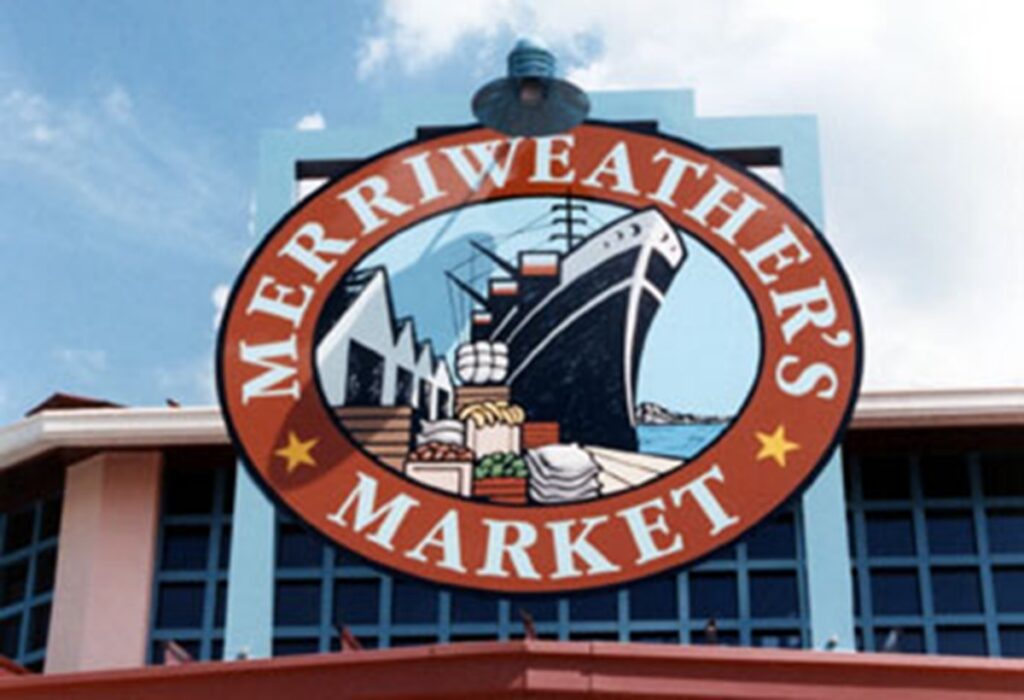
Merriweather’s Market was a counter-service food court located on Pleasure Island, the former nightlife and entertainment district at Walt Disney World that is now part of Disney Springs. Opening with Pleasure Island in May 1989, the restaurant provided casual dining for visitors exploring the island’s nightclubs, shops, and entertainment venues. Named after Merriweather Adam Pleasure, the fictional industrialist whose story inspired the district’s elaborate theming, the Market occupied a building presented as Pleasure’s original sailmaking factory. It operated until 1993, when it was converted into the Pleasure Island Jazz Company. The building subsequently underwent another major transformation, becoming part of Raglan Road Irish Pub & Restaurant, which opened in October 2005.
Although Merriweather’s Market operated for only about four years, it was an important part of Pleasure Island’s original dining lineup. Unlike the island’s elaborate themed restaurants, the Market followed a food-court format, allowing guests to obtain casual meals without committing to a formal dining experience.
Its location was especially convenient for visitors spending an evening moving between entertainment venues.
The restaurant stood on the southern side of Pleasure Island, within a group of buildings that also contained shops and other guest services. Its neighbors included The Mouse House, a store selling Disney merchandise, and Propeller Heads, an arcade.
These businesses helped create a more varied environment than a conventional nightclub district. Visitors could purchase souvenirs, play arcade games, eat a meal, and enjoy entertainment without leaving Pleasure Island.
The Market also played an important role in the elaborate fictional history that Disney Imagineers developed for the island.
Pleasure Island’s original concept
Pleasure Island officially opened on May 1, 1989, as an expansion of the Walt Disney World Village shopping and dining district.
The project was designed to provide nighttime entertainment for adult visitors staying at Walt Disney World. Its opening coincided with a major period of resort expansion that also included Disney-MGM Studios and Disney’s Typhoon Lagoon.
Rather than building a conventional collection of unrelated nightclubs, Disney developed Pleasure Island around a detailed fictional history.
According to the story, the island had once been the industrial headquarters of Merriweather Adam Pleasure, an eccentric entrepreneur, inventor, and adventurer.
Pleasure supposedly established a collection of businesses devoted to shipbuilding, sailmaking, manufacturing, and other commercial enterprises.
The island’s buildings were presented as abandoned industrial facilities that had been restored and converted into restaurants, shops, and entertainment venues.
Each establishment contributed to the broader narrative.
Mannequins Dance Palace occupied a former canvas fabrication plant. The Fireworks Factory restaurant was associated with an imaginary industrial accident at Pleasure’s pyrotechnics operation. The Adventurers Club was designed as a gathering place for explorers and world travelers.
Merriweather’s Market was similarly integrated into the story, with its building representing one of Pleasure’s earliest business ventures.
The architectural treatment helped make the fictional history convincing.
Rather than giving every business a new, modern exterior, Imagineers incorporated materials and decorative elements suggesting that the buildings had existed for decades.
The result was a district intended to resemble a former industrial community that had been adapted for contemporary entertainment.
The original sailmaking factory
Merriweather’s Market had one of the most significant fictional histories of any Pleasure Island business.
According to an original historical plaque installed at the location, the building had been constructed in 1912 as Merriweather Adam Pleasure’s first sailmaking factory.
The plaque identified the enterprise as the foundation of Pleasure’s considerable fortune.
In the fictional chronology, the factory produced its first sail on December 18, 1912.
The operation supposedly continued until June 4, 1931, when the final sail was completed.
At that point, Pleasure insisted that the factory be preserved intact.
The story reflected his supposed perfectionism and sentimental attachment to the business that had established his commercial empire.
The plaque also described an unusual ritual.
Once each month, during the full moon, Merriweather Pleasure supposedly climbed onto the factory roof and chanted to the goddess of the tides, seeking protection for his various enterprises.
This detail was characteristic of Pleasure Island’s original humor.
The fictional history incorporated unusual personalities and absurd incidents while maintaining the appearance of a serious historical record.
The building’s story continued after the sailmaking operation ended.
According to the plaque, Hurricane Connie devastated the former factory in 1955.
Disney supposedly restored the structure in 1989, allowing it to reopen as Merriweather’s Market.
These dates belonged to the invented Pleasure Island narrative rather than the actual history of the Walt Disney World property.
The real restaurant and entertainment district were developed during the 1980s.
Nevertheless, the fictional chronology was central to the original guest experience.
The Market’s association with the sailmaking factory helped connect it to nearby businesses and reinforced the idea that Pleasure Island was a community with a shared past.
Architecture and appearance
Surviving photographs from approximately 1989 and 1990 provide a useful record of Merriweather’s Market’s exterior.
The building was relatively large compared with some of the smaller shops on Pleasure Island.
Its most recognizable architectural feature was a prominent red metal roof with several intersecting sections.
A raised central structure, capped by a steep red roof, created a distinctive silhouette above the main entrance.
Large windows beneath the upper roofline admitted light and gave the building an industrial-commercial appearance.
The exterior combined pale-colored walls with greenish-blue architectural details and red roofing.
The arrangement was more colorful than a conventional abandoned warehouse, but it fit the stylized industrial environment Disney had created.
A large circular Merriweather’s Market sign appeared near the entrance.
Its design included nautical imagery associated with the business’s fictional sailmaking history.
Additional circular signs decorated the exterior walls.
The entrance was set beneath a projecting roof, providing some protection from the Florida sun and rain.
Nearby landscaping included trees, palms, planted areas, and low brick borders.
Decorative streetlamps and benches contributed to the pedestrian setting.
The photographs also show outdoor tables and chairs positioned near the restaurant.
These details suggest that guests could purchase food and enjoy it outside while watching activity along the island’s walkways.
The exterior photographs are particularly valuable because the restaurant’s original appearance has largely disappeared from modern Pleasure Island imagery.
After the building was converted for later uses, its architectural identity changed substantially.
A food court serving Pleasure Island
Merriweather’s Market operated as a food court rather than a conventional full-service restaurant.
This format made it different from several of Pleasure Island’s other original dining establishments.
Fireworks Factory specialized in barbecue and offered a more elaborate themed restaurant experience.
Portobello Yacht Club served Italian cuisine in a waterfront setting.
The Empress Lilly riverboat restaurant, which predated Pleasure Island, was also included among the district’s dining offerings.
Merriweather’s Market provided a more informal alternative.
Its food-court arrangement was suited to visitors who wanted to eat without spending a substantial amount of time at a table-service restaurant.
This was particularly important because Pleasure Island encouraged guests to visit multiple entertainment venues during a single evening.
Visitors might attend a Comedy Warehouse performance, explore the Adventurers Club, visit a dance club, and watch outdoor entertainment.
A counter-service food court offered a practical opportunity to eat between activities.
Historical descriptions consistently identify Merriweather’s Market as a food court, although a complete contemporary menu has not been located.
The surviving sources do not establish the names of individual food counters, specific entrées, or original prices.
Consequently, menu items associated with other Pleasure Island restaurants should not be automatically attributed to Merriweather’s Market.
For example, Hill Street Diner is documented as serving pizza, hot dogs, hot deli sandwiches, fries, and salads.
Those offerings are not independently verified as the Merriweather’s Market menu.
The distinction matters because Pleasure Island contained several separate casual dining businesses during its original operating period.
The Market’s confirmed defining feature was its food-court service arrangement, not any particular signature dish.
The lack of an original menu is one of the principal limitations in reconstructing its culinary history.
Nevertheless, its role within the district is well established.
It provided casual dining in a centrally themed building and supported the combination of nightlife, shopping, and entertainment that defined early Pleasure Island.
Neighboring shops and entertainment
Merriweather’s Market was part of a larger commercial complex rather than an isolated restaurant.
Historical photographs identify The Mouse House merchandise location immediately to the left of the Market’s entrance.
The shop was recognizable by a yellow awning and a decorative mailbox with Mickey Mouse ears.
The Mouse House sold Disney merchandise, providing visitors with a convenient shopping option within the entertainment district.
Propeller Heads, an arcade, also occupied the surrounding complex.
The arcade offered another activity for visitors who did not want to spend the entire evening inside a nightclub.
Together, these establishments reinforced the idea that Pleasure Island was intended to offer more than dancing and alcoholic beverages.
The mixture of dining, retail, games, and entertainment encouraged visitors to explore different sections of the property.
Merriweather’s Market contributed to that variety by supplying a casual food-service option.
It also connected directly to the island’s fictional industrial history through its signage and historical plaque.
This combination of practical function and environmental storytelling was a hallmark of the original Pleasure Island design.
Closing in 1993
Merriweather’s Market remained in operation until 1993.
The available historical sources agree on the closing year, although a specific final operating day has not been established.
Disney subsequently converted the former food court into a new entertainment venue.
The replacement was the Pleasure Island Jazz Company.
The Jazz Company opened on August 27, 1993.
Rather than offering general counter-service dining, the new establishment focused on live jazz performances.
Its entertainment featured professional musicians and a rotating selection of performers.
The change reflected Disney’s continued adjustments to Pleasure Island’s nightclub lineup.
The district had originally opened with an eclectic assortment of entertainment concepts, including dance clubs, comedy, and live music.
By the early 1990s, some businesses were already being replaced or repositioned.
The conversion of Merriweather’s Market into the Jazz Company was among the first significant changes to the original dining and entertainment lineup.
It also represented an important departure from the original fictional story.
The former sailmaking factory’s identity had been closely tied to Merriweather Adam Pleasure.
The Jazz Company was a more straightforward entertainment concept.
Although it occupied the former Market building, the new club did not preserve the restaurant’s food-court function or its sailmaking-factory identity.
Historical accounts note that the original Merriweather’s Market plaque disappeared during the succession of businesses.
Its removal was one example of how Pleasure Island gradually lost portions of its original environmental storytelling.
The Jazz Company remained a fixture of the district throughout the 1990s and early 2000s.
It provided a live-music alternative to Pleasure Island’s dance clubs and comedy venues.
The club eventually closed on January 5, 2005.
Its closure prepared the location for another major redevelopment.
The arrival of Raglan Road
The next major business to occupy the former Merriweather’s Market area was Raglan Road Irish Pub & Restaurant.
Raglan Road opened in October 2005, introducing a large Irish-themed dining and entertainment destination to Pleasure Island.
The restaurant emphasized Irish cuisine, traditional music, dance performances, and an extensive beverage program.
Its design incorporated furniture, decorative woodwork, and architectural elements created by Irish craftspeople.
The restaurant’s development involved considerably more than a simple interior renovation.
In a 2006 interview, one of Raglan Road’s owners explained that the project incorporated the former Jazz Company building, additional space provided by Disney, and substantial new construction.
The completed restaurant complex occupied approximately 20,000 square feet.
This is an important distinction when tracing Merriweather’s Market’s physical location.
Raglan Road did not simply reopen inside the unchanged 1989 food court.
The former structure became part of a much larger restaurant development.
The new business also incorporated two outdoor patio areas and extensive backstage facilities.
The project fundamentally changed the size, appearance, and purpose of the property.
Merriweather’s Market had provided casual counter-service dining.
The Pleasure Island Jazz Company had operated as a live-music nightclub.
Raglan Road combined a substantial restaurant with Irish entertainment and a full-service pub.
The transformation reflected the changing direction of Pleasure Island during the 2000s.
Disney was gradually moving away from its original collection of nightclubs and toward a greater emphasis on dining and shopping.
Raglan Road became one of the most successful examples of that shift.
Unlike many other Pleasure Island establishments, it survived the nightclub closures of September 2008.
Disney continued operating the surrounding shopping district while redeveloping the former entertainment area.
In 2013, the company announced plans to transform Downtown Disney into Disney Springs.
Pleasure Island eventually became The Landing, a waterfront neighborhood emphasizing restaurants, shopping, and pedestrian gathering spaces.
Raglan Road remained open through that redevelopment and continues to operate at Disney Springs.
The former Merriweather’s Market location therefore has a direct historical connection to one of the modern district’s most recognizable restaurants.
However, the physical space and overall complex have changed so substantially that Raglan Road should be understood as a later development incorporating the former Market/Jazz Company area rather than a preserved example of the original food court.
Historical significance
Merriweather’s Market is noteworthy because it was part of Pleasure Island’s original May 1989 lineup.
Its food-court format offered an alternative to the island’s full-service restaurants and nightlife venues.
The Market was also closely connected to the district’s original fictional history.
Its name referenced Merriweather Adam Pleasure, and its building was presented as the industrialist’s first sailmaking factory.
The detailed historical plaque connected the restaurant to a larger imaginary chronology involving the founding of Pleasure’s businesses, the production of his first sails, and the eventual restoration of the building.
That storytelling gave an otherwise practical food court a distinctive identity.
The surviving photographs are especially useful because they show how the Market’s colorful architecture, circular nautical signage, landscaping, and outdoor seating fit into the original Pleasure Island environment.
The restaurant’s closure in 1993 also marked an early change in the district’s priorities.
By converting the food court into the Pleasure Island Jazz Company, Disney replaced a casual dining establishment with a dedicated entertainment venue.
The later transformation into Raglan Road represented another major change, this time moving from nightclub entertainment toward destination dining.
The building’s progression therefore reflects three distinct periods in Pleasure Island history.
Merriweather’s Market represented the original 1989 industrial-themed entertainment district.
The Pleasure Island Jazz Company reflected the nightclub-centered years of the 1990s and early 2000s.
Raglan Road represented the growing emphasis on full-service restaurants that preceded and continued through the development of Disney Springs.
Each business occupied the same general location but served a different purpose.
The Market’s relatively short operating history makes it less familiar than the Adventurers Club, Comedy Warehouse, or other Pleasure Island institutions.
However, its importance extends beyond the specific food it served.
Merriweather’s Market demonstrated how Disney Imagineers applied detailed storytelling to practical guest facilities.
Even a casual food court was given a fictional history, a distinctive architectural identity, and a place within the larger narrative of Merriweather Adam Pleasure.
Its historical plaque explained why the building supposedly existed, while its restaurant operation provided a useful service to guests exploring the island.
As of November 2026, Merriweather’s Market remains permanently closed.
The food-court concept has not returned under that name, and the original building has been extensively incorporated into subsequent developments.
Raglan Road Irish Pub & Restaurant occupies the broader site within The Landing at Disney Springs.
Although the restaurant itself lasted only from 1989 until 1993, Merriweather’s Market remains an interesting part of Walt Disney World’s dining history and one of the clearest examples of the elaborate environmental storytelling that distinguished Pleasure Island during its earliest years.