
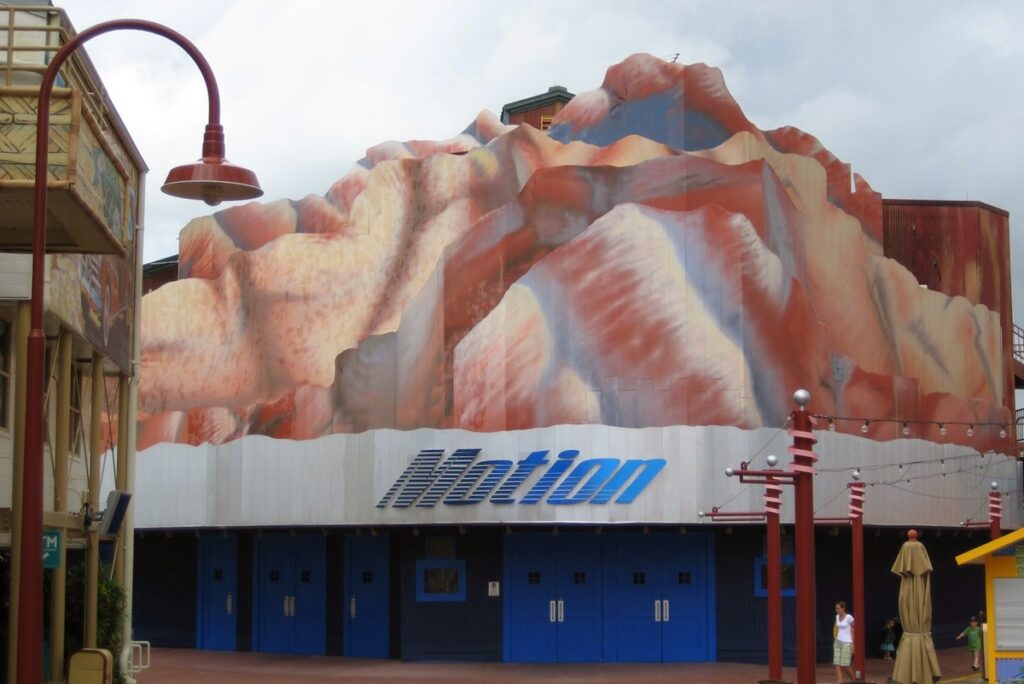
Motion was a popular dance club located on Pleasure Island, the former nightlife and entertainment district at Walt Disney World that is now part of Disney Springs. Opening on May 12, 2001, Motion specialized in contemporary Top 40 music, hip-hop, music videos, and popular dance hits. Its large video screen, professional DJs, dance floor, and high-energy atmosphere made it one of Pleasure Island’s primary destinations for guests interested in mainstream popular music. The nightclub occupied a building that had previously housed Fireworks Factory and Wildhorse Saloon, two very different entertainment and dining establishments. Motion closed permanently on September 27, 2008, along with Pleasure Island’s remaining nightclubs. The building was demolished between December 2010 and January 2011, and its former site was incorporated into the redevelopment that eventually produced The Landing at Disney Springs.
Motion was situated near the northeastern end of Pleasure Island, beside the former Rock ‘n’ Roll Beach Club.
Its location placed it close to one of the principal pedestrian routes connecting the entertainment district with the surrounding Downtown Disney shopping and dining areas.
Unlike Pleasure Island’s more elaborately themed venues, Motion emphasized contemporary nightclub entertainment.
Its identity was built around popular music, dancing, and video technology rather than a complicated fictional storyline.
That approach distinguished it from establishments such as the Adventurers Club, Comedy Warehouse, and Mannequins Dance Palace.
Although Motion was one of the newer nightclubs on Pleasure Island, its building had a history extending back to the district’s original opening in 1989.
The original Fireworks Factory
Pleasure Island officially opened on May 1, 1989, as an expansion of Walt Disney World’s shopping and dining district.
Disney developed the island as an adult-oriented entertainment destination, offering nightclubs, live music, restaurants, comedy performances, and specialty shops.
The district was built around an elaborate fictional history.
According to the story created by Disney Imagineers, Pleasure Island had once been the industrial headquarters of Merriweather Adam Pleasure, an eccentric entrepreneur, inventor, and adventurer.
The buildings were presented as former factories, warehouses, and workshops that had been restored for entertainment purposes.
Motion’s building originally housed Fireworks Factory, a heavily themed barbecue restaurant operated by Levy Restaurants.
The restaurant’s fictional history was among the most elaborate on the island.
According to the story, Merriweather Pleasure had used the building to manufacture and store fireworks.
An accident supposedly occurred when Pleasure’s cigar ignited explosive materials, causing extensive damage.
The restaurant’s interior incorporated artificial cracks, scorched surfaces, and other decorations suggesting the aftermath of the explosion.
Its menu emphasized barbecue, including ribs, chicken, and other grilled meats.
Fireworks Factory operated from May 1, 1989, until 1997.
The building was subsequently renovated for another entertainment concept.
The Wildhorse Saloon years
On May 31, 1998, Wildhorse Saloon opened in the former Fireworks Factory building.
The establishment was associated with Gaylord Entertainment and Levy Restaurants.
It combined a country music dance club with a barbecue restaurant.
Wildhorse capitalized on the popularity of country music and line dancing during the 1990s.
Unlike Fireworks Factory, which concentrated primarily on themed dining, Wildhorse placed greater emphasis on dancing and live entertainment.
The club offered guests an opportunity to enjoy country music in an environment inspired by traditional American saloons.
Its operating history was relatively brief.
Gaylord Entertainment’s financial records show that the company ceased operating its Orlando Wildhorse Saloon in November 2000.
Disney acquired the company’s assets associated with the location and released it from the operating lease.
The establishment’s final public closure is commonly dated February 25, 2001.
These dates reflect different stages in the transfer and closure of the business, rather than necessarily conflicting accounts of a single event.
Disney subsequently prepared the building for a new nightclub.
The replacement abandoned the country-and-western theme in favor of contemporary popular music.
Motion opens in 2001
Motion officially opened on May 12, 2001.
The opening date is confirmed by Disney’s historical encyclopedia.
The new establishment emphasized Top 40 music, with DJs playing current popular hits accompanied by music videos.
A massive video screen became one of the club’s defining features.
Rather than treating videos as background decoration, Motion incorporated them directly into the dance-club experience.
Guests could watch the latest music videos while dancing to the corresponding songs.
This combination of audio and video was consistent with the entertainment trends of the late 1990s and early 2000s.
Music television remained influential, and videos were an important way for recording artists to promote new releases.
Motion brought that format into a nightclub setting.
The club also featured an extensive lighting system, professional sound equipment, and a dedicated DJ booth.
The dance floor occupied the central portion of the venue.
Unlike the revolving dance floor at Mannequins Dance Palace, Motion’s primary attraction was its music selection and visual presentation.
The building’s earlier interiors had been substantially adapted to accommodate the new operation.
Although the former Fireworks Factory structure remained, the emphasis on modern dance music created an entirely different atmosphere.
Music and entertainment
Motion concentrated on music that was currently popular with mainstream audiences.
Its format included Top 40 hits, hip-hop, and other dance-oriented selections.
The club also featured recognizable group dances and line-dance favorites.
This made Motion relatively accessible to visitors who preferred familiar popular music over specialized nightclub genres.
Pleasure Island offered several distinct music experiences during Motion’s operating years.
Mannequins Dance Palace emphasized electronic dance music, including techno, house, and progressive styles.
8TRAX concentrated on music from the 1970s and 1980s.
BET Soundstage Club featured hip-hop, R&B, reggae, and related styles.
Rock ‘n’ Roll Beach Club offered live bands performing rock and popular music.
Motion provided an alternative for guests who wanted to hear contemporary chart hits.
A visitor could therefore choose between different musical styles without leaving Pleasure Island.
Motion was particularly appealing to younger adults and guests who enjoyed dancing to familiar songs.
The club’s DJs played an important role in maintaining the atmosphere.
Unlike a venue featuring a fixed live performance, the DJ could adjust the musical selections according to the crowd.
Popular songs, recognizable music videos, and group dances encouraged audience participation.
A firsthand account of Motion’s final operating years specifically recalls DJ Talie leading crowded dance floors through dances such as the Cupid Shuffle and Cha Cha Slide.
Those selections provide a useful indication of the club’s musical character.
Motion was not exclusively a hip-hop club or an electronic dance venue.
Its programming emphasized popular music that appealed to a relatively broad audience.
The nightclub interior
Motion’s interior reflected its emphasis on music and dancing.
The large dance floor was positioned beneath an extensive lighting installation.
A raised DJ booth provided a focal point for the nightclub.
The video screen allowed guests to watch music videos while dancing.
Bars were positioned around the venue to serve customers without requiring them to leave the building.
Photographs taken after the club’s closure provide valuable details about its layout.
The building included a north bar, a stage area, and a substantial lighting bridge over the dance floor.
Professional sound and lighting equipment remained installed for some time after the nightclub stopped operating.
These photographs confirm that Motion was a fully equipped dance venue rather than a temporary entertainment space created inside an otherwise unchanged restaurant.
The DJ booth was also a recognizable part of the interior.
Its placement allowed the DJ to oversee the dance floor and coordinate music with the surrounding lighting and video effects.
Motion’s decorations were comparatively modern.
The club did not attempt to recreate the damaged fireworks factory associated with the original restaurant or the country saloon atmosphere of Wildhorse.
Instead, its identity was driven by lighting, video, music, and crowds.
This made it representative of the changing entertainment tastes that Disney was attempting to accommodate at Pleasure Island during the early 2000s.
Admission and operating hours
Motion operated within Pleasure Island’s nighttime entertainment system.
During the island’s earlier years, guests purchased admission that generally provided access to multiple nightclubs.
In August 2004, Disney changed Pleasure Island’s admission arrangements.
Visitors could enter the island’s public pedestrian areas without purchasing admission.
However, admission was still required to enter the nightclubs.
This allowed guests to explore shops and restaurants without paying for the entertainment venues.
Motion continued operating as a separately controlled nightclub.
An archived September 2008 visitor guide identifies its usual opening time as approximately 9 p.m.
The club generally remained open until the nightlife district closed in the early morning.
Its hours could vary when private functions or special events were scheduled.
The same archived guide describes Motion as an energetic club featuring Top 40 music.
This contemporary description supports its identification as Pleasure Island’s mainstream popular-music venue.
Motion was primarily a nightclub rather than a conventional restaurant.
Although bars served alcoholic beverages, the establishment was not known for a substantial food menu.
Its original predecessors, Fireworks Factory and Wildhorse Saloon, had been major dining locations.
Motion represented a shift toward an entertainment experience centered on drinking and dancing.
The available records do not establish a complete contemporary cocktail menu or reliable prices for individual drinks.
It would therefore be inappropriate to attribute specific signature cocktails or food selections to Motion without further documentation.
The final years of Pleasure Island
Motion continued operating throughout the middle of the 2000s.
However, Disney was increasingly reconsidering Pleasure Island’s role within Downtown Disney.
The island had originally been developed as a destination for adult nightlife.
By the 2000s, the surrounding shopping and dining district had expanded substantially.
The West Side offered additional restaurants, shops, and entertainment venues.
Disney also introduced new dining concepts to Pleasure Island itself.
Raglan Road Irish Pub & Restaurant opened in October 2005, occupying the former Pleasure Island Jazz Company area.
Other retail businesses were replaced or renovated.
In February 2008, Rock ‘n’ Roll Beach Club closed.
Its location was immediately beside Motion, making the disappearance of the neighboring venue particularly noticeable.
Motion remained open, along with the other principal nightclubs.
The decisive change came in June 2008.
Disney announced that Pleasure Island’s remaining nightclubs would close permanently that September.
The affected businesses included Motion, Mannequins Dance Palace, 8TRAX, the Adventurers Club, Comedy Warehouse, and BET Soundstage Club.
Disney explained that it intended to introduce a new mixture of shopping, dining, and entertainment experiences.
The remaining restaurants and certain shops would continue operating.
The decision marked the end of Pleasure Island’s original nightclub-centered identity.
For Motion, the announcement meant that a relatively new nightclub would close after only seven years of operation.
Motion’s final night
Motion served its final regular guests on September 27, 2008.
The club closed in the early morning hours of September 28, following the final Saturday-night celebration.
A firsthand retrospective identifies DJs Hollywood Bob and Pete Haynes as the performers during Motion’s final night.
The music included Top 40 hits, hip-hop, and popular line dances.
The club attracted a capacity crowd.
Motion’s closing was part of a much larger event across Pleasure Island.
Visitors gathered at the remaining nightclubs for their final performances and parties.
The Adventurers Club presented its final ceremonies, Comedy Warehouse held its last improvisational shows, and the dance clubs welcomed longtime visitors for one final evening.
The closing also marked the end of Pleasure Island’s nightly New Year’s Eve tradition.
For guests who had visited regularly, the event represented the disappearance of an entire entertainment district rather than the closure of a single establishment.
Within 24 hours of Motion’s closure, its exterior name sign had been removed.
The rapid removal of the branding demonstrated that Disney intended the nightclub’s regular operation to end permanently.
However, the building itself remained standing.
Private events after closure
Motion’s history did not end completely in September 2008.
Although the nightclub no longer admitted the general public, Disney retained the building for other uses.
In early 2009, plans emerged to make several former Pleasure Island venues available for private events.
Motion was among the locations considered, along with the Adventurers Club and BET Soundstage Club.
The arrangement offered a way to use the existing buildings while Disney evaluated the future of the district.
The former nightclub retained much of its entertainment infrastructure.
Its dance floor, DJ booth, bars, and lighting equipment were still available.
This allowed the building to accommodate private parties and internal Disney events without requiring a complete renovation.
In June 2009, a promoter associated with Gay Days rented Motion for a private dance party.
The event was restricted to invited or ticketed guests.
Disney separated the venue from the surrounding public walkways so that visitors would not mistake the event for a reopening of the nightclub.
A firsthand visitor account confirms that the interior remained recognizable as Motion.
The DJ booth and dance-floor arrangement were still present.
The event provided an unusual opportunity for guests to experience the former nightclub after its official closure.
However, it did not represent a permanent reopening.
Motion continued functioning primarily as private meeting and event space.
Disney meeting and banquet use
By 2010, Disney was using the former nightclub for cast member meetings and other internal functions.
Photographs taken in April 2010 show the interior arranged for a banquet-style event.
Tables and chairs had been placed in the former dance area.
The lighting bridge remained suspended above the room.
The bars and DJ booth were still recognizable.
Many elements of the original sound and lighting system also remained installed.
The photographs suggest that the facility could have returned to nightclub use with relatively little modification, although Disney had no announced plan to resume regular operations.
Later photographs from September and October 2010 show evidence of additional meeting activity.
The building remained structurally intact and continued offering useful event space more than two years after Motion’s final public night.
That continued use helps distinguish Motion from some of the other former Pleasure Island nightclubs.
Its interior was not immediately stripped or abandoned following the closure.
For a period, Disney maintained the facility as a usable venue.
However, the long-term redevelopment of Pleasure Island eventually required the building’s removal.
Demolition in 2010 and 2011
During 2010, Disney prepared a new redevelopment plan for the former nightclub district.
The project was initially associated with Hyperion Wharf, a proposed waterfront entertainment and dining area.
The plan required the removal of several former nightclub buildings.
Motion was among the first selected for demolition.
Interior gutting began in November 2010.
Construction walls appeared around Motion and Rock ‘n’ Roll Beach Club the following month.
Demolition work began in December.
By early January 2011, much of Motion’s front section had disappeared.
The remaining portions of the building were removed during the following weeks.
By the end of January, Motion had been completely demolished.
Contemporary construction photographs confirm the demolition sequence.
The structure was removed rather than converted into another nightclub or restaurant.
The reason was partly related to pedestrian circulation.
Motion’s location occupied space needed for a new walkway connecting the surrounding shopping and dining areas.
Its demolition also opened views toward the waterfront and surrounding developments.
The removal of Motion therefore created opportunities for a substantially different arrangement of pedestrian routes and entertainment facilities.
Rock ‘n’ Roll Beach Club was demolished during the same general redevelopment period.
Together, the two former nightclubs occupied a significant portion of the island’s northeastern waterfront area.
Their removal changed the physical appearance of Pleasure Island considerably.
What replaced Motion?
The former Motion site was ultimately incorporated into the redevelopment of Pleasure Island as The Landing at Disney Springs.
After Hyperion Wharf was abandoned, Disney announced the larger Disney Springs project in March 2013.
The redevelopment introduced new restaurants, specialty retail stores, waterfront walkways, and outdoor gathering spaces.
The area formerly occupied by Motion and Rock ‘n’ Roll Beach Club was reconfigured.
A major new waterfront restaurant, The BOATHOUSE, opened in April 2015.
The restaurant occupies portions of the broader redevelopment area associated with the former Motion nightclub.
However, the precise footprints of the original clubs and the newer facilities do not correspond exactly.
The demolition created space not only for restaurants but also for new pedestrian walkways and surrounding public areas.
Historical photographic comparisons identify The BOATHOUSE as the modern landmark most closely associated with Motion’s former location.
Other nearby redevelopment features include the Waterview Stage and the expanded waterfront pedestrian network.
This is an important distinction for historical records.
Motion was not directly renovated into The BOATHOUSE.
The nightclub was demolished, the surrounding area was reconfigured, and new structures were built.
The BOATHOUSE therefore represents a later use of the broader site rather than a continuation of Motion’s original building.
Historical significance
Motion is noteworthy because it represents the final generation of nightclubs introduced at Pleasure Island.
The original 1989 district emphasized elaborate environmental storytelling, with buildings designed around Merriweather Adam Pleasure’s fictional industrial empire.
The Fireworks Factory restaurant was a particularly detailed example of that approach.
Wildhorse Saloon later introduced a country-and-western theme to the same building.
Motion abandoned those identities in favor of contemporary popular music, video technology, and a high-energy nightclub atmosphere.
The three businesses illustrate the changing entertainment preferences of Walt Disney World visitors between 1989 and 2008.
Fireworks Factory emphasized themed dining.
Wildhorse combined barbecue with country music and line dancing.
Motion concentrated on DJs, Top 40 hits, hip-hop, and music videos.
Each occupied the same general structure but served a different purpose.
Motion also broadened Pleasure Island’s musical lineup.
Guests who preferred contemporary popular music could visit Motion rather than the electronic dance music at Mannequins, the retro selections at 8TRAX, or the R&B-focused programming at BET Soundstage.
Its large video screen was central to that identity, combining the music-video culture of the early 2000s with the social environment of a nightclub.
The club also became associated with popular group dances.
Songs such as the Cupid Shuffle and Cha Cha Slide were particularly well suited to its accessible, mainstream format.
The closing in September 2008 was especially significant because Motion had operated for only about seven years.
It was one of the newer clubs eliminated during the shutdown of Pleasure Island’s nightlife district.
Its later use for private events and Disney meetings also illustrates the uncertain transition period that followed the nightclub closures.
For approximately two years, the building remained usable even though the public entertainment operation had ended.
The eventual demolition removed one of the last physical connections to Fireworks Factory, Wildhorse Saloon, and Motion.
Unlike some former Pleasure Island venues that were incorporated into new restaurants, Motion’s building disappeared entirely.
The modern waterfront landscape bears little resemblance to the location during the nightclub years.
As of November 2026, Motion remains permanently closed.
Its building was demolished in January 2011, and the nightclub has not reopened elsewhere at Walt Disney World.
The broader site is now part of The Landing at Disney Springs, near The BOATHOUSE and the surrounding waterfront pedestrian areas.
For guests who visited Pleasure Island during the early and middle 2000s, Motion was a place to dance to familiar popular music while watching videos on a giant screen.
Its combination of Top 40 hits, energetic DJs, and a busy dance floor provided a distinctive alternative to the island’s other entertainment venues.
Although Motion operated for a relatively short period, its history connects three major eras of the same Pleasure Island building and illustrates the transformation of Walt Disney World’s former nightlife district into the shopping and dining destination known today as Disney Springs.