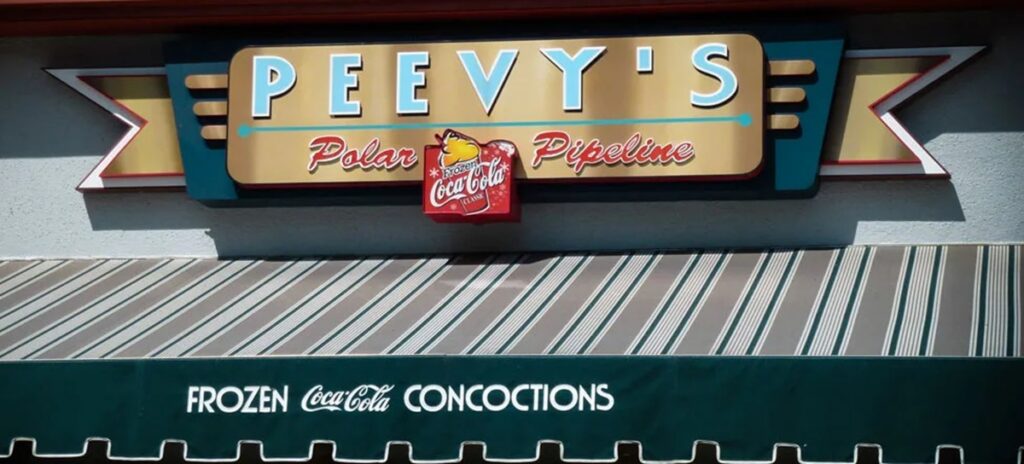
Peevy’s Polar Pipeline is a small outdoor refreshment stand located in the Echo Lake area of Disney’s Hollywood Studios. Specializing in frozen Coca-Cola beverages, flavored slushies, and ice cream novelties, the kiosk is one of the park’s more easily overlooked dining locations. Its real significance, however, lies in its elaborate references to Disney’s 1991 live-action film The Rocketeer. Designed to resemble the workshop of inventor and aviation mechanic A. “Peevy” Peabody, the stand incorporates movie-related props, fictional newspaper clippings, mechanical equipment, and other details that connect it to the original Hollywood theme of Disney-MGM Studios.
The kiosk is situated behind Keystone Clothiers, near the intersection of Keystone Street and Echo Lake Drive. Guests entering the park can find it by turning toward Echo Lake from Hollywood Boulevard, rather than continuing straight toward the Chinese Theater. Its location places it near Hollywood & Vine and the surrounding Echo Lake businesses, in a relatively quiet corner of the park.
Unlike a conventional refreshment cart, Peevy’s Polar Pipeline occupies a permanent storefront integrated into the architecture of the original Disney-MGM Studios streetscape.
The building’s history predates the introduction of the Rocketeer theme.
When Disney-MGM Studios opened on May 1, 1989, the location was known as Lakeside News, a small newsstand selling newspapers, magazines, comic books, and other publications.
This original business fit the park’s recreation of Hollywood during the 1930s and 1940s. Newsstands were familiar fixtures of American commercial districts, particularly in neighborhoods associated with film studios, offices, theaters, and other businesses.
The original merchandise reportedly included period-style magazines and publications appropriate to the surrounding setting.
Lakeside News was part of a larger collection of storefronts designed to make the entrance to Echo Lake resemble an established Los Angeles neighborhood.
The architecture was not entirely fictional. The building’s façade drew inspiration from a fire station constructed in 1940 on Pasadena Avenue in the Lincoln Heights neighborhood of Los Angeles.
Its streamlined commercial appearance complemented the Art Deco and early twentieth-century architectural styles represented throughout Hollywood Boulevard and Echo Lake.
The surrounding buildings incorporated references to real Hollywood history, including early movie studios, entertainment industry businesses, and the neighborhoods where Walt Disney and other filmmakers worked during the industry’s formative decades.
One nearby storefront references Holly-Vermont Realty, a name connected to the intersection of Hollywood Boulevard and Vermont Avenue, where Walt Disney established his first Hollywood studio in 1923.
The area also includes architectural references to Keystone Studios, the pioneering comedy production company associated with filmmaker Mack Sennett.
Above Peevy’s Polar Pipeline is a billboard advertising Maroon Studios, the fictional animation company featured in Disney’s 1988 film Who Framed Roger Rabbit.
These details place the kiosk within a particularly rich section of the park’s original Hollywood-themed environment.
The transformation from Lakeside News to Peevy’s Polar Pipeline occurred after the release of The Rocketeer.
The film premiered in American theaters on June 21, 1991, and was produced by Walt Disney Pictures under the Touchstone Pictures banner.
Directed by Joe Johnston, The Rocketeer is set in Los Angeles during 1938 and follows Cliff Secord, a young stunt pilot who discovers an experimental rocket pack that allows him to fly.
The film stars Billy Campbell as Cliff Secord, Jennifer Connelly as Jenny Blake, Alan Arkin as A. “Peevy” Peabody, and Timothy Dalton as Hollywood actor Neville Sinclair.
Peevy is Cliff’s friend, mechanic, and technical adviser.
An experienced aviation engineer, he helps maintain Cliff’s aircraft and eventually modifies the mysterious rocket pack so that it can be operated more safely.
His ingenuity is essential to Cliff’s transformation into the Rocketeer.
The character was originally created by writer and artist Dave Stevens for The Rocketeer comic-book series, which debuted in 1982.
Stevens drew heavily on the visual culture of the 1930s, including pulp adventure stories, aviation heroes, Hollywood serials, and the streamlined industrial design of the period.
Those influences made The Rocketeer particularly appropriate for Disney-MGM Studios.
The film’s 1938 setting closely matched the era represented by the park’s original Hollywood Boulevard and Echo Lake architecture.
Following the film’s release, Disney converted the former Lakeside News location into Peevy’s Polar Pipeline.
The exact date of the conversion is disputed.
Several detailed historical accounts identify 1991, indicating that the newsstand was repurposed shortly after the film opened.
Other historical chronologies identify 1996 as the opening year, while acknowledging that 1991 appears in competing accounts.
The surviving evidence establishes the original Lakeside News operation in 1989 and the subsequent Rocketeer-themed conversion, but a definitive contemporary opening announcement for Peevy’s Polar Pipeline has not been identified.
The most defensible historical dating is therefore the early-to-mid-1990s, with 1991 frequently cited as the conversion year.
That uncertainty should be preserved rather than assigning the kiosk an exact opening day.
The conversion was more substantial than simply changing the sign.
Imagineers transformed the storefront into a fictional workshop associated with Peevy’s engineering activities.
The location was decorated with vintage industrial equipment, aviation-related artifacts, mechanical tools, and references to the events of The Rocketeer.
The most recognizable display is the Rocketeer’s helmet and rocket pack.
These items are positioned near the left side of the refreshment counter, giving guests an opportunity to examine replicas or production-related artifacts associated with the film.
Historical examinations identify the displayed helmet as a stunt helmet, designed with a wider shape that made it easier for a performer to remove during demanding sequences.
The rocket pack is another recognizable element of the character’s costume.
In the film, the device is an experimental invention that becomes the target of criminals and enemy agents who recognize its potential military significance.
Peevy modifies the equipment to make it usable by Cliff, helping create the distinctive flying hero known as the Rocketeer.
Displaying these objects at the refreshment stand establishes an immediate connection to the fictional mechanic’s workshop.
Other decorative details are more subtle.
The menu was historically printed over a faded blueprint depicting the rocket pack’s mechanical design.
This gave an ordinary food-service menu the appearance of a document that might have been found among Peevy’s engineering papers.
Vintage welding tanks and red tool trays reinforced the workshop setting.
These objects helped make the kiosk resemble a place where aircraft equipment was being repaired rather than a conventional beverage stand.
Another notable detail is a framed newspaper describing the Rocketeer’s first public appearance.
The fictional newspaper is dated to the film’s 1938 setting and features a headline and image associated with the character’s dramatic debut.
The display also includes other period-style news stories, reinforcing the illusion that the events of The Rocketeer occurred within the Hollywood neighborhood represented by the park.
Nearby, a banner advertises Bigelow’s Air Circus.
The fictional air show plays an important role in the movie.
Cliff appears at the event wearing the rocket pack and ultimately uses it to rescue a pilot in danger, revealing the Rocketeer’s flying abilities to a public audience.
The Bigelow’s Air Circus reference connects the refreshment stand to a specific sequence from the film rather than relying exclusively on recognizable props.
It also reinforces the aviation theme that runs throughout the location.
The circus banner has an additional connection to Walt Disney World.
Jock Lindsey, a character introduced in Raiders of the Lost Ark, has been incorporated into Disney’s broader fictional aviation history through Jock Lindsey’s Hangar Bar at Disney Springs.
The fictional history surrounding the hangar bar includes references to Jock’s aviation adventures and his connections to the world of The Rocketeer.
Although this is not central to Peevy’s Polar Pipeline’s original identity, it demonstrates how Disney occasionally connects details from different adventure films through environmental storytelling.
The Rocketeer had a larger presence at Disney-MGM Studios during the film’s initial release.
In the summer of 1991, Disney incorporated the character into the park’s Sorcery in the Sky nighttime spectacular.
During the special presentation, the Rocketeer appeared near the Chinese Theater and performed an aerial sequence using rocket-powered effects.
The stunt was intended to promote the new movie and complemented the park’s original focus on filmmaking and special effects.
Other Rocketeer-related displays were also featured in the park.
The Studio Backlot Tour included props and vehicles associated with the film, while a Rocketeer Gallery displayed additional production materials.
For several years, guests could encounter the character and his equipment in multiple areas of Disney-MGM Studios.
Most of those promotional displays eventually disappeared.
Peevy’s Polar Pipeline became one of the few surviving permanent references to the film.
That distinction became increasingly important as Disney’s Hollywood Studios moved away from its original working-movie-studio identity.
The refreshment stand itself maintained a relatively simple menu.
Its principal specialty was a selection of frozen Coca-Cola beverages marketed as Peevy’s Frozen Concoctions.
The drinks included traditional frozen Coca-Cola and fruit-flavored frozen beverages.
The limited menu fit the location’s small physical footprint.
Unlike nearby Hollywood & Vine or the 50’s Prime Time Café, Peevy’s did not operate a kitchen serving complete meals.
Its primary purpose was to provide cold drinks and packaged snacks to visitors walking between Hollywood Boulevard and Echo Lake.
During its early history, the kiosk concentrated on nonalcoholic beverages.
Later menus introduced alcoholic frozen drinks, allowing adults to add liquor to selected slushy flavors.
This expansion became one of Peevy’s distinguishing features during the 2010s and 2020s.
A documented July 2019 menu listed four frozen beverage flavors: Cosmic Coca-Cola, Fanta Blue Raspberry, Wild Cherry, and Lemonade.
Nonalcoholic frozen drinks were priced at $4.99.
Guests could add a shot of rum or vodka for $11.50.
A Jack Daniel’s and Coke combination was also available for $11.50.
The frozen cocktail offerings helped differentiate Peevy’s from some of the simpler snack kiosks around the park.
Although the drinks were relatively straightforward, the ability to purchase a frozen Coca-Cola with whiskey or a fruit-flavored slushy with rum made the location appealing to adult visitors.
The stand also served Disney ice cream novelties.
Mickey’s Premium Ice Cream Bars and Mickey’s Ice Cream Sandwiches were priced at $5.19 on the July 2019 menu.
Frozen lemonade and frozen strawberry-lemonade cups were also available.
Bottled Coca-Cola products, Powerade, Dasani water, and Smartwater completed the beverage selection.
By May 2021, the menu had retained the same basic structure.
Peevy’s Frozen Concoctions were still offered in Coca-Cola, Blue Raspberry, Wild Cherry, and Minute Maid Lemonade flavors for $4.99.
Adding Bacardi Superior Rum or Tito’s Handmade Vodka increased the price to $13.
Jack Daniel’s Tennessee Whiskey with frozen Coke was also priced at $13.
Mickey’s Premium Ice Cream Bars and Ice Cream Sandwiches cost $6, while frozen lemonade cups were priced at $5.75.
The consistency of the menu illustrates the kiosk’s straightforward operating model.
Unlike restaurants that periodically introduced elaborate new dishes or seasonal menus, Peevy’s continued concentrating on cold beverages and familiar frozen snacks.
Its relatively small selection was appropriate for a location designed primarily around convenience and themed atmosphere.
The stand also developed a reputation for irregular operating hours.
During various periods, Peevy’s opened seasonally or operated only during the busiest parts of the day.
Its hours were not always listed in the My Disney Experience app, and the kiosk could remain closed on days when attendance was comparatively low.
This made the location easy to miss.
Guests walking directly down Hollywood Boulevard toward the park’s major attractions might never notice the refreshment counter behind Keystone Clothiers.
Even visitors who knew where it was located could encounter the service window closed.
The building’s elaborate decorations remained visible, however, allowing guests to appreciate the Rocketeer references whether or not the kiosk was serving drinks.
That distinction is significant because Peevy’s historical value does not depend entirely on the snack operation.
The building is also a small permanent exhibit celebrating a Disney film that has relatively little representation elsewhere in the theme parks.
In February 2024, renewed attention focused on the location because Disney was preparing to open Ice Cold Hydraulics, another Coca-Cola-themed frozen beverage stand on Grand Avenue.
The new kiosk offered frozen Coca-Cola, Blue Raspberry, and Minute Maid Lemonade drinks, along with alcoholic variations.
Its menu overlapped substantially with Peevy’s established beverage selection.
This raised questions about whether Disney would continue operating both locations.
However, Disney did not announce that Ice Cold Hydraulics would replace Peevy’s Polar Pipeline.
The two businesses occupied separate locations and featured entirely different architectural concepts.
Ice Cold Hydraulics opened on February 20, 2024, in a new building designed to resemble a vintage automotive repair business.
Peevy’s remained in its longtime Echo Lake location.
The distinction matters because the newer kiosk did not represent a direct conversion or relocation of the Rocketeer-themed stand.
By April 2026, Peevy’s Polar Pipeline continued operating and was the subject of a firsthand menu review.
The updated menu confirmed that frozen beverages and ice cream novelties remained the primary offerings.
Nonalcoholic frozen drinks were available in Coca-Cola, Blue Raspberry, Lemonade, and Wild Cherry flavors.
Each was priced at $6.29.
Guests could add Bacardi Silver Rum or Tito’s Handmade Vodka for $16.50.
The Jack Daniel’s Tennessee Whiskey and Coke combination was also listed at $16.50.
Mickey’s Premium Ice Cream Bars and Mickey’s Cookies ‘n’ Cream Ice Cream Sandwiches cost $6.49 each.
Frozen Lemonade Cups and Frozen Strawberry Lemonade Cups were priced at $6.29.
Bottled Coca-Cola beverages were listed at $5.50, while bottled water cost $4.25.
Powerade was priced at $5.50, and Smartwater cost $6.25.
The April 2026 menu also identified the location as participating in the Disney Dining Plan for eligible snack items.
These prices demonstrate the gradual increase in the cost of refreshments since the late 2010s while confirming that the underlying menu concept had changed relatively little.
As of October 2026, Peevy’s Polar Pipeline remains an established refreshment location at Disney’s Hollywood Studios.
Dining guides updated during 2026 continue identifying the kiosk in Echo Lake, and firsthand reporting from April confirms its operation during the current year.
However, the stand retains a history of seasonal or limited-hour operation. Its continued listing should not be interpreted as a guarantee that the service counter is open every day.
No permanent closure or replacement has been confirmed as of October 2026.
The original building remains in place behind Keystone Clothiers, preserving the unusual collection of Rocketeer-themed details that distinguish it from other Walt Disney World refreshment stands.
Peevy’s Polar Pipeline is particularly interesting because its historical significance is considerably greater than its menu might suggest.
The location began as a relatively ordinary newsstand serving the original Disney-MGM Studios entrance area.
Its conversion into a Rocketeer-themed refreshment kiosk transformed it into a small tribute to a specific Disney film and the visual culture of 1930s aviation.
Unlike attractions that presented a complete story through elaborate ride systems or live performances, Peevy’s communicated its theme through individual props and environmental details.
The helmet, rocket pack, newspaper, air circus banner, and engineering blueprints collectively established the identity of a fictional inventor’s workshop.
The kiosk also preserved a connection to the period when Disney-MGM Studios prominently featured props and artifacts from recent Disney and Touchstone Pictures productions.
As the park evolved, many of those displays disappeared.
The Studio Backlot Tour closed in 2014, the Great Movie Ride closed in 2017, and numerous original film-production references were removed during major redevelopment projects.
Peevy’s survived those transformations.
Its continued presence demonstrates how a relatively small food-service location can preserve elements of a theme park’s original identity long after larger attractions have disappeared.
The building’s architecture also contributes to that historical continuity.
The original Lakeside News storefront reflected the commercial buildings of 1930s and 1940s Los Angeles, while the Rocketeer overlay introduced props and mechanical equipment appropriate to the movie’s 1938 setting.
The result is a location whose fictional history fits naturally into the surrounding Echo Lake streetscape.
Peevy’s Polar Pipeline may never have been one of Disney’s Hollywood Studios’ busiest or most elaborate restaurants, but its connection to The Rocketeer makes it one of the park’s more distinctive small dining locations.
More than three decades after the film’s release, the kiosk continues offering frozen drinks and ice cream novelties from a storefront filled with references to Cliff Secord, Peevy Peabody, and the fictional world of 1930s aviation.
Its survival provides a rare physical link between the original Disney-MGM Studios, the promotional history of The Rocketeer, and the modern Disney’s Hollywood Studios experience.