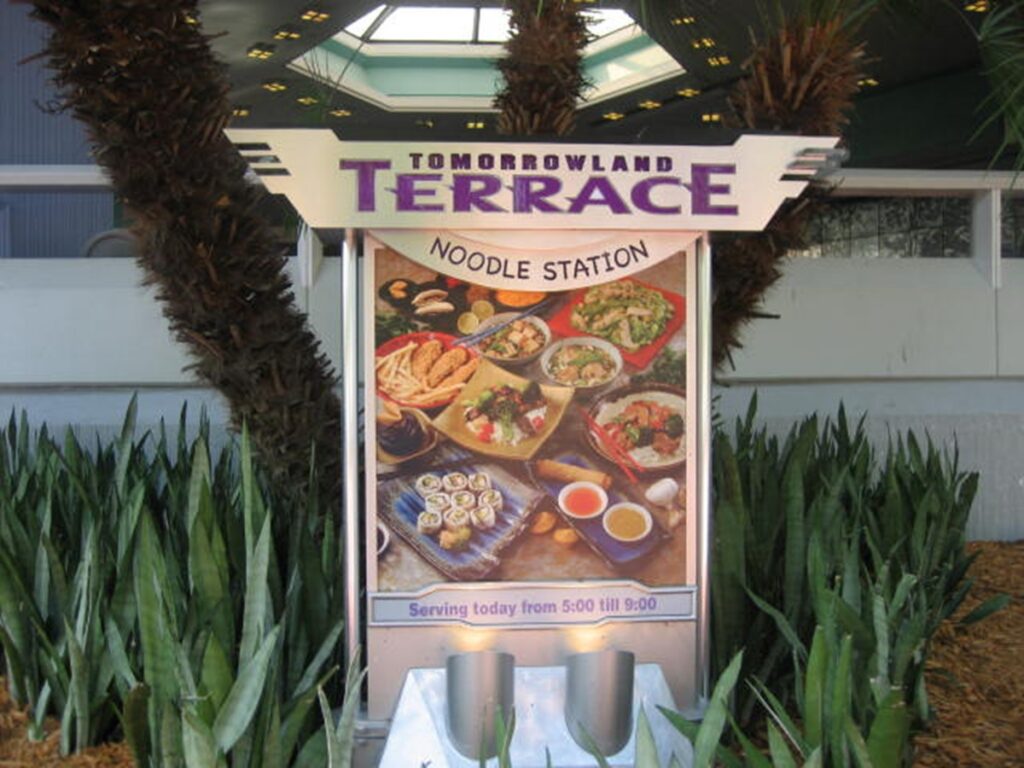
Tomorrowland Terrace Noodle Station was an Asian-inspired quick-service restaurant located at the entrance to Tomorrowland in the Magic Kingdom. Opening on March 15, 2005, the establishment replaced the long-running Plaza Pavilion Restaurant and introduced a menu of noodle bowls, stir-fry, Pad Thai, steamed buns, pot stickers, and other Asian fusion dishes to a park traditionally dominated by American counter-service food.
The restaurant occupied a large, partially covered dining complex overlooking the Magic Kingdom’s central hub and Cinderella Castle. Its tiered outdoor seating areas provided views of the park’s gardens, waterways, and nighttime fireworks, making the location particularly attractive even when the food-service counters were closed.
Tomorrowland Terrace Noodle Station was developed as part of Disney’s effort to expand the variety of quick-service meals available at the Magic Kingdom. Rather than offering another menu of hamburgers, hot dogs, and chicken strips, Disney introduced dishes influenced by Chinese, Japanese, Thai, and other Asian cuisines.
Although the concept initially attracted interest among visitors seeking alternatives to conventional theme park food, the restaurant struggled with inconsistent operating hours. Within months of opening, it was already operating seasonally, and guests frequently encountered closed ordering counters.
The Asian-inspired menu gradually disappeared around 2010–2011, and the establishment was renamed Tomorrowland Terrace Restaurant. Its later operations emphasized American cuisine, pasta, and specialty dining experiences.
The restaurant’s greatest long-term significance ultimately came from its waterfront seating terraces, which became a popular location for Magic Kingdom fireworks dessert parties beginning in 2009.
Origins of the Plaza Pavilion
The history of Tomorrowland Terrace Noodle Station begins with the Plaza Pavilion, a restaurant that opened in the early 1970s.
The Plaza Pavilion occupied the boundary between Main Street, U.S.A., and Tomorrowland, near the pathway leading toward what later became Monsters, Inc. Laugh Floor.
The restaurant opened in 1973, following the Magic Kingdom’s original October 1, 1971 debut.
Its architecture blended the decorative style of Main Street with the more contemporary buildings of Tomorrowland.
The restaurant featured a series of covered dining terraces overlooking the Magic Kingdom hub.
The elevated seating areas allowed guests to enjoy their meals while observing the surrounding gardens and castle.
During the Plaza Pavilion years, the menu concentrated on conventional American quick-service food.
Historical accounts identify hamburgers, hot dogs, pizza, and soft drinks among its selections.
The restaurant was not an especially elaborate dining destination, but its convenient location and extensive seating made it useful during busy park periods.
The Plaza Pavilion remained in operation for approximately three decades.
By the early 2000s, however, Disney was evaluating ways to expand the culinary variety available at the Magic Kingdom.
The decision ultimately led to the restaurant’s conversion into Tomorrowland Terrace Noodle Station.
The 2005 Transformation
In March 2005, Disney announced that the Plaza Pavilion would reopen as Tomorrowland Terrace Noodle Station.
The new concept represented a significant departure from the restaurant’s traditional American menu.
Disney described the establishment as a fast-casual restaurant serving Asian fusion cuisine.
The company explained that the new menu would provide additional variety and healthier alternatives to standard quick-service meals.
The restaurant’s opening was scheduled for March 15, 2005.
An announcement circulated among Walt Disney World Cast Members on March 10 identified the new restaurant and outlined its culinary concept.
The initial menu included noodle bowls, stir-fry, Pad Thai, steamed buns, pot stickers, egg rolls, Asian-inspired salads, and specialty desserts.
The conversion retained the existing restaurant structure.
Rather than constructing a new building, Disney adapted the Plaza Pavilion’s ordering counters and dining terraces to accommodate the new menu.
This approach allowed the company to introduce a different culinary concept while preserving the restaurant’s established location and seating capacity.
Location and Dining Room Design
Tomorrowland Terrace Noodle Station occupied one of the Magic Kingdom’s most distinctive quick-service dining areas.
The restaurant was positioned near the transition between Main Street, U.S.A., and Tomorrowland.
Guests could approach the location from the castle hub or from the walkway leading into Tomorrowland.
The main service counters were located beneath a covered structure.
Dining tables were distributed across several outdoor terraces.
The seating areas were arranged at different elevations, creating views toward Cinderella Castle and the park’s central gardens.
The architecture incorporated geometric details associated with Tomorrowland while retaining elements of the original Plaza Pavilion structure.
Unlike many Magic Kingdom restaurants, most of the seating was outdoors or beneath open-sided covered areas.
The arrangement provided shade and shelter from some weather conditions while maintaining a connection to the surrounding park.
The terraces were also accessible to guests who were not purchasing food.
This became particularly important during the restaurant’s frequent seasonal closures.
Even when the ordering counters were shuttered, visitors could often use the dining areas as a place to sit and rest.
The Original Noodle Bowls
Noodle bowls were the centerpiece of the restaurant’s original menu.
The opening selection included a Shrimp Noodle Bowl, Chicken Noodle Bowl, and Vegetarian Noodle Bowl with Tofu.
A surviving March 2005 menu listed the Shrimp Noodle Bowl at $7.99.
The Chicken Noodle Bowl was priced at $7.29.
The vegetarian version cost $6.79.
These dishes provided quick-service alternatives to the burgers and sandwiches commonly available throughout the Magic Kingdom.
The restaurant also offered Chicken Stir-Fry with Lo Mein Noodles for $6.99.
This selection combined chicken, vegetables, and noodles in a preparation inspired by Chinese-American cuisine.
Another offering was Shrimp Pad Thai, priced at $7.99.
Pad Thai is a Thai noodle dish commonly prepared with rice noodles, eggs, vegetables, and a tangy sauce.
The inclusion of Pad Thai demonstrated Disney’s intention to offer a broad Asian-inspired menu rather than specializing in the cuisine of one country.
Although the recipes were adapted for a large theme park audience, they represented a substantial change from the Plaza Pavilion’s earlier offerings.
Steamed Buns and Appetizers
The Noodle Station also offered several appetizers and smaller dishes.
One distinctive selection was a steamed bun stuffed with barbecued pork and served with Asian slaw.
The opening price was $5.99.
The preparation resembled a Chinese-style steamed bun, combining a soft bread exterior with a savory meat filling.
Fried Egg Rolls were available for $2.39.
Pot Stickers were priced at $2.99.
These offerings were suitable for guests seeking a light meal or a snack rather than a full entrée.
The appetizers also allowed families to share several dishes.
This was somewhat unusual for a Magic Kingdom quick-service restaurant during the mid-2000s, when most counter-service locations concentrated on individual combination meals.
Asian-Inspired Salads
Salads were another important component of the opening menu.
Cashew Chicken Salad was offered for $7.49.
Mandarin Orange Salad was available for $6.49.
These dishes reinforced Disney’s stated goal of introducing additional menu variety and lighter meal options.
The salads incorporated ingredients commonly associated with Asian-inspired American restaurant cuisine.
Their inclusion also distinguished Tomorrowland Terrace Noodle Station from locations concentrating on fried foods and conventional sandwiches.
For visitors seeking something other than a hamburger, the combination of salads, noodle bowls, and stir-fry provided several alternatives.
Children’s Menu
Tomorrowland Terrace Noodle Station included a children’s menu intended to accommodate families with younger guests.
The opening selection featured a choice of stir-fry or noodle soup.
The meal was priced at $3.99.
Disney also offered more familiar food for children who preferred conventional American dishes.
An opening-week guest account documented a hot dog as an additional option displayed on a restaurant sign.
The availability of familiar selections reflected the operational challenge of introducing unfamiliar foods in a family-oriented theme park.
Although adults might welcome the opportunity to order Pad Thai or a vegetarian noodle bowl, children did not necessarily share those preferences.
Providing conventional alternatives helped the restaurant accommodate a broader audience.
Ginger Crème Brûlée and Desserts
One of the restaurant’s most distinctive opening-day desserts was Ginger Crème Brûlée.
The dessert combined the traditional custard preparation with ginger, incorporating an Asian-inspired flavor into a familiar French dessert.
It was priced at $1.99 on the March 2005 menu.
Chocolate Cake was another dessert option, priced at $2.29.
The Ginger Crème Brûlée received attention in early guest reviews because it was an unusual selection for a Magic Kingdom quick-service restaurant.
Rather than offering only cookies, ice cream, or standard packaged desserts, Disney included a preparation more commonly associated with table-service dining.
This reflected the Noodle Station’s broader culinary ambitions.
The concept was intended to provide somewhat more distinctive food without requiring guests to make dining reservations or commit to a lengthy meal.
Specialty Teas
The beverage program also incorporated Asian-inspired selections.
Iced green teas were available in Blackberry Jasmine and Peach Organic flavors.
They were priced at $2.39.
Hot tea selections included Mango Black Tea, Green Tea, and Ginger Ginseng Tea.
The hot teas were priced at $2.19.
These beverages complemented the restaurant’s food menu and offered alternatives to conventional soft drinks.
Their presence also reinforced the effort to create a consistent Asian-inspired dining concept.
The restaurant continued serving traditional fountain beverages, bottled water, coffee, and other familiar refreshments.
Early Guest Reception
Tomorrowland Terrace Noodle Station attracted considerable interest when it opened.
Many Walt Disney World visitors welcomed the addition of Asian-inspired food to the Magic Kingdom.
At the time, guests seeking this type of cuisine frequently traveled to EPCOT’s World Showcase or other Walt Disney World dining locations.
The Noodle Station provided an opportunity to enjoy noodle bowls and stir-fry without leaving the Magic Kingdom.
A detailed guest review published on March 23, 2005, described an early meal at the restaurant.
The reviewers ordered Chicken Stir-Fry with Lo Mein Noodles, Shrimp Pad Thai, pot stickers, an egg roll, children’s noodle soup, and Ginger Crème Brûlée.
They reported that the portions were substantial.
The reviewer also appreciated having an alternative to traditional Magic Kingdom counter-service food.
However, not all early reactions were positive.
Other guests criticized the flavor and preparation of some noodle dishes.
Some visitors found the food insufficiently authentic or poorly executed.
These differing reactions demonstrated the challenges of introducing Asian fusion cuisine to a broad theme park audience.
The Seasonal Operating Problem
One of Tomorrowland Terrace Noodle Station’s most notable characteristics was its inconsistent operating schedule.
Although the restaurant opened in March 2005, it soon began closing during slower periods.
By July 2005, guests were already discussing its seasonal operation.
Some visitors reported that the location was open during the Independence Day holiday period but closed during other summer visits.
The restaurant’s posted menus sometimes remained visible even when the ordering counters were closed.
This created confusion among guests planning to eat there.
Because the location served food not widely available elsewhere in the Magic Kingdom, visitors who specifically wanted noodle bowls could be disappointed when they discovered that the stand was not operating.
The seasonal schedule continued for years.
In March 2009, guests reported that the restaurant was sometimes open during weekends or busy periods, including evening hours.
Other visitors stated that they had repeatedly passed the restaurant without ever finding it open.
By September 2009, its unpredictable schedule had become a recognizable part of the restaurant’s reputation.
The location was frequently described as a restaurant that was rarely open.
Disney did not publicly establish a single reason for the irregular schedule.
The operation was likely influenced by guest traffic and food-service demand, but it would be inaccurate to attribute the closures to a specific menu failure without supporting evidence.
Menu Changes During the Later Years
The restaurant’s menu changed substantially after its opening.
A surviving August 2007 menu shows that the original selection had become more conventional.
The Shrimp Pad Thai, steamed pork bun, and Ginger Crème Brûlée were no longer listed.
Chicken Noodle Bowl remained available for $6.99.
Vegetable Noodle Bowl with Tofu cost $6.79.
Other entrées included Teriyaki Chicken with Steamed Rice for $6.79, Beef and Broccoli with Steamed Rice for $7.69, and a Chicken Caesar Salad for $6.99.
A Sweet and Sour Chicken Bowl appeared as a special for $6.79.
The menu also offered a California Roll for $9.
Fried Chicken Strips were available for $6.69.
This revised selection reflected a gradual movement toward familiar Americanized Asian dishes and conventional quick-service options.
The inclusion of chicken strips and Caesar salad provided alternatives for guests who did not want noodles or stir-fry.
By the end of the decade, the menu was considerably different from the more experimental selection introduced in March 2005.
The Wishes Fireworks Dessert Party
One of the most significant developments in the restaurant’s history occurred in June 2009.
Disney introduced a special fireworks dessert party at Tomorrowland Terrace Noodle Station.
The experience combined a reserved dining area with a buffet of desserts and views of Wishes: A Magical Gathering of Disney Dreams.
The original offering was scheduled from June 23 through August 28, 2009.
Advance reservations were required.
The introductory price was $17.99 for adults and $9.99 for children ages three through nine.
Guests received access to a self-service dessert buffet featuring sweets and beverages.
The experience also included a designated seating area overlooking the Magic Kingdom fireworks.
The venue was particularly suited to this purpose because its terraces faced Cinderella Castle.
Although not every table provided an unobstructed view, the location offered a convenient alternative to standing in the crowded castle hub.
The dessert party became an important part of Tomorrowland Terrace’s later identity.
It also provided a new use for a dining facility that otherwise operated only intermittently.
The Transformation into Tomorrowland Terrace Restaurant
The Asian-inspired Noodle Station concept gradually disappeared during the early 2010s.
Historical sources disagree on the precise date of the transition.
Some retrospectives identify 2010 as the year the establishment became Tomorrowland Terrace Restaurant.
Other restaurant histories place the full renaming and menu change in November 2011.
Contemporary descriptions from July 2011 already refer to Tomorrowland Terrace Restaurant and document a menu that had moved away from the original noodle-focused concept.
Consequently, the change should be understood as a transition occurring around 2010–2011 rather than assigned a single unverified closing date.
The successor restaurant concentrated on American quick-service food.
Menu selections included burgers, sandwiches, salads, and pasta.
A July 2011 review documented Pasta Primavera and Pasta Alfredo, with options to add shrimp or chicken.
A lobster roll and several salads were also available.
The restaurant retained its original covered dining terraces and counter-service arrangement.
The transformation preserved the physical location while abandoning the Noodle Station’s original culinary identity.
The Original Tomorrowland Terrace Name
The name Tomorrowland Terrace has a longer history at the Magic Kingdom than the Noodle Station.
When the park opened on October 1, 1971, a different restaurant called Tomorrowland Terrace operated deeper inside Tomorrowland.
That original restaurant featured a stage for live musical entertainment.
The stage could rise and lower using an elevator mechanism.
Over the years, it hosted numerous performers and entertainment programs.
The original Tomorrowland Terrace closed in September 1994 during the New Tomorrowland redevelopment.
It reopened in December 1994 as Cosmic Ray’s Starlight Café.
The new restaurant introduced Sonny Eclipse, an Audio-Animatronics lounge singer who performs in the Starlight Lounge.
The Tomorrowland Terrace name was subsequently revived for the former Plaza Pavilion location near Main Street.
These two restaurants should not be confused.
The original Tomorrowland Terrace that became Cosmic Ray’s was a different building from the Plaza Pavilion and Tomorrowland Terrace Noodle Station.
Continued Use of the Dining Terraces
Following the end of the Noodle Station concept, Tomorrowland Terrace continued operating intermittently.
The restaurant sometimes opened during busy periods to provide additional quick-service capacity.
Its menu changed several times.
During the COVID-19 pandemic, Disney used the location to provide additional outdoor dining space and temporarily serve menu items associated with Columbia Harbour House.
This arrangement helped distribute guests across the park while certain restaurants operated with modified procedures.
The location also continued serving as a venue for fireworks dessert parties.
Over time, the dessert experiences expanded to include different viewing arrangements and premium packages.
The dining terraces remained particularly valuable because of their proximity to Cinderella Castle.
By August 2025, Tomorrowland Terrace had not operated as a regular quick-service restaurant for an extended period.
The area was primarily used for seating and fireworks dessert parties.
The continued use of the space demonstrates that the building’s location and outdoor terraces remained useful even when conventional restaurant operations were reduced.