
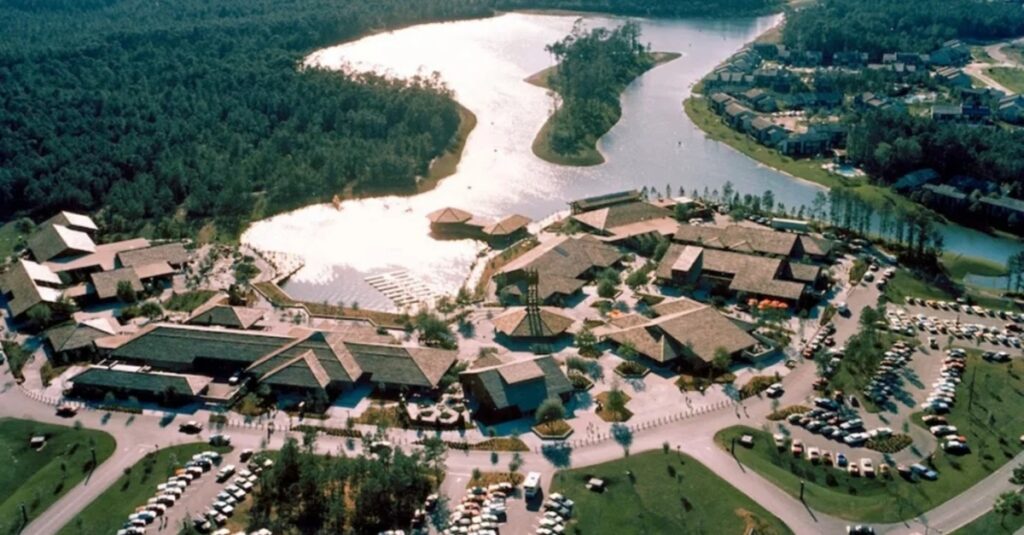
The Village Chummery, later known as the Village Lounge, was a cocktail lounge and live jazz venue located at Lake Buena Vista Shopping Village at Walt Disney World, in the area now known as the Marketplace at Disney Springs. Opening in March 1975 as part of the original shopping village, the lounge initially featured the popular folk duo Salt Water Express before evolving into one of Central Florida’s most respected jazz venues. The Village Lounge became known for performances by internationally recognized musicians, including Clark Terry, Benny Carter, Urbie Green, Teddy Wilson, Kenny Burrell, and numerous other jazz artists. Its longtime house band was the Bubba Kolb Trio, which accompanied an impressive rotating lineup of guest performers. The lounge’s original jazz operation ended before the adjoining Village Restaurant was transformed into Chef Mickey’s in July 1990. The space subsequently became the Disney Cartoon Theatre and was eventually incorporated into the Rainforest Cafe redevelopment in 1996.
Although it was located outside Walt Disney World’s theme parks, the Village Lounge played an unusually important role in the resort’s early entertainment history.
During the 1970s, it offered the kind of intimate, sophisticated live music experience that was otherwise difficult to find in Central Florida. Rather than presenting elaborately staged Disney entertainment, the lounge featured accomplished professional musicians performing jazz standards, improvisations, and small-group arrangements.
For several years, it was a destination for serious jazz enthusiasts as well as Walt Disney World visitors looking for an evening of live music.
Opening with Lake Buena Vista Shopping Village
Lake Buena Vista Shopping Village officially opened on March 22, 1975.
The development was part of Disney’s original vision for Lake Buena Vista, which was intended to become a much larger resort community featuring residential developments, recreational amenities, and a commercial town center.
The shopping village was designed to serve both vacationers and Central Florida residents.
Rather than creating another conventional theme park shopping area, Disney emphasized specialty retail, distinctive restaurants, and a relaxed waterfront atmosphere.
The original businesses included Gourmet Pantry, Village Spirits, Heidelberger’s Deli, Cap’n Jack’s Oyster Bar, and numerous specialty shops.
The Village Restaurant was one of the development’s principal dining establishments.
Occupying a two-level building overlooking the Buena Vista Lagoon, the restaurant offered American cuisine with an emphasis on beef, chicken, and seafood.
Its adjoining cocktail lounge was originally called the Village Chummery.
The unusual name was part of the original shopping village’s somewhat whimsical identity.
Unlike the later Pleasure Island, which developed elaborate fictional histories for its businesses, the original Village concentrated on sophisticated shopping, dining, and entertainment experiences.
The Chummery was designed as a comfortable place where guests could socialize, enjoy cocktails, and listen to live music.
Its location next to the Village Restaurant also allowed it to serve diners waiting for tables.
The Salt Water Express connection
The Chummery’s earliest entertainment was closely associated with the Polynesian Village Resort.
Since Walt Disney World’s opening in 1971, the Polynesian had offered nighttime entertainment in its lounges and restaurants.
One of its most popular acts was Salt Water Express, a folk-music duo consisting of Bob Christopher and Gary Stratton.
The pair performed with guitar and bass, combining music with humor and audience interaction.
Their original home was Cap’n Cook’s Hideaway, a lounge at the Polynesian Village Resort.
They developed a following among vacationers, local residents, and Disney Cast Members.
When Lake Buena Vista Shopping Village opened in March 1975, Disney relocated Salt Water Express to the new Village Chummery.
The decision was intended to establish the lounge as a nighttime entertainment destination.
Disney was attempting to attract visitors to the shopping district after the retail stores had closed.
A recognizable musical act provided a reason for guests to return in the evening.
However, the arrangement was brief.
Within several weeks, Disney was advertising the duo’s return to the Polynesian Village.
The available historical documentation does not establish precisely how many performances Salt Water Express gave at the Chummery.
The original residency was therefore much shorter than the group’s earlier association with the Polynesian.
Nevertheless, the booking demonstrates Disney’s original intentions for the lounge.
From its beginning, the Chummery was conceived as a live entertainment venue rather than simply a bar attached to the Village Restaurant.
The original cocktail menu
One of the most interesting surviving documents associated with the Village Chummery is a promotional article about strawberry margaritas.
The article appeared in an early edition of Lake Buena Vista Village News, a publication that combined promotional information with news about the shopping district.
It described a new specialty drink available at both the Village Chummery and nearby Cap’n Jack’s Oyster Bar.
The cocktail was a strawberry margarita prepared with Valido Fresa strawberry tequila.
The promotional article emphasized that the flavored tequila was unusual in the eastern United States at the time.
The drink combined strawberry tequila, conventional tequila, triple sec, and sweetened lemon-and-lime ingredients.
It was served in a chilled glass with a salted rim and lemon garnish.
The cocktail was also connected to Village Spirits, the specialty wine and liquor shop within the shopping district.
Guests could purchase the strawberry tequila at Village Spirits and prepare the drink themselves.
This was a particularly interesting example of Disney’s original approach to Lake Buena Vista Shopping Village.
Rather than treating the shops and restaurants as unrelated businesses, Disney encouraged customers to discover products in one location and enjoy them in another.
The strawberry margarita was also an early example of the specialty cocktails that would eventually become associated with the shopping district’s nightlife.
A complete original Chummery beverage menu has not been located, so specific prices and additional signature cocktails cannot be reliably documented.
The strawberry margarita remains its best-established early drink.
Becoming the Village Lounge
After Salt Water Express returned to the Polynesian, Disney reconsidered the entertainment program at the Chummery.
Within the first year, the establishment adopted the Village Lounge name and began developing a regular jazz program.
Historical research places the transition during 1975, with jazz performances established by December of that year.
The new identity was considerably different from the original folk-music concept.
Instead of emphasizing an informal duo performing songs and jokes, the Village Lounge concentrated on professional jazz musicians.
The entertainment program was organized around a resident trio that accompanied visiting performers.
This arrangement provided continuity while allowing Disney to introduce different musical personalities throughout the year.
The format was particularly appropriate for a relatively small lounge.
A jazz trio required less space than a large orchestra and could accompany a variety of guest soloists.
The intimate setting also encouraged a close relationship between performers and audiences.
The Bubba Kolb Trio
The musician most closely associated with the Village Lounge was Franklin Dial “Bubba” Kolb.
A pianist and trombonist, Kolb had studied music at North Texas State University.
He became the leader of the resident jazz trio at the Village Lounge.
The Bubba Kolb Trio performed there from 1975 into the early 1980s, accompanying an extensive rotation of guest artists.
The group provided the musical foundation for the lounge’s ambitious entertainment schedule.
Rather than booking a completely different band every evening, Disney could retain the trio while introducing featured performers for extended engagements.
This arrangement was familiar in traditional jazz clubs, where a resident rhythm section often accompanied traveling musicians.
At the Village Lounge, however, the quality of the visiting artists was unusually high for a venue located inside a vacation resort shopping district.
The trio helped establish the lounge’s reputation as a serious jazz destination.
Kolb’s association with the venue lasted for several years, making him one of the most important figures in its history.
Major jazz performers
The Village Lounge hosted a remarkable selection of jazz musicians during its operating years.
Among the best-known were Clark Terry, Benny Carter, Teddy Wilson, Urbie Green, Kenny Burrell, Barney Kessel, Flip Phillips, and Red Norvo.
These performers represented several generations and styles of jazz.
Clark Terry was a celebrated trumpeter and flugelhorn player whose career included associations with Count Basie, Duke Ellington, and television’s Tonight Show orchestra.
Benny Carter was a major figure in jazz history, known for his work as an alto saxophonist, trumpeter, composer, arranger, and bandleader.
Teddy Wilson was one of the most influential swing-era jazz pianists and had performed with musicians such as Benny Goodman and Billie Holiday.
Urbie Green was an accomplished jazz trombonist with extensive recording and orchestral experience.
Kenny Burrell was a leading jazz guitarist associated with numerous important recordings.
Barney Kessel was another highly regarded guitarist whose work spanned jazz, studio recording, and popular music.
Other artists associated with the Village Lounge included Art Van Damme, James Moody, Zoot Sims, Buddy DeFranco, Marian McPartland, and Ira Sullivan.
The number of prominent musicians who performed there was extraordinary for a lounge within a Disney shopping district.
The Village Lounge did not simply present background music for restaurant guests.
It offered a rotating series of serious jazz performances that attracted listeners specifically interested in the musicians.
Contemporary jazz listings
The Village Lounge’s reputation can be verified through contemporary jazz publications.
During the 1970s, DownBeat magazine included the lounge in its listings of live jazz performances.
These listings identified the Bubba Kolb Trio as the resident group and advertised visiting musicians.
An April 1979 listing, for example, documented engagements featuring Larry McShann, Roy Eldridge, and Tommy Flanagan.
A June 1979 listing identified Red Norvo and James Moody among the featured performers.
A separate 1978 listing advertised appearances involving Hank Jones, Milt Hinton, Bobby Rosengarden, Buddy DeFranco, and Ira Sullivan.
These listings are particularly valuable because they provide contemporary evidence of the entertainment program rather than relying exclusively on later visitor memories.
They also demonstrate that the Village Lounge participated in the broader national jazz scene.
Its performances were promoted alongside concerts and nightclub engagements in major American cities.
For Walt Disney World, this was a distinctive achievement.
The company had created a venue where internationally recognized jazz performers appeared regularly within a shopping and dining district.
A popular destination for jazz enthusiasts
The Village Lounge became popular enough to attract audiences from beyond the immediate Walt Disney World resort area.
Historical accounts describe jazz enthusiasts traveling from college campuses, including the University of Florida, to hear the performers.
The growing audience created an unexpected challenge.
The lounge had originally operated without a cover charge or minimum purchase requirement.
However, some visitors came specifically to hear the musicians without spending much money on food or beverages.
Disney eventually introduced a $5 cover charge.
The decision helped support the entertainment program while managing demand for seating.
The change also reflected the lounge’s evolving identity.
What had begun as a comfortable cocktail lounge attached to a restaurant had become a destination for serious jazz listeners.
The performers themselves were increasingly the principal attraction.
The cover charge made the Village Lounge operate more like a conventional jazz club than a restaurant waiting area.
Hours and atmosphere
The Village Lounge offered entertainment late into the evening.
Historical operating information identifies performances from approximately 8 p.m. until 1 a.m. on regular evenings.
On Fridays and Saturdays, the schedule extended from approximately 9 p.m. until 2 a.m.
These hours made the lounge one of the shopping village’s most important nighttime establishments.
Its principal neighboring late-night business was Cap’n Jack’s Oyster Bar.
Both establishments stood near the waterfront and the eastern side of the shopping district.
Their proximity helped create a small concentration of evening activity.
Visitors could enjoy seafood or cocktails at Cap’n Jack’s and then listen to jazz at the Village Lounge.
The atmosphere inside the lounge was comparatively intimate.
Historical descriptions identify overstuffed chairs and comfortable furnishings, giving the space the appearance of a residential sitting room.
This setting distinguished it from the large theatrical entertainment venues that Disney would later introduce at Pleasure Island.
The Village Lounge’s appeal came from professional musicians performing in a relaxed environment.
Its atmosphere was particularly appropriate for small-group jazz.
Guests could listen closely to the performers rather than watching a large staged production.
The Village Restaurant relationship
The Village Lounge was physically connected to the Village Restaurant.
The restaurant opened with Lake Buena Vista Shopping Village in March 1975.
It occupied a two-level building overlooking the Buena Vista Lagoon.
The menu emphasized traditional American restaurant dishes, including beef, chicken, seafood, soups, salads, and desserts.
Guests could also enjoy waterfront views.
The adjoining lounge served as a waiting area for restaurant customers.
However, its jazz entertainment eventually became a separate attraction.
Visitors could attend performances without necessarily planning a full meal at the restaurant.
This relationship was important because the lounge and restaurant shared a building but operated with different purposes.
The Village Restaurant was a conventional table-service establishment.
The Village Lounge was primarily a cocktail lounge and live entertainment venue.
Although some dishes may have been available through shared food-service arrangements, a separate dated Village Lounge food menu has not been verified.
Consequently, menu items associated with the Village Restaurant should not automatically be attributed to the lounge.
The best-documented offerings at the Village Lounge are alcoholic beverages, particularly its early strawberry margarita, and the live jazz performances.
The later jazz years
The Bubba Kolb Trio did not remain the house band throughout the lounge’s entire history.
After Kolb’s departure, other musicians continued supporting the entertainment program.
A retrospective article by jazz writer Jack Simpson identifies Don Scaletta as a later pianist associated with the resident group.
The article also discusses subsequent personnel changes involving bassist George Morrow and drummers Barry Smith and Don Lamond.
These musicians helped maintain the venue’s jazz identity after the original trio changed.
The lounge continued attracting accomplished performers into the 1980s.
The entertainment program therefore lasted considerably longer than the original Village Chummery name.
However, the surviving records do not establish a complete year-by-year schedule or an exact date for the final regular jazz performance.
The lounge’s musical identity gradually disappeared as Disney prepared to introduce new entertainment concepts throughout Walt Disney World.
The arrival of Pleasure Island
Pleasure Island opened on May 1, 1989.
The new district was designed specifically for nighttime entertainment, with dance clubs, live music, comedy, restaurants, and specialty shops.
It represented a substantial departure from the original Lake Buena Vista Shopping Village concept.
During the 1970s, the Village Lounge and Cap’n Jack’s had been among the resort’s principal late-night destinations outside the hotels.
Pleasure Island introduced a much larger collection of evening entertainment options.
Its clubs included Mannequins Dance Palace, Neon Armadillo Music Saloon, XZFR Rockin’ Rollerdrome, and the Adventurers Club.
The new district also offered a nightly New Year’s Eve celebration.
The emphasis on elaborate nightlife experiences changed the role of the older Village.
Disney increasingly promoted the original shopping area as a destination for family-oriented dining and retail.
This change contributed to the disappearance of the Village Lounge’s traditional jazz operation.
The Disney Cartoon Theatre
In July 1990, Disney transformed the adjoining Village Restaurant into Chef Mickey’s Village Restaurant.
The new establishment incorporated Disney character dining, with Mickey Mouse greeting guests during dinner.
The concept was considerably different from the original restaurant.
Its identity was tied to familiar Disney characters rather than conventional American dining.
The former Village Lounge space became the Disney Cartoon Theatre.
Instead of jazz performances, the area was used to entertain guests with Disney animated cartoons.
Historical tenant reconstructions identify cartoon presentations during the evening, generally between approximately 5 p.m. and 10 p.m.
The lounge’s former function as a restaurant waiting area was therefore retained in a different form.
However, its identity as a jazz destination had ended.
The transformation was particularly significant because it demonstrated Disney’s changing approach to the shopping village.
An intimate lounge that had hosted internationally recognized jazz musicians was converted into a family-oriented cartoon screening area.
This change reflected the broader movement toward character-themed experiences during the late 1980s and early 1990s.
The exact final date of the Village Lounge’s regular jazz performances has not been independently established.
However, the conversion to the Disney Cartoon Theatre was associated with the introduction of Chef Mickey’s in July 1990.
The original jazz lounge should therefore be considered closed by that period.
The Rainforest Cafe redevelopment
Chef Mickey’s Village Restaurant continued operating until September 30, 1995.
Disney subsequently relocated the Chef Mickey’s concept to Disney’s Contemporary Resort, where it opened on December 22, 1995.
The former Marketplace restaurant building underwent extensive renovations.
The replacement was Rainforest Cafe, which opened in 1996.
The new restaurant introduced elaborate jungle theming, animatronic animals, thunderstorms, waterfalls, and a large retail component.
The transformation fundamentally changed the appearance and purpose of the former Village Restaurant and Lounge complex.
Unlike the original building’s relatively understated architecture, Rainforest Cafe emphasized theatrical environmental effects.
The restaurant became one of the Marketplace’s most recognizable landmarks.
Its elaborate exterior and large dining rooms attracted visitors who might not otherwise have stopped at the former Village Restaurant.
The redevelopment also eliminated the remaining recognizable elements of the original Village Lounge.
Its overstuffed chairs, jazz performance area, and intimate cocktail lounge atmosphere were replaced by the new restaurant’s theatrical environment.
As of November 2026, Rainforest Cafe continues operating in the Marketplace at Disney Springs.
The original Village Chummery and Village Lounge no longer exist as separate establishments.
Historical significance
The Village Chummery and Village Lounge represent an unusually important chapter in Walt Disney World’s entertainment history.
Opening with Lake Buena Vista Shopping Village in March 1975, the Chummery was originally intended as a comfortable cocktail lounge with live music.
Its early connection to Salt Water Express demonstrated Disney’s attempt to transfer a successful resort entertainment act into the new shopping district.
However, the lounge’s most significant contribution came after its transition to jazz.
Under the Village Lounge name, it became one of Central Florida’s principal jazz destinations.
The Bubba Kolb Trio provided a professional resident group capable of accompanying major visiting musicians.
The resulting performance schedule included an extraordinary collection of jazz talent.
Artists such as Clark Terry, Benny Carter, Teddy Wilson, Urbie Green, Kenny Burrell, and Barney Kessel brought nationally and internationally recognized music to a relatively small Walt Disney World lounge.
The venue’s appearance in contemporary jazz publications confirms that it was recognized beyond the resort’s regular vacation audience.
Its popularity among college students and dedicated jazz listeners also demonstrates its importance to the wider Central Florida music community.
The Village Lounge was not simply a place where a restaurant hired a pianist to provide background entertainment.
It operated as a genuine jazz club, with rotating guest artists, extended performance hours, and eventually a cover charge.
Its atmosphere was equally distinctive.
The comfortable furnishings and intimate setting created a different experience from the elaborate, highly themed nightclubs introduced at Pleasure Island in 1989.
Guests came primarily to listen to accomplished musicians performing in relatively close quarters.
The lounge’s transformation into the Disney Cartoon Theatre illustrates a major change in Walt Disney World’s commercial priorities.
By 1990, Disney was concentrating nighttime entertainment at Pleasure Island and introducing more family-oriented dining concepts in the original Marketplace.
The former jazz lounge was incorporated into Chef Mickey’s Village Restaurant, replacing live jazz with animated cartoons and Disney character entertainment.
The later Rainforest Cafe redevelopment removed the remaining recognizable traces of the original establishment.
For historical records, the distinction between the two lounge names is important.
The Village Chummery was the original 1975 identity, initially associated with Salt Water Express.
The Village Lounge was the successor name under which the establishment developed its nationally significant jazz program.
These were successive identities of the same adjoining lounge space, not two separate restaurants.
As of November 2026, both names are extinct.
The former location is incorporated into the Rainforest Cafe complex at Disney Springs.
Although the lounge has disappeared, its history remains a reminder that Walt Disney World once operated a serious jazz venue where some of the most accomplished musicians of the twentieth century performed regularly.
The Village Chummery and Village Lounge therefore deserve recognition not only as former Walt Disney World drinking establishments but also as an important part of Central Florida’s musical history.