
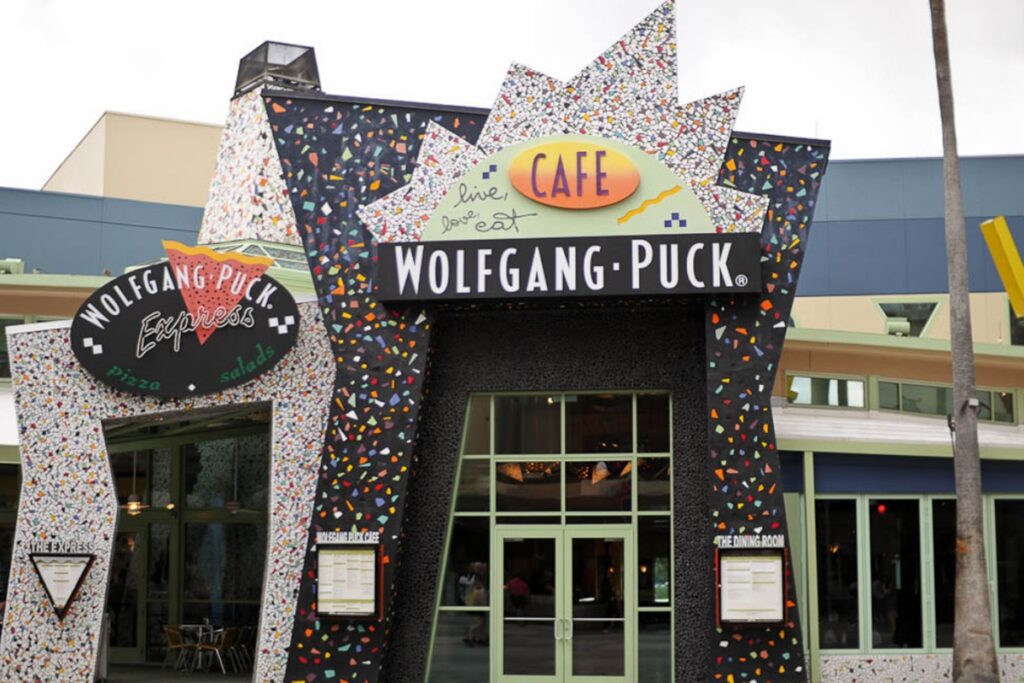
Wolfgang Puck Café, also known as Wolfgang Puck Grand Café, was a large, multi-level restaurant and dining complex located on the West Side of Downtown Disney at Walt Disney World, now known as Disney Springs. Opening on September 15, 1997, the restaurant was one of the original businesses introduced with the West Side expansion. The 22,000-square-foot establishment combined several dining experiences under one roof, including a casual California-inspired café, a sushi bar and lounge, an upscale second-floor Dining Room, and a counter-service Wolfgang Puck Express. Known for its wood-fired gourmet pizzas, innovative salads, pasta, sushi, and California-Asian fusion cuisine, the restaurant operated for nearly twenty years before closing permanently after service on July 31, 2017. Its former location was extensively reconstructed as Jaleo by José Andrés, which opened in March 2019.
Wolfgang Puck Grand Café was one of the first major celebrity-chef restaurants at Walt Disney World. Its arrival reflected the growing importance of nationally recognized chefs in American dining and helped establish Downtown Disney’s West Side as a destination for restaurants as well as entertainment.
Unlike conventional theme park restaurants, which frequently relied on elaborate environments or Disney characters, Wolfgang Puck Café emphasized the chef’s culinary reputation.
Its menu featured dishes associated with Puck’s California cooking style, combining European techniques with American ingredients and Asian influences.
The complex was also unusual because guests could choose between several different levels of service without leaving the building.
The development of Downtown Disney West Side
The history of Wolfgang Puck Café is closely connected to the expansion of Walt Disney World’s shopping and entertainment district during the 1990s.
The original Lake Buena Vista Shopping Village opened on March 22, 1975, offering specialty stores, restaurants, and waterfront recreation.
Pleasure Island followed on May 1, 1989, introducing nightclubs, live music, comedy performances, and additional restaurants.
During the following decade, Disney developed plans for a substantial new entertainment district adjoining Pleasure Island.
The project became Downtown Disney West Side.
The 66-acre expansion officially opened on September 15, 1997, introducing a collection of major restaurants, specialty retailers, and entertainment attractions.
Its businesses included House of Blues, Bongo’s Cuban Café, DisneyQuest, Virgin Megastore, and Wolfgang Puck Café.
The West Side was intended to attract both Walt Disney World vacationers and Central Florida residents.
Its restaurants and entertainment venues were accessible without theme park admission, encouraging guests to visit the property independently of the parks.
Wolfgang Puck’s name was particularly valuable to the development because of his established reputation in the restaurant industry.
His involvement helped distinguish the new district from a conventional shopping center.
Wolfgang Puck’s culinary reputation
Wolfgang Puck was born in Austria and trained in European kitchens before moving to the United States.
He became nationally recognized after opening Spago in West Hollywood in 1982.
The restaurant helped popularize California cuisine, emphasizing fresh ingredients, creative combinations, and a less formal approach to fine dining.
Puck became especially associated with gourmet pizzas featuring ingredients that were uncommon on conventional American pizza menus.
These included smoked salmon, duck sausage, specialty cheeses, and fresh herbs.
His subsequent restaurant Chinois on Main, which opened in Santa Monica in 1983, combined French and Asian culinary influences.
The success of these restaurants helped establish Puck as one of America’s earliest celebrity chefs.
He subsequently expanded into additional restaurants, packaged foods, cookbooks, television appearances, catering, and other commercial ventures.
By the time Downtown Disney West Side opened, the Wolfgang Puck name was associated with both upscale dining and more accessible casual restaurants.
The Disney World project brought those different dining formats together in a single building.
Opening in September 1997
Wolfgang Puck Café opened as part of the West Side’s September 15, 1997 debut.
The complex covered approximately 22,000 square feet.
Contemporary corporate histories describe the project as an approximately $8 million development.
The restaurant combined four principal dining areas.
The ground-floor Café offered casual table-service dining.
The upstairs Dining Room provided a more formal experience with an upscale menu.
B’s Lounge & Sushi Bar specialized in sushi and beverages.
Wolfgang Puck Express offered quick-service meals for guests who did not want a conventional table-service experience.
This arrangement was one of the restaurant’s defining characteristics.
Rather than requiring guests to choose between separate restaurants in different locations, the building offered several dining formats associated with the same chef.
A family could enjoy pizza and pasta downstairs, while couples celebrating a special occasion could select the more formal upstairs Dining Room.
Visitors seeking sushi could use the dedicated bar, and guests in a hurry could stop at Express.
The complex was among the most ambitious restaurant developments introduced with Downtown Disney West Side.
Architecture and interior design
The original Wolfgang Puck Café building was visually distinctive.
Its exterior featured a combination of geometric forms, large windows, and colorful architectural elements characteristic of the late 1990s.
The interior was similarly expressive.
The ground-floor restaurant incorporated bright colors, decorative mosaics, patterned surfaces, and modern furnishings.
An open kitchen provided views of the food preparation areas.
This was consistent with the design philosophy Wolfgang Puck had helped popularize at Spago, where the kitchen was treated as part of the dining experience rather than hidden completely from guests.
The restaurant’s staircase connected the ground-floor Café with the more formal Dining Room upstairs.
The arrangement gave the complex a recognizable two-level interior.
The building also incorporated a sushi bar and other dining areas, allowing guests to experience different culinary concepts within the same structure.
The original design was closely associated with the visual style of Wolfgang Puck’s restaurant company during the 1990s.
By the final years of operation, its colorful finishes had become noticeably dated compared with the newer restaurants opening at Disney Springs.
Nevertheless, the interior remained recognizable to longtime visitors who had dined there since the West Side’s early years.
The ground-floor Café
The ground-floor Café was the most accessible of the complex’s table-service restaurants.
Its menu emphasized California-inspired casual cuisine.
Gourmet pizzas were a principal specialty.
These were generally prepared with thin crusts and combinations of ingredients associated with Wolfgang Puck’s culinary style.
The menu also included salads, soups, pasta, sandwiches, meatloaf, and other substantial entrées.
The Café offered a more relaxed experience than the upstairs Dining Room.
Guests could arrive in casual Walt Disney World vacation clothing and enjoy a meal without the formal atmosphere associated with signature restaurants.
The open kitchen and brightly decorated dining room contributed to the informal setting.
One of the restaurant’s strengths was its varied menu.
Visitors who wanted something familiar could choose pizza or pasta, while guests interested in Puck’s California-Asian fusion cooking could order specialty salads or sushi.
The Café was also convenient for visitors attending nearby entertainment venues.
Guests could enjoy dinner before visiting DisneyQuest, House of Blues, Cirque du Soleil’s La Nouba, or the AMC movie theater.
Wolfgang Puck’s gourmet pizzas
Pizza was central to Wolfgang Puck Café’s identity.
Puck had helped popularize California-style gourmet pizza during the 1980s, and the Downtown Disney location continued that tradition.
One of the restaurant’s recognizable specialties was BBQ Chicken Pizza.
Its toppings included barbecue chicken, caramelized onions, mozzarella, and cilantro.
The combination reflected Puck’s approach to pizza as a vehicle for ingredients beyond conventional pepperoni and sausage.
The restaurant also served pizzas with more traditional Italian-inspired ingredients.
A June 2017 review documented an Italian Meats Pizza featuring salami, pepperoni, soppressata, mortadella, cheese, and red onion.
Other selections changed over the restaurant’s operating history.
The menu’s flexibility allowed the kitchen to introduce seasonal ingredients while retaining familiar favorites.
The pizzas were an important reason many guests returned to the Café.
They provided a connection to the chef’s original California restaurants while remaining accessible to families visiting Walt Disney World.
California-Asian fusion cuisine
Wolfgang Puck Café was not simply an Italian restaurant.
Its menu incorporated Asian ingredients and preparations alongside American and Mediterranean dishes.
One of the most recognizable examples was Chinois Chicken Salad.
The dish was inspired by Puck’s Chinois on Main restaurant in California.
A May 2017 menu described the salad as a combination of cabbage, romaine, mixed greens, pickled ginger, cashews, crispy wontons, and ginger-sesame vinaigrette.
The price was $16.
The salad demonstrated the restaurant’s California-Asian fusion identity.
Instead of relying on a conventional American salad dressing, the dish incorporated Asian-inspired flavors and textures.
The menu also featured other salads emphasizing fresh produce, grains, vegetables, and specialty dressings.
These included a chopped salad with quinoa, chickpeas, cucumbers, radishes, tomatoes, feta, and croutons.
The combination of familiar and less conventional ingredients gave the Café a broader culinary identity than a typical theme park restaurant.
The sushi bar
The sushi bar was another important element of the complex.
Originally associated with B’s Lounge & Sushi Bar, it provided a dedicated menu of Japanese-inspired dishes.
Guests could order sushi while sitting at the bar or select items from the sushi menu while dining elsewhere in the Café.
The menu included traditional rolls, specialty preparations, sashimi, and sushi platters.
A May 2017 menu listed a California Roll for $14.
A Rainbow Roll, combining a California roll with tuna, whitefish, salmon, shrimp, and avocado, cost $15.
The Sushi Platter included a California roll, four pieces of nigiri sushi, and miso soup for $24.
Another combination, the Chef’s Sampler, included a spicy tuna roll, five pieces of nigiri, three pieces of sashimi, edamame, and miso soup.
That selection cost $25.
Additional offerings included seaweed salad, edamame, sunomono salad, and sashimi.
The separate sushi menu helped distinguish the restaurant from conventional American casual dining establishments.
It also reflected Puck’s longstanding interest in Asian culinary influences.
For visitors who wanted sushi without visiting a dedicated Japanese restaurant at EPCOT, the West Side location provided another option.
The upstairs Dining Room
The second-floor Dining Room offered a more upscale experience than the Café below.
It operated as a distinct table-service venue within the same building.
The Dining Room emphasized contemporary California cuisine, specialty ingredients, and more elaborate preparations.
Its setting was quieter and more formal.
The upstairs location also provided views of Lake Buena Vista and the surrounding Downtown Disney area.
This made the restaurant particularly suitable for special occasions.
Unlike the downstairs Café, which focused on casual meals, the Dining Room was positioned as a fine-dining destination.
Its menu changed over the years, but the concept remained associated with Wolfgang Puck’s more sophisticated culinary style.
Disney’s dining program eventually classified the two restaurants differently.
The downstairs Café participated in the Disney Dining Plan as a one-credit table-service location during qualifying periods.
The upstairs Dining Room required two table-service credits.
This distinction reflected the different levels of service and pricing.
For historical records, the Café and Dining Room should be recognized as separate dining experiences within the same Wolfgang Puck Grand Café complex.
Signature dishes and desserts
The restaurant developed a following for several dishes beyond pizza and sushi.
Butternut Squash Soup was one of its recognizable specialties.
A late-period preparation incorporated cardamom cream and chives.
The May 2017 menu priced the soup at $7 for a cup or $9 for a bowl.
Bacon-Wrapped Meatloaf was another memorable entrée.
The dish featured meatloaf wrapped in bacon and served with mashed potatoes, crispy onion strings, and a port wine reduction.
The preparation combined familiar American comfort food with the more elaborate presentation associated with Puck’s restaurants.
Desserts were also important.
The Café’s Classic Carrot Cake became particularly well known.
Its May 2017 menu described a cake with homemade cream cheese icing and candied pecans.
The price was $10.
Florida Key Lime Pie featured a buttery graham cracker crust and Swiss meringue.
It cost $9.
Other desserts included cheesecake and a Brownie Sundae with vanilla ice cream, chocolate sauce, caramel sauce, whipped cream, and berries.
The menu therefore accommodated guests interested in a complete multi-course meal as well as those who wanted pizza or a relatively quick dinner.
Wolfgang Puck Express at the West Side
A separate counter-service Wolfgang Puck Express operated within the original West Side complex.
It provided an alternative for visitors who wanted food prepared in the Wolfgang Puck style without a table-service reservation.
The Express component was distinct from the Café and upstairs Dining Room.
Its menu emphasized accessible quick-service selections, including pizzas and other casual dishes.
This format was especially convenient for guests visiting nearby entertainment attractions.
The West Side Express closed with the larger Grand Café complex in 2017.
However, it should not be confused with the separate Wolfgang Puck Express restaurant in the Marketplace.
The Marketplace location had opened in June 1997 in the former Minnie Mia’s Italian Eatery space.
It continued operating independently after the West Side Grand Café closed.
The Marketplace Express eventually closed permanently in October 2020.
Its former location became eet by Maneet Chauhan, which opened in December 2023.
These were separate Wolfgang Puck establishments with different locations and operating histories.
The restaurant’s final years
Wolfgang Puck Grand Café continued operating as Downtown Disney evolved into Disney Springs.
In March 2013, Disney announced a major redevelopment of the shopping and dining district.
New restaurants, retail stores, parking facilities, and pedestrian areas were introduced.
The project brought nationally recognized culinary names to the property.
Restaurants such as Morimoto Asia, The BOATHOUSE, and later Jaleo reflected the growing importance of destination dining.
Wolfgang Puck Café remained one of the established West Side restaurants throughout much of the construction period.
However, its original 1997 design increasingly contrasted with the newer restaurants opening elsewhere at Disney Springs.
By 2017, the complex was approaching its twentieth anniversary.
Disney and its restaurant partners were reconsidering the future of the West Side location.
The decision was ultimately made to replace it with a new culinary concept rather than continue operating the original Grand Café.
Closure in August 2017
In June 2017, plans were confirmed for Wolfgang Puck Grand Café to close permanently.
Levy Restaurants, the restaurant’s operator, filed a notice indicating that approximately 193 employees would be affected.
The planned layoffs were scheduled for August 1 through August 15.
The restaurant served its final guests on July 31, 2017, with its closure effective August 1.
The closing affected the entire West Side complex, including the ground-floor Café, upstairs Dining Room, sushi bar, and Express component.
The announcement marked the end of approximately twenty years of Wolfgang Puck dining at that location.
However, it did not immediately end the chef’s association with Disney Springs.
Plans had already been announced for a new Wolfgang Puck Bar & Grill in the Town Center neighborhood.
The new establishment would be developed as a separate restaurant with a different architectural identity.
The former Grand Café property, meanwhile, was selected for a restaurant associated with another internationally recognized chef.
Jaleo by José Andrés
The replacement for Wolfgang Puck Grand Café was Jaleo by José Andrés.
José Andrés is a Spanish-born chef known for introducing traditional and contemporary Spanish tapas to American audiences.
His Jaleo restaurant concept originated in Washington, D.C., before expanding to additional locations.
At Disney Springs, the project introduced a substantial new Spanish restaurant featuring tapas, paella, Spanish wines, and other regional specialties.
The original Wolfgang Puck building underwent an extensive reconstruction.
Contemporary construction photographs show that portions of the original structure were retained and incorporated into the new development.
However, the exterior was dramatically redesigned.
Architectural work introduced a distinctive curved form inspired by an artichoke.
The project included a new steel structure featuring 42 petal-like frames, creating one of the most recognizable restaurant exteriors at Disney Springs.
The new building incorporated dining areas on two levels, several bars, and indoor and outdoor seating.
The transformation was much more substantial than a simple interior renovation.
Jaleo officially opened on March 17, 2019.
The restaurant occupied the same general site as Wolfgang Puck Grand Café but presented an entirely different culinary and architectural identity.
Its opening represented another stage in the West Side’s evolution toward destination restaurants associated with nationally recognized chefs.
Wolfgang Puck Bar & Grill
While the original Grand Café site became Jaleo, Wolfgang Puck’s association with Disney Springs continued at a new location.
Wolfgang Puck Bar & Grill opened in the Town Center neighborhood in November 2018.
It occupied a separate building near the Coca-Cola Store and Planet Hollywood.
The restaurant featured a contemporary farmhouse-inspired design and a menu emphasizing California cuisine with Mediterranean influences.
Its offerings included pizza, pasta, steak, seafood, salads, and specialty cocktails.
Unlike the original multi-level Grand Café complex, the new Bar & Grill was developed as a 250-seat restaurant with a more unified dining concept.
The new establishment continued serving Walt Disney World guests for nearly eight years.
However, Wolfgang Puck Bar & Grill closed permanently after service on September 13, 2026.
The closure ended the chef’s remaining restaurant presence at Disney Springs.
As of November 2026, no Wolfgang Puck-branded restaurant remains in operation at the shopping and dining district.
The former Grand Café site continues operating as Jaleo, while the former Marketplace Express location is occupied by eet by Maneet Chauhan.
The former Wolfgang Puck Bar & Grill space in Town Center remains closed, with no replacement announced as of early November 2026.
Historical significance
Wolfgang Puck Café was one of the most important restaurants introduced during the original Downtown Disney West Side expansion.
Its opening in September 1997 helped establish the area as a destination for dining and entertainment outside Walt Disney World’s theme parks.
The restaurant was especially significant because it brought the name of one of America’s most recognizable chefs to the resort.
Puck’s reputation had been established through Spago, Chinois on Main, and other restaurants associated with California cuisine.
The Downtown Disney complex introduced that culinary approach to a broader vacation audience.
Its unusual format was another important distinction.
The building contained a casual Café, upscale Dining Room, sushi bar, lounge, and counter-service Express.
These different experiences allowed guests to choose the level of service appropriate to their visit.
The menu was similarly varied.
Gourmet pizzas, Chinois Chicken Salad, sushi, butternut squash soup, bacon-wrapped meatloaf, and specialty desserts became recognizable parts of the restaurant’s identity.
Its California-Asian fusion cooking also helped introduce guests to combinations of ingredients that were less common at traditional Walt Disney World restaurants during the late 1990s.
The restaurant’s history illustrates the changing direction of the resort’s dining offerings.
During the 1970s and 1980s, the shopping village had emphasized traditional American restaurants, delicatessens, and specialty food counters.
By the late 1990s, Disney was attracting celebrity chefs and nationally recognized restaurant concepts.
Wolfgang Puck Café was among the first major examples of that transition.
Its closing in August 2017 reflected another period of change.
Disney Springs was introducing newer restaurants with distinctive architectural environments and increasingly ambitious culinary programs.
The Grand Café’s replacement, Jaleo, continued the celebrity-chef tradition but introduced Spanish cuisine and a dramatically redesigned building.
Wolfgang Puck’s subsequent Bar & Grill maintained the chef’s presence at Disney Springs until September 2026.
The full history therefore spans nearly twenty-nine years, beginning with the original Grand Café in 1997 and ending with the closure of the final Wolfgang Puck restaurant in 2026.
For guests who remember Downtown Disney during the late 1990s and 2000s, Wolfgang Puck Café was a distinctive place to enjoy gourmet pizza, sushi, and California-inspired cuisine before attending the surrounding entertainment attractions.
Its colorful interior, open kitchen, upstairs Dining Room, and broad menu made it one of the defining restaurants of the original West Side.
Although the Grand Café is permanently closed, its former location remains an important dining destination through Jaleo.
Wolfgang Puck Café and Wolfgang Puck Grand Café therefore represent an important chapter in Walt Disney World’s restaurant history and the evolution of Downtown Disney into Disney Springs.