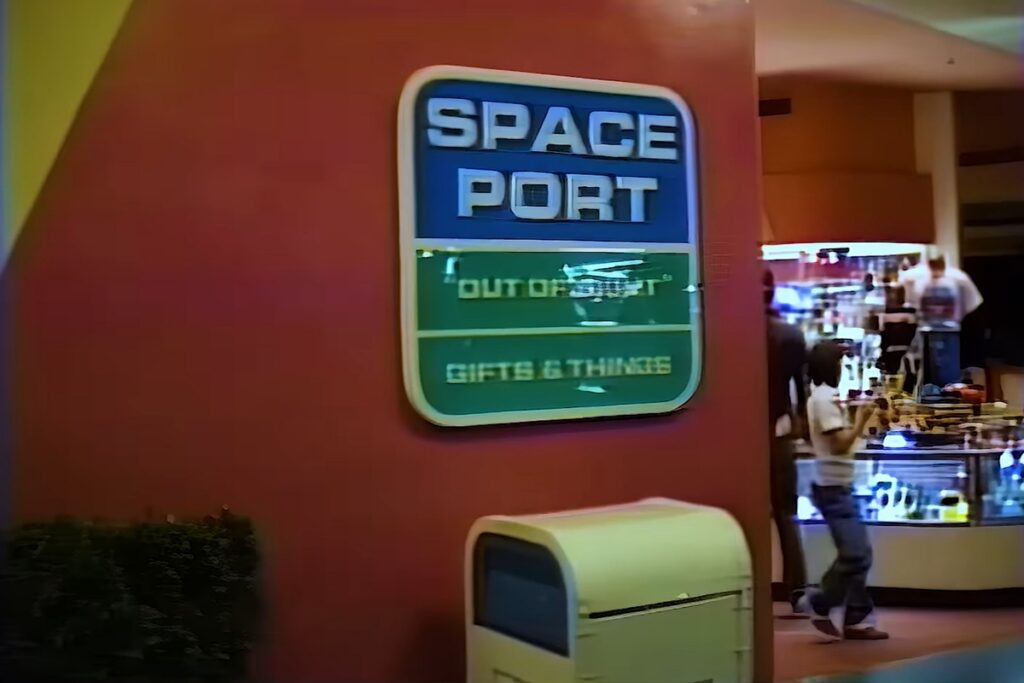
Space Port was one of the original-era merchandise shops in Tomorrowland at Magic Kingdom, operating from the park’s first years until June 1994. Located near the center of Tomorrowland across from The Lunching Pad—in the space later known as Merchant of Venus—the shop originally specialized in what Disney rather intriguingly described as “contemporary decorative gifts.”
By the early 1990s, Disney’s description had become much broader: Space Port simply sold “mementos.”
That evolution neatly summarizes the shop’s more than two decades of operation.
Space Port belonged to the original version of Tomorrowland, a land that looked dramatically different from either the colorful retro-futuristic environment introduced in 1994 or the Tomorrowland guests know today.
Magic Kingdom’s early Tomorrowland was built around a sleek, clean vision of the future.
White concrete.
Geometric architecture.
Broad pedestrian plazas.
Monorail-like transportation systems.
Corporate-sponsored attractions demonstrating technological progress.
The land felt less like an alien city and more like an idealized American space-age exposition.
Space Port fit naturally into that world.
Unlike modern Disney gift shops built around a particular movie, attraction, or character, Space Port was essentially a futuristic general merchandise store.
Disney’s official 1972 information guide listed only three principal Tomorrowland shops: Mickey’s Mart, Skyway Station Shop, and The Space Port.
Each had a somewhat different purpose.
Mickey’s Mart sold toys, souvenirs, apparel, and Coppertone products.
Skyway Station Shop carried Disney favorites and souvenirs.
Space Port specialized in “contemporary decorative gifts.”
That wording is unusually revealing.
Disney was not positioning Space Port solely as somewhere to buy Mickey Mouse merchandise. The shop was intended to feel like a retail establishment that belonged in Tomorrowland itself, offering modern-looking decorative objects and souvenirs appropriate to the land’s space-age aesthetic.
The same description appeared again in Disney’s official 1973 guidebook.
And in the official 1977 guide, Space Port was still described as carrying “contemporary decorative gifts.”
That consistency suggests the merchandise concept remained remarkably stable through much of the 1970s.
The name reinforced the setting.
A real-world port is a place where travelers arrive, depart, and purchase supplies or souvenirs. In Tomorrowland, the equivalent could logically be a “space port.”
The idea made particular sense in a land filled with simulated transportation experiences.
Guests could board Flight to the Moon and later Mission to Mars.
Eastern Airlines’ If You Had Wings carried them on a stylized journey around the world.
The WEDway PeopleMover traveled above Tomorrowland.
The Star Jets eventually lifted riders over the land.
And beginning in 1975, Space Mountain transformed the entire eastern side of Tomorrowland into what looked like a massive futuristic transportation terminal.
Against that backdrop, a shop called Space Port sounded less like a clever pun and more like a business that genuinely belonged there.
It is important, however, not to confuse the Magic Kingdom store with another Disney concept using the same name.
During the 1960s, Walt Disney and his Imagineers explored a much larger “Space Port” concept for Disneyland. Walt envisioned a futuristic complex containing an indoor roller coaster through outer space—the project that eventually evolved into Space Mountain.
The Walt Disney Family Museum has documented that concept extensively.
Magic Kingdom’s Space Port shop was not that proposed attraction.
The shared terminology simply reflected the broader mid-century fascination with space travel and the transportation-oriented vocabulary Disney was using for Tomorrowland.
The Florida shop was retail.
The conceptual Disneyland Space Port was the ancestor of a major attraction.
Magic Kingdom’s Space Port was positioned near the end of Tomorrowland’s central corridor, across from The Lunching Pad.
The same physical location can still be identified because it later became Merchant of Venus.
Its placement put the store close to some of Tomorrowland’s most important attractions over the years, including Flight to the Moon, Mission to Mars, Circle-Vision presentations, the Tomorrowland Transit Authority PeopleMover route, and eventually The ExtraTERRORestrial Alien Encounter.
For much of the 1970s and 1980s, the shop apparently changed far less dramatically than the attractions around it.
Flight to the Moon became Mission to Mars.
America the Beautiful gave way to other Circle-Vision films.
Space Mountain opened in 1975.
Star Jets arrived in 1974.
Carousel of Progress opened in 1975.
If You Had Wings eventually became If You Could Fly and then Delta Dreamflight.
Through those changes, Space Port continued functioning as one of Tomorrowland’s basic merchandise locations.
The merchandise emphasis gradually broadened.
By a 1993 Magic Kingdom guide map, Disney no longer characterized Space Port specifically as a store for contemporary decorative gifts.
The guide simply described it as selling:
“Mementos.”
That vaguer term suggests that by the final years of the shop, Space Port had become a more conventional Disney souvenir location.
The change also reflected a broader transformation throughout Walt Disney World retail.
Many early Magic Kingdom shops had highly specialized merchandise.
Liberty Square had antiques, silver, perfumes, and gourmet cooking supplies.
Adventureland sold imported merchandise associated with different parts of the world.
Tomorrowland offered modern decorative pieces.
Over time, much of that specialized inventory gave way to more standardized Disney souvenirs, clothing, plush toys, collectibles, and character merchandise.
Space Port survived into that transition.
What it did not survive was the complete reinvention of Tomorrowland in the mid-1990s.
Disney’s original white-and-concrete vision of the future had aged awkwardly.
The problem with trying to portray a realistic future is that eventually the future arrives.
By the early 1990s, much of Tomorrowland no longer appeared especially futuristic.
Disney responded with one of the largest thematic overhauls in Magic Kingdom history.
The new Tomorrowland was conceived as a bustling intergalactic city—a retro-futuristic world inspired by science-fiction comics, Art Deco design, alien technology, and the optimistic idea of “the future that never was.”
Existing buildings received dramatic new façades.
New signs, metallic structures, planetary motifs, alien details, neon lighting, and elaborate fictional businesses appeared throughout the land.
Generic names were replaced by playful science-fiction identities.
The Plaza Pavilion became Tomorrowland Terrace Noodle Station years later, while other locations adopted names such as Auntie Gravity’s Galactic Goodies and Cosmic Ray’s Starlight Café.
Space Port was transformed as part of this change.
In June 1994, Disney replaced it with Merchant of Venus.
The new name was a deliberate science-fiction play on William Shakespeare’s The Merchant of Venice.
More importantly, it sounded like an actual business operating in the newly imagined interplanetary metropolis.
The Merchant of Venus was presented as a collector and trader dealing in unusual merchandise from across the universe, fitting the elaborate fictional world Disney was constructing around attractions such as The ExtraTERRORestrial Alien Encounter.
The change represented a fundamental difference in Disney storytelling.
Space Port had been futuristic largely because of its architecture, merchandise, and name.
Merchant of Venus had a fictional proprietor and existed within an implied intergalactic society.
The original Space Port identity disappeared completely.
The building did not.
Merchant of Venus continued operating from the former Space Port location for decades.
When Stitch’s Great Escape! replaced Alien Encounter in 2004, the shop became increasingly dominated by Lilo & Stitch merchandise. For years, Stitch even appeared to have crashed through the ceiling, providing one of Tomorrowland’s more memorable retail displays.
The store later carried substantial amounts of Star Wars merchandise.
By the period surrounding the COVID-19 closure of Walt Disney World in 2020, however, Merchant of Venus had effectively stopped functioning as a conventional merchandise location.
Disney reopened the former shop as an indoor seating and decompression area in August 2022, giving guests a climate-controlled place to rest rather than returning the building to regular retail use.
Another notable change came in March 2026.
Disney removed the remaining Merchant of Venus branding from the exterior signage.
As of 2026, therefore, the structure that began as Space Port still exists in Tomorrowland, but neither of its two longtime retail identities is functioning as an active shop.
That makes Space Port an interesting example of how Tomorrowland has evolved.
It began during an era when Disney genuinely tried to portray what the future might look like.
Its merchandise was described not simply as souvenirs but as “contemporary decorative gifts.”
Its name suggested that Magic Kingdom guests had entered a functioning transportation hub for a future of routine space travel.
Twenty-three years later, Disney abandoned that literal vision of tomorrow and replaced it with a deliberately fantastical one.
Space Port became Merchant of Venus.
Clean modernism became retro science fiction.
A straightforward souvenir shop became the storefront of an imaginary interplanetary trader.
Yet beneath all of those changes is essentially the same Tomorrowland retail space that welcomed visitors during Walt Disney World’s earliest years.
For longtime Magic Kingdom visitors, Space Port represents the original Tomorrowland particularly well.
It was sleek.
It was optimistic.
It did not need a Disney character or movie franchise to explain itself.
It simply assumed that in the world of tomorrow, people would travel through space—and naturally, every good spaceport would need somewhere to buy a souvenir before departure.