
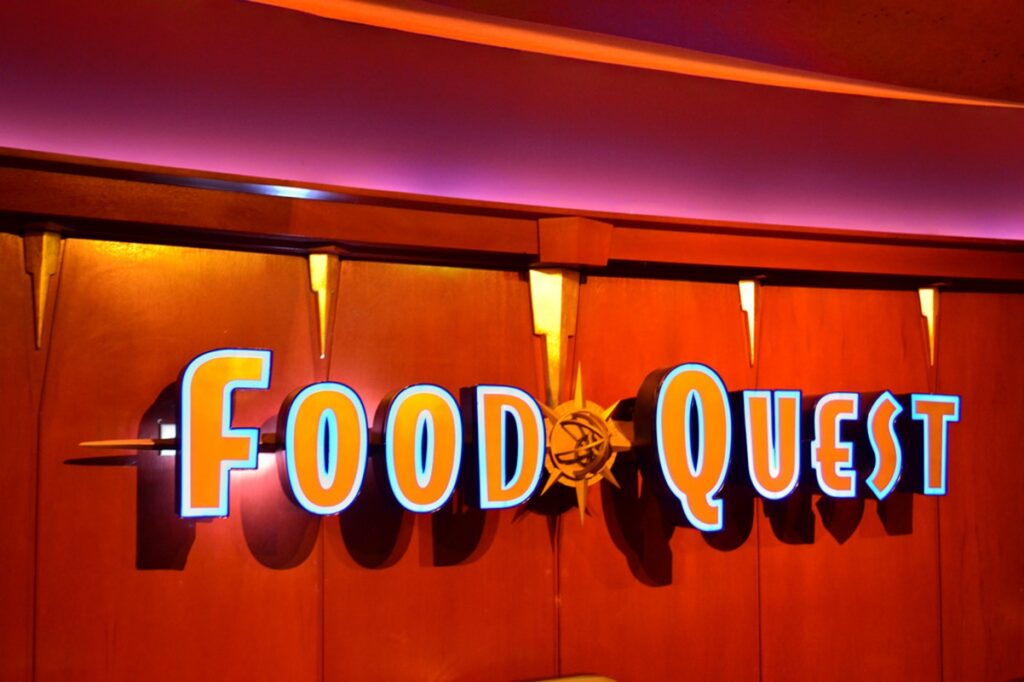
FoodQuest was a counter-service restaurant located on the fifth floor of DisneyQuest, the five-story indoor interactive theme park at Downtown Disney’s West Side, later Disney Springs, at Walt Disney World. Introduced in June 2008 as the Disney-operated replacement for The Cheesecake Factory Express, FoodQuest served hamburgers, chicken tenders, pizza, pasta, sandwiches, salads, and other familiar American meals. It provided a convenient dining option for guests spending several hours playing DisneyQuest’s arcade games and virtual-reality attractions. The restaurant closed permanently with DisneyQuest in July 2017, bringing an end to nearly two decades of food service within the entertainment complex.
FoodQuest was located near the top of the DisneyQuest building, which stood on the West Side of Downtown Disney.
The restaurant was not accessible directly from the outdoor shopping district. Guests generally needed admission to DisneyQuest to reach its dining areas.
Its location on the fifth floor provided convenient access to the attractions and arcade games distributed throughout the upper levels of the building.
Unlike a conventional restaurant at Downtown Disney, FoodQuest was designed primarily to serve people who were already visiting an entertainment venue.
Guests could stop for lunch or dinner, take a break from playing games, and return to the attractions without leaving the building.
This arrangement was particularly important because DisneyQuest encouraged visitors to spend several hours exploring its interactive experiences.
The history of FoodQuest begins with the creation of DisneyQuest.
During the 1990s, The Walt Disney Company developed plans for a series of indoor entertainment centers that would bring Disney-themed interactive attractions to major cities.
The concept was developed through Disney Regional Entertainment, an organization responsible for expanding Disney’s recreational offerings beyond its established theme parks.
DisneyQuest combined arcade games, computer technology, virtual reality, and interactive simulations within a single multistory building.
The first location opened at Downtown Disney West Side on June 19, 1998.
The enormous facility contained five floors of entertainment.
Its attractions were arranged into four principal zones: Explore, Score, Create, and Replay.
The Explore Zone included interactive adventures such as Virtual Jungle Cruise and Aladdin’s Magic Carpet Ride.
The Score Zone emphasized competitive games and action-oriented experiences, including Buzz Lightyear’s AstroBlasters.
The Create Zone allowed guests to experiment with artistic and musical activities, including the Animation Academy and CyberSpace Mountain.
The Replay Zone concentrated on classic arcade-style entertainment.
Although the individual attractions differed considerably, they shared an emphasis on interactive technology.
DisneyQuest was particularly ambitious for its time.
In the late 1990s, virtual reality was still a relatively unusual experience for most consumers.
High-performance home gaming computers, smartphones, and modern standalone virtual-reality headsets had not yet transformed the entertainment industry.
DisneyQuest allowed visitors to experience computer-driven attractions that would have been difficult or prohibitively expensive to reproduce at home.
The building also offered a practical advantage in Central Florida.
All five floors were indoors and air-conditioned, making DisneyQuest a popular alternative during thunderstorms, extreme summer heat, and other unfavorable weather conditions.
The size of the facility created a need for food and beverage service.
Visitors could spend several hours moving between attractions, and Disney wanted to provide convenient refreshments without requiring guests to leave the building.
Two principal dining locations were developed.
The larger food-service operation occupied the fifth floor, while Wonderland Café was located on the fourth floor.
Both dining spaces were originally associated with The Cheesecake Factory.
The Cheesecake Factory Express opened with DisneyQuest in 1998.
Unlike a conventional Cheesecake Factory restaurant, the Express location used a limited-menu, self-service format.
Guests could purchase familiar meals and desserts without the full-service experience associated with the company’s larger restaurants.
The arrangement was unusual for Walt Disney World because The Cheesecake Factory operated the dining facilities inside a Disney entertainment attraction rather than occupying a conventional restaurant space in Downtown Disney.
The company considered the Express operation a potential prototype for expansion into other Disney entertainment locations.
A second DisneyQuest opened in Chicago on June 16, 1999, with a similar Cheesecake Factory food-service arrangement.
However, the Chicago attraction closed on September 4, 2001.
The original Orlando location continued operating, and The Cheesecake Factory remained responsible for its food service.
The relationship lasted approximately ten years.
By 2008, The Cheesecake Factory decided not to renew its DisneyQuest agreement.
The company’s lease was approaching expiration, and its remaining Express operation was no longer a major focus of the restaurant chain.
On April 1, 2008, restaurant industry reporting confirmed that The Cheesecake Factory Express was scheduled to close in May.
The report identified approximately 55 employees affected by the decision.
It also confirmed Disney’s plans to replace the existing food-service operation with a company-owned counter-service concept called FoodQuest.
The transition occurred during the first weekend of June 2008.
A contemporary guest account published shortly afterward documented the change in food service and menu presentation.
The account described the disappearance of several familiar Cheesecake Factory offerings and differences in portion sizes.
For example, the former large chicken Caesar salad had been replaced by a noticeably smaller serving.
Pizza was no longer available by the slice in the same format. Instead, FoodQuest introduced smaller individual pizzas.
These observations provide a useful snapshot of the transition because they describe specific operational changes rather than simply recording a new restaurant name.
The June 2008 conversion marked the beginning of FoodQuest as a Disney-operated dining location.
However, the name FoodQuest had also been used in connection with the broader DisneyQuest food-service area before the ownership transition.
The distinction is important when examining historical photographs or restaurant guides.
An earlier description of FoodQuest does not necessarily establish that Disney had already replaced The Cheesecake Factory Express.
The clearest documented change in management and restaurant concept occurred in June 2008.
Under Disney’s operation, FoodQuest emphasized familiar quick-service food.
The menu was designed around dishes that could be prepared and served efficiently within a relatively compact kitchen.
Hamburgers and cheeseburgers became principal offerings.
Chicken tenders provided another convenient entrée, particularly for families with children.
Pizza remained available, along with sandwiches, wraps, salads, and selected pasta dishes.
This was a broad enough selection to accommodate visitors with different tastes, although the restaurant did not offer the variety associated with larger Walt Disney World dining establishments.
A September 2010 description identifies the fifth-floor location as the principal restaurant inside DisneyQuest.
Its menu included hot dogs, hamburgers, wraps, pizza, and salads.
At that time, published operating hours were noon to 9 p.m.
The restaurant provided tables in an adjacent seating area, allowing guests to eat before returning to the arcade games.
The dining room was functional rather than elaborately themed.
The principal emphasis was on providing enough seating for families and groups visiting the attraction.
Because DisneyQuest was an indoor entertainment center, the surrounding atmosphere was considerably different from that of most Walt Disney World restaurants.
The building contained music, electronic sound effects, video screens, arcade machines, and numerous groups moving between attractions.
The noise from those activities contributed to the dining environment.
Even when guests were seated, they remained surrounded by the sounds and visual activity of DisneyQuest.
A firsthand dining review from the early 2010s specifically described the fifth-floor dining area as noisy.
Although this was not necessarily a problem for guests expecting an arcade environment, it distinguished FoodQuest from the quieter restaurants elsewhere at Downtown Disney.
The restaurant was intended to offer convenience rather than a relaxing destination-dining experience.
A contemporary review published in 2013 provides unusually specific information about its menu and prices.
The review identifies a Grilled Chicken BLT served on a wheat roll with French fries for $9.19.
A one-third-pound Angus Bacon Cheeseburger with French fries cost $9.39.
Domestic beer was listed at $5.75, while bottled water cost $2.50.
These prices establish that FoodQuest offered substantial quick-service meals rather than concentrating exclusively on small snacks.
They also provide a useful comparison with other Walt Disney World counter-service restaurants during the same period.
The restaurant’s menu included beverages for both adults and children.
Soft drinks, bottled water, beer, and wine were available, although the exact selection changed over time.
The ability to purchase alcoholic beverages reflected DisneyQuest’s appeal to adults as well as families.
While children were attracted to arcade games and interactive experiences, adult visitors could also enjoy many of the attractions.
FoodQuest provided refreshments for both groups.
The restaurant’s fifth-floor location also meant that visitors could easily overlook other food-service options inside the building.
Wonderland Café, located on the fourth floor, offered a smaller selection of snacks, desserts, beverages, and ice cream novelties.
It also served selected grab-and-go meals, particularly when FoodQuest was closed.
The two restaurants therefore had complementary roles.
FoodQuest was the primary destination for a substantial meal, while Wonderland Café concentrated on lighter refreshments.
During some periods, Wonderland Café remained open later than FoodQuest or offered selected sandwiches and salads when the larger restaurant was not operating.
The two locations should be maintained as separate entries in historical restaurant records.
Although both originated within the Cheesecake Factory food-service arrangement, they occupied different floors and offered different dining experiences.
By the middle of the 2010s, FoodQuest’s menu continued to emphasize familiar American quick-service dishes.
An archived February 2016 allergy-friendly menu provides particularly detailed information about its offerings.
The menu listed one-third-pound Angus cheeseburgers and bacon cheeseburgers.
Chicken tenders were another established entrée.
Pizza selections included cheese, pepperoni, and chicken flatbread varieties, depending on the dietary category.
Sandwiches included a Grilled Chicken Parmesan Sandwich and a Turkey Wrap with lettuce and tomato.
A mixed greens salad contained green apples, dried cherries, feta cheese, bacon, and vinaigrette dressing.
The children’s menu included cheeseburgers, grilled chicken sandwiches, pizza, and other familiar selections.
These offerings demonstrate that FoodQuest maintained a broader menu than a conventional arcade snack counter.
Guests could purchase a complete lunch or dinner, including a side dish and beverage.
The allergy-friendly menu is also significant because it illustrates how Walt Disney World was expanding its accommodations for guests with dietary restrictions.
By 2015, Disney had introduced standardized allergy-friendly menus at many of its restaurants.
FoodQuest participated in that initiative.
Its February 2016 menu addressed the eight major food allergens commonly recognized at the time.
Gluten- and wheat-friendly options included burgers served on rice flour buns.
Gluten-friendly pizza was prepared using a rice crust.
Allergy-friendly cookies and brownies were listed among the dessert selections.
However, the existence of an allergy-friendly menu did not mean that the restaurant had a dedicated allergen-free kitchen.
A firsthand review from February 2016 documented the limitations of the facility.
The guest discussed chicken tenders with restaurant management and was advised that the small kitchen made it difficult to guarantee complete separation from certain allergens.
That distinction is important because FoodQuest’s compact kitchen was designed primarily for conventional quick-service efficiency.
Guests with serious food allergies still needed to discuss their individual requirements with restaurant employees.
The restaurant’s relatively limited preparation space also influenced the range of meals it could serve.
Unlike the original full-service Cheesecake Factory restaurants, FoodQuest did not have the extensive kitchens needed to produce a large selection of freshly prepared entrées.
Its menu focused on products suited to a smaller operation.
The practical nature of FoodQuest was reflected in its appearance.
Guests ordered from a service counter and carried their meals to nearby tables.
The restaurant did not offer conventional table service, advance dining reservations, or an elaborate themed interior.
Its principal attraction was convenience.
For families spending several hours at DisneyQuest, the ability to purchase a meal without leaving the building could be valuable.
Visitors who preferred restaurants elsewhere at Downtown Disney also had the option of leaving DisneyQuest and returning later, subject to the attraction’s admission and reentry policies.
This created a degree of competition between FoodQuest and the surrounding restaurants.
Downtown Disney and, later, Disney Springs offered a large number of dining choices.
Guests could visit Earl of Sandwich, Wolfgang Puck Express, House of Blues, or other nearby establishments.
FoodQuest was therefore most appealing to visitors who wanted to remain inside DisneyQuest or avoid interrupting their gaming sessions.
By the final years of DisneyQuest, the food-service operation had become more limited.
A photographic retrospective of the attraction’s closing period documented that the original Cheesecake Factory Express and FoodQuest had once used two separate service sections.
As demand changed, the menu was reduced and only one principal service counter remained in use.
Some former attraction space was also temporarily used for additional FoodQuest seating.
The former Ride the Comix area, for example, was repurposed for a period before being closed off entirely.
These adjustments reflected the changing nature of DisneyQuest itself.
The attraction had originally emphasized cutting-edge interactive technology.
By the 2010s, many of its games and simulators were considerably older than contemporary home gaming systems.
Some attractions had been removed, while others continued operating with technology dating to the late 1990s.
The arcade environment remained nostalgic for longtime visitors, but its original technological novelty had diminished.
Disney’s announcement of the Disney Springs redevelopment ultimately placed the future of the building in question.
In June 2015, Disney confirmed plans for DisneyQuest to close and be replaced by a new basketball-themed entertainment destination.
The proposed replacement was the NBA Experience.
Although an initial closure period was discussed, DisneyQuest continued operating throughout 2016.
On January 30, 2017, Disney announced that the attraction would close in early July.
Its final day welcoming guests was July 2, 2017, with the official closure taking effect on July 3.
FoodQuest closed as part of the same shutdown.
The restaurant was not relocated or reopened elsewhere at Walt Disney World.
Its closure marked the end of the Disney-operated quick-service restaurant concept introduced in 2008.
DisneyQuest’s original five-story building was subsequently demolished.
This is an important distinction when tracing the location’s history.
Although later entertainment businesses occupied the same general site, they did not reuse FoodQuest’s fifth-floor dining room.
The physical restaurant and the building containing it were removed.
Disney developed the NBA Experience as the replacement attraction.
The new complex officially opened on August 12, 2019.
It offered interactive basketball-themed activities, including shooting challenges, skills competitions, and experiences inspired by professional basketball.
The development also included retail and dining facilities.
City Works Eatery & Pour House opened nearby in February 2020, providing a full-service restaurant and bar associated with the newer entertainment development.
However, City Works was not a direct continuation of FoodQuest.
It occupied a new restaurant space and featured a different menu, ownership arrangement, and service model.
The NBA Experience itself operated for only a short period.
It closed in March 2020 during the COVID-19 pandemic.
Disney confirmed in August 2021 that the attraction would not reopen.
The former NBA Experience space remained without a permanent public entertainment operation for several years.
In 2025, plans emerged for Level99, an interactive entertainment concept combining physical challenges, puzzles, competitive games, and social activities.
The new venue was developed within the former NBA Experience building.
Level99 officially opened at Disney Springs on June 29, 2026.
The attraction features 63 physical and mental challenges distributed across two floors.
Its activities include cooperative challenge rooms, competitive games, and an interactive art scavenger hunt.
The venue also offers a large bar and food-service area, with dishes such as Detroit-style pizza and burgers.
Although Level99 occupies the broader site historically associated with DisneyQuest, its food and beverage operation has no organizational or culinary connection to FoodQuest.
The current restaurant is part of a completely different entertainment concept housed in a newer building.
As of October 2026, FoodQuest remains permanently closed.
Neither the restaurant nor the original DisneyQuest building survives.
The site is occupied by Level99 and the surrounding Disney Springs West Side development.
FoodQuest is historically notable because it represents the transition from an outside-operated restaurant concession to a Disney-managed food-service operation within a major entertainment attraction.
The original Cheesecake Factory Express was an unusual experiment in extending a well-known restaurant brand into an interactive entertainment center.
When that arrangement ended in 2008, Disney introduced FoodQuest to continue providing meals inside the building.
The restaurant retained the convenience of the original location while replacing the Cheesecake Factory’s branded menu with more conventional Disney quick-service offerings.
Its history also illustrates the challenges of operating food service within a large indoor attraction.
DisneyQuest visitors often spent several hours inside the building, but they also had access to numerous restaurants immediately outside.
FoodQuest needed to provide convenient meals without the extensive facilities or menu of a full-service restaurant.
As the attraction aged and its operating needs changed, the restaurant’s menu and service capacity were reduced.
Despite those limitations, FoodQuest remained the principal dining location inside DisneyQuest through the attraction’s final years.
For visitors who remember DisneyQuest, the restaurant was part of the experience of spending an afternoon or evening moving between arcade games, virtual-reality attractions, and interactive simulations.
A meal at FoodQuest provided an opportunity to rest before returning to CyberSpace Mountain, Buzz Lightyear’s AstroBlasters, Pirates of the Caribbean: Battle for Buccaneer Gold, or the other attractions.
The restaurant was never intended to compete with the most elaborate dining establishments at Walt Disney World.
Its role was practical, providing familiar meals in a convenient location.
Nevertheless, FoodQuest remains an important part of the history of DisneyQuest and Downtown Disney’s West Side.
Its documented operating period extended from June 2008 until July 2, 2017, following approximately ten years of Cheesecake Factory food service in the same location.
The restaurant disappeared when DisneyQuest closed, ending a nearly 19-year tradition of dining inside one of Walt Disney World’s most unusual former entertainment attractions.