
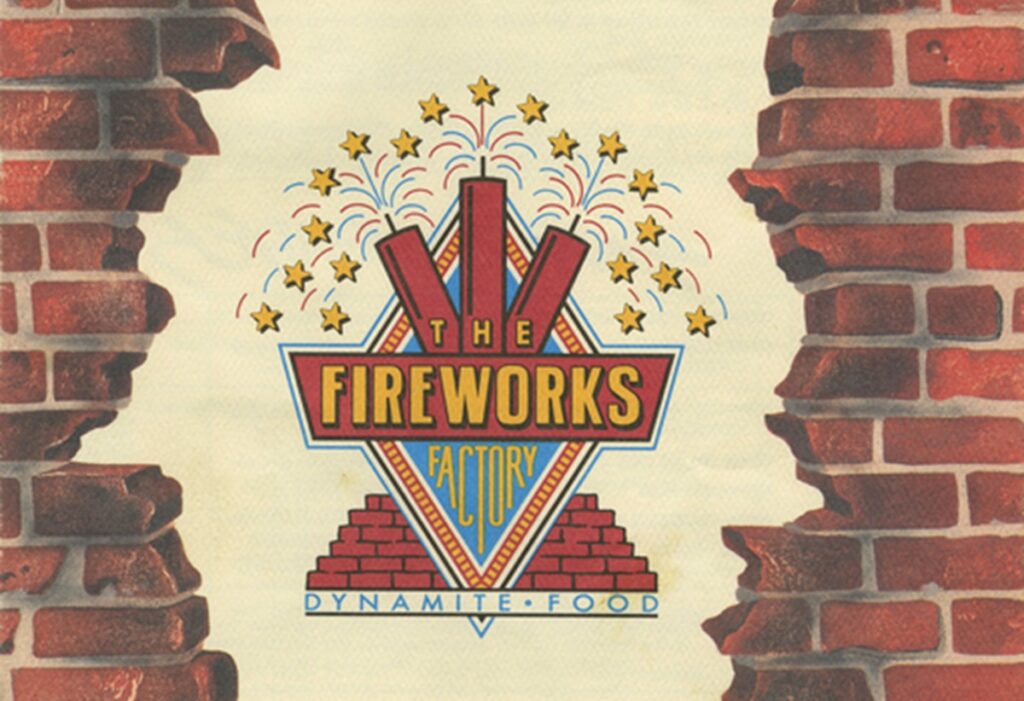
Fireworks Factory was a heavily themed barbecue restaurant located on Pleasure Island, the former nightlife and entertainment district at Walt Disney World that is now part of Disney Springs. Opening on May 1, 1989, alongside Pleasure Island itself, the restaurant specialized in smoked ribs, barbecue chicken, steaks, seafood, and creatively named cocktails and desserts. Operated by Levy Restaurants, Fireworks Factory was designed to resemble an abandoned fireworks laboratory that had been partially destroyed by an enormous explosion. It closed in 1997 and was replaced by Wildhorse Saloon in 1998. The building later became the Motion nightclub before being demolished during the redevelopment of Pleasure Island in 2010–2011.
Fireworks Factory was one of the original dining establishments created for Pleasure Island, a major expansion of Walt Disney World’s shopping and entertainment district.
Before Pleasure Island opened, the surrounding area was known primarily for the Walt Disney World Village, a waterfront collection of specialty shops and restaurants that had debuted in March 1975.
Disney developed Pleasure Island to introduce a new type of entertainment destination aimed particularly at adults.
The district included nightclubs, live music venues, comedy performances, specialty shops, and restaurants, all connected by a fictional history developed by Walt Disney Imagineering.
Rather than constructing a collection of unrelated businesses, Disney created the impression of an industrial island that had been established decades earlier and subsequently transformed into an entertainment district.
At the center of that story was Merriweather Adam Pleasure, an eccentric industrialist, inventor, and adventurer who supposedly founded the island’s original commercial enterprises.
According to the fictional history, Pleasure established a successful manufacturing operation and developed numerous experimental businesses.
His enterprises included shipbuilding, canvas production, mechanical inventions, and other unusual projects.
The buildings scattered throughout Pleasure Island were presented as the surviving structures of those earlier industries.
Disney’s Imagineers used weathered architecture, industrial equipment, faded signs, and historical plaques to reinforce the story.
Fireworks Factory was one of the clearest examples of that approach.
Instead of merely decorating a restaurant with fireworks-related objects, Imagineering created an elaborate explanation for why the building appeared damaged.
In the fictional history, Merriweather Pleasure had a particular fascination with pyrotechnics.
In 1922, he persuaded a celebrated Chinese fireworks inventor known as the Bang Master to move to Central Florida.
Together, they established a laboratory and fireworks storage facility on Pleasure Island.
The operation produced elaborate displays that supposedly entertained Orlando residents during Independence Day celebrations.
For several years, the fireworks business flourished.
That success ended on July 3, 1927.
According to the story preserved on the restaurant’s historical plaque, a stray spark from Pleasure’s pipe ignited explosive materials inside the factory.
The resulting explosion was supposedly powerful enough to be heard in Tampa, approximately 82 miles away.
The building was devastated.
Pleasure’s wife insisted that the wreckage remain standing as a reminder of her husband’s carelessness.
The ruins became known as Pleasure’s Folly.
Decades later, the fictional structure was supposedly restored for use as a restaurant, retaining the visible evidence of the original disaster.
This backstory explained the restaurant’s unusual appearance.
Fireworks Factory was designed to look as though its previous occupants had left behind a building that was still scarred by an industrial accident.
Decorative elements suggested blast damage, scorched surfaces, and the remnants of an old pyrotechnics operation.
The floor reportedly contained marks resembling gunpowder stains.
Architectural details incorporated the appearance of damaged walls and other evidence of an explosion.
The effect was intentionally theatrical.
Guests were meant to feel that they were dining inside a restored industrial building rather than a newly constructed restaurant.
The props contributed to that illusion.
Fireworks Factory featured authentic pyrotechnic objects associated with the Grucci family, a well-known American fireworks manufacturer.
The Gruccis had established an international reputation for large-scale fireworks displays and professional pyrotechnic productions.
Their equipment and decorative objects gave the restaurant a more convincing industrial character.
Rather than relying exclusively on fabricated props, Disney incorporated genuine materials associated with fireworks production.
The result was a restaurant whose storytelling extended from its exterior architecture to the smallest decorative elements.
The fireworks story also connected Fireworks Factory to another Walt Disney World location.
Disney’s Typhoon Lagoon water park opened on June 1, 1989, just one month after Pleasure Island.
Typhoon Lagoon presented an entirely different fictional disaster.
According to its story, a powerful typhoon had swept through a tropical resort community, scattering boats, surfboards, fishing equipment, and other objects throughout the landscape.
Disney incorporated a connection between the two properties through references to explosives supposedly thrown from the Fireworks Factory explosion.
The fictional debris appeared in the Typhoon Lagoon environment, including references near the park’s original family raft ride.
This was an example of the interconnected storytelling that Disney Imagineers incorporated into Walt Disney World during the late 1980s.
Although the locations belonged to different attractions and entertainment districts, their fictional histories overlapped.
Guests familiar with both stories could discover a connection that was not necessary to understand either location individually.
Fireworks Factory’s restaurant operation was managed by Levy Restaurants.
The Chicago-based company was already involved in major dining projects and subsequently operated several other Walt Disney World restaurants.
Its Disney relationships included Portobello Yacht Club and, later, Fulton’s Crab House.
Fireworks Factory was therefore a professionally operated restaurant rather than a conventional Disney-operated snack stand.
Its concept combined the theatrical setting of Pleasure Island with a substantial American barbecue menu.
Historical descriptions identify a seating capacity of approximately 377 guests.
The restaurant contained two dining rooms, providing considerably more space than a small lounge or walk-up counter.
Its primary culinary identity was barbecue.
The menu included both baby back ribs and Texas-style beef ribs.
These were reportedly smoked using an applewood-fired grill and served with a custom barbecue sauce.
The preparation emphasized the smoky flavors associated with traditional American barbecue.
Barbecued chicken was another principal offering.
The restaurant also served hot chicken wings, allowing guests to order a smaller dish or appetizer rather than a full entrée.
One of its signature selections was the Fireworks 3 & 3 Combo.
The dish combined hot chicken wings, catfish, and barbecue shrimp.
This was an unusual combination, bringing together barbecue, poultry, and seafood in a single entrée.
It reflected the restaurant’s broader menu, which offered more variety than ribs and chicken alone.
Guests could also order filet mignon, pork chops, and Kansas City strip steak.
The availability of steaks and chops positioned Fireworks Factory as a full-service restaurant rather than simply a themed barbecue counter.
Its food was intended to appeal to diners seeking a substantial meal before an evening of entertainment.
The menu’s emphasis on grilled and smoked meats also complemented the fictional industrial setting.
Even the restaurant’s promotional language incorporated references to its explosive past.
Advertising described the offerings as “Dynamite Food” and “Explosive Specials.”
These phrases were particularly appropriate to a restaurant supposedly located within the remains of a fireworks factory.
Disney and Levy extended the concept to the printed menus.
Surviving original menus featured decorative effects resembling burned edges and holes caused by explosions.
The presentation reinforced the idea that even the restaurant’s paperwork had been damaged by pyrotechnic activity.
An original Fireworks Factory menu from the 1990s, including its reservation card, has survived in the Disney memorabilia market.
Its unusual design demonstrates how carefully the restaurant’s fictional identity was applied to ordinary dining materials.
Desserts followed the same approach.
Atomic Chocolate Cake was one of the restaurant’s most recognizable sweets.
The name provided another connection to the factory’s explosive history.
Other desserts included Key Lime Pie and Turtle Pie.
The menu also offered Toll House Cookie Sundaes, combining a familiar chocolate chip cookie dessert with ice cream.
Ben & Jerry’s ice cream appeared on earlier menus, while Edy’s was used during a later period.
The dessert selection provided a mixture of creatively named specialties and familiar American favorites.
The bar offered an equally distinctive collection of beverages.
One cocktail was called the Coconut Peach Explosion.
Another was the Pleasure Island Iced Tea.
These drinks contributed to the restaurant’s identity as both a dining establishment and an evening entertainment destination.
Although Fireworks Factory was primarily remembered for its barbecue, the bar was an important part of the experience.
Pleasure Island attracted adults who might spend an entire evening moving between dinner, live entertainment, and nightclubs.
A restaurant offering substantial meals and specialty cocktails was well suited to that pattern.
Fireworks Factory also sold branded merchandise.
Items included shirts bearing the restaurant’s logo, hurricane glasses, and other souvenirs.
Guests could purchase bottles of the restaurant’s barbecue sauce.
The availability of bottled sauce was particularly appropriate because it allowed visitors to take home a product directly associated with the menu.
Fireworks Factory and Pleasure Island-branded matchbooks were also produced.
These objects have become useful historical artifacts because they preserve the restaurant’s original artwork and identity.
The merchandise program reflected a broader Pleasure Island practice of treating individual businesses as destinations with their own branding.
During its early years, the restaurant was part of a dining lineup that included Portobello Yacht Club and Merriweather’s Market.
Portobello emphasized Italian cuisine, while Merriweather’s Market operated as a food court.
Fireworks Factory concentrated on American barbecue and grilled entrées.
Together, these businesses provided dining options for guests visiting the entertainment district.
The restaurant’s location was particularly convenient for guests attending the nearby clubs.
Fireworks Factory stood beside the XZFR Rockin’ Rollerdrome, a nightclub that originally combined music and roller-skating.
The Rockin’ Rollerdrome was subsequently transformed into the Rock ‘n’ Roll Beach Club.
The neighboring venues helped make this portion of Pleasure Island an active entertainment area.
Guests could have dinner at Fireworks Factory before moving on to live music or dancing.
Pleasure Island initially operated under a different admission arrangement from the one many visitors remember.
During its earliest months, individual clubs were accessible through a variety of admission options.
In April 1990, Disney introduced a nightly New Year’s Eve celebration, creating a more unified entertainment experience.
The celebration included live performances, fireworks, music, and a countdown to the new year.
The changes reinforced Pleasure Island’s identity as an evening destination.
Fireworks Factory continued operating throughout this period.
Its combination of elaborate theming and substantial meals distinguished it from the surrounding nightclubs.
Although the restaurant did not offer the same type of recurring performances as the Adventurers Club or Comedy Warehouse, its interior was itself a carefully staged environment.
Guests could examine the supposed damage from Merriweather Pleasure’s disastrous fireworks experiment while enjoying dinner.
The restaurant’s atmosphere was therefore an important part of its appeal.
Unlike a restaurant decorated with a few themed photographs or signs, Fireworks Factory incorporated a specific fictional event into the building’s appearance.
The damaged surfaces, authentic fireworks equipment, printed menus, and descriptive plaque all supported the same story.
This made it one of the more distinctive examples of Disney’s late-1980s themed restaurant design.
Fireworks Factory operated until 1997.
Historical photographs, restaurant chronologies, and retrospective accounts consistently identify 1989 through 1997 as its operating period.
However, an independently verified final operating day has not been established.
The restaurant did not close because Disney demolished its building.
Instead, the space was selected for conversion into a different restaurant and entertainment concept.
On May 31, 1998, Wildhorse Saloon opened in the former Fireworks Factory location.
The new venue was developed as a combination barbecue restaurant and country-western dance club.
It was associated with the broader Wildhorse Saloon concept, which had become popular in Nashville, Tennessee.
The Pleasure Island version combined dining with country music, dancing, and live entertainment.
Its introduction reflected the popularity of country-themed nightlife during the 1990s.
The new operation retained the ability to serve substantial meals while adding a greater emphasis on entertainment.
However, much of the original Fireworks Factory storyline disappeared during the conversion.
The damaged industrial setting and fireworks-related narrative were no longer the central focus of the establishment.
This represented a significant change in the building’s identity.
Where Fireworks Factory had relied on the fictional industrial history of Merriweather Pleasure, Wildhorse Saloon emphasized a recognizable country-western entertainment concept.
The new business continued operating until February 25, 2001.
Following its closure, the building was converted once again.
The next concept was Motion, a nightclub focused on contemporary popular music.
Motion opened in 2001 and featured large video screens showing music videos, accompanied by a dance floor and modern sound system.
The new club represented another departure from the restaurant’s original identity.
The building was now primarily a dance venue rather than a dining destination.
Although Motion occupied the former Fireworks Factory structure, the restaurant’s barbecue menu, themed décor, and merchandise program did not continue.
The physical building remained, but its original concept had effectively disappeared.
Motion operated until September 27, 2008, when Disney closed Pleasure Island’s remaining nightclubs.
The closures included the Adventurers Club, Comedy Warehouse, Mannequins Dance Palace, 8TRAX, and BET Soundstage Club.
Disney’s decision ended the original nightclub-centered operation of Pleasure Island.
The company subsequently began exploring ways to transform the area into a broader shopping, dining, and entertainment destination.
For a period after the nightclub closures, the former Motion building remained standing.
It was occasionally used for private events and other purposes.
However, the structure’s future became uncertain as Disney developed plans for a major redevelopment.
In November 2010, Disney announced a proposed transformation of Pleasure Island into Hyperion Wharf.
The project envisioned a waterfront entertainment district featuring restaurants, retail businesses, pedestrian areas, and outdoor performance spaces.
Although the Hyperion Wharf concept was never completed as originally announced, Disney began removing several former nightclub buildings.
The Motion structure was among those selected for demolition.
Construction walls appeared around Motion and the neighboring Rock ‘n’ Roll Beach Club in December 2010.
Demolition began shortly afterward.
By January 2011, most of the Motion building had been removed.
Contemporary photographs show the former nightclub being dismantled, including portions of the structure that had previously housed Fireworks Factory.
The demolition eliminated the last substantial physical connection to the original 1989 restaurant.
The site was cleared to improve pedestrian circulation and accommodate future development.
For several years, the surrounding area remained in transition.
Disney ultimately abandoned the Hyperion Wharf branding and announced a more extensive redevelopment of Downtown Disney into Disney Springs in March 2013.
The former Pleasure Island section became The Landing.
The transformation introduced a new collection of restaurants, shops, pedestrian walkways, and waterfront destinations.
One of the major restaurants developed in this area was The BOATHOUSE, which opened on April 13, 2015.
The restaurant occupies an area associated with the former Motion nightclub and its surrounding redevelopment site.
The BOATHOUSE emphasizes seafood, steaks, waterfront dining, and attractions involving vintage amphibious automobiles.
Its architecture and culinary concept are unrelated to Fireworks Factory.
It should therefore be considered a later development occupying the former building’s general location rather than a direct operational continuation.
The original Fireworks Factory structure was demolished, and the restaurant’s identity was not incorporated into the new business.
As of October 2026, Fireworks Factory remains permanently closed.
Its former Pleasure Island location is part of The Landing at Disney Springs, in the broader area redeveloped for The BOATHOUSE and surrounding pedestrian spaces.
No restaurant operating under the Fireworks Factory name remains at Walt Disney World.
The original building is also gone.
Fireworks Factory is historically significant for several reasons.
First, it was one of the original restaurants created for Pleasure Island in 1989.
Its opening coincided with a major expansion of Walt Disney World’s entertainment offerings beyond the theme parks and original resort hotels.
Second, it was closely integrated into Pleasure Island’s fictional history.
The restaurant did not merely borrow fireworks imagery for decoration. It was presented as the remains of a specific industrial disaster involving the island’s fictional founder.
The story explained the building’s damaged appearance, its unusual props, and the references incorporated into the menu.
Third, it provided one of the most elaborate dining environments in the original entertainment district.
The use of genuine Grucci fireworks materials, simulated explosion damage, and specially designed menus helped establish a convincing setting.
Fourth, the restaurant’s barbecue menu was more substantial than many guests might expect from a venue associated primarily with nighttime entertainment.
With smoked ribs, chicken, steaks, seafood, appetizers, and distinctive desserts, it operated as a full-service dining destination.
The restaurant also had a clear merchandise identity, selling branded souvenirs and barbecue sauce.
Finally, its history illustrates the transformation of Pleasure Island over more than two decades.
The same building housed a heavily themed barbecue restaurant, a country-western dining and dancing establishment, and a contemporary dance club before being demolished.
Each version reflected a different approach to dining and entertainment at Walt Disney World.
Fireworks Factory embodied the original Imagineering philosophy behind Pleasure Island, when individual buildings were connected through a detailed fictional history.
Wildhorse Saloon reflected the popularity of country music and dance venues during the late 1990s.
Motion represented a more conventional nightclub concept centered on contemporary music and video.
The building’s demolition in 2010–2011 marked the end of that sequence and the beginning of a new phase of waterfront redevelopment.
For visitors who experienced Pleasure Island during its earliest years, Fireworks Factory was a memorable restaurant where barbecue, cocktails, and theatrical surroundings came together in an unusually detailed setting.
The restaurant’s simulated explosion damage and fictional history distinguished it from more conventional dining establishments.
Although Fireworks Factory operated for only approximately eight years, its theming remains a notable example of Walt Disney Imagineering’s approach to environmental storytelling during the late 1980s.
Its disappearance also represents the loss of one of the original Pleasure Island businesses most directly connected to the district’s elaborate fictional history.
Today, the modern restaurants and shops of Disney Springs occupy a landscape that has changed substantially since 1989.
However, Fireworks Factory remains an important part of the area’s history, illustrating the ambition, humor, and attention to detail that characterized the original Pleasure Island entertainment district.