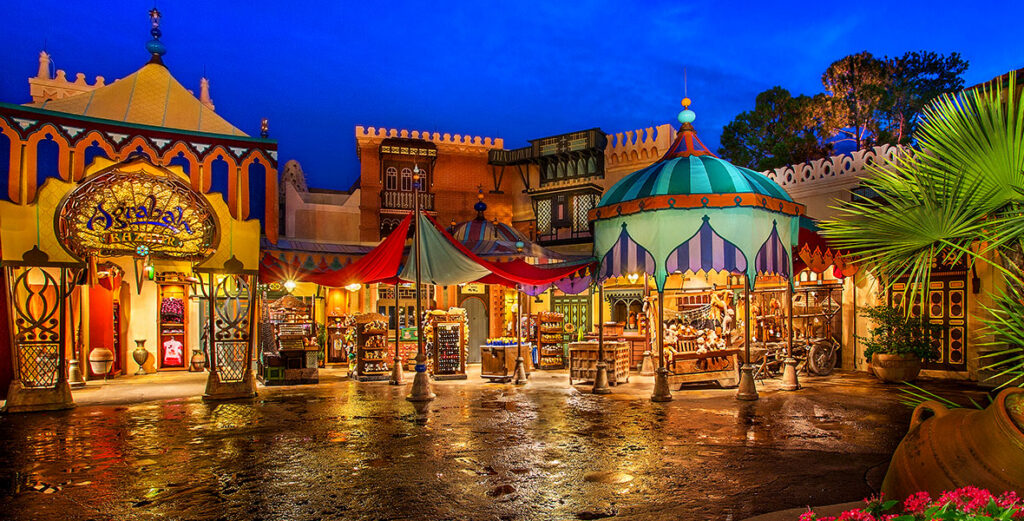
Agrabah Bazaar is a former merchandise marketplace in Adventureland at Magic Kingdom, created as part of the extensive Aladdin-themed redevelopment that transformed the center of the land around the turn of the millennium. Officially opening on December 15, 2000, several months before The Magic Carpets of Aladdin began operating in May 2001, the Bazaar replaced an earlier generation of Adventureland shops and helped establish a new Arabian-inspired district based on the fictional city of Agrabah. Although the merchandise shop itself never resumed normal operation after Walt Disney World’s 2020 pandemic closure, the Agrabah Bazaar name and setting remain very much alive: Aladdin and Princess Jasmine continue meeting guests there, while the former retail space has most recently been repurposed for face painting.
The Bazaar represented a substantial change in the identity of this portion of Adventureland. When Magic Kingdom opened in 1971, the land was intentionally eclectic, combining influences from Polynesia, Southeast Asia, Africa, the Caribbean, and colonial jungle outposts without trying to represent one continuous geographic location. The shops occupying the future Agrabah Bazaar site reflected that broader approach.
Two original stores, The Magic Carpet and Oriental Imports, Ltd., operated here during Magic Kingdom’s early years. Despite the coincidence of the Magic Carpet name, this predated Disney’s animated Aladdin by more than two decades and had no connection to the character or film. In April 1987, the two stores were consolidated and replaced by The Elephant’s Trunk, later known as Elephant Tales.
The Elephant’s Trunk leaned more strongly toward an African safari identity, selling African-inspired merchandise and fitting naturally with the nearby Jungle Cruise environment. As Disney merchandising evolved during the 1990s, however, the shop increasingly carried character products, including items connected with The Lion King and Aladdin. That gradual shift foreshadowed the much larger physical transformation that would follow.
Disney’s 1992 animated film Aladdin had become one of the defining movies of the Disney Renaissance, but Magic Kingdom initially had no permanent attraction devoted to it. Disney eventually decided to introduce The Magic Carpets of Aladdin, a family spinner attraction similar in basic mechanics to Dumbo the Flying Elephant.
Simply placing a brightly colored Aladdin ride into the existing Adventureland streetscape would have created an obvious thematic clash, so Imagineers reshaped much of the surrounding retail environment as well. Elephant Tales disappeared, neighboring structures were modified or removed, and the entire area took on a stronger Middle Eastern and North African visual identity.
Agrabah Bazaar was actually ready before the ride itself. Disney’s official historical record dates the marketplace to December 15, 2000, while The Magic Carpets of Aladdin did not open until May 23, 2001. Together, however, the two projects were conceived as parts of the same larger environment.
The finished marketplace borrowed heavily from the visual language of Aladdin: colorful awnings, pointed arches, ornamental fabrics, patterned surfaces, hanging lamps, carpets, baskets, carved objects, and densely packed merchandise created the impression of a bustling open-air souk. The spaces did not attempt to recreate one real-world marketplace with strict historical accuracy. Instead, they blended broad Arabian and North African imagery with the exaggerated fantasy architecture of Disney’s Agrabah.
One of the most easily overlooked pieces of storytelling was beneath guests’ feet.
Around the Bazaar and Magic Carpets area, Imagineers embedded broken tiles, jewels, coins, and decorative fragments into the pavement. The details suggest years of marketplace activity, as though small valuables and pieces of merchandise had become permanently lodged in the street. They also help distinguish this section from the greener jungle pathways elsewhere in Adventureland.
The surrounding rooftops deserve similar attention. False upper stories, weathered surfaces, hanging textiles, decorative windows, towers, and irregular rooflines make the marketplace appear considerably larger than the actual guest-accessible footprint. Like many successful Disney environments, Agrabah relies on the suggestion that life continues in places guests cannot enter.
The arrival of The Magic Carpets of Aladdin dramatically strengthened that setting. Sixteen flying carpet vehicles rotate around a giant Genie-inspired central structure, while two enormous camel figures periodically spit water at riders and passing pedestrians. Those camels have their own Disney history: they originally appeared in Aladdin’s Royal Caravan, a Disney-MGM Studios parade that ran from 1992 through 1995, before eventually being relocated to Magic Kingdom.
Together, the ride, camels, marketplace architecture, pavement details, shops, and character greetings created what amounted to a small Agrabah sub-land inside Adventureland.
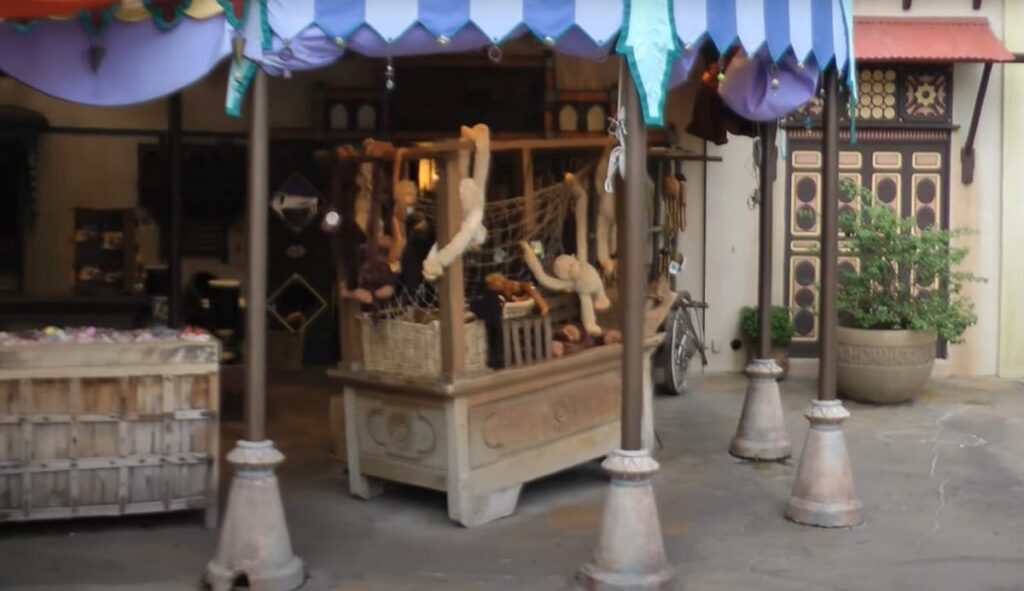
During its years as a functioning shop, Agrabah Bazaar specialized in a mixture of Aladdin merchandise and items chosen to reinforce the marketplace setting. Guests could find Aladdin and Jasmine apparel, toys, costumes, character merchandise, and souvenirs alongside products such as carpets, carvings, masks, clothing, decorative objects, and Arabian- or Moroccan-inspired merchandise.
Princess Jasmine costumes became one of the store’s particularly recognizable products, while children could find merchandise connected with Aladdin, Genie, Abu, and the Magic Carpet. At different times, the shelves also carried more general Adventureland and Disney products.
The shop was never entirely frozen in its original concept. Like many Magic Kingdom merchandise locations, its assortment gradually became more flexible as Disney centralized product lines across the resort. By the late 2010s, Agrabah Bazaar could carry merchandise tied to contemporary Disney releases that had little direct connection with Agrabah. During 2019, for example, The Lion King products appeared there during the release of the live-action-style film.
Even so, the physical setting remained distinctive enough that the shop never felt completely generic.
The Bazaar also became closely associated with Aladdin and Princess Jasmine character greetings. A shaded meeting location was incorporated into the marketplace, allowing guests to encounter the characters in an environment that visually belongs to their story rather than at a generic character backdrop.
That function has outlasted the store itself.
Disney’s current character information still directs guests to the Agrabah Bazaar to meet Aladdin and Jasmine beneath a colorful awning. The name therefore continues to appear in official Magic Kingdom operations even though the original merchandise business has effectively become extinct.
The turning point came in March 2020, when Walt Disney World closed during the COVID-19 pandemic.
When Magic Kingdom reopened that July, numerous smaller shops remained closed as Disney consolidated merchandise operations. Agrabah Bazaar was among them. Unlike many other locations that gradually returned over the following months and years, its retail operation never reopened.
For several years, curtains and barriers concealed portions of the former sales area. Shelving and checkout fixtures remained inside, giving the space the appearance of a shop simply waiting to return, but no normal merchandise operation resumed.
Disney experimented with new uses beginning in 2024. That summer, portions of the former Bazaar reopened as a shaded seating area accompanied by a small snack operation. Guests could purchase simple refreshments including ice-cream novelties, beverages, cinnamon-glazed nuts, and other grab-and-go items while using the covered marketplace for relief from the Florida sun.
The setup was clearly more adaptive reuse than a full restaurant conversion. Former retail fixtures remained visible, and Disney had not announced that Agrabah Bazaar was permanently becoming a food location.
A more significant change followed in December 2025, when Magic Kingdom relocated its face-painting operation into the former Agrabah Bazaar shop. Chairs, sample designs, and face-painting equipment were installed within the marketplace, while surviving retail shelving and counters continued to reveal the building’s original purpose. Cast Members indicated that the Adventureland face-painting location was intended to be permanent.
Disney still refers to the surrounding area as Agrabah Bazaar in connection with the Aladdin and Jasmine meet-and-greet, and older shopping directories may continue listing the store. Physically, the marketplace remains recognizable. Operationally, however, the former shop space has been repurposed.
That evolution is particularly interesting because Agrabah Bazaar was itself the result of repurposing older Adventureland retail environments.
The footprint began with The Magic Carpet and Oriental Imports in 1971. Those became The Elephant’s Trunk in 1987. Elephant Tales eventually gave way to Agrabah Bazaar in 2000. The Bazaar operated for roughly two decades before the 2020 closure, subsequently becoming seating, temporary food service, and finally a home for face painting.
The surrounding architecture has therefore remained much more stable than the businesses occupying it.
Agrabah Bazaar is also significant in the broader history of Adventureland because the 2000–2001 redevelopment marked one of the clearest moments when an existing Magic Kingdom land was altered to accommodate a specific Disney animated property. Adventureland had traditionally relied on broad concepts—jungle expeditions, tropical environments, Polynesian culture, pirates, and exotic travel. The arrival of Aladdin introduced a recognizable fictional city directly into that mixture.
The result was not universally celebrated among fans of the earlier Adventureland. The new Magic Carpets attraction occupied a relatively narrow pedestrian corridor and added a strong Arabian visual identity to an area that had previously leaned more toward African and tropical influences. Yet more than two decades later, the Agrabah section has become an established part of the land’s visual history.
For an entire generation of Magic Kingdom visitors, Adventureland has always included spitting camels, flying carpets, jewel-studded pavement, colorful marketplace awnings, and Aladdin and Jasmine.
That longevity is what makes the former shop worth documenting even though guests can no longer browse its shelves.
Agrabah Bazaar began as a merchandise location, but its larger contribution was environmental. It helped transform a section of Adventureland into a believable extension of Aladdin, providing the architectural and retail framework around The Magic Carpets of Aladdin and giving the movie’s characters a permanent physical home at Magic Kingdom.
Today, the souvenirs have largely disappeared, but the marketplace remains. Aladdin and Jasmine still greet travelers in Agrabah. The flying carpets circle outside. The camels continue threatening unsuspecting guests with water. Coins and fragments remain embedded in the pavement. And within the old shop, another generation of Magic Kingdom visitors can now have their faces painted beneath an environment originally built to convince them that they had wandered into one of Agrabah’s busy market streets.