
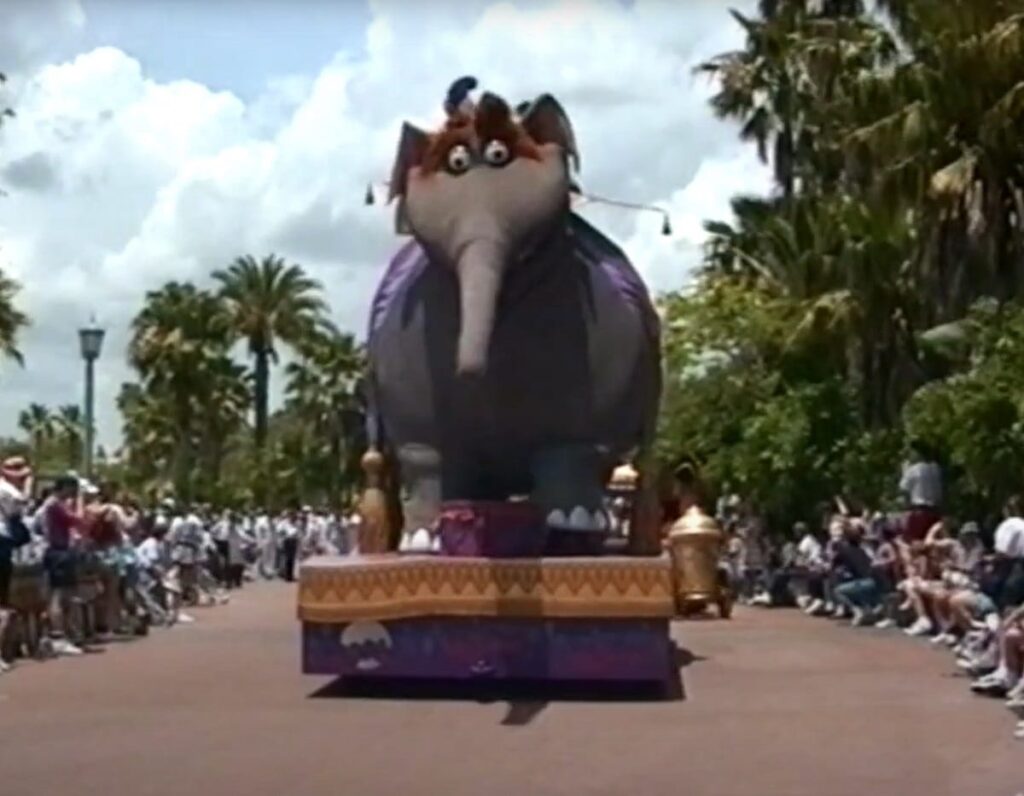
Aladdin’s Royal Caravan was a lively daytime parade performed at Disney-MGM Studios during the early 1990s. Inspired by the exuberant “Prince Ali” sequence from Disney’s 1992 animated film Aladdin, the production transformed Hollywood Boulevard into a procession through Agrabah. Rather than telling the movie’s complete story, the parade focused on the moment when Aladdin arrives in the city disguised as the wealthy and extravagant Prince Ali Ababwa, accompanied by a seemingly endless entourage of performers, animals, and larger-than-life characters.
The parade debuted at Disney-MGM Studios on December 21, 1992, approximately one month after Aladdin opened in theaters. Its rapid arrival reflected the movie’s immediate cultural impact and an era when the park regularly introduced attractions and entertainment tied to current film releases. The Walt Disney World version continued through August 27, 1995, giving it a substantially longer run than the Disneyland edition, which operated from April 1993 through June 1994.
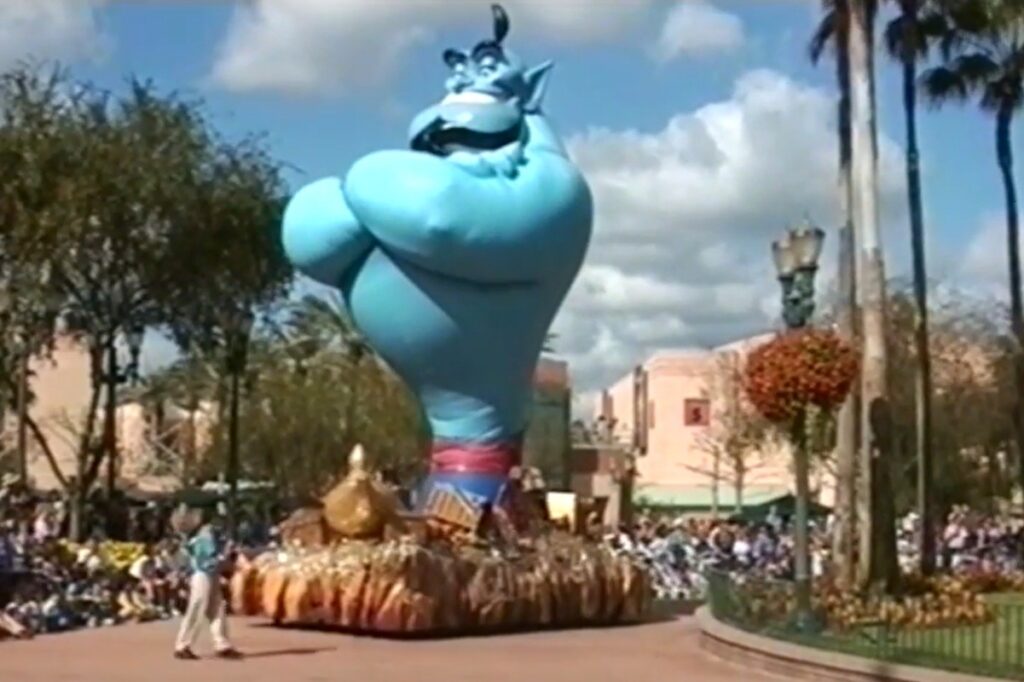
Genie was the parade’s dominant presence, appearing in several comic forms throughout the procession. Guests encountered a towering 32-foot Genie, a Genie apparently split into two pieces, and a bathtub version of the character, among other playful variations. The caravan also included dancers, musicians, marketplace characters, and a particularly memorable pair of golden camels. As the camels turned their heads from side to side, they sprayed water at spectators lining the route—an effect that was especially welcome during hot Florida afternoons. Aladdin and Jasmine appeared aboard an oversized version of Abu transformed into an elephant, recreating the theatrical spectacle of the film’s musical number.
Aladdin’s Royal Caravan also helped establish a pattern at Disney-MGM Studios: elaborate parades based on recently released animated films. After its run ended, the park introduced the Toy Story Parade in late 1995, continuing the strategy with Disney and Pixar’s newest theatrical release.
Although the parade disappeared decades ago, part of it remains visible at Walt Disney World. The golden spitting camels were eventually relocated to Adventureland at Magic Kingdom, where they became part of the setting surrounding The Magic Carpets of Aladdin. Today, Aladdin’s Royal Caravan is remembered as a quintessential early-1990s Disney-MGM Studios production: colorful, energetic, unapologetically promotional, and filled with the playful excess that made the original “Prince Ali” sequence so memorable.