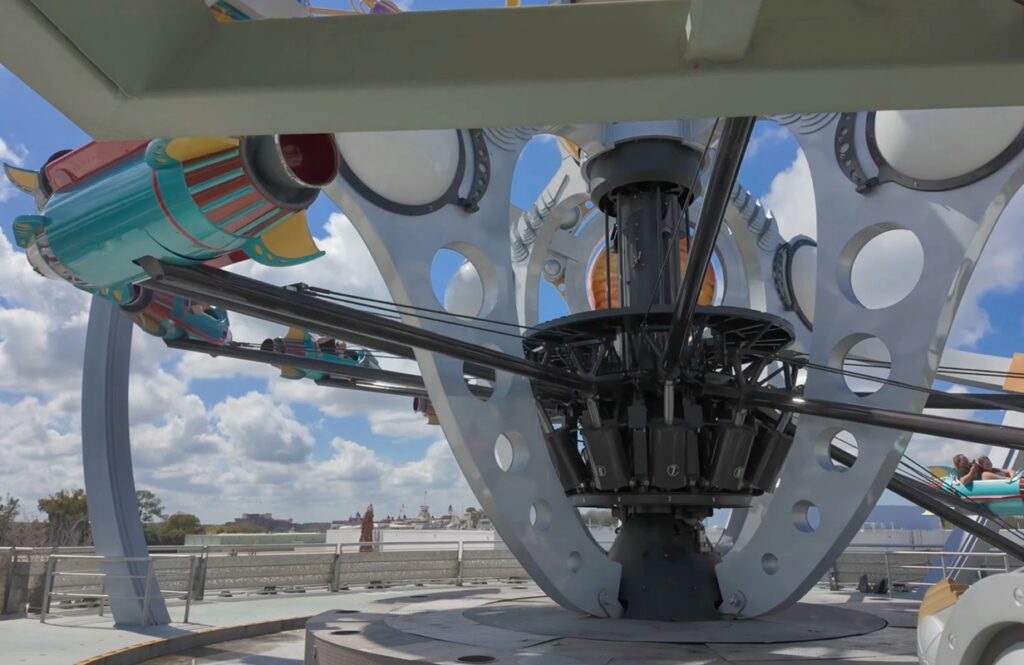
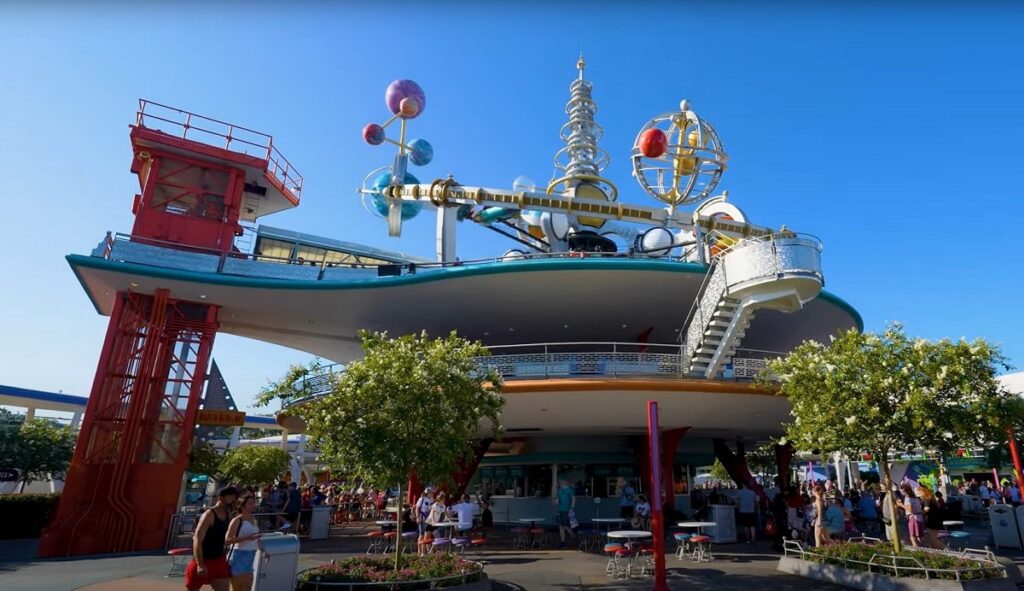
Astro Orbiter is a high-flying spinner attraction in Tomorrowland at Magic Kingdom, perched above the Tomorrowland Transit Authority PeopleMover station and The Lunching Pad in one of the most visually prominent locations in the land. Although the basic ride experience is deceptively simple—guests board a small rocket, circle a central structure, and use a lever to control their altitude—its elevated position makes Astro Orbiter considerably more dramatic than Magic Kingdom’s other spinner attractions. Riders soar above the rooftops of Tomorrowland with unusually open views toward Cinderella Castle, Space Mountain, the Contemporary Resort, and other portions of Walt Disney World.
The attraction as it exists today dates to April 30, 1994, but its history in this location reaches back two decades earlier. Astro Orbiter replaced the Star Jets, which opened on November 28, 1974 as part of the major expansion that transformed Magic Kingdom’s relatively sparse original Tomorrowland into a much more complete vision of the future.
The 1974 expansion was one of the most important periods in Tomorrowland history. The WEDWay PeopleMover, Carousel of Progress, Space Mountain, and Star Jets collectively gave the land many of the attractions and architectural elements that would define it for decades. Star Jets occupied the central elevated platform above what was then the WEDWay PeopleMover station, instantly becoming one of Tomorrowland’s most visible kinetic landmarks.
Star Jets followed the general concept established by Disneyland’s Rocket Jets. Riders boarded open-air spacecraft mounted to long arms extending from a rotating central structure. As the attraction spun, passengers could pull or push a control lever to make their vehicle rise or descend.
The centerpiece was an enormous Saturn-style rocket, giving the entire installation a strong connection to the real-world space program. The design reflected the original philosophy of Tomorrowland, which frequently looked toward contemporary aerospace engineering and imagined how rapidly developing technology might shape the future.
Magic Kingdom’s vehicles differed somewhat from Disneyland’s more traditional rocket-shaped craft. The Florida Star Jets had broader bodies and prominent fins that gave them an appearance closer to small space shuttles. Guests circled high above Tomorrowland, with the elevated platform already providing much of the sensation that would later distinguish Astro Orbiter.
Star Jets operated for nearly 20 years before Magic Kingdom undertook a sweeping redesign of Tomorrowland in the early 1990s.
The original land had increasingly become a problem for Disney Imagineering because a Tomorrowland based on realistic predictions of the future could quickly look dated. Technologies that once seemed futuristic became commonplace, while architectural styles intended to suggest tomorrow inevitably became recognizable products of the era in which they were designed.
Rather than repeatedly trying to predict what the actual future would look like, Disney developed the New Tomorrowland concept that debuted in 1994. The land was reimagined as a fantastical intergalactic city inspired by early science fiction, pulp magazines, World’s Fair futurism, and the optimistic mechanical visions of writers and artists from an earlier generation.
Tomorrowland became less concerned with demonstrating tomorrow’s technology and more interested in portraying a future that had supposedly been imagined in the past.
Star Jets closed on January 10, 1994 as part of that transformation.
When the attraction reopened a few months later as Astro Orbiter, its basic ride mechanics remained familiar, but its appearance had changed almost completely. The towering central rocket disappeared. In its place was a complex metallic structure resembling an enormous orrery, the mechanical model traditionally used to illustrate the movement of planets around the sun.
Large stylized planets, moons, spheres, rings, and mechanical arms now revolved around the central tower. Rather than simply flying around one rocket, riders appeared to weave their spacecraft through a miniature solar system.
The redesign was an excellent match for the new Tomorrowland.
Its brass-colored details, metallic framework, brightly colored planets, exposed mechanical components, and deliberately retro rockets looked like technology envisioned by a science-fiction illustrator rather than NASA engineers. Even decades later, Astro Orbiter retains that unusual mixture of Victorian astronomical machinery and mid-century space fantasy.
During the New Tomorrowland era, the attraction was incorporated into the land’s larger fictional mythology. PeopleMover narration referred to it as the “League of Planets Astro Orbiter,” tying it to the concept that Tomorrowland served as an intergalactic gathering place for travelers from throughout the universe.
That detailed backstory has become less explicit over time, but the physical design remains one of the strongest surviving reminders of the 1994 version of Tomorrowland.
Reaching the attraction is itself unusual.
Astro Orbiter’s queue begins at ground level near The Lunching Pad and the entrance to the Tomorrowland Transit Authority PeopleMover. Guests do not simply walk onto the ride platform. Instead, they are loaded into elevators that transport them to the upper level.
Stepping out of the elevator changes the perspective dramatically. From the ground, Astro Orbiter looks like a decorative kinetic sculpture spinning above Tomorrowland. From the platform, guests suddenly find themselves high above the surrounding pathways before the ride has even begun.
The compact rockets accommodate one or two passengers seated one behind the other. A safety belt secures the riders, and a control lever allows the front passenger to determine the vehicle’s vertical position.
Once the ride begins, the central mechanism accelerates and centrifugal force pushes the spacecraft outward. Pulling the lever raises the rocket along its support arm; pushing it lowers the vehicle. Guests can remain relatively close to the platform or climb toward the upper limit of the ride throughout the cycle.
Mechanically, that makes Astro Orbiter similar to Dumbo the Flying Elephant and The Magic Carpets of Aladdin. Experientially, however, it feels considerably different.
The reason is elevation.
Dumbo begins at ground level. Astro Orbiter begins several stories above Tomorrowland. When a rocket reaches its highest point, riders are not merely elevated above a circular ride platform—they are soaring over the edge of a rooftop structure while much of Magic Kingdom spreads out below.
The sensation can be surprisingly intense for an attraction with no height requirement.
Disney categorizes Astro Orbiter as appropriate for guests of any height, and there are no drops or coaster elements. Nevertheless, the combination of rapid circular movement, elevation, open-sided vehicles, and the outward angle created as the rockets spin can feel far more thrilling than the attraction appears from below. Guests uncomfortable with heights or sustained spinning may find it considerably more challenging than its family-friendly classification suggests.
For everyone else, those same qualities are the attraction’s greatest strength.
Astro Orbiter offers one of the most unusual elevated views available on a standard Magic Kingdom attraction. Cinderella Castle can be visible beyond the rooftops, while Space Mountain dominates the Tomorrowland skyline nearby. The Contemporary Resort and portions of the surrounding Walt Disney World property can also be seen from the upper platform and during the flight.
The experience becomes especially distinctive after sunset.
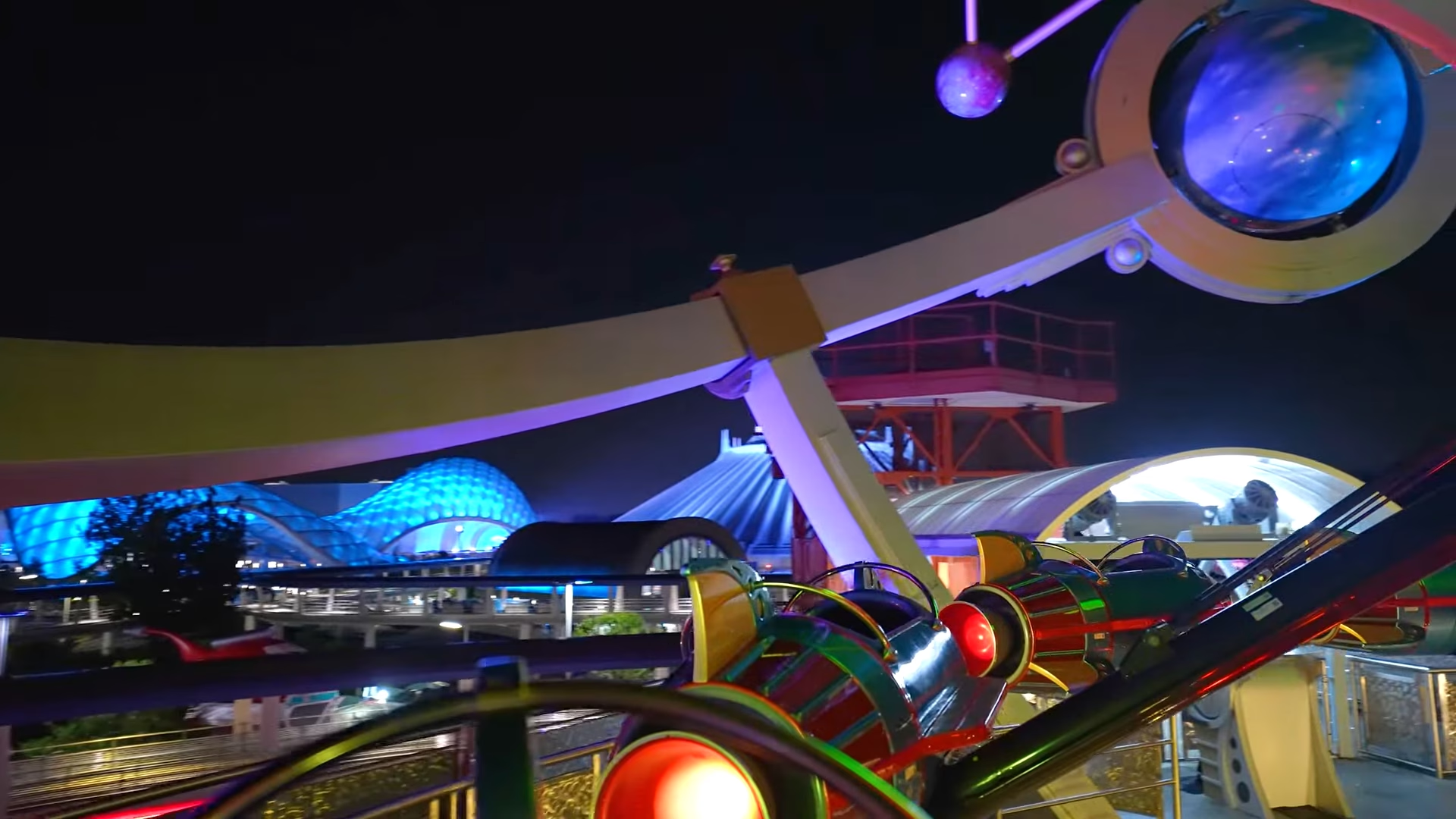
Tomorrowland has always depended heavily on kinetic movement and nighttime lighting. The illuminated PeopleMover glides beneath Astro Orbiter while rockets circle overhead, neon and architectural lighting cover the surrounding buildings, and Space Mountain glows nearby. Astro Orbiter’s own planets and metallic structure take on a completely different personality under artificial lighting.
From the rocket itself, guests can look across a Magic Kingdom filled with lights rather than the largely white rooftops visible during the daytime. For that reason, nighttime rides have long been particularly popular among enthusiasts, even though the attraction itself is mechanically unchanged.
Astro Orbiter also plays an important role for guests who never ride it.
Tomorrowland was designed around the concept of kinetic energy—the idea that moving vehicles and machinery make the environment feel active and futuristic. The PeopleMover continually glides along elevated tracks. Space Mountain’s exterior establishes a dramatic visual anchor. TRON Lightcycle / Run now adds illuminated trains racing beneath its canopy. In the middle of everything, Astro Orbiter’s rockets and planets continuously rotate above the land.
That motion helps make Tomorrowland feel alive.
The attraction therefore functions almost as much as architecture as it does as a ride. Remove the spinning planets and rockets from the center of Tomorrowland and the visual character of the land would change considerably.
Like most outdoor mechanical attractions of its age, Astro Orbiter has undergone numerous periods of maintenance and refurbishment. One particularly extensive refurbishment occurred in 2025.
Astro Orbiter closed on January 13, 2025, and the project quickly proved to be far more substantial than an ordinary repaint. Disney dismantled essentially the entire ride assembly. Rockets, planetary decorations, mechanical components, and major portions of the central structure were removed from the elevated platform and taken away for off-site refurbishment.
For several months, the center of Tomorrowland looked unusually empty. The famous planetary structure disappeared almost completely while crews worked on the attraction away from the park.
Beginning in spring 2025, the components gradually returned. The central spire was reinstalled first, followed by the large planets, smaller celestial bodies, support arms, and finally the familiar rocket vehicles.
The refurbishment did not substantially redesign Astro Orbiter. The rockets retained their familiar blue, red, gold, and green appearance, while the elaborate planets returned in essentially their established forms. One of the most noticeable cosmetic differences was the central elevator shaft, which changed from an orange-toned finish to a more subdued silver-gray treatment that better matched the surrounding metallic Tomorrowland architecture.
After testing during June, Astro Orbiter quietly reopened on June 27, 2025, ending a closure of more than five months.
The scale of the refurbishment is significant because it demonstrates Disney’s willingness to invest in preserving the attraction rather than replacing it. Astro Orbiter occupies valuable space in the center of Tomorrowland and is fundamentally based on a ride concept that dates to the earliest years of Disney theme parks. Yet its visual contribution to the land and distinctive elevated experience continue to justify its presence.
As of 2026, Astro Orbiter remains fully operational. Disney describes the attraction as a retro two-passenger spacecraft experience in which guests pilot their rocket through a gleaming constellation of planets and control their altitude using the onboard lever. It has no minimum height requirement, although guests using wheelchairs or ECVs must transfer to the ride vehicle.
Operationally, Astro Orbiter has an unusual limitation that can make its wait longer than its physical size might suggest. Every group has to move through the ground-level queue, enter one of the elevators, travel to the rooftop platform, wait for a ride cycle, board the narrow rockets, complete the flight, unload, and eventually travel back down. The elevator process creates a natural bottleneck that spinner rides located directly at ground level do not have.
That inefficiency is also part of the attraction’s character. Boarding Astro Orbiter feels slightly more like traveling to a launch platform than simply stepping onto an amusement ride.
The attraction’s long history gives it another layer of importance.
The location has been associated with spinning rockets since 1974—more than half a century. Guests who rode Star Jets during the 1970s or 1980s can return with children or grandchildren and follow essentially the same ritual: enter beneath the elevated attraction, take an elevator to the flight deck, squeeze into a rocket, pull the lever, and circle high above Tomorrowland.
What surrounds them has changed enormously.
The original Tomorrowland gave way to the League of Planets-inspired version of the 1990s. Mission to Mars disappeared. If You Had Wings became Dreamflight, then Take Flight, then Buzz Lightyear’s Space Ranger Spin. Alien Encounter arrived and vanished. Stitch came and went. TRON Lightcycle / Run rose beyond the PeopleMover. Space Mountain itself has undergone decades of technological change.
Through it all, rockets have continued circling above the center of the land.
That continuity is what makes Astro Orbiter more important than its relatively simple mechanics might imply. It is simultaneously a spinner ride, observation point, kinetic sculpture, surviving piece of 1994 New Tomorrowland, and direct descendant of one of Magic Kingdom’s defining 1970s attractions.
A ride aboard Astro Orbiter lasts only a few minutes, and the experience can be summarized very easily: go up, spin around, and come back down.
But very few rides make those three actions feel quite the same.
The elevator carries guests above Tomorrowland. The rocket rises farther still. Cinderella Castle and Space Mountain slide repeatedly across the horizon. Planets whirl around the central tower while the PeopleMover moves beneath it.
For a brief moment, the simplest ride mechanism in the park produces exactly the illusion Tomorrowland has been promising since the 1970s:
you are flying above the future.