Buzz Lightyear’s Space Ranger Spin is an interactive dark ride in Tomorrowland at Magic Kingdom that combines the continuous-motion tradition of classic Disney attractions with the competitive mechanics of a shooting gallery. Originally opened on October 7, 1998, the attraction recruits guests as rookie Space Rangers and sends them aboard maneuverable XP-37 Star Cruisers to help Buzz Lightyear defeat the Evil Emperor Zurg. After more than a quarter century of operation, Space Ranger Spin received its most substantial modernization yet in 2025–2026, reopening on April 8, 2026 with new ride vehicles, handheld blasters, digital targets, expanded scoring, a new character named Buddy, and other gameplay improvements while preserving the familiar scenes and basic mission that have defined the attraction since the late 1990s.
The story casts guests as new members of Star Command during an emergency in the Gamma Quadrant. Zurg and his robot forces are stealing crystolic fusion power cells—essentially batteries—from the galaxy’s toys so he can power a destructive new weapon. Buzz Lightyear needs additional recruits immediately, and guests are assigned to board Star Cruisers, travel into hostile territory, recover the energy supply, and score as many hits as possible against Zurg’s forces.
That premise makes unusually clever use of Buzz Lightyear’s original characterization in Toy Story. To Andy and the audience, Buzz is a plastic action figure. In Buzz’s own mind, however, he is a genuine intergalactic Space Ranger battling an evil emperor. Space Ranger Spin allows visitors to enter that imagined mythology directly. Rather than following Woody, Andy, or the other toys through a recreation of the films, guests effectively become characters inside the fictional science-fiction universe Buzz believes is real.
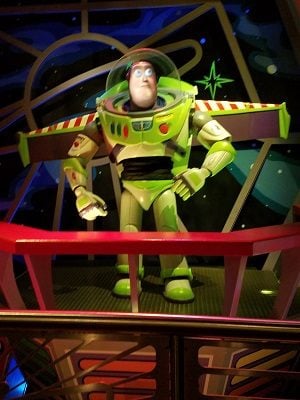
The experience begins inside Star Command headquarters. The queue uses oversized graphics, glowing power systems, futuristic equipment, warning displays, and imagery of Buzz and Zurg to establish the mission. One of its longtime signature features is a large animated Buzz Lightyear figure who briefs incoming recruits about the crisis. Because the attraction is presented largely from Buzz’s perspective, the environment embraces bright toy-like science fiction rather than attempting to create a realistic vision of space.
That visual style is part of the attraction’s enduring charm. Sets are intentionally exaggerated and colorful, with enormous robots, glowing planets, oversized batteries, alien creatures, mechanical arms, stars, rockets, and targets marked with Zurg’s familiar “Z.” Everything feels like a three-dimensional version of the kind of elaborate playset that might accompany a Buzz Lightyear action figure.
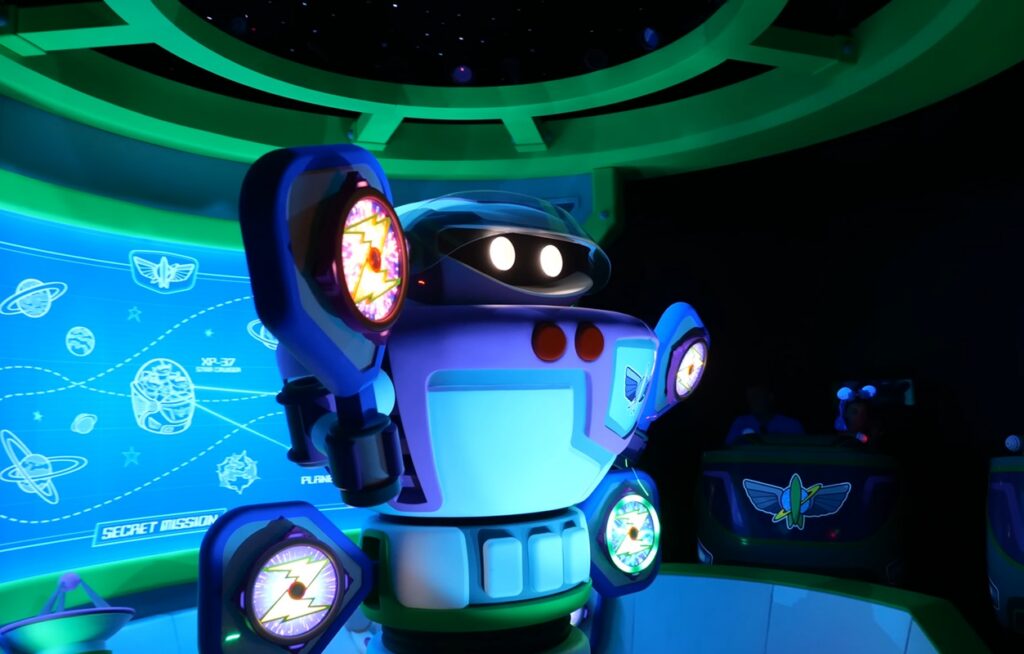
The attraction changed significantly in 2026 with the addition of Buddy, a new support-bot created jointly by Walt Disney Imagineering and Pixar Animation Studios. Buddy appears near the beginning of the mission and helps prepare departing Space Rangers by running final system checks and providing a short target-practice opportunity before the real battle begins.
The addition is more consequential than simply placing a new robot into an existing scene. Buddy introduces guests to the mechanics of the modernized attraction before scoring becomes competitive, giving first-time riders—particularly young children—an opportunity to understand how the blasters and targets respond. It also gives the attraction a new character created specifically for the theme-park experience rather than imported directly from a Pixar film.
Once training is complete, guests board an XP-37 Star Cruiser. The ride vehicles follow a continuously moving track through a series of dark-ride scenes, but riders can rotate their cruiser through a full 360 degrees using a central joystick. That ability gives guests an unusual amount of control for a Disney Omnimover-style attraction.
Turning the vehicle is not merely decorative. Some targets appear behind or above the cruiser, and an experienced player can rotate strategically to line up valuable shots, remain focused on a particularly profitable target, or quickly switch between scenes. Two people riding together may therefore find themselves negotiating—or fighting over—where the vehicle should point.
For the attraction’s first 26 years, each position used a laser cannon permanently mounted to the front of the cruiser. Those fixed blasters became one of the defining differences between the Florida attraction and later Buzz Lightyear rides constructed at other Disney parks, many of which used guns that could be lifted and aimed more freely.
The 2026 refurbishment finally eliminated that limitation.
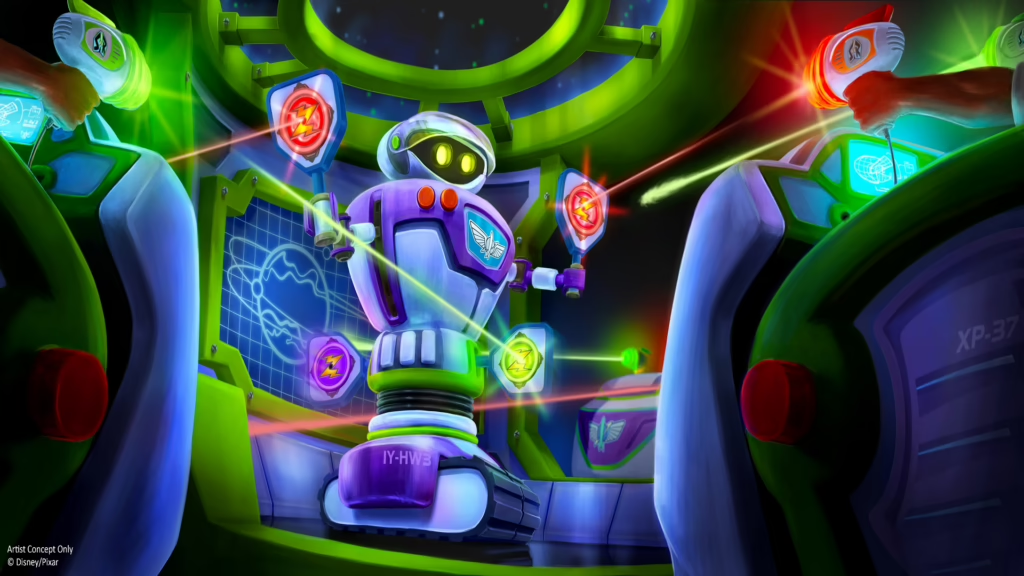
Each redesigned Star Cruiser now has two fully handheld blasters, making it much easier to aim independently of the vehicle itself. One projects a red targeting laser and the other green, allowing riders to distinguish their own shots. The lasers remain continuously visible rather than appearing only when the trigger is pulled, making it much easier to determine exactly where the weapon is pointed.
The upgraded blasters also respond physically and audibly. Lighting, sound, and vibration provide immediate feedback, transforming what was once a relatively simple trigger mechanism into something closer to a modern interactive-game controller. The improvement is especially noticeable for younger riders, who previously could struggle to aim the fixed cannons while seated far back in the vehicle.
New onboard video monitors also provide real-time score and rank information.
The targets received an equally important modernization. The familiar circular Zurg targets remain throughout most of the original locations, preserving the visual identity of the attraction, but they are now digital interactive displays capable of responding instantly when struck. A successful hit generates color-coded animation matching the rider’s blaster, making it much clearer when a shot has actually registered.
That change corrected one of the attraction’s longtime weaknesses. On the original version, riders could fire rapidly at targets without always knowing precisely which shots had scored. The new system provides immediate visual confirmation.
Disney also transformed the scoring into a considerably deeper game.
Target difficulty still matters, and distant or difficult-to-reach targets generally offer greater rewards. Several of the famous high-value targets memorized by longtime fans remain in approximately their traditional locations, although their values and the overall strategy have been rebalanced.
The digital system introduces randomized special target states as well. A target surrounded by a white ring is temporarily worth double its normal value. Even more important is a rare multicolored target that appears unpredictably for only a short period. Hitting that target triggers a temporary bonus mode in which targets throughout the scene become dramatically more valuable.
That randomization changes the experience considerably for repeat riders. The original attraction could eventually become an exercise in memorization: knowledgeable fans knew which two or three targets to shoot repeatedly and could largely ignore everything else. The refreshed version still rewards experience but introduces enough changing conditions that riders need to watch the environment and react in real time.
Disney further encourages broader participation through an end-of-mission bonus based on the number of distinct targets hit. A player who continually searches for new targets can therefore receive an additional score increase even without repeatedly exploiting one hidden high-value location.
The ranking system was revised with the 2026 update as well. The lowest current rank is Star Flyer, followed by Solar Navigator, Astro Aviator, Planetary Pilot, Space Ace, Cosmic Commando, and ultimately Galactic Hero. Reaching Galactic Hero now requires a score of at least 1,000,000 points, removing the old 999,999-point ceiling that longtime riders associated with the attraction.
That change is emblematic of the entire refurbishment. Disney did not fundamentally rebuild Space Ranger Spin. The recognizable environments, characters, targets, spinning vehicles, and Zurg battle remain. Instead, Imagineering modernized the interactive layer around them, making aiming clearer, scoring more dynamic, competition deeper, and the attraction easier for first-time guests to understand.
The ride itself moves through a sequence of exaggerated cosmic environments populated by Zurg’s robots and alien machinery. Guests fire continuously at targets positioned on moving figures, walls, props, ceilings, and large set pieces while using the joystick to control their orientation.
Some shots activate additional lighting, movement, or sound effects. As the mission escalates, riders eventually confront Zurg himself before returning to Star Command to learn their final scores and ranks.
The attraction is deliberately family-friendly. Disney lists it as appropriate for any height, and despite its name, the “spin” is controlled largely by the passengers rather than imposed as a high-speed thrill effect. The ride moves slowly, making it accessible to young children even as the scoring system gives older guests and adults something competitive to pursue.
That broad appeal has helped Space Ranger Spin remain remarkably durable. A preschooler can enjoy pulling the trigger and watching lights flash without understanding the score, while an experienced adult can approach the same ride as a serious optimization challenge.
The current version also incorporates attraction photography more deeply into the game. Following the 2026 refresh, ride photos can display participants’ scores and final rank, making the competitive results part of the souvenir rather than simply capturing an action shot.
The building occupied by Space Ranger Spin has a history stretching far beyond Buzz Lightyear.
For more than 25 years before Buzz arrived, the same Tomorrowland show building housed a succession of aviation-themed attractions using essentially the same continuously moving ride infrastructure.
The lineage began with If You Had Wings, an Eastern Air Lines-sponsored attraction that opened in 1972. Guests boarded Omnimover vehicles for a stylized journey through destinations served by Eastern, including Mexico, the Caribbean, and other vacation locations. The attraction became famous for its catchy theme song and elaborate projection effects.
When Eastern ended its sponsorship, Disney briefly operated the attraction as If You Could Fly before closing it in 1989.
The building then became Delta Dreamflight, opening on June 26, 1989. Instead of advertising vacation destinations directly, Dreamflight presented an upbeat history of aviation, taking guests from the barnstorming era through commercial passenger flight and into an optimistic vision of aviation’s future.
After Delta’s sponsorship ended in 1996, Disney first shortened the name to Dreamflight and then renamed it Take Flight. Take Flight closed permanently on January 5, 1998.
Rather than demolishing the elaborate ride system, Disney reused much of the underlying infrastructure for Buzz Lightyear.
That reuse explains several characteristics of Space Ranger Spin. Its long, winding layout was not originally designed around an intergalactic shooting game. Beneath the modern scenery is the path guests once followed through decades of aviation attractions. Even Tomorrowland’s PeopleMover interacts with the building, continuing the interconnected architectural relationship that has existed for generations.
Buzz Lightyear’s Space Ranger Spin opened later in 1998, giving the building its fifth major attraction identity while preserving the basic Omnimover concept established in the 1970s.
Its arrival also represented an important shift in Tomorrowland.
The land had historically concentrated on visions of transportation, technological progress, space exploration, and speculative futures. By the late 1990s, Disney increasingly embraced a more character-driven interpretation of Tomorrowland, and Buzz Lightyear proved unusually compatible with that transition. His fictional world already contained rockets, aliens, laser weapons, robots, interplanetary travel, and optimistic retro-futuristic technology.
The attraction consequently felt more at home in Tomorrowland than many character overlays might have.
Space Ranger Spin was also an early example of Disney turning a traditional dark ride into a fully interactive competition. Riders were no longer simply observing scenes as they passed them. Their actions affected lights, sound effects, animation, scores, and ultimately their rank.
The concept proved successful enough to expand internationally. Variations of the Buzz Lightyear shooting attraction subsequently appeared at multiple Disney resorts under names such as Buzz Lightyear Astro Blasters, Buzz Lightyear Laser Blast, and Buzz Lightyear Planet Rescue. The Magic Kingdom version was the original template from which that international family developed.
By the mid-2020s, however, the Florida attraction was showing its age. The ride’s fixed blasters were less intuitive than systems used in newer interactive attractions, target registration could be difficult to interpret, and decades of operation had left parts of the presentation feeling technologically dated.
Disney therefore closed Space Ranger Spin on August 4, 2025 for an extensive refurbishment.
During the closure, Imagineering replaced and updated major gameplay components, redesigned the Star Cruisers, installed handheld blasters, converted targets to interactive digital displays, created the Buddy scene, refreshed the entrance, updated exterior colors and signage, and added the new scoring system.
The project was deliberately framed as a recharge rather than a replacement. Disney repeatedly emphasized that the attraction guests knew would remain recognizable.
That proved true when Buzz Lightyear’s Space Ranger Spin reopened on April 8, 2026.
Unlike some modern attraction renovations that remove nearly everything except the building shell, the refreshed Space Ranger Spin remains unmistakably the 1998 ride. Buzz still recruits guests. Zurg remains the villain. Riders still board XP-37 Star Cruisers. The vehicles still rotate. The familiar targets remain scattered throughout the scenes.
The difference is that the interactive technology finally feels much closer to the competitive game the attraction was always trying to be.
That balance between preservation and modernization is particularly appropriate given the building’s history. Tomorrowland has repeatedly reused this same ride infrastructure instead of discarding it. Aviation destinations became aviation history; aviation history became Buzz Lightyear; and Buzz Lightyear has now evolved into a substantially more sophisticated interactive experience without losing the physical foundation beneath it.
As of 2026, Buzz Lightyear’s Space Ranger Spin remains one of Magic Kingdom’s most accessible competitive attractions. It has no height requirement, does not depend on a guest’s familiarity with every Toy Story film, and works equally well as a colorful dark ride and a serious scoring challenge.
Its enduring strength comes from that dual identity.
A family can simply enjoy joining Buzz on a mission through a glowing cartoon galaxy. Two competitive adults can spend the entire ride hunting bonus targets and fighting for control of the cruiser. A longtime fan can compare the modern digital system with the fixed cannons they remember from 1998. And beneath all of it, the same Tomorrowland ride route that once carried guests through the history of aviation continues moving steadily forward.
After more than a quarter century, Buzz Lightyear’s Space Ranger Spin has not been reinvented so much as rearmed-preserving the playful original while finally giving Magic Kingdom’s Space Rangers the equipment and scoring system to match their mission.