
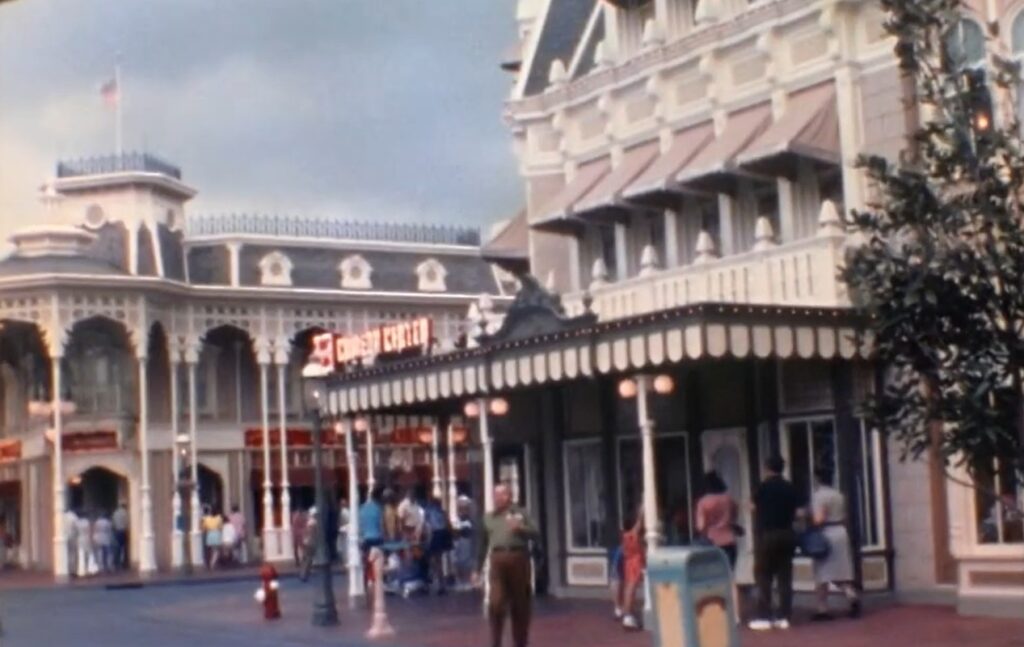
The Camera Center was an opening-day photography shop on Main Street, U.S.A. at Magic Kingdom that provided film, cameras, rentals, repairs, processing, photographic advice, and other services during an era when documenting a Walt Disney World vacation required significantly more planning than pulling a smartphone from a pocket. Opening on October 1, 1971 as the GAF Camera Center, the shop later operated under Polaroid and Kodak sponsorship before eventually relocating to the Town Square Exhibition Hall in 1998.
For nearly four decades in one form or another, the Camera Center served as Magic Kingdom’s photography headquarters.
Its original location was ideal.
The store stood on the east side of Town Square near The Chapeau and Main Street Confectionery, only moments after guests entered the park beneath the Walt Disney World Railroad station.
That positioning was extremely practical.
If someone had forgotten film, needed batteries, wanted to rent a camera, discovered a problem with their equipment, or simply wanted advice before spending an entire day photographing Magic Kingdom, the Camera Center was available before they had walked more than a few hundred feet.
Today, that level of dedicated photographic infrastructure can seem almost unnecessary.
In 1971, it was essential.
A family might arrive at Walt Disney World carrying a 35mm camera, an Instamatic, a Super 8 movie camera, or some other film-based equipment.
Every photograph consumed a physical frame.
Flash photography required bulbs, cubes, or electronic equipment.
Film could run out.
Batteries failed.
Cameras jammed.
Nothing could be reviewed immediately on a digital screen.
If a photograph was poorly exposed, the family might not discover the problem until the roll had been developed days or weeks later.
The Camera Center existed to solve those problems.
Disney’s official 1977 guidebook described the GAF Camera Center as offering:
“Film, cameras, supplies, slides and photo tips.”
Historical documentation adds camera rentals, minor repairs, and film processing to that list.
GAF—General Aniline & Film—was the Camera Center’s original sponsor.
The company also used its Walt Disney World partnership to encourage guests to photograph the park.
GAF-sponsored guide maps incorporated a “Photo Trail” highlighting especially scenic locations for pictures.
That idea later evolved into the familiar Kodak Picture Spots placed throughout Disney parks.
The relationship was mutually beneficial.
Disney wanted guests to document their vacations and preserve positive memories.
A film company wanted them to use as much film as possible.
Few environments offered better opportunities than Walt Disney World.
Every character encounter, parade, attraction façade, fireworks show, landscaped area, and family gathering represented another potential photograph.
GAF’s presence therefore extended well beyond the physical camera store.
The company’s branding appeared on park literature and photography information, subtly guiding guests toward the places where their cameras might get the most use.
GAF’s sponsorship ended during the late 1970s.
Polaroid became the Camera Center sponsor in 1979 and introduced an experience particularly appropriate to the instant-photography company.
Guests could borrow a Polaroid camera after placing a deposit and pay primarily for the instant film they used.
That allowed vacationers who had arrived without a camera—or simply wanted to experiment with instant photography—to document their day without purchasing an entirely new camera system.
Polaroid also introduced one of the Camera Center’s most memorable services.
During the early 1980s, guests could dress in 19th-century costumes and pose for an “instant 8×10 portrait.”
The backdrop resembled the rear platform of a railroad car, tying the experience to both Main Street’s period setting and the Walt Disney World Railroad station nearby.
Families could dress in old-fashioned clothing, step into the railroad scene, and leave with a finished Polaroid portrait rather than waiting days for traditional film processing.
The Walt Disney Archives has specifically confirmed this unusual service.
For many guests, those photographs became cherished pieces of Walt Disney World nostalgia.
They also show how much more ambitious the Camera Center was than a modern convenience kiosk selling memory cards and batteries.
It was part retail store, part photo studio, part repair facility, and part guest service.
Kodak replaced Polaroid as sponsor in 1984.
That change connected Magic Kingdom with one of the most famous names in consumer photography.
Kodak products, advertising, park maps, processing services, and designated photo locations became increasingly visible throughout Walt Disney World.
The Camera Center continued selling film and photographic supplies while offering rentals and processing.
During the Kodak period, guests could at times receive use of a Kodak Disc camera when purchasing the necessary film.
The Disc camera itself became a fascinating artifact of 1980s photography.
Introduced by Kodak in 1982, it used a flat circular film disc rather than a conventional roll. The format was compact and easy to load but ultimately proved short-lived because its small negatives limited image quality.
For a time, however, Walt Disney World actively supported it.
The Camera Center also participated in Disney’s film-processing infrastructure.
Guests could drop off exposed film for developing rather than waiting until they returned home.
Services associated with Mickey’s Film Express allowed film to be collected at various Walt Disney World locations, processed, and in some cases mailed to the guest.
Slides and movie film could also be handled.
By 1993, Disney was advertising camera and camcorder rentals and promoting two-hour film processing.
That speed mattered enormously.
A guest could potentially shoot a roll of film early in the vacation, have it processed while still at Magic Kingdom, inspect the pictures, and discover whether the camera was functioning correctly before taking hundreds more photographs.
An official 1996 Magic Kingdom guide still listed the Kodak Camera Center and advertised film, accessories, and two-hour processing.
The physical shop’s days at its original location were nevertheless numbered.
Main Street retail was becoming increasingly consolidated.
The adjacent Confectionery required more room, while Disney had another large Town Square facility that could accommodate a broader photography experience.
On August 27, 1998, the Camera Center officially relocated into the new Town Square Exhibition Hall.
The original store space was subsequently absorbed into the expanding Main Street Confectionery, with historical records placing that physical expansion in November 1998.
The Town Square Exhibition Hall was much more than a relocated camera counter.
Disney transformed the former Walt Disney Story complex into what D23 described as a venue housing the Camera Center, while Kodak sponsorship supported an entire series of photographic exhibits.
Guests encountered the Hall of Still Images, which included photography displays and vintage photographic equipment.
Souvenir photo opportunities allowed visitors to pose against themed Disney backgrounds.
The former theater became the Hall of Moving Images, where classic Disney cartoons could be shown.
Another portion became the Hall of Digital Technology, examining changing photographic methods and displaying historic Walt Disney World images.
The Camera Center itself occupied the retail portion of the complex.
This arrangement effectively transformed a practical Main Street shop into a small photography pavilion.
The relocation also occurred at a fascinating technological moment.
Digital photography was beginning to move from specialist equipment toward consumer use.
For most guests, however, traditional film remained dominant.
Within only a decade, that balance would reverse.
Digital cameras eliminated the need to buy rolls of film.
Memory cards could store hundreds or thousands of photographs.
Images could be reviewed immediately.
Mobile phones increasingly incorporated capable cameras.
Film processing—once one of the Camera Center’s most important services—rapidly became irrelevant to most theme-park visitors.
Disney was changing its own photography operation at the same time.
Disney’s PhotoPass service debuted during the 2000s, creating a network of professional photographers who could capture guests around the parks and associate those images with a card for later viewing and purchasing.
The vacation-photography ecosystem was becoming digital.
The Camera Center gradually became a relic of the era it had helped define.
The Town Square Exhibition Hall closed in 2010 as Disney prepared to transform the building into Town Square Theater.
The Camera Center disappeared with it.
In 2011, Town Square Theater opened as a major character-greeting facility, initially housing Mickey Mouse and Disney Princess experiences.
The building continues serving guests in that broader role today.
Both of the Camera Center’s principal Magic Kingdom homes therefore survive physically.
Its original 1971 location has been incorporated into the Main Street Confectionery.
Its later Exhibition Hall location became Town Square Theater.
What disappeared was the need for a dedicated photography store of that scale.
That makes the Camera Center one of the best examples of a Walt Disney World business rendered obsolete not by changing Disney storytelling but by changing technology.
For an opening-day guest, the shop was genuinely important.
A broken camera could threaten the photographic record of an entire vacation.
Running out of film inside Magic Kingdom was a real problem.
Getting pictures developed required equipment and time.
The Camera Center solved all of those problems only steps from the front gate.
Modern guests can take thousands of photographs during a single day without purchasing a single frame of film.
They can see each photograph instantly, edit it on the spot, send it around the world within seconds, and store it indefinitely in the cloud.
For most of the Camera Center’s history, that would have sounded like Tomorrowland science fiction.
From 1971 into the digital age, however, Disney understood one basic truth remarkably well:
Guests were coming to Walt Disney World to make memories.
And they wanted photographs to prove it.