

Dok-Ondar’s Den of Antiquities is one of the most elaborately themed merchandise locations in Star Wars: Galaxy’s Edge at Disney’s Hollywood Studios, functioning simultaneously as a shop, character encounter, museum-like collection of Star Wars artifacts, and piece of the larger mythology surrounding Black Spire Outpost. The store opened on August 29, 2019, alongside the Florida version of Galaxy’s Edge, and quickly became a destination in its own right-particularly for serious Star Wars collectors interested in Legacy Lightsabers, kyber crystals, holocrons, jewelry, and other objects designed to appear as though they were acquired from across the galaxy rather than manufactured specifically as theme-park souvenirs.
That distinction is fundamental to the experience. Most merchandise locations at Walt Disney World acknowledge, at least implicitly, that guests are shopping inside a theme park. Dok-Ondar’s instead operates entirely within the fiction of Batuu. There are no conventional racks of brightly packaged Star Wars merchandise dominating the room. Products are displayed as relics, weapons, tools, carvings, and mysterious artifacts collected over a lifetime by a notoriously well-connected antiquities dealer.
The proprietor himself is Dok-Ondar, an Ithorian whose species will be familiar to longtime Star Wars fans from characters such as Momaw Nadon, the famous “Hammerhead” alien seen in the Mos Eisley cantina in the original 1977 film. Dok is not merely a character invented for a sign outside the shop. Guests can actually see him working behind his elevated desk as an impressive Audio-Animatronics figure.
The enormous Ithorian spends his day examining inventory, handling objects, taking communications, grumbling to himself, and occasionally barking instructions to his employees. His elevated position allows him to survey both his merchandise and the customers wandering below, reinforcing the sense that everyone entering the shop is stepping into his domain.
Within Star Wars lore, Dok-Ondar is far more than a retailer. He is described as the gatekeeper of the black market at Black Spire Outpost, a collector who buys, sells, and trades rare objects and whose knowledge and connections stretch far beyond Batuu. His establishment is considered one of the oldest businesses in the settlement, and his collection includes material representing numerous civilizations, conflicts, religions, and historical periods.
Disney and Lucasfilm deliberately established Dok beyond the physical theme park. His name was referenced in Solo: A Star Wars Story before Galaxy’s Edge opened, and he subsequently became an important character in Marvel’s Star Wars: Galaxy’s Edge comic series. He also appears in the virtual-reality adventure Star Wars: Tales from the Galaxy’s Edge. That cross-media development reinforces one of the defining ideas behind Galaxy’s Edge: Batuu was intended to be a genuine location within the larger Star Wars universe rather than a theme-park land that exists separately from the films, television series, books, comics, and games.
The shop itself feels appropriately old, crowded, and slightly overwhelming. Dok’s collection rises several stories above the sales floor, filling shelves, cages, balconies, walls, and shadowy storage areas with objects that most visitors cannot purchase. Crates are stacked beside ancient statues. Helmets and weapons hang overhead. Creatures and taxidermic specimens occupy unexpected corners. Some objects are instantly recognizable; others reward guests with enough Star Wars knowledge to identify obscure references spanning decades of storytelling.
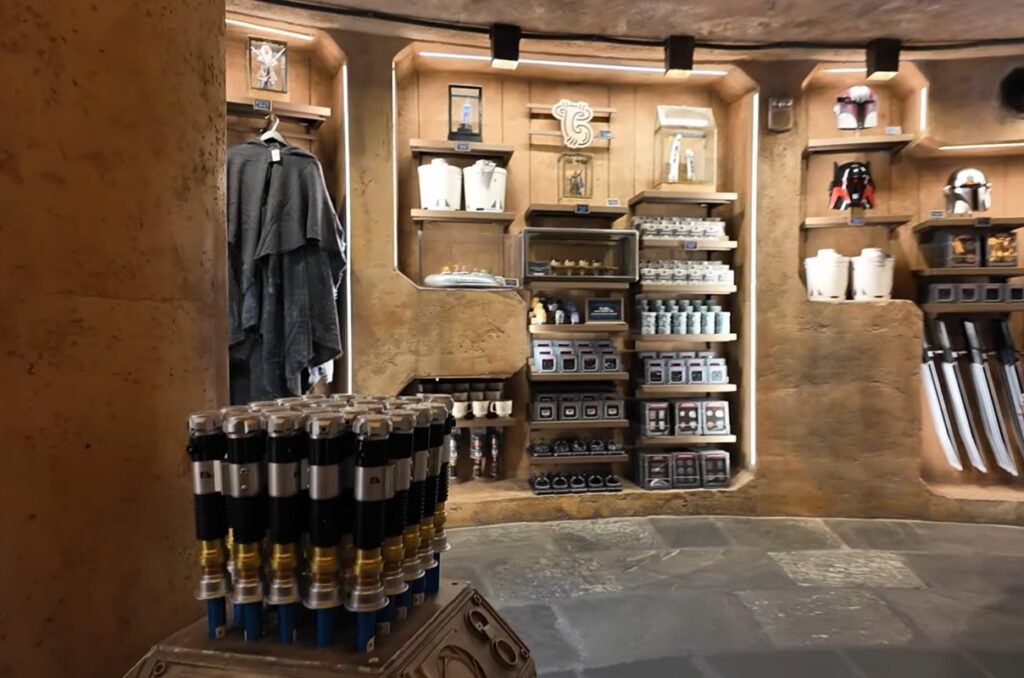
Among the creatures displayed inside are a Nexu head, recognizable as belonging to the vicious feline-like beast encountered in the Geonosis arena in Attack of the Clones. Guests can also find a profrogg, a large horned rodent, and an ollopom, a small creature associated with the swamps of Naboo. Helmets belonging to stormtroopers, bounty hunters, and other galactic figures are integrated into the collection.
The abundance of material makes Dok-Ondar’s substantially different from a conventional attraction exit store. Many of its best details are not merchandise at all. The upper reaches of the room effectively function as an enormous Star Wars Easter-egg display, encouraging fans to look upward and study shelves they cannot physically reach.
That approach reflects the design philosophy used throughout Galaxy’s Edge. Walt Disney Imagineering and Lucasfilm worked closely together, with Imagineers studying actual film sets and accessing the Lucasfilm archives while developing the land. For merchandise, teams examined original props and costumes, sometimes using detailed digital scans and 3D reproductions to recreate objects with unusual accuracy.
One of the best examples was Princess Leia’s ceremonial necklace from the ending of Star Wars: A New Hope. Rather than simply sculpting a piece that looked approximately like the movie prop, Disney contacted the original European designer, who still possessed the mold used decades earlier. That mold helped create the version offered through Dok-Ondar’s, illustrating how seriously the store treats the idea of selling collectible artifacts rather than generic movie merchandise.
The most famous merchandise category is undoubtedly the Legacy Lightsaber collection. Unlike the custom lightsabers created by guests nearby at Savi’s Workshop, Legacy Lightsabers reproduce weapons associated with established Star Wars characters. Over the years, the collection has included designs inspired by Jedi, Sith, and other lightsaber users from the films, television series, video games, comics, and publishing eras.
That has allowed Dok-Ondar’s to become a central destination for collectors whenever Disney releases a new hilt. Characters represented over time have ranged from familiar figures to considerably deeper cuts, including limited releases tied to Jedi such as Ki-Adi-Mundi, High Republic characters such as Stellan Gios, and video-game protagonists such as Cal Kestis from Star Wars Jedi: Fallen Order. Some hilts have been released in elaborate limited-edition boxes, turning the store into something closer to a specialty collector shop than an ordinary theme-park retailer.
The presentation enhances the experience. Lightsaber hilts are displayed behind a large counter where guests can examine available designs before making a purchase. Separate blades and accessories allow many of the hilts to become functioning illuminated display pieces rather than static replicas.
Kyber crystals are another important component of the shop and of Galaxy’s Edge storytelling. Within Star Wars, kyber crystals form the heart of lightsabers and have a powerful connection to the Force. At Walt Disney World, crystals can interact with compatible lightsabers and holocrons, allowing the physical merchandise to behave differently depending on which crystal is inserted.
Dok-Ondar’s also sells Jedi and Sith holocrons, cube- and pyramid-shaped devices based on repositories of knowledge seen throughout Star Wars storytelling. Combined with the kyber crystals, these objects help create a merchandise system in which individual purchases connect to one another instead of functioning as isolated souvenirs.
Other merchandise has included jewelry, ancient-looking tools, sculptures, carvings, medallions, accessories, collectible objects, and replicas inspired by artifacts from throughout the franchise. The exact assortment changes regularly, which fits the in-world explanation that Dok is continuously buying, trading, and acquiring new treasures.
Even the fact that expensive merchandise sits beside strange curiosities is part of the storytelling. Dok-Ondar is not supposed to be running an officially licensed Star Wars store. He is a trader operating on the edge of civilized space, and the Den feels like a place where priceless Jedi relics, questionable black-market goods, old weapons, and bizarre taxidermy might reasonably accumulate over decades.
The store also provides an interesting contrast with the other retailers throughout Black Spire Outpost. Black Spire Outfitters specializes in clothing, Toydarian Toymaker presents handmade-looking toys, the Creature Stall deals in creatures from across the galaxy, and Resistance Supply and First Order Cargo represent opposing political factions. Dok-Ondar’s occupies the collector and antiquities niche, giving the marketplace another believable type of business rather than repeating the same souvenirs in every storefront.
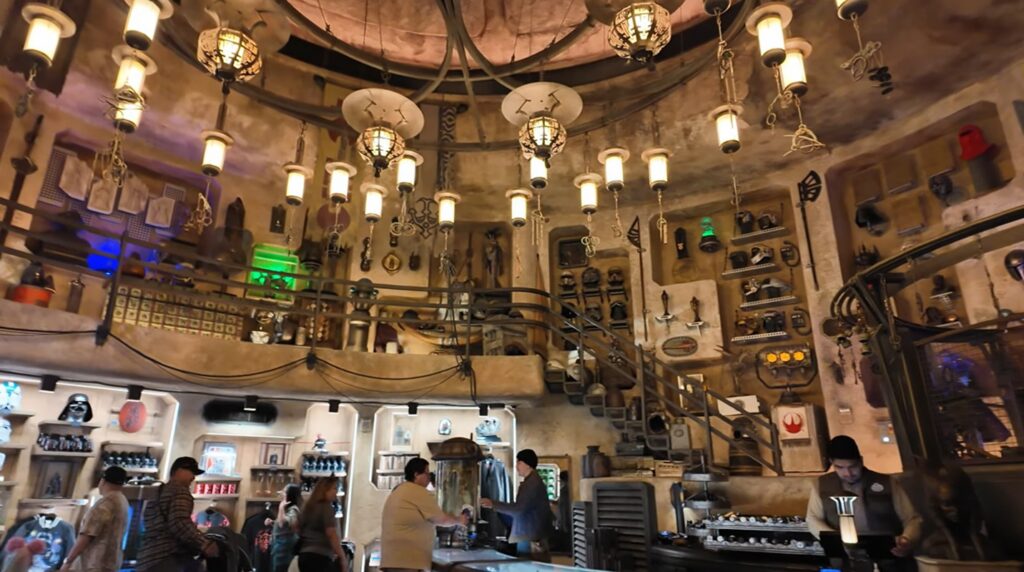
That retail differentiation was an important part of Galaxy’s Edge from the beginning. Rather than constructing one enormous Star Wars superstore, Disney scattered specialized shops throughout the settlement and gave each one an owner, history, visual identity, and merchandise category. The idea is closer to exploring a functioning marketplace than walking through a modern shopping mall.
Dok-Ondar’s may be the strongest realization of that philosophy because the character is physically present. Seeing the massive Ithorian above the sales floor fundamentally changes the relationship between the environment and the products. Guests are not simply buying a lightsaber from Disney; within the story, they are purchasing a rare weapon from a powerful black-market antiquities dealer who happens to have acquired it through methods he would probably prefer not to explain.
The Audio-Animatronics figure has even become a reference point for Dok’s appearances outside the park. When ILMxLAB developed Dok-Ondar for Tales from the Galaxy’s Edge, the team physically scanned the park’s Audio-Animatronics figure and worked with Imagineering to reproduce his appearance and movement digitally. The result effectively reversed the traditional process: rather than a theme park attempting to reproduce a character created for film or television, the physical theme-park character became the source model for a later Star Wars production.
Dok-Ondar’s Den of Antiquities is consequently one of the clearest demonstrations of what makes Galaxy’s Edge different from earlier Disney movie-based lands. Its purpose is obviously commercial, but Imagineering treats the commercial transaction itself as part of the story. Merchandise design, architecture, character performance, franchise lore, props, interactive technology, and environmental storytelling all work together to disguise the boundaries between shop and attraction.
As of 2026, Dok-Ondar’s Den of Antiquities remains an operating cornerstone of Black Spire Outpost, with Disney continuing to describe its inventory as a rotating collection of jewelry, ancient tools, rare kyber crystals, statues, carvings, and famous lightsabers. New collectible releases continue to give dedicated fans reasons to return, while the densely layered interior means that visitors can spend considerable time exploring without purchasing anything at all.
For a casual visitor, Dok-Ondar’s is an unusually atmospheric place to shop for Star Wars souvenirs. For serious fans, it is closer to a walk-through archive filled with references to multiple eras of the franchise. And within the fiction of Galaxy’s Edge, it is exactly what the sign claims: the shadowy establishment of an Ithorian antiquities dealer whose shelves contain objects with histories stretching from the age of the Jedi to the conflicts of the modern galaxy.
That combination makes Dok-Ondar’s Den of Antiquities one of Walt Disney World’s most successful examples of retail as an attraction-a merchandise location where the most memorable thing may not be what guests take home, but everything they discover by looking around.