
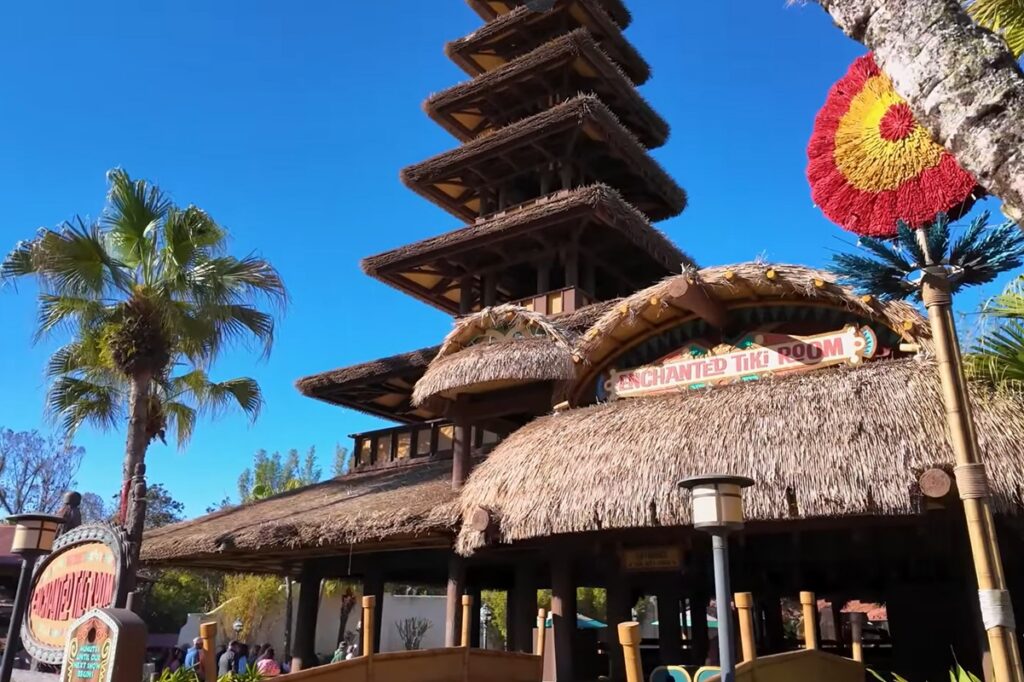
Walt Disney’s Enchanted Tiki Room is an Audio-Animatronics musical attraction in Adventureland at Magic Kingdom and one of the park’s most important surviving links to the earliest generation of Disney theme-park technology. Located inside the tropical Sunshine Pavilion, the attraction surrounds guests with more than 225 singing birds, flowers, tiki figures, and other animated performers in a theater-in-the-round presentation led by four colorful macaws: José, Michael, Pierre, and Fritz. Although the attraction currently carries Walt Disney’s name and closely resembles the classic show first created for Disneyland, the Florida version has undergone an unusually complicated history involving multiple names, corporate sponsorship, a complete character-driven overhaul, a fire, and ultimately a return to its roots.
The attraction opened with Magic Kingdom on October 1, 1971, under the name Tropical Serenade. It was housed inside the Sunshine Pavilion and sponsored by the Florida Citrus Growers, whose presence extended into the adjoining Sunshine Tree Terrace and resulted in the creation of one of Walt Disney World’s most enduring original characters: the Orange Bird.
Tropical Serenade was essentially Walt Disney World’s version of the groundbreaking Enchanted Tiki Room, which had debuted at Disneyland on June 23, 1963. That California attraction was enormously significant in Disney history because it introduced audiences to the sophisticated synchronized Audio-Animatronics technology that would subsequently make attractions such as Pirates of the Caribbean, Haunted Mansion, and “it’s a small world” possible.
Walt Disney had originally imagined Disneyland’s Tiki Room as a restaurant where mechanical birds would entertain diners. The concept evolved as the technology developed, eventually becoming a dedicated theater show instead. Its success made it an obvious candidate for inclusion in the new Florida resort after Walt Disney World moved into development.
Magic Kingdom’s Tropical Serenade retained the core musical presentation, but the Florida attraction was not simply a duplicate building.
The Sunshine Pavilion was larger and built specifically for the enormous crowds expected at Walt Disney World. Its architecture featured a dramatic pagoda-like roof and tropical decorative elements intended to establish the attraction as one of Adventureland’s major visual landmarks. The queue and preshow were also different from Disneyland’s version.
Rather than Disneyland’s garden of talking tiki gods, the original Florida preshow featured two Audio-Animatronics toucans named Clyde and Claude. Hidden behind a waterfall, the birds emerged to entertain waiting guests with jokes and dialogue before the theater opened. The arrangement gave Tropical Serenade its own personality even though the main show remained very close to Walt’s California original.
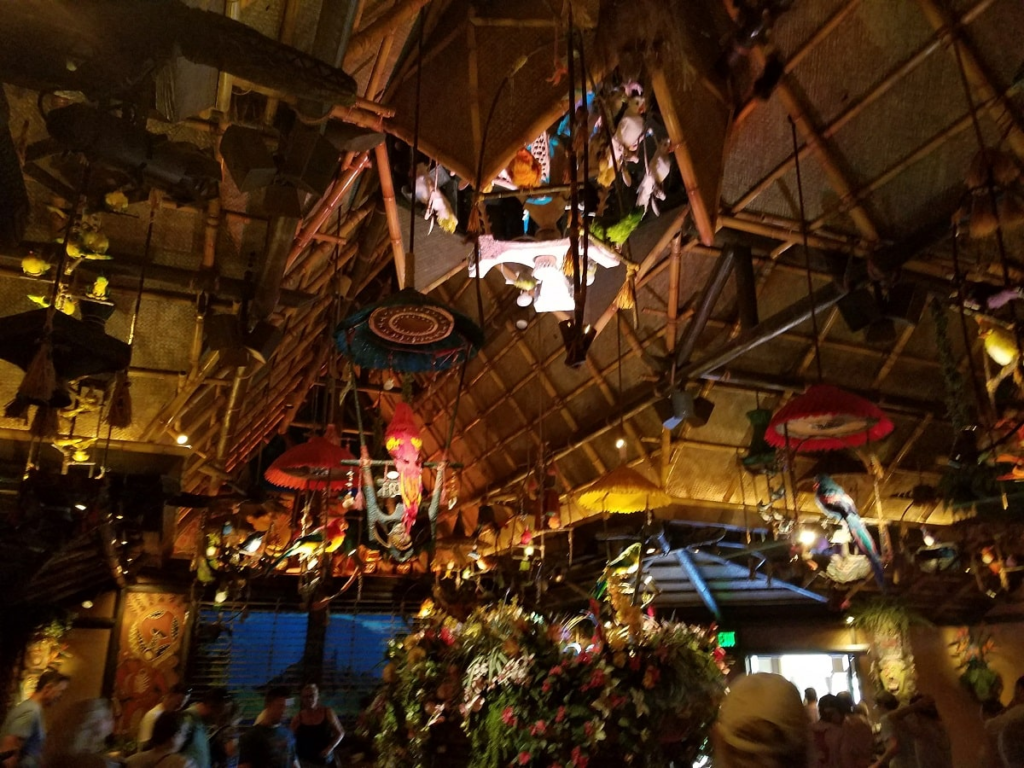
Inside, guests entered a circular ceremonial room where nearly every surface seemed capable of coming alive.
The show begins when José, one of four central macaws, is awakened. He soon rouses Michael, Pierre, and Fritz, establishing the multinational comic personalities that help distinguish the hosts. José speaks with a Spanish accent, Pierre with a French accent, Fritz with a German accent, and Michael with an Irish accent.
Together they awaken the surrounding birds and launch into the attraction’s signature song, “The Tiki Tiki Tiki Room,” written by Disney Legends Richard and Robert Sherman. The song performs the unusual task of explaining the attraction while simultaneously establishing its personality: this is a place where birds sing words, flowers croon, and the entire building seems to participate in the performance.
The four hosts are only a small portion of the cast.
Birds line perches throughout the theater. Colorful flowers emerge as performers. Carved tiki figures begin chanting and drumming. A large central fountain helps conceal theatrical machinery used to reveal additional performers. The entire room functions like an enormous mechanical stage rather than a conventional theater with performers confined to one end.
One of the show’s signature moments arrives when a large Birdmobile descends from the ceiling carrying a group of white cockatoo showgirls. The birds—Collette, Suzette, Mimi, Gigi, Fifi, and Josephine—lead “Let’s All Sing Like the Birdies Sing,” eventually joined by José, Pierre, Fritz, and the surrounding chorus.
That sequence incorporates several old-fashioned musical impressions that reflect the attraction’s early-1960s origins. José croons in the style of Bing Crosby, Fritz adopts a raspy jazz voice reminiscent of Louis Armstrong, and Pierre delivers his verse in the manner of Maurice Chevalier.
The room becomes increasingly elaborate as the performance continues.
Tropical flowers join the show, followed by tiki drummers and chanting figures during the increasingly frenetic “Hawaiian War Chant.” The music builds until lightning flashes and thunder erupts around the theater, suggesting that all of the celebrating has angered the gods. The performers eventually recover, complete their finale, and humorously encourage the audience to leave so another group can enter.
The original attraction depended as much on engineering as music.
The birds used real feathers, while carefully selected fabrics allowed portions of their bodies to flex naturally as internal mechanisms moved. Audio, lighting, figure movement, curtains, theatrical effects, and music had to be precisely synchronized—an enormously sophisticated undertaking when Disney developed the original technology in the early 1960s.
The Florida installation therefore represented more than entertainment. It was part of a technological lineage directly connected with Walt Disney himself.
That connection makes the Sunshine Pavilion particularly interesting in the context of Magic Kingdom. Unlike many opening-day attractions that were subsequently demolished or completely transformed, the physical Tiki Room still houses a show derived directly from an attraction developed under Walt’s personal supervision.
The Florida Citrus Growers sponsorship added another uniquely Walt Disney World layer.
Disney created the Orange Bird as a promotional character for the citrus organization. Unlike Mickey Mouse or Donald Duck, Orange Bird could not speak; he communicated by thinking orange-colored images that appeared above his head. He became the mascot of the Sunshine Pavilion and appeared in advertising, merchandise, promotional materials, and as a walkaround character.
Guests leaving Tropical Serenade could find citrus beverages and snacks nearby at Sunshine Tree Terrace. This combination of Tropical Serenade, Sunshine Tree Terrace, Florida citrus products, and Orange Bird made the entire pavilion feel like one interconnected experience.
The sponsorship eventually ended, and Orange Bird largely disappeared from Walt Disney World for years before enjoying a major revival beginning in the 2010s. Today he has once again become one of Adventureland’s most popular merchandise characters, creating an unexpected modern connection to the original 1971 Sunshine Pavilion.
Tropical Serenade itself survived largely intact for more than a quarter century.
By the 1990s, however, Disney was increasingly interested in introducing recognizable film characters into older attractions. Attendance at Tropical Serenade had declined, and the relatively leisurely musical revue was viewed as a candidate for modernization.
The original Florida presentation closed on September 1, 1997.
On April 5, 1998, the theater reopened as The Enchanted Tiki Room – Under New Management.
The title was literal. The attraction’s fictional management had supposedly been taken over by Iago from Aladdin and Zazu from The Lion King, two enormously recognizable Disney birds from films released during the company’s animation renaissance.
Iago, voiced by Gilbert Gottfried, became the abrasive centerpiece of the new storyline. Zazu attempted to maintain some order while Iago criticized the old-fashioned Tiki Room, complained about the original music, and demanded that the show become more contemporary and commercially successful.
The four original macaws remained, but they were effectively demoted from starring hosts to supporting performers.
The attraction’s preshow changed as well. Two toucan talent agents, William and Morris, entertained waiting guests, voiced by Don Rickles and Phil Hartman. Their show-business banter established the idea that the Tiki Room was now part of a contemporary entertainment operation.
Inside, portions of the classic material survived, but Iago repeatedly interrupted the old show. The soundtrack incorporated newer musical references, including a modified version of “Friend Like Me” from Aladdin and the popular song “Hot Hot Hot.”
The storyline eventually took a darker turn when Iago’s disrespect toward the Tiki gods awakened Uh-Oa, the Tiki Goddess of Disaster. A large Audio-Animatronics figure emerged from the center of the room and punished Iago for his arrogance, temporarily blasting him out of the show.
The remaining performers then demonstrated that the Tiki Room could be contemporary without Iago’s interference before he eventually returned in a considerably more respectful mood.
Under New Management was very much a product of late-1990s Disney.
It was louder, faster, more sarcastic, more dependent on familiar characters, and much more self-aware than Tropical Serenade. For some guests, the modernization made an aging attraction considerably more entertaining. For many longtime Disney fans, however, Iago’s constant criticism of the original show felt almost like Disney itself was mocking an attraction created during Walt’s lifetime.
The version nevertheless operated for nearly 13 years.
Its end arrived unexpectedly on January 12, 2011, when a small fire broke out in the attraction’s attic. The sprinkler system extinguished the fire and no guests were injured, but the Tiki Room remained closed afterward.
Instead of simply repairing Under New Management, Disney used the extended closure to undertake a far more consequential restoration.
On August 15, 2011, the attraction reopened as Walt Disney’s Enchanted Tiki Room.
Iago, Zazu, Uh-Oa, William, Morris, and the entire Under New Management storyline were gone. José, Michael, Pierre, and Fritz were once again the stars.
Disney did not restore the exact full-length 1971 Tropical Serenade presentation. The current show is a somewhat shortened version of the classic material, eliminating some portions of the original program while preserving its most important musical numbers and characters.
The restoration also incorporated modern technical upgrades. Updated show-control technology, improved lighting, and restored audio allowed the classic presentation to operate using contemporary systems while retaining the appearance and personality of its 1960s predecessor.
That combination is one of the attraction’s most interesting qualities today.
Walt Disney’s Enchanted Tiki Room feels old because it is supposed to. The humor, musical arrangements, character voices, international stereotypes, South Seas imagery, and theatrical pacing all reflect a particular era of Disney entertainment. Yet beneath that presentation, modern systems keep hundreds of synchronized mechanical performers operating show after show.
Disney currently describes the production as featuring more than 225 choreographed Audio-Animatronics performers, including tropical birds, flowers, and tiki figures.
The attraction is also one of Magic Kingdom’s few remaining theater-in-the-round experiences. Guests sit on benches facing inward and outward rather than toward a single traditional stage. Because the performers surround the audience and descend from overhead, there is no obvious “best” seat. Looking around the room is part of the experience.
The physical theater provides another major advantage that generations of Magic Kingdom visitors have appreciated: it is indoors and air-conditioned.
That practical benefit should not be underestimated. Adventureland can be oppressively hot and humid during the Florida summer, and the Tiki Room offers roughly a quarter-hour of seated entertainment with no height requirement and relatively predictable waits. Families with small children, older visitors, and anyone needing a break from the heat can enjoy the show together.
The lack of thrill mechanics also allows guests to concentrate on details that would disappear quickly on a moving attraction.
Individual birds each have distinctive colors and personalities. Orchids surrounding the room unexpectedly begin singing. Tiki figures that initially appear decorative reveal themselves as performers. Drums join the music. The central ceiling suddenly opens to release the Birdmobile. Lighting transforms what first looks like a decorative tropical pavilion into an enormous synchronized stage.
That gradual awakening remains one of the attraction’s cleverest theatrical ideas.
The Tiki Room also occupies an important place in the broader history of Walt Disney Imagineering.
The original Disneyland show demonstrated that Audio-Animatronics figures could be more than isolated mechanical novelties. Dozens—or eventually hundreds—of characters could perform together while synchronized with prerecorded dialogue, music, lighting, and environmental effects.
That lesson directly influenced the extraordinary wave of Audio-Animatronics attractions Disney created during the 1960s, including the four shows developed for the 1964–1965 New York World’s Fair. Technologies and techniques refined through those projects would ultimately become fundamental to Walt Disney World.
In that sense, the Magic Kingdom Tiki Room is not merely another opening-day attraction.
It represents one of the technologies that made Magic Kingdom possible in the first place.
Its survival has become increasingly significant as the park has evolved. Magic Kingdom has replaced many attractions since 1971, and even surviving opening-day experiences have undergone major revisions. The Tiki Room itself spent 13 years with an almost entirely different storyline before Disney made the unusual decision to move backward creatively and restore something much closer to its original identity.
That makes the 2011 transformation particularly fascinating.
Theme parks generally replace old attractions with newer concepts. Walt Disney’s Enchanted Tiki Room did essentially the opposite: a modernized, character-driven version was removed so a presentation rooted in 1963 could return.
The result has now survived longer than Under New Management did.
As of 2026, Walt Disney’s Enchanted Tiki Room remains an operating Adventureland attraction, open to guests of any height and still performing its classic musical revue throughout the day. José, Michael, Pierre, and Fritz remain in their perches. The cockatoos still descend from the ceiling. Flowers still sing. Tiki figures still chant and drum. The room still erupts into its wonderfully excessive musical finale.
Some elements inevitably feel like artifacts from another era, but that is increasingly part of the attraction’s value.
Few experiences remaining at Walt Disney World provide such a direct connection to Walt Disney’s own approach to themed entertainment. The Florida building arrived after his death, but the show inside was created from an attraction he personally championed, built around a technology his organization helped invent, performed by characters developed during his lifetime, and driven by songs from collaborators closely associated with him.
More than half a century after Tropical Serenade welcomed Magic Kingdom’s first visitors, the Sunshine Pavilion therefore remains one of Adventureland’s most historically important spaces.
It has been Tropical Serenade. It has been called The Enchanted Tiki Birds. It spent more than a decade Under New Management. A fire unexpectedly changed its future. Orange Bird disappeared and returned. Adventureland grew around it, adding Pirates of the Caribbean, The Magic Carpets of Aladdin, character merchandise, and decades of new attractions elsewhere in the park.
Yet once the doors close and José wakes up, much of that history falls away.
The lights dim, the birds begin singing, the flowers start to croon, and Magic Kingdom returns—at least for a few minutes—to the kind of mechanical musical fantasy that helped define Disney theme parks in the first place.