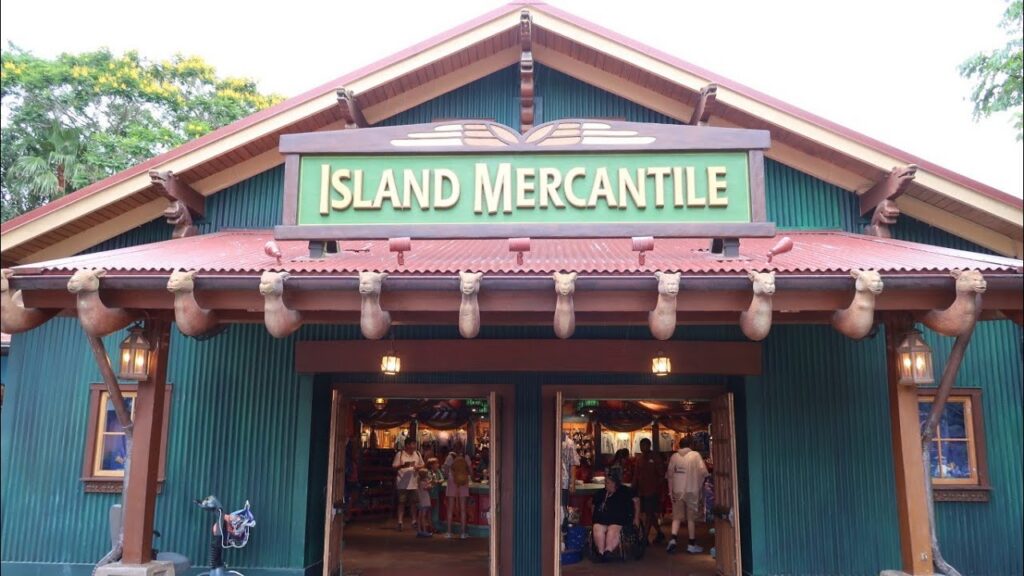
Island Mercantile is one of Disney’s Animal Kingdom’s original merchandise locations and one of the principal shops on Discovery Island, positioned just to the left after guests cross the bridge from The Oasis toward the Tree of Life. Opening with the park on April 22, 1998, the store has spent more than a quarter century serving as one of Animal Kingdom’s broadest general merchandise destinations while retaining an unusually detailed decorative concept centered on animals that migrate, cooperate, and work.
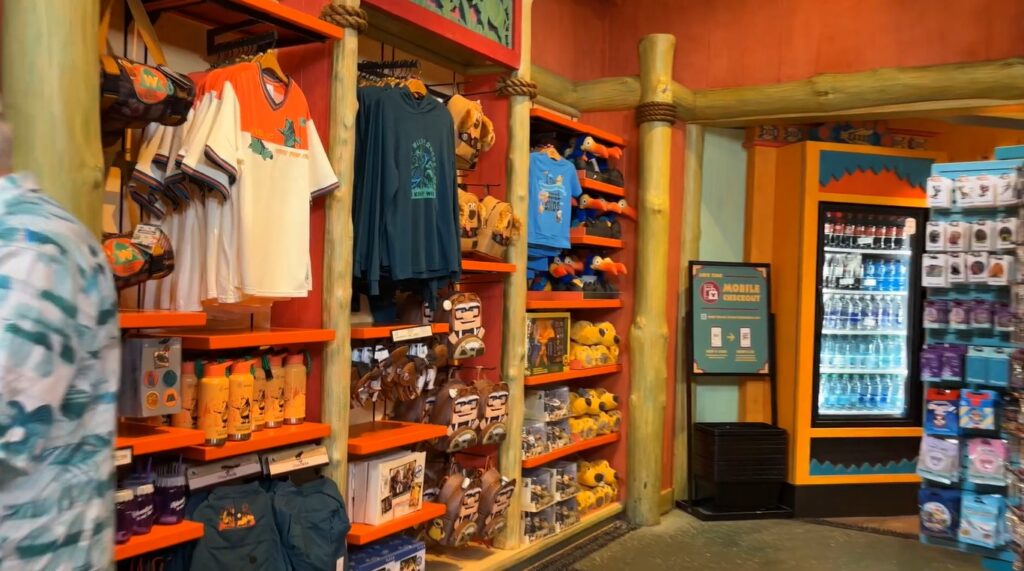
Today, Island Mercantile carries a changing assortment of Disney’s Animal Kingdom apparel, accessories, headwear, plush, toys, pins, MagicBand+ products, snacks, seasonal merchandise, and Disney character collections. Its inventory is deliberately flexible, allowing the shop to absorb merchandise tied to new attractions, characters, anniversaries, and areas of the park. What makes the location particularly interesting, however, is that beneath those constantly changing products remains a layer of environmental storytelling dating directly to Animal Kingdom’s opening day.
When the park debuted, the central island surrounding the Tree of Life was known as Safari Village rather than Discovery Island. It served much the same purpose it does today: a central hub from which bridges radiated toward Africa, Asia, DinoLand U.S.A., Camp Minnie-Mickey, and the park entrance. Disney changed the land’s name to Discovery Island in December 2000, borrowing the name of the former zoological attraction in Bay Lake that had closed the previous year.
Island Mercantile was one of four major shops originally surrounding the Tree of Life. The others were Disney Outfitters, Creature Comforts, and Beastly Bazaar. Rather than decorating each store with a random assortment of wildlife imagery, Imagineers assigned individual animal concepts to the buildings.
Island Mercantile’s theme centered on animals that work and animals that migrate.
That theme can be easy to overlook because the shop is filled with merchandise, but it is embedded throughout the architecture and ornamentation. Outside, carved and sculpted animals appear to participate in the operation of the building itself. Elephants use their trunks to hold lanterns, visually turning the animals into members of the store’s workforce rather than simply decorative figures.
Inside, the concept becomes even more playful.
Beavers were traditionally among the store’s most prominent inhabitants. For years, one of Island Mercantile’s checkout areas appeared to have been constructed with the assistance of industrious beavers, complete with log supports showing signs of being gnawed. Other areas incorporate or have incorporated animals such as camels, donkeys, geese, bees, ants, and migrating salmon. Some represent literal beasts of burden, while others demonstrate collective labor, long-distance movement, or instinctive cooperation.
The choice of bees and ants is particularly clever. Neither needs to pull a cart or carry a human rider to qualify as a “working” animal. Both species live in highly organized colonies in which individuals cooperate toward the survival of the group. The decoration therefore extends Animal Kingdom’s central idea-that the natural world contains behaviors, relationships, and systems worth observing-into what might otherwise have been a conventional souvenir store.
Similarly, migrating animals broaden the theme from labor to movement. Salmon, birds, and other traveling species connect naturally with a park built around journeys into distant environments.
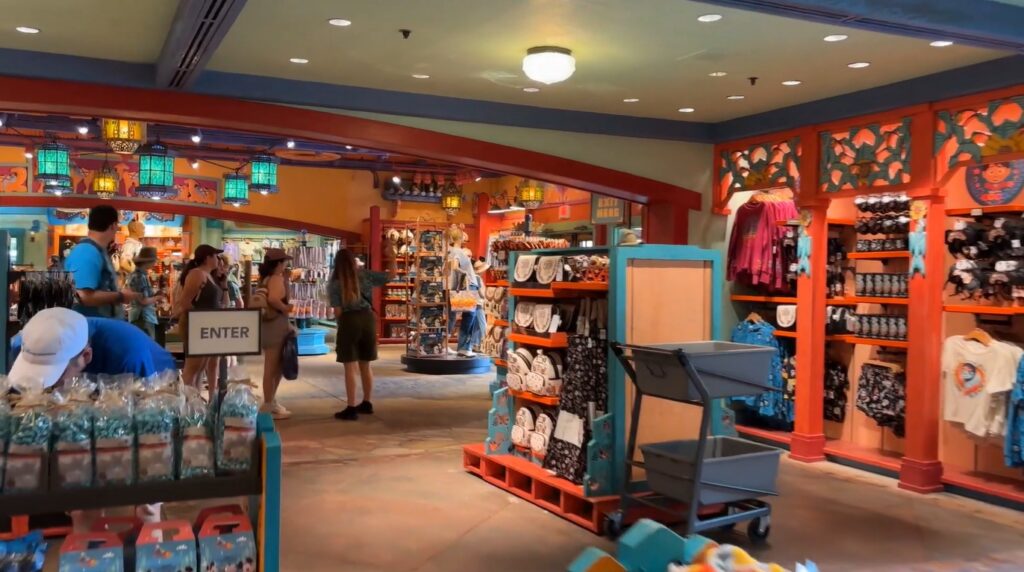
Island Mercantile belongs to the distinctive architectural vocabulary created for Discovery Island. Imagineers did not model the area after one identifiable country. Instead, Discovery Island uses a deliberately eclectic visual language combining tropical vernacular architecture, folk art, weathered wood, bright colors, carved animals, hand-painted details, corrugated surfaces, stonework, and forms suggesting structures built and altered by generations of residents.
The result is intentionally difficult to place geographically. Discovery Island is not Africa, Asia, or the Americas; those destinations have their own lands elsewhere in Animal Kingdom. Instead, the island functions as a fantastical crossroads where artistic influences from many parts of the world can coexist around the Tree of Life.
Island Mercantile fits that approach perfectly. Its colorful exterior, deep rooflines, wood construction, carved decorations, lanterns, irregular detailing, and animal ornamentation make it feel like a trading house that might have grown organically in an international port rather than a purpose-built theme-park store.
That visual philosophy was especially important to the original Animal Kingdom. Disney was determined that the park should not look like Magic Kingdom with animals added to it. Even utility buildings, restaurants, shops, benches, signs, lamps, and merchandise counters were used to reinforce the relationship between people and nature.
An early Animal Kingdom park guide described Island Mercantile simply as offering themed merchandise representing the park’s various lands. That made the store something of a central marketplace from the beginning. A guest did not necessarily have to return to Africa, Asia, or DinoLand to find something representing an experience elsewhere in the park.
That broad role remains one of the shop’s strengths.
As Animal Kingdom expanded, Island Mercantile’s merchandise evolved with it. Character apparel and plush became increasingly prominent, along with park-logo products, Loungefly bags, Minnie ear headbands, pins, drinkware, toys, and merchandise connected with newer areas such as Pandora – The World of Avatar.
The store has also become a useful location for new and temporary Animal Kingdom collections. In 2026, for example, Island Mercantile became one of the principal places to find merchandise connected with Bluey’s Wild World, including Bluey and Bingo apparel, accessories, pins, water bottles, and character products. Disney specifically directed Animal Kingdom guests to Island Mercantile for the new Bluey merchandise when Bluey’s Wild World opened at Conservation Station.
That same year, the shop received a new Wilderness Explorer collection, drawing from the youth nature program inspired by Russell and the Wilderness Explorers from Pixar’s Up. Bags, apparel, accessories, and designs referencing Wilderness Explorer badges fit particularly naturally at Animal Kingdom because the real Wilderness Explorers activity sends guests around the park completing nature and conservation challenges.
Island Mercantile has also occasionally served as a kind of temporary archive for merchandise from attractions that have disappeared. After the final portions of DinoLand U.S.A. closed in 2026, remaining DINOSAUR and dinosaur-related products appeared at Island Mercantile, allowing the centrally located store to absorb inventory after the original DinoLand retail locations were no longer available.
These changes demonstrate how differently the store functions from a highly specialized shop such as Windtraders in Pandora or Serka Zong Bazaar in Asia. Island Mercantile does not depend on a single attraction or franchise. It is essentially one of Animal Kingdom’s merchandising pressure valves: large enough and centrally located enough to accommodate whatever products are currently important to the park.
That operational flexibility has occasionally resulted in changes to the original interior.
In 2023, Disney undertook a refurbishment that significantly altered the checkout configuration. Large freestanding register islands were removed to create more open floor space, with registers relocated along walls. Among the casualties was the memorable beaver-themed checkout island, whose carved logs and working-beaver imagery had been one of the shop’s most overt original thematic elements.
For enthusiasts of Animal Kingdom’s early design, its removal was unfortunate because the register was not merely decorated furniture-it was part of the shop’s underlying story. At the same time, many animal carvings and decorative motifs remain around the building, preserving the central working-and-migrating-animals concept even as the sales floor has become more operationally efficient.
The changes reflect a recurring challenge for Walt Disney World’s oldest shops. Merchandise displays must accommodate larger crowds, mobile checkout technology, strollers, accessibility requirements, new product categories, and ever-changing retail strategies, while the buildings themselves are expected to preserve thematic details designed decades earlier.
Island Mercantile has generally managed that balance better than its status as a large souvenir store might suggest.
Its location contributes significantly to its success. Guests encounter it almost immediately after leaving The Oasis, when the Tree of Life first comes fully into view. Because Discovery Island is Animal Kingdom’s central hub, many visitors pass the shop multiple times during the day while traveling between Africa, Pandora, Asia, and other areas of the park. It also makes a convenient final shopping stop before guests leave through The Oasis.
That makes Island Mercantile something like Animal Kingdom’s counterpart to the Emporium at Magic Kingdom, although on a smaller scale and with a very different visual philosophy. Both provide broad merchandise selections close to the park entrance, but Island Mercantile was designed to feel less like a grand commercial establishment and more like a trading outpost integrated into a tropical settlement.
Its opening-day status also gives it increasing historical value.
Animal Kingdom has changed enormously since 1998. Camp Minnie-Mickey gave way to Pandora. Beastly Bazaar became Adventurers Outpost. Creature Comforts became home to Starbucks. DinoLand U.S.A. disappeared as Disney began transforming that section of the park into Tropical Americas. Attractions, restaurants, entertainment, animal exhibits, and pathways have all evolved.
Island Mercantile, by contrast, still operates under the same name in the same Discovery Island location where it opened in 1998.
Its merchandise is dramatically different, and some of its interior details have changed, but the colorful building filled with hard-working and migrating animals continues performing essentially the same role it did on Animal Kingdom’s first morning.
For guests who simply need a shirt, plush toy, pair of ears, or last-minute souvenir, Island Mercantile remains one of the park’s most practical shopping locations. For guests interested in Imagineering, it is worth slowing down and looking past the merchandise.
The elephants holding the lights, animal carvings, migration imagery, folk-art details, brightly painted surfaces, and surviving traces of those industrious creatures reveal the philosophy behind early Animal Kingdom design: nature did not stop when guests walked inside a store.
Even retail environments were expected to participate in the park’s larger story.
That makes Island Mercantile more than Animal Kingdom’s convenient central gift shop. It is a surviving opening-day piece of Discovery Island, an example of the exceptionally detailed environmental storytelling created for the park in 1998, and a location where the merchandise may change every season while the animals around it continue working away.