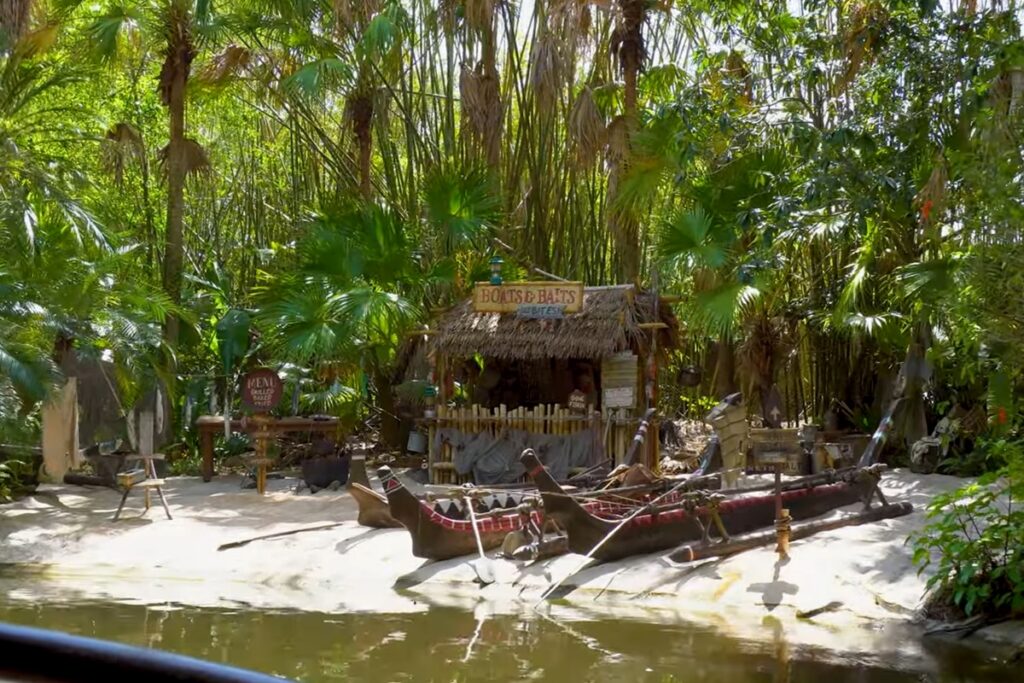
Jungle Cruise is an opening-day Adventureland attraction at Magic Kingdom that sends guests aboard weathered riverboats for a deliberately improbable expedition through the waterways of South America, Africa, and Asia. Opening on October 1, 1971, the attraction combines lush landscaping, Audio-Animatronics wildlife, elaborate scenic environments, and one of Disney’s most distinctive forms of live entertainment: a Cast Member skipper delivering a rapid-fire stream of puns, deliberately bad jokes, deadpan observations, and improvised audience interaction.
The current attraction lasts roughly 10 minutes and is described by Disney as a 10,000-mile journey. In reality, of course, the boats never leave Adventureland, but careful landscaping and winding waterways allow Magic Kingdom to compress multiple continents into a surprisingly convincing tropical expedition.
More than most Disney attractions, Jungle Cruise changes depending on who is operating it.
The mechanical animals, waterfalls, river bends, and major scenes remain essentially the same from one voyage to another, but the skipper is a live performer. Disney provides established material and scene-specific jokes, yet timing, delivery, audience participation, and personality can vary enormously. One skipper may perform the script with exaggerated enthusiasm; another may treat every disaster along the river with absolute indifference. The best performers make familiar material sound spontaneous, turning a ride that many guests have experienced dozens of times into something unpredictable.
That live-performance tradition is fundamental to Jungle Cruise’s identity.
Guests board covered launches styled after early-20th-century tramp steamers, the sort of utilitarian river craft that might plausibly have carried explorers and cargo into remote tropical regions. The basic design traces back to Imagineer Harper Goff, who drew inspiration from the riverboat in the 1951 Humphrey Bogart and Katharine Hepburn film The African Queen. Each vessel carries its own name, reinforcing the fiction that the Jungle Navigation Company operates a full fleet rather than a continuous theme-park ride system.
The skipper appears to steer, but the boats follow a predetermined underwater guidance system, allowing the Cast Member to concentrate on narration, timing, and safely controlling the vessel’s speed.
The journey begins in the Amazon, where the jungle quickly closes around the boat. Butterflies, dense vegetation, waterfalls, and wildlife establish the idea that civilization has disappeared almost immediately after departure.
From there, guests travel into the Congo, where an expedition camp has been thoroughly overrun by gorillas. The scene captures the attraction’s basic comic philosophy: humans enter the jungle believing they are in control, and the animals repeatedly demonstrate otherwise.
That idea became even more important during the attraction’s major 2021 update.
The Nile River portion contains several of Jungle Cruise’s most enduring sequences. Elephants appear along the water, including the celebrated elephant bathing pool, while the nearby African veldt assembles an improbable collection of giraffes, antelope, lions, zebras, and other wildlife into one panoramic scene.
The attraction never tries particularly hard to maintain zoological realism. Animals that would rarely stand peacefully together in nature are arranged almost like an illustrated wildlife panorama. The skipper’s commentary acknowledges the artificiality through jokes rather than attempting to present Jungle Cruise as a serious nature expedition.
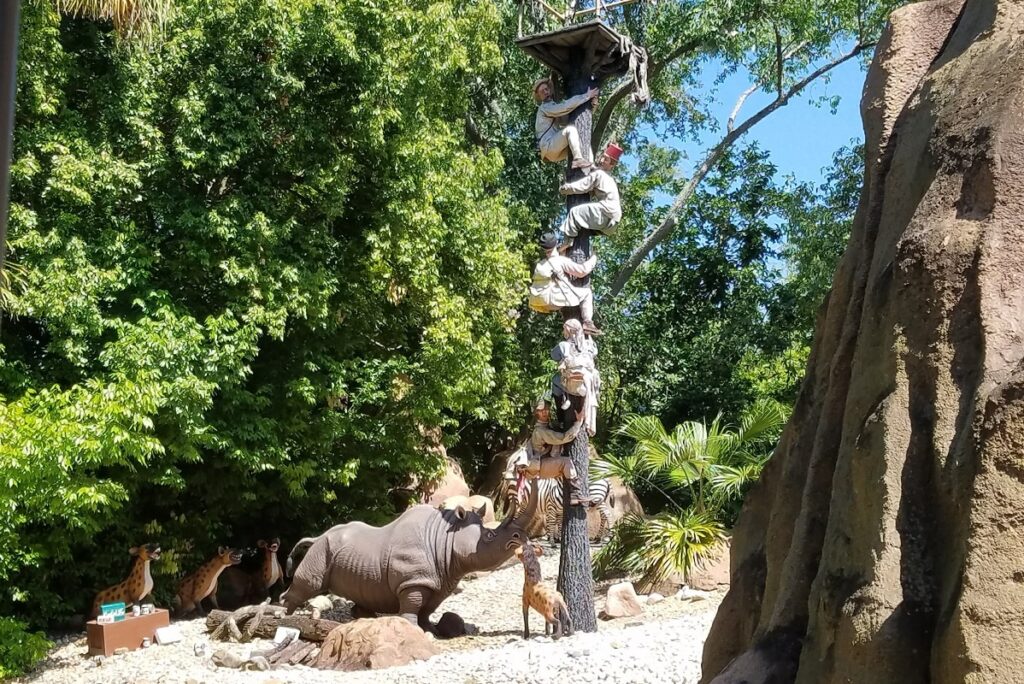
One of the ride’s most famous comic tableaux involves a safari party stranded above an irritated rhinoceros. The scene originated from concepts by Disney Legend Marc Davis, whose ability to communicate an entire joke through character poses fundamentally reshaped Jungle Cruise.
Davis joined Walt Disney Imagineering after a celebrated career in animation and brought with him an animator’s understanding of staging and personality. Rather than treating the animals merely as realistic specimens, he built visual jokes in which every figure contributes to the gag.
That influence is one reason the Magic Kingdom attraction was humorous from the beginning.
The original Disneyland Jungle Cruise, which opened in 1955, had been conceived much more seriously. Walt Disney wanted to bring the spirit of his award-winning True-Life Adventures nature documentaries into Disneyland. Early plans even explored the possibility of using live animals, but predictable daily animal behavior could not be guaranteed. Mechanical wildlife became the practical solution.
Harper Goff developed the river layout, boats, and much of the attraction’s visual vocabulary, while landscapers Bill and Jack Evans created the extraordinary living jungle surrounding it. Goff’s boats drew from The African Queen, and the entire experience was originally intended to feel like a genuine expedition into distant parts of the world.
Over time, Walt recognized that repeat guests already knew where every animal would appear. Humor offered something mechanical scenes alone could not: variation.
Marc Davis subsequently developed many of the attraction’s most famous sight gags, and the skipper spiel grew increasingly comedic. By the time Magic Kingdom opened in 1971, Florida’s Jungle Cruise inherited a much more developed version of the concept, combining wildlife spectacle with jokes and theatrical absurdity from the start.
The Florida jungle also benefited from the resort’s climate. Orlando’s warmth, humidity, and rainfall allowed dense tropical and subtropical vegetation to flourish around the waterways. Plants that were comparatively difficult to maintain in Southern California could grow aggressively in Florida, giving portions of the ride an unusually convincing canopy.
That landscape is one of Jungle Cruise’s most important effects.
There is no enormous show building hiding the attraction. Most of the illusion is created outdoors through vegetation, berms, carefully positioned rockwork, waterways, and sightline control. Guests may be only a short distance from crowded Adventureland pathways, yet the dense plant growth frequently makes the outside park disappear.
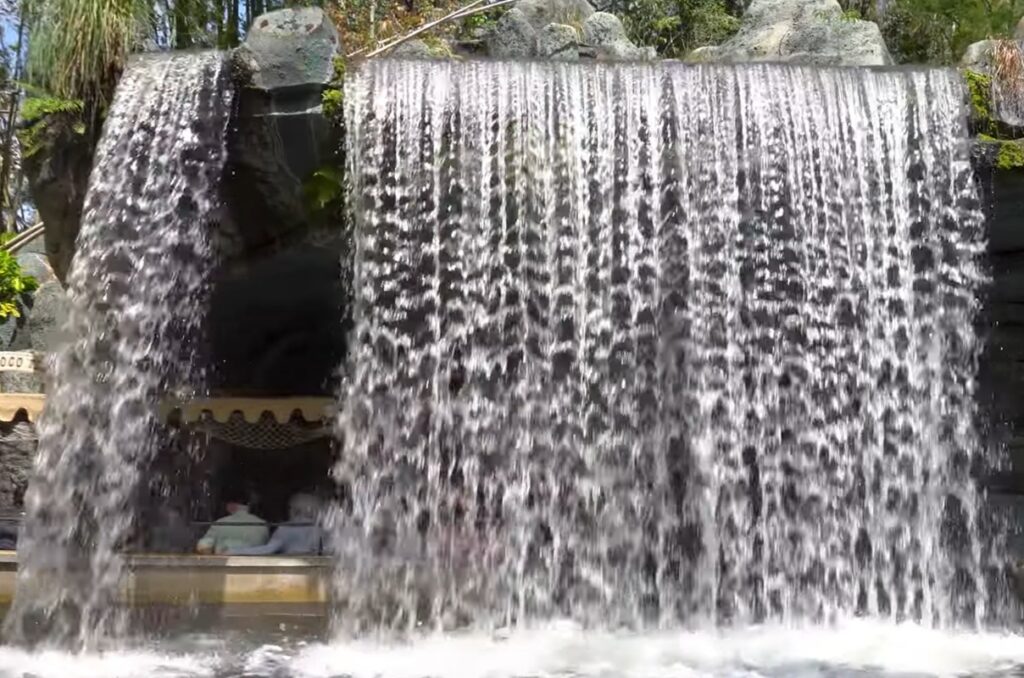
Among the attraction’s most celebrated visual jokes is Schweitzer Falls, named in the spiel for the fictional—or very loosely referenced—explorer Dr. Albert Falls. The waterfall is less famous for what guests see approaching it than for what happens after passing it.
The skipper excitedly presents the “backside of water,” one of the most enduring jokes in Disney attraction history.
The gag has become so closely associated with Jungle Cruise that Disney has repeatedly referenced it in merchandise, other attractions, Disney Cruise Line venues, and the 2021 Jungle Cruise feature film. Like many Jungle Cruise jokes, its appeal comes partly from its deliberate stupidity. Guests know exactly what they are about to see, the skipper knows they know, and the ritual itself becomes the entertainment.
Another memorable portion of the ride sends boats through a darkened Southeast Asian temple, where crumbling stone architecture, statues, cobras, and other details create a brief tonal shift from the bright outdoor jungle. The enclosed environment also gives Disney more control over lighting and atmosphere before sending guests back into daylight.
The ride eventually makes its way toward the remains of another failed expedition.
That storyline became the centerpiece of a substantial 2021 reimagining.
Disney did not rebuild Jungle Cruise or tie it directly to the feature film released that same year. Instead, Imagineering revised several scenes that contained outdated and negative caricatures of Indigenous peoples and created a continuous narrative connecting previously independent visual jokes.
The updated backstory places greater emphasis on the Jungle Navigation Company Ltd., now operated by Alberta Falls, granddaughter of Dr. Albert Falls.
Alberta was not invented solely for the refurbishment. The character had already been developed as part of the elaborate mythology surrounding nearby Jungle Navigation Co. LTD Skipper Canteen, the Adventureland restaurant that opened in 2015. Bringing her into the ride itself allowed Disney to connect multiple Adventureland experiences into a shared fictional history.
The 2021 storyline follows an ill-fated private expedition whose participants ignored one of the most basic rules of Jungle Cruise: stay in the boat.
The revised rhinoceros scene now shows a diverse group of explorers and their skipper trapped above the animal. The characters include specialists with their own interests and backgrounds, such as an ornithologist, entomologist, wildlife painter, and botanically inclined explorer.
Rather than ending the joke there, Imagineering asked an obvious question: what happened to their boat?
Guests eventually find out.
Pieces of the expedition’s wrecked launch appear farther along the river, and a family of chimpanzees has taken possession of the vessel. One chimp tries to operate the boat while others investigate maps, supplies, food, and the explorers’ belongings. Additional chimpanzees encounter crates filled with butterflies and scientific equipment.
The scenes deliberately follow the comic tradition Marc Davis established decades earlier. The animals have defeated the supposedly sophisticated human expedition and are now happily playing with everything the explorers left behind.
Disney described the guiding principle as allowing the jungle and the animals to get the last laugh.
Other culturally insensitive scenes were removed during the project and replaced with environments that continued the Jungle Navigation Company story. The attraction’s former Indigenous caricatures and ambush imagery disappeared, while new details, props, wildlife, and jokes filled the available spaces.
The longtime finale involving the shrunken-head merchant commonly known as Trader Sam was also removed. Trader Sam himself was not eliminated from Adventureland mythology, however.
In the updated story, Alberta Falls has placed her longtime friend in charge of the Jungle Navigation Company’s Lost & Found operation. Trader Sam, displaying the entrepreneurial instincts associated with the character elsewhere in Disney lore, has apparently converted the facility into Trader Sam’s Gift Shop and begun selling the items passengers have lost.
Naturally, even that plan has gone wrong.
Monkeys have taken over the shop while Sam is away collecting inventory, creating another final joke in which the wildlife proves considerably more capable than the humans.
The 2021 update also significantly expanded storytelling in the queue.
The Jungle Cruise boathouse had always been full of expedition equipment, notices, maps, shipping materials, and visual jokes, but Imagineering incorporated more explicit Jungle Navigation Company history. Alberta Falls’ office, expedition photographs, life preservers, luggage, scientific supplies, correspondence, and references to explorers create a deeper sense that an actual organization operates from the dock.
Several details connect Jungle Cruise with the wider network of Disney park mythology.
References can be found to the Society of Explorers and Adventurers, the fictional organization that links attractions and restaurants across Disney resorts around the world. Objects associated with characters from the former Adventurers Club at Pleasure Island and other Disney experiences appear among the expedition material.
The 2021 Jungle Cruise film also contributed several subtle props and references, including objects associated with Frank Wolff and Lily Houghton. Importantly, however, the ride was not rethemed to the movie. Dwayne Johnson and Emily Blunt did not replace the skippers or become the attraction’s central characters. The movie was allowed to reference the ride, while the ride continued to stand largely on its own.
That was a significant creative decision.
Jungle Cruise had already generated more than six decades of its own mythology before the film existed. The attraction inspired the movie rather than the other way around, and Disney preserved that hierarchy.
The skippers themselves remain its most important component.
The Jungle Cruise spiel has produced an enormous collection of recurring jokes, some formally incorporated into Disney’s scripts and others developed, adapted, or passed between generations of skippers. References to dangerous animals, suspicious plants, waterfalls, lost expeditions, and impending disasters create opportunities for wordplay throughout the trip.
Many jokes depend less on the words than on timing.
A pause of an extra second can determine whether a painfully obvious pun lands perfectly. Experienced skippers often play with audience expectations, beginning one familiar joke before abruptly delivering another. Guests who know the attraction well frequently enjoy anticipating the classics almost as much as hearing new material.
That performance tradition has given Jungle Cruise an outsized influence beyond the attraction.
Former skippers have carried its style of deadpan humor into entertainment careers, Disney management, themed restaurants, and other park experiences. Nearby Skipper Canteen essentially turns Jungle Cruise humor and mythology into a dining experience, while Trader Sam’s themed bars at Disney resorts extend the same adventurous, joke-heavy world into nightlife.
In 2013, Magic Kingdom introduced another enduring variation: Jingle Cruise.
During the holiday season, the Jungle Cruise receives temporary Christmas decorations, altered boat names, props suggesting the skippers have received holiday packages from home, and a seasonal version of the spiel filled with intentionally terrible Christmas jokes.
The overlay has become a recurring Magic Kingdom holiday tradition.
What makes Jingle Cruise particularly successful is that it does not require rewriting the attraction’s basic premise. The same expedition company, slightly questionable boats, stranded explorers, animals, and waterfalls remain; the skippers simply attempt to celebrate Christmas while working in the jungle, usually with chaotic results.
Jungle Cruise has naturally required extensive maintenance throughout its long life. Boats, docks, mechanical animals, waterways, landscaping, show effects, and underwater infrastructure all operate in an outdoor Florida environment that is exceptionally demanding on themed attractions.
A major refurbishment in 2024 closed the Magic Kingdom version for approximately two months. The attraction reopened in October after work throughout the river and show scenes. Such closures are critical for an attraction whose apparent age and decay are carefully designed theatrical effects rather than actual neglect.
That distinction is central to Jungle Cruise.
The boats are supposed to look worn. Buildings are supposed to feel patched together. Cargo should appear weathered. The jungle should seem barely under control.
But every element has to function safely and reliably beneath that appearance.
Today, Jungle Cruise remains an any-height family attraction, allowing almost everyone in a visiting party to experience it together. The boats require guests using wheelchairs or mobility devices to follow specific boarding procedures, but there is no minimum-height restriction.
Its popularity is particularly impressive considering how little the fundamental ride system has changed.
There is no high-speed launch, trackless vehicle, large projection dome, or elaborate screen-based finale. Guests sit on benches inside a small boat and travel slowly past mechanical animals while a Cast Member tells jokes.
That simplicity is precisely why Jungle Cruise has endured.
The foliage has matured. Scenes have changed. Outdated material has been replaced. The mythology has grown. Alberta Falls has inherited the company. Chimpanzees have commandeered an expedition boat. Trader Sam has discovered retail. The ride even became the inspiration for a major Hollywood film.
But the essential experience is still remarkably close to Walt Disney’s original premise from the 1950s: get into a boat, disappear into a man-made jungle, and see what is waiting around the next bend.
At Disneyland, the concept began as a serious attempt to bring Walt’s True-Life Adventures to life. Marc Davis and generations of skippers gradually discovered that fake elephants become considerably more entertaining when everyone acknowledges the absurdity.
Magic Kingdom inherited that lesson in 1971, and more than 55 years later the attraction still depends on it.
The hippos are not especially frightening. The elephants are not particularly unpredictable. Most repeat visitors know exactly where Schweitzer Falls is located.
Yet the skipper may say something differently.
And that small possibility is enough to make another trip through the jungle worthwhile.