
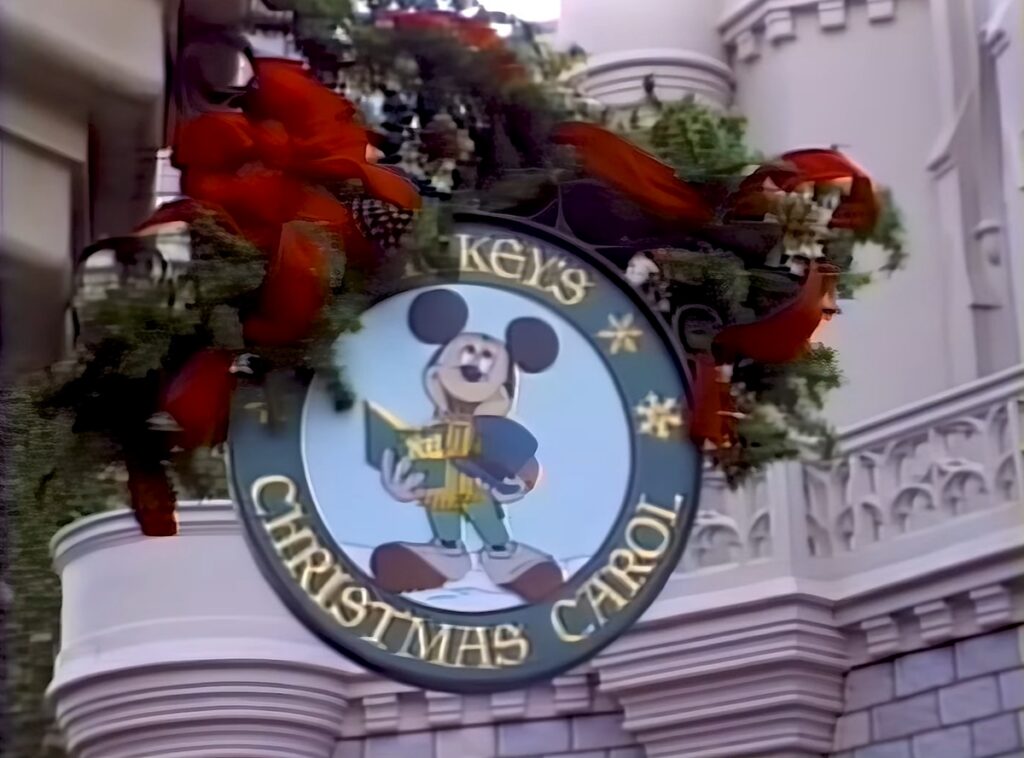
Mickey’s Christmas Carol was a year-round Christmas merchandise shop in Fantasyland at Magic Kingdom that operated from 1986 until early 1996. Located just behind Cinderella Castle in the space previously occupied by Merlin’s Magic Shop, the store sold Disney Christmas ornaments, holiday accessories, decorative items, and wax creations at a time when dedicated year-round Christmas shopping was still relatively unusual at Walt Disney World.
Despite sharing its name with Disney’s 1983 animated featurette Mickey’s Christmas Carol, the Fantasyland location was a merchandise shop rather than an attraction or film presentation.
The store occupied one half of a pair of neighboring Fantasyland shops that would eventually be combined to create Sir Mickey’s.
On one side was The AristoCats, a general Disney character merchandise shop that had opened shortly after Magic Kingdom itself in November 1971.
Next door was Merlin’s Magic Shop.
Merlin’s opened in March 1972 and was one of the more distinctive retail locations in early Fantasyland. Rather than selling the increasingly standardized assortment of Disney souvenirs found throughout the park, it specialized in magic tricks, puzzles, monster masks, books, practical-joke items, and other novelties.
The store’s name came from Merlin, the wizard from Disney’s 1963 animated film The Sword in the Stone, making it an especially appropriate business for the medieval Fantasyland courtyard.
Merlin’s Magic Shop remained there until May 1986.
Disney then replaced the magic merchandise with something entirely different.
Christmas.
Mickey’s Christmas Carol opened later in 1986.
The timing was logical because the animated short that inspired its name was still relatively new.
Disney released Mickey’s Christmas Carol theatrically in the United States on December 16, 1983. Directed by Burny Mattinson, the 25-minute film retold Charles Dickens’ A Christmas Carol using a remarkable collection of Disney characters.
Scrooge McDuck played Ebenezer Scrooge.
Mickey Mouse became Bob Cratchit.
Donald Duck portrayed Scrooge’s nephew Fred.
Goofy appeared as the ghost of Jacob Marley.
Jiminy Cricket served as the Ghost of Christmas Past.
Willie the Giant became the Ghost of Christmas Present.
Pete portrayed the ominous Ghost of Christmas Future.
The film was particularly significant because it marked Mickey Mouse’s first starring theatrical cartoon appearance in approximately 30 years, following The Simple Things in 1953.
Mickey’s Christmas Carol received an Academy Award nomination and quickly became a recurring television holiday favorite.
Naming a Disney Christmas store after the film therefore gave the shop both an instantly recognizable holiday identity and an obvious connection to Mickey Mouse.
The concept was also well suited to Fantasyland.
Unlike Main Street, U.S.A., where Christmas merchandise might naturally have been presented within a Victorian retail environment, Fantasyland allowed Disney to frame Christmas through the imagery of fairy tales, cottages, castles, and classic Disney characters.
The exterior retained much of the stone-and-timber storybook architecture associated with this portion of Fantasyland.
Inside, however, the shelves shifted dramatically from Merlin’s tricks and masks to Christmas merchandise.
Historical accounts describe Mickey’s Christmas Carol as selling ornaments, holiday accessories, and wax creations.
The wax merchandise is particularly interesting because candle making and decorative wax goods had a surprisingly long history at Magic Kingdom.
During the park’s early years, Main Street, U.S.A. had housed Wonderland of Wax and later the Main Street Candle Shop. Guests could watch craftsmen create candles and purchase elaborate wax decorations, including seasonal items.
By the 1980s, Christmas merchandise and wax products were increasingly grouped together in specialized holiday shops.
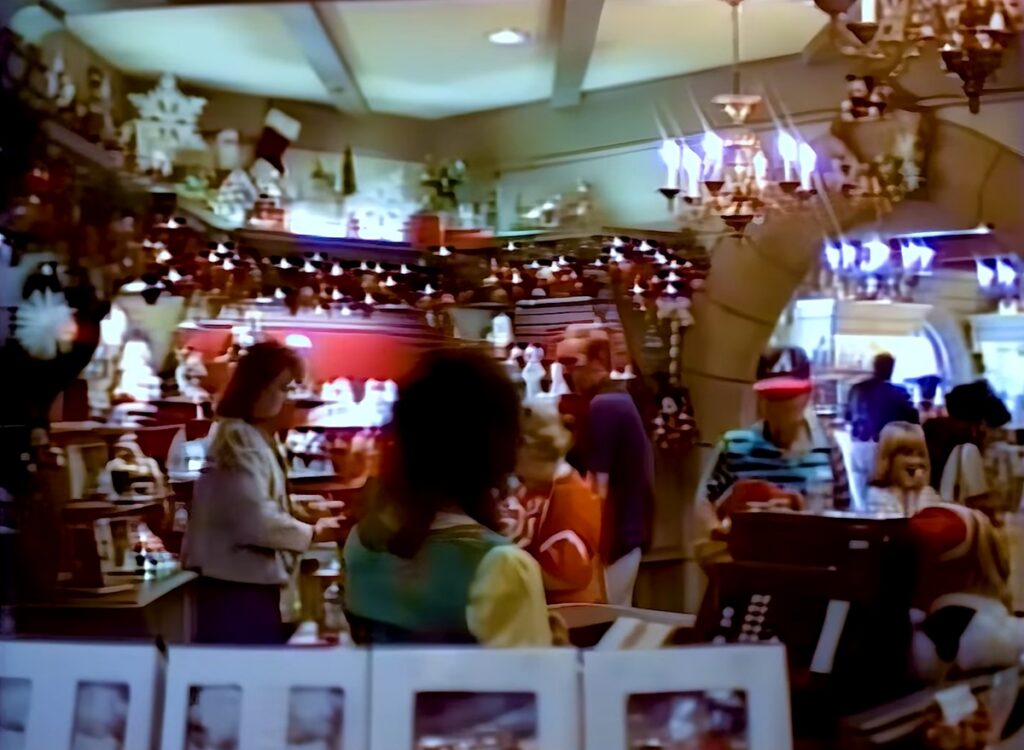
Mickey’s Christmas Carol continued that tradition in Fantasyland.
Most importantly, the shop was open throughout the year.
Guests visiting Magic Kingdom in July could walk behind Cinderella Castle and shop for Christmas ornaments just as easily as someone visiting in December.
Today, year-round Disney Christmas stores are a familiar part of the resort experience, but the concept was considerably more distinctive during the 1980s.
At various times, Walt Disney World experimented with holiday retail locations on Main Street and elsewhere before establishing the more permanent Christmas-shopping traditions guests would later associate with Liberty Square and Disney Springs.
Mickey’s Christmas Carol therefore occupied an interesting transitional period.
It provided a dedicated Magic Kingdom Christmas store before the holiday retail identity became firmly established in Liberty Square.
Its merchandise was not limited exclusively to the characters appearing in the animated short.
The store used Mickey’s Christmas Carol as its overarching identity, but it served as a general Disney holiday merchandise location.
Guests could find ornaments, decorations, accessories, and seasonal collectibles featuring a variety of Disney characters.
Naturally, merchandise tied directly to Mickey, Minnie, Scrooge McDuck, and the 1983 film also fit particularly well within the shop.
The store’s location placed it in one of Fantasyland’s busiest pedestrian areas.
Guests emerging from the Cinderella Castle passageway entered the courtyard near the shop.
Snow White’s Adventures, Cinderella’s Golden Carrousel, Mr. Toad’s Wild Ride, and other classic Fantasyland attractions were nearby.
Across the courtyard stood Cinderella Fountain.
The neighboring AristoCats store helped create a relatively substantial retail complex immediately beside the castle.
During the Mickey’s Christmas Carol era, however, the two stores remained distinct businesses.
The AristoCats specialized in general Disney character merchandise.
Mickey’s Christmas Carol specialized in Christmas.
That division would ultimately disappear.
By the middle of the 1990s, Disney was extensively updating Magic Kingdom’s Fantasyland merchandise locations.
The land was increasingly moving away from the eclectic collection of independent stores that had characterized its first two decades and toward larger shops with stronger unified themes.
Mickey’s Christmas Carol and The AristoCats were obvious candidates for consolidation because they occupied adjoining spaces.
Both closed in early 1996.
The most specific surviving chronology gives February 4, 1996 as the final day for both shops, although some later historical accounts simply describe Mickey’s Christmas Carol as closing in March.
Because contemporary documentation is limited, the safest description is that the store closed during the first months of 1996.
Disney then combined the two former retail spaces into Sir Mickey’s.
The transformation was much more elaborate than simply knocking down a wall and changing a sign.
Imagineers created a detailed new Fantasyland shop inspired by two classic Mickey Mouse stories: the 1938 animated short The Brave Little Tailor and the Mickey and the Beanstalk segment of the 1947 feature Fun and Fancy Free.
The result was one of Magic Kingdom’s most heavily themed merchandise locations.
A giant beanstalk winds through the building.
Mickey appears in the role of a medieval tailor preparing to confront a giant.
Willie the Giant actually lifts part of the shop’s roof and peers inside.
Scissors, thread, fabric, armor, heraldry, clocks, and other storybook details connect the merchandise environment with the two animated adventures.
The former Mickey’s Christmas Carol portion became integrated into this larger setting so completely that most modern guests would never realize it had once been an independent Christmas store.
Sir Mickey’s remains open in 2026.
Disney currently describes the shop as a place for costumes, apparel, and accessories set within the world of The Brave Little Tailor and surrounded by the giant beanstalk.
The physical continuation makes Mickey’s Christmas Carol different from many extinct Walt Disney World stores.
Its building was not demolished.
Instead, its footprint survives inside one of Fantasyland’s current merchandise locations.
The Christmas-store identity, however, disappeared.
Magic Kingdom’s primary year-round Christmas shopping eventually became associated with Ye Olde Christmas Shoppe in Liberty Square, where guests can still purchase Disney ornaments and holiday decorations in a setting themed to colonial America.
Mickey’s Christmas Carol nevertheless occupies an important place in the evolution of Walt Disney World retail.
It belonged to a period when individual shops could specialize heavily in one type of merchandise.
Magic tricks had their own store.
Antiques had their own shops.
Perfume had dedicated retail space.
Christmas ornaments could fill an entire Fantasyland storefront throughout the year.
That specialization gave early Walt Disney World shopping a character very different from the broad souvenir selections found in many modern stores.
The name has also retained a separate presence at Magic Kingdom in a completely different form.
During the Christmas season, the Emporium windows on Main Street, U.S.A. continue to feature elaborate dimensional scenes telling the story of the 1983 Mickey’s Christmas Carol film.
Those displays should not be confused with the former Fantasyland store, but they preserve the same holiday story that once gave the shop its name.
The windows depict scenes involving Scrooge McDuck, Mickey, Donald, Goofy, Jiminy Cricket, Willie the Giant, Pete, and the Cratchit family and have become a recurring Magic Kingdom holiday tradition.
For guests who remember the 1980s and early 1990s, though, Mickey’s Christmas Carol meant something else entirely.
It meant walking through Fantasyland in the Florida heat and stepping into Christmas.
Ornaments hung from the displays.
Holiday decorations filled the shelves.
Wax creations recalled an older tradition of Disney park craftsmanship.
And outside, Cinderella Castle stood only steps away.
For roughly a decade, Christmas at Magic Kingdom did not have to wait until December.
It was always waiting inside Mickey’s Christmas Carol.