
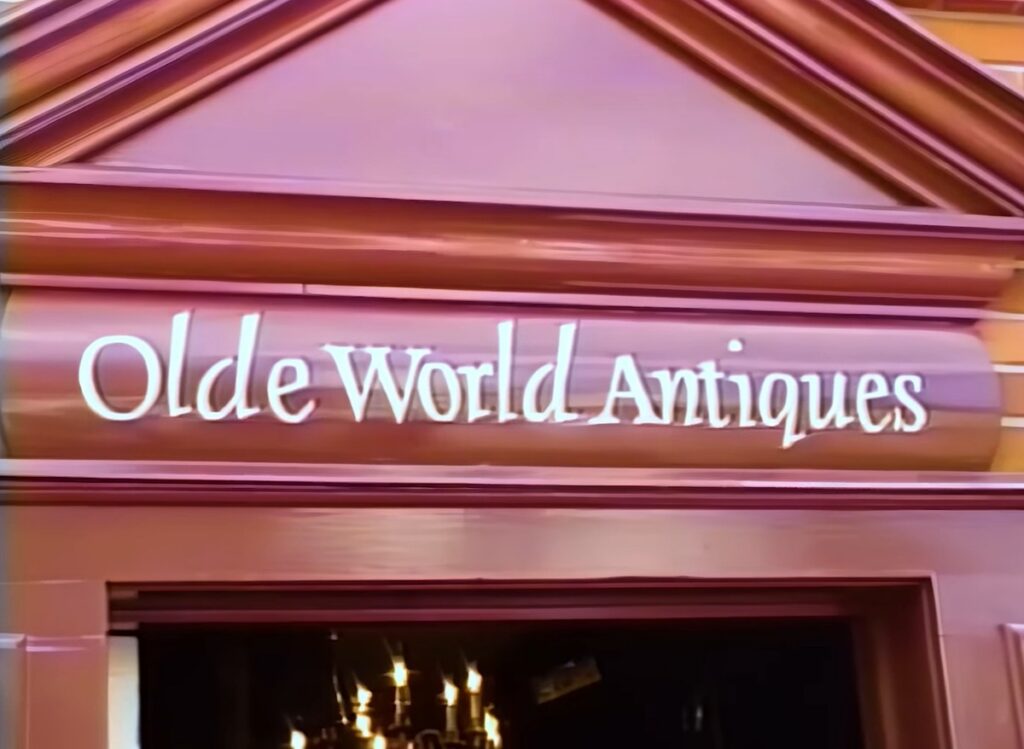
Olde World Antiques was a remarkably unusual retail shop in Liberty Square at Magic Kingdom that sold genuine European antiques alongside carefully selected reproductions. Opening in March 1972 and closing on January 30, 1996, the store offered everything from furniture, grandfather clocks, paintings, and vintage jewelry to decorative objects made from brass, pewter, copper, and wood.
This was not Disney merchandise designed to look old.
Much of it actually was old.
Disney employed a dedicated antiques buyer who traveled through Europe searching for pieces that could be shipped back to Walt Disney World and placed directly on sale inside Magic Kingdom. As a result, Olde World Antiques functioned simultaneously as a legitimate antique store, a themed environment, and an extension of Liberty Square’s historical storytelling.
The shop was located near the entrance to Liberty Square in the connected group of colonial-style buildings now occupied by Ye Olde Christmas Shoppe.
It was not an October 1, 1971 opening-day store.
Disney’s official D23 history dates Olde World Antiques to March 1972, roughly five months after Magic Kingdom opened. By the time Walt Disney World published its 1972 information guide, the store was firmly established and Disney described its merchandise as:
“Antique decorative gifts, one-of-a-kind antiques.”
That description immediately distinguished Olde World Antiques from almost every modern theme-park gift shop.
A guest could actually purchase a unique piece of European history while visiting Magic Kingdom.
The concept reflected the original philosophy behind Liberty Square.
Rather than representing a single precise American town or year, Liberty Square combines architectural and cultural influences associated with colonial America and the early United States. The land was designed to suggest communities shaped by immigrants who brought European traditions, crafts, furniture, tools, clothing, and decorative arts with them to the colonies.
Olde World Antiques helped communicate that story through real objects.
A 1975 Walt Disney World Vacationland article explained that the shop’s furniture, tools, paintings, and other European relics were intended to represent the foreign influences that helped shape early America.
In other words, the antiques were not merely merchandise.
They were part of the show.
A guest browsing the shop could encounter objects similar to those European settlers might have brought with them or that later generations of Americans might have imported into their homes.
That approach was typical of early Walt Disney World retail.
When Magic Kingdom opened, shops were frequently treated almost like attractions.
Adventureland sold imported goods associated with Africa, Asia, Polynesia, and the Middle East.
The Silversmith in Liberty Square sold sterling and silver-plated goods appropriate to an 18th-century craftsman’s shop.
Mlle. Lafayette’s Parfumerie offered imported perfumes and even custom-blended fragrances.
Main Street, U.S.A. contained separate shops devoted to clocks, candles, flowers, magic tricks, cameras, china, and other specialties.
Olde World Antiques may have been the most extreme example.
Disney hired antique buyer Otto Rabby specifically to obtain merchandise for its antique operations.
In a 1973 Walt Disney World Vacationland interview, Rabby explained that the Magic Kingdom shop dealt exclusively in objects obtained from abroad.
Once or sometimes twice each year, he would spend approximately eight weeks traveling through Europe searching for unusual pieces.
His buying trips took him to countries including Italy, France, England, Denmark, Holland, Austria, Spain, and Germany.
Rather than purchasing mass-produced merchandise from conventional suppliers, Rabby worked with established antique dealers who understood what Disney wanted and could alert him when appropriate pieces became available.
That meant inventory could change dramatically.
A chair sold to one guest could not necessarily be replaced with an identical chair the following week.
One painting might disappear and another entirely different work take its place.
A cabinet, table, or clock could literally be one of a kind.
The shop therefore rewarded repeat visits in a way few Disney stores do today.
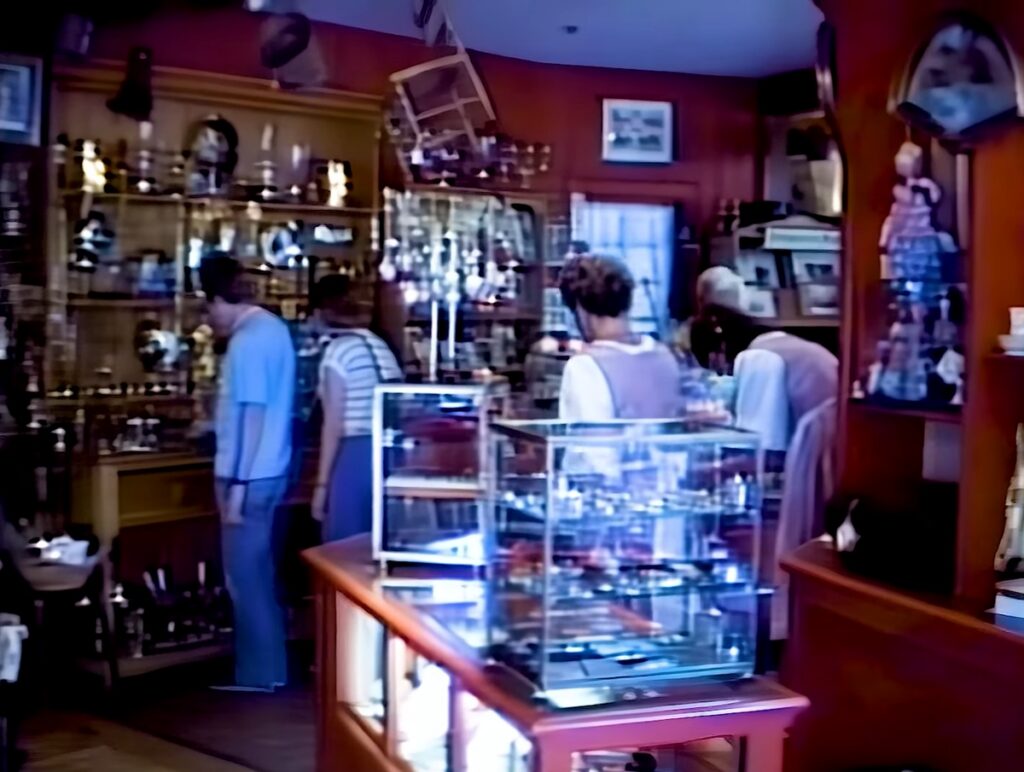
Historical descriptions document a remarkably eclectic assortment.
There were large pieces of furniture.
Grandfather clocks.
Tables.
Paintings.
Tools.
Vintage clothing.
Vintage jewelry.
Decorative objects crafted from brass, pewter, copper, and wood.
Some pieces were modest enough to take home as vacation souvenirs.
Others cost hundreds or even thousands of dollars and were serious antiques rather than casual theme-park purchases.
Authentic antiques were supplemented by reproductions when appropriate, allowing the store to maintain its period atmosphere while providing merchandise at a broader range of prices.
The interior reinforced the experience.
Lace-curtained windows, low ceilings, wooden floors, antique cabinets, crowded displays, and the seemingly irregular arrangement of rooms made Olde World Antiques feel less like a carefully organized modern retail store and more like a shop that had accumulated treasures over generations.
It was easy to forget that Cinderella Castle stood only a short walk away.
The surrounding retail complex made the experience even richer.
Immediately adjacent was the Silversmith.
That shop carried silver and pewter goods, including spoons, bowls, tea sets, plates, candelabras, and other items that would have looked appropriate in an 18th-century household.
Disney gave the Silversmith its own fictional proprietor: “J. Tremaine.”
The reference was to Johnny Tremain, the apprentice silversmith from Esther Forbes’ novel and Disney’s 1957 film adaptation.
Johnny’s story connected naturally with nearby Liberty Tree imagery and the Revolutionary-era atmosphere Disney wanted for Liberty Square.
Another adjoining shop was Mlle. Lafayette’s Parfumerie.
The small French-inspired perfume store carried well-known and difficult-to-find fragrances, soaps, powder sachets, potpourri, crystal and china atomizers, and other products.
Guests could even have a custom perfume blended from a selection of fragrance oils, with the formula recorded so it could be reordered later.
Together, the three businesses created one of the most unusual retail environments anywhere in Magic Kingdom.
Visitors could move from genuine European antiques to handmade-looking silver goods to imported French perfume without leaving the interconnected collection of colonial buildings.
The borders between them could sometimes feel intentionally vague.
Historical descriptions note that Olde World Antiques effectively rambled through the center of the complex, connecting with the neighboring specialty shops.
That arrangement became even more pronounced in 1986.
Mlle. Lafayette’s Parfumerie ended its independent operation, and its former space was incorporated into Olde World Antiques.
The antique shop consequently occupied an even larger portion of the building during its final decade.
Olde World Antiques also became famous among Disney historians for apparently being a particularly questionable business proposition.
A widely repeated anecdote attributed to an early manager claims that the shop might sell only around $100,000 worth of merchandise while Disney spent close to $1 million acquiring inventory.
Exact financial figures from a privately operated Disney store are difficult to independently verify, so the numbers should not be treated as audited results.
The larger point, however, is consistent with accounts of early Walt Disney World merchandising.
Disney sometimes tolerated specialty stores that were comparatively inefficient retailers because they contributed strongly to the atmosphere of the park.
Olde World Antiques may not have moved merchandise with the efficiency of a modern Disney souvenir store.
It did something arguably more important for Liberty Square.
It made the place believable.
A genuine antique cabinet did not merely decorate the shop.
It was the inventory.
An old European clock could simultaneously establish the room’s atmosphere and carry a price tag.
The line between set decoration and merchandise essentially disappeared.
Disney had experimented with a similar concept at Disneyland.
The One-of-a-Kind Shop opened in New Orleans Square in 1967 and sold genuine antiques. Disney’s official history notes that Lillian Disney’s personal interest in antiques reportedly helped inspire that location.
Olde World Antiques became Walt Disney World’s counterpart.
For a period, Disney actually operated several antique businesses, including the Magic Kingdom shop, Disneyland’s One-of-a-Kind, and Von Otto’s Antiques at the Walt Disney World Village.
By the 1990s, however, this highly specialized style of theme-park retail was disappearing.
Operating a real antique shop required buyers with specialized expertise, international sourcing, shipping, authentication, storage, and constantly changing inventory.
At the same time, Disney character merchandise and standardized souvenirs were becoming increasingly important throughout Walt Disney World.
The economics and operating complexity that made Olde World Antiques distinctive also made the concept difficult to sustain.
Its remarkably long run finally ended on January 30, 1996.
Olde World Antiques had operated for nearly 24 years.
The neighboring Silversmith closed during the same transition.
Only days later, on February 5, Disney opened Ye Olde Christmas Shoppe.
The new store combined the former retail spaces into a larger year-round Christmas merchandise location.
Because the old Mlle. Lafayette’s Parfumerie area had previously been incorporated into Olde World Antiques, the modern Christmas store effectively encompasses the footprint of all three historic businesses.
The exterior architecture still reveals that history.
Rather than appearing as a single purpose-built store, Ye Olde Christmas Shoppe resembles a connected row of individual colonial buildings.
Different façades, rooflines, materials, doors, windows, and architectural details preserve the impression that several neighboring businesses once occupied the site.
They did.
During a 2024 exterior refurbishment, contemporary photographs made the divisions particularly easy to see, including the façade corresponding to the former Olde World Antiques space.
Ye Olde Christmas Shoppe remains open in 2026, selling Disney ornaments and holiday merchandise year-round.
The antiques are long gone.
There are no international buying trips filling the rooms with European furniture.
Guests no longer encounter thousand-dollar clocks or vintage jewelry beside conventional Magic Kingdom souvenirs.
That makes Olde World Antiques particularly representative of a retail philosophy that has largely disappeared from Disney parks.
It was not designed primarily around a Disney character.
It was not an attraction exit store.
Its shelves were not stocked with dozens of identical products.
Disney instead treated retail as environmental storytelling.
The merchandise itself helped explain Liberty Square.
For nearly a quarter century, a guest could walk into Magic Kingdom and purchase an actual antique imported from Europe.
The object might have existed decades—or generations—before Walt Disney World itself.
That is what made Olde World Antiques extraordinary.
The shop did not simply sell souvenirs of Liberty Square.
For a time, it sold pieces of the real world that had inspired Liberty Square in the first place.