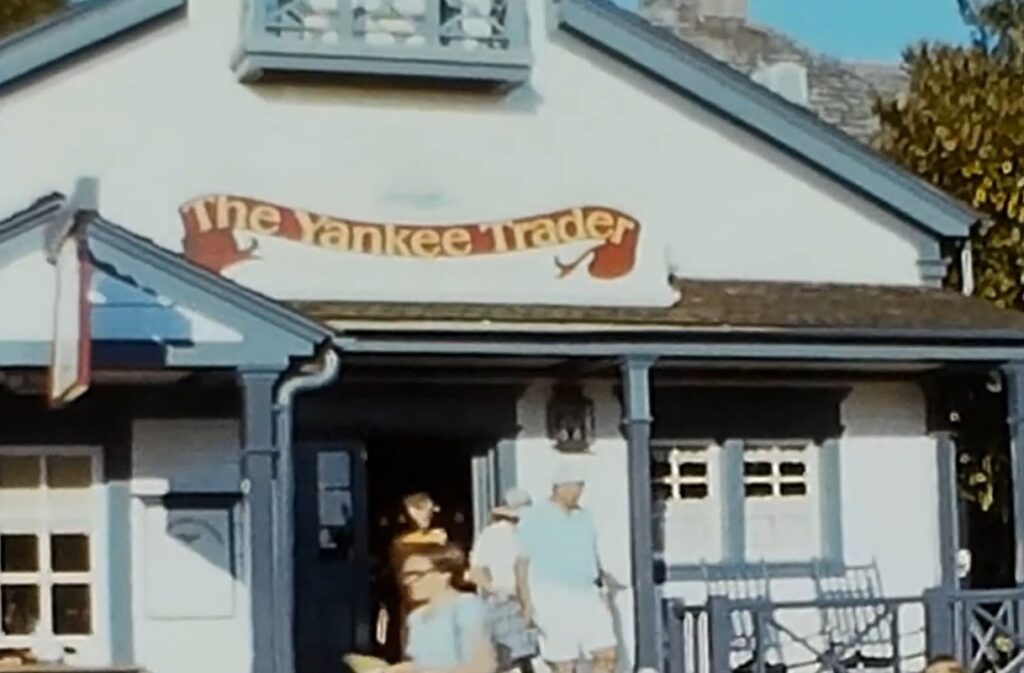
The Yankee Trader was a longtime specialty shop in Liberty Square at Magic Kingdom that sold kitchenware, cooking accessories, gourmet foods, cookbooks, and an eclectic assortment of household merchandise for more than 40 years. Opening in September 1973 under the longer name Yankee Pedlar Gourmet Culinary Aids, the store stood directly across from the Haunted Mansion and beside Columbia Harbour House. It ultimately closed on July 27, 2014 and was transformed into Memento Mori, Disney’s dedicated Haunted Mansion merchandise shop.
For much of its life, The Yankee Trader was one of the best examples of the highly specialized retail philosophy that characterized early Walt Disney World.
It was not primarily a Disney souvenir store.
It was essentially a colonial-themed kitchen shop inside a theme park.
Guests could browse unusual cooking utensils, serving accessories, spices, gourmet foods, cookbooks, household decorations, and later an increasing assortment of Disney-themed kitchen merchandise.
The concept made particular sense in Liberty Square.
Disney designed the land as an idealized journey through colonial and early American history, with architecture inspired by different regions and periods of the United States. Instead of filling every storefront with identical Mickey Mouse souvenirs, the original Liberty Square retail lineup was designed to resemble businesses that might plausibly exist within the community.
Olde World Antiques sold genuine antiques.
The Silversmith offered silver and pewter goods.
Mlle. Lafayette’s Parfumerie sold perfume.
Heritage House carried patriotic and historical merchandise.
The Yankee Pedlar specialized in household and culinary goods.
Together, these shops helped make Liberty Square feel like a functioning town rather than simply a collection of attractions.
The Yankee Trader was not technically an October 1, 1971 opening-day shop.
Disney’s official D23 history dates its opening to September 1973.
That timing is supported by an official Walt Disney World guidebook from 1973, which lists the store as the “Yankee Pedlar Gourmet Culinary Aids.”
Disney described its merchandise as:
“Unusual cooking and serving accessories along with a selection of exotic spices.”
That description reveals how distinctive the original concept was.
The store was not simply selling ordinary spatulas and coffee mugs.
Its inventory was intended to feel unusual and somewhat worldly, with specialty utensils and imported or exotic ingredients reinforcing Liberty Square’s historical connection with international trade.
The location itself enhanced that idea.
The shop stood near Columbia Harbour House, the nautical-themed restaurant whose upper level is connected to the building through an enclosed passageway.
That architectural arrangement suggests a small commercial district tied to Liberty Square’s imaginary waterfront.
It is easy to imagine goods arriving by ship, being unloaded near the harbor, and then appearing for sale inside the nearby merchant’s shop.
Whether or not Disney formally developed such a detailed backstory during the 1970s, the architecture makes the relationship remarkably convincing.
Even the original word “Pedlar” suited the setting.
A peddler or pedlar was historically a traveling merchant who sold small goods directly to customers, particularly in rural communities where conventional shops might be limited.
Disney’s old-fashioned spelling helped the store feel less like a contemporary kitchen retailer and more like a business that belonged in Liberty Square.
The name did not remain unchanged.
By 1977, Walt Disney World’s official guidebook was listing the shop as Yankee Trader Gourmet Culinary Aids.
The merchandise description remained essentially the same: unusual cooking and serving accessories.
The transition from “Pedlar” to “Trader” was therefore primarily a naming adjustment rather than the creation of an entirely new store.
For approximately the next decade, the longer Yankee Trader Gourmet Culinary Aids name continued appearing in park materials.
By the late 1980s, Disney simplified it again.
An official 1987 Magic Kingdom guide identified the shop simply as The Yankee Trader.
That would remain its familiar name until the store closed in 2014.
Although the wording changed, cooking and household merchandise remained central to the business.
For longtime Walt Disney World visitors, Yankee Trader became the place in Magic Kingdom to find kitchen gadgets.
That could include serving pieces, utensils, decorative kitchen accessories, food products, coffee, candy, cookbooks, and eventually Disney-character housewares.
As Walt Disney World merchandising became more standardized, Mickey Mouse and other Disney characters increasingly appeared on items such as dishes, mugs, kitchen tools, towels, and other household products.
The shop therefore gradually evolved from a relatively serious specialty culinary store into a blend of practical kitchen retailer and Disney souvenir shop.
That shift mirrored what happened across Magic Kingdom.
During the 1970s, stores frequently carried merchandise that could have been purchased even if Disney characters did not exist.
A guest might buy perfume in Liberty Square, imported goods in Adventureland, a genuine antique, a magic trick, or an unusual cooking utensil.
Over time, branded Disney merchandise became increasingly prominent.
The Yankee Trader adapted rather than disappearing.
By the 1990s, the J.M. Smucker Company had become an important part of the store’s identity.
An official November 1996 Magic Kingdom guide identified The Yankee Trader as being “Presented by the J.M. Smucker Company.”
Disney described the merchandise at the time as:
“Kitchen accessories, gourmet food, snacks.”
Smucker products fit naturally into the shop’s culinary theme.
Jams, jellies, preserves, and other packaged foods could be integrated into displays alongside cooking accessories without fundamentally changing the store’s purpose.
The sponsorship also continued Walt Disney World’s longstanding tradition of pairing appropriately themed retail and dining locations with outside companies.
Over subsequent years, Yankee Trader’s inventory fluctuated.
Some periods emphasized cookware and kitchen accessories particularly strongly.
At other times the shop carried more general Disney merchandise.
Early-2000s accounts mention kitchen utensils, cookbooks, scrapbooking materials, and plush toys sharing the store.
In 2004, contemporary Walt Disney World reporting noted that Yankee Trader was being returned to a stronger housewares emphasis, illustrating how Disney periodically adjusted the product mix while retaining the store’s culinary identity.
By the shop’s final years, visitors could find colonial-style and Mickey-themed kitchenware, coffee, candy, packaged foods, and other household goods.
The merchandise may have become more recognizably Disney, but Yankee Trader remained unusual within Magic Kingdom simply because it continued devoting significant space to the kitchen.
Its position beside the Haunted Mansion eventually became more important than its historical culinary identity.
For decades, the Haunted Mansion had one unusual omission compared with many major Disney attractions:
It did not have a dedicated merchandise store.
Guests exited the attraction without being routed through a gift shop, and Haunted Mansion merchandise was scattered among different Walt Disney World retail locations.
As attraction-specific merchandise became increasingly popular during the 2000s and early 2010s, that absence became more conspicuous.
Meanwhile, Yankee Trader sat almost perfectly positioned for a Haunted Mansion store.
It was directly beside the attraction.
The building’s aged colonial architecture already looked appropriate.
And Disney had evidence that guests wanted significantly more Haunted Mansion merchandise.
In 2013, Disney tested a line of higher-end Haunted Mansion home décor and collectibles.
The products reportedly sold extremely well.
The success helped encourage Disney to develop a much larger assortment of attraction-specific merchandise and finally create a dedicated Haunted Mansion retail location.
Yankee Trader was selected for the transformation.
Disney officially announced in July 2014 that the store would close after July 27.
The culinary shop served guests for the final time that day, ending a run of nearly 41 years.
Unlike many extinct Magic Kingdom stores, Yankee Trader was not demolished.
Disney completely rethemed the existing structure.
On October 6, 2014, Memento Mori officially opened.
The change was dramatic.
Where Yankee Trader had displayed kitchen utensils and gourmet foods, Memento Mori was filled with Haunted Mansion apparel, artwork, collectibles, home décor, accessories, souvenirs, and attraction-specific merchandise.
Disney also created a fictional history for the store.
Memento Mori is presented as the former home of Madame Leota, the mysterious medium whose disembodied head appears inside the Haunted Mansion’s séance room.
Portraits and supernatural effects suggest Leota’s lingering presence within the building.
One of the store’s best-known original offerings allowed guests to have their photograph taken and transformed into a lenticular portrait that appeared to shift between their normal face and a ghostly version depending on the viewing angle.
The result effectively turned the former kitchen shop into a small extension of the Haunted Mansion itself.
There is an appropriate irony in the transformation.
For decades, Yankee Trader had sold housewares.
Memento Mori began selling substantial quantities of Haunted Mansion housewares.
The kitchen merchandise did not disappear entirely from the broader concept—it simply became haunted.
The change also created a thematic relationship between the shop and attraction that is so natural that many modern guests probably assume the building was always associated with Haunted Mansion.
It was not.
For more than four decades, the mysterious old house on the hill had a kitchen shop for a neighbor.
Memento Mori remains open in 2026, and Disney continues describing it as Madame Leota’s former abode and a destination for Haunted Mansion merchandise.
Very little about the interior now suggests the old Yankee Trader.
Yet the structure itself preserves one of Magic Kingdom’s longest-running retail locations.
The Yankee Trader deserves to be remembered because it represents a style of theme-park shopping that has become increasingly rare.
A guest could walk into Liberty Square and genuinely shop for the kitchen.
Not because the store happened to carry a Mickey Mouse mug beside hundreds of other souvenirs, but because kitchen merchandise was the entire reason the shop existed.
In 1973, that meant exotic spices and unusual serving accessories.
Later it meant cookbooks, coffee, gourmet foods, Smucker’s products, Disney housewares, and Mickey-themed kitchen gadgets.
The inventory changed with the decades, but the central idea survived for almost 41 years.
Today, guests entering Memento Mori are surrounded by ghosts, tombstones, Madame Leota, and merchandise celebrating the 999 Happy Haunts.
Before those spirits took possession, however, this little building beside the Haunted Mansion had a far more domestic purpose.
It was where Liberty Square went shopping for the kitchen.