
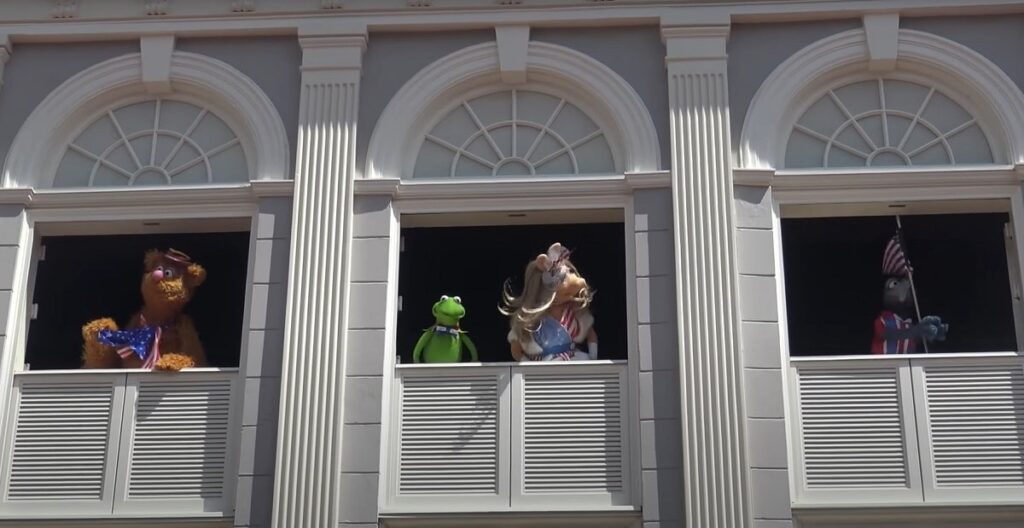
The Muppets Present… Great Moments in American History was a live outdoor puppet show performed in Liberty Square at Magic Kingdom from October 2, 2016 through October 5, 2019, with several limited return engagements afterward. Featuring Kermit the Frog, Miss Piggy, Fozzie Bear, Gonzo, Sam Eagle, and a human Liberty Square town crier named James “J.J.” Jefferson, the show used the second-story windows of the former Heritage House building and neighboring structures to stage deliberately inaccurate-but surprisingly educational-reenactments of events from the American Revolution.
Rather than building a conventional theater, Disney integrated the production directly into Liberty Square.
Guests simply gathered in the street outside The Hall of Presidents, where J.J. Jefferson would begin attracting attention with his bell and town-crier routine. Sam Eagle appeared from a nearby upper window, and before long Kermit, Fozzie, Gonzo, and Miss Piggy emerged from windows above the Heritage House.
The arrangement made the show feel almost spontaneous. There was no queue, reserved seating, or elaborate stage. Guests walking between Frontierland and the central hub could suddenly hear Sam Eagle addressing the square and discover that the Muppets had taken over the colonial buildings around them.
That integration was one of the show’s greatest strengths.
Liberty Square already presents a highly theatrical version of colonial America, complete with period architecture, the Liberty Tree, a Liberty Bell replica, colonial costumes, and The Hall of Presidents. Instead of constructing a separate Muppet environment that might have clashed with the land, Disney used the existing architecture as the scenery.
The result felt like the Muppets had temporarily invaded Liberty Square rather than Liberty Square having been redesigned for the Muppets.
The production usually alternated between two different historical presentations.
The first focused on the signing of the Declaration of Independence.
J.J. Jefferson served as the closest thing the show had to a responsible historian, supplying actual facts while Sam Eagle attempted to deliver an appropriately dignified presentation. The other Muppets, naturally, made that almost impossible.
Kermit portrayed Thomas Jefferson, Gonzo became John Adams, and Fozzie Bear played Benjamin Franklin. Miss Piggy took on multiple roles and costumes, including flamboyant interpretations of figures such as George Washington and King George III.
The joke was not that history itself was unimportant. Quite the opposite: Sam treated the material with almost unbearable seriousness, while everyone around him continually mangled his attempt at a respectable historical pageant.
That gave the production a distinctly Muppet tone.
The characters could deliver genuine historical information one moment and derail the lesson with wordplay, costume changes, arguments, or absurd theatrical decisions the next. Show director James Silson summarized the approach particularly well at the attraction’s debut: the characters sincerely tried to present history accurately, but inevitably got a great deal of it wrong.
The second program tackled Paul Revere’s midnight ride.
Kermit portrayed Paul Revere while Sam Eagle attempted to narrate the famous Revolutionary War episode. The show drew heavily from the familiar cultural version of the story, particularly Henry Wadsworth Longfellow’s poem, while allowing the Muppets to interrupt, exaggerate, misunderstand, and embellish events.
As with the Declaration show, the real historical framework remained visible beneath the comedy. The audience could follow the basic story of Revere warning colonial communities of British troop movements while simultaneously watching the Muppets turn the entire event into a chaotic musical pageant.
Both versions incorporated the original song “Great Moments in History,” written by Valerie Vigoda and Brendan Milburn.
Its refrain neatly summarized the show’s philosophy: American history contained important moments, but allowing the Muppets to explain them almost guaranteed that things would become ridiculous.
The music also provided a recurring structure that allowed the relatively brief presentation to move quickly between narration, jokes, characters, and historical scenes.
Performances generally ran around seven to eleven minutes, making the attraction closer to street entertainment than a major scheduled theater show.
That scale worked particularly well in Liberty Square. Guests did not need to devote a substantial portion of their day to seeing it. They could encounter one version while passing through the land, discover that another historical story was being presented later, and return for the alternate program.
The show’s physical production was more sophisticated than it appeared from the street.
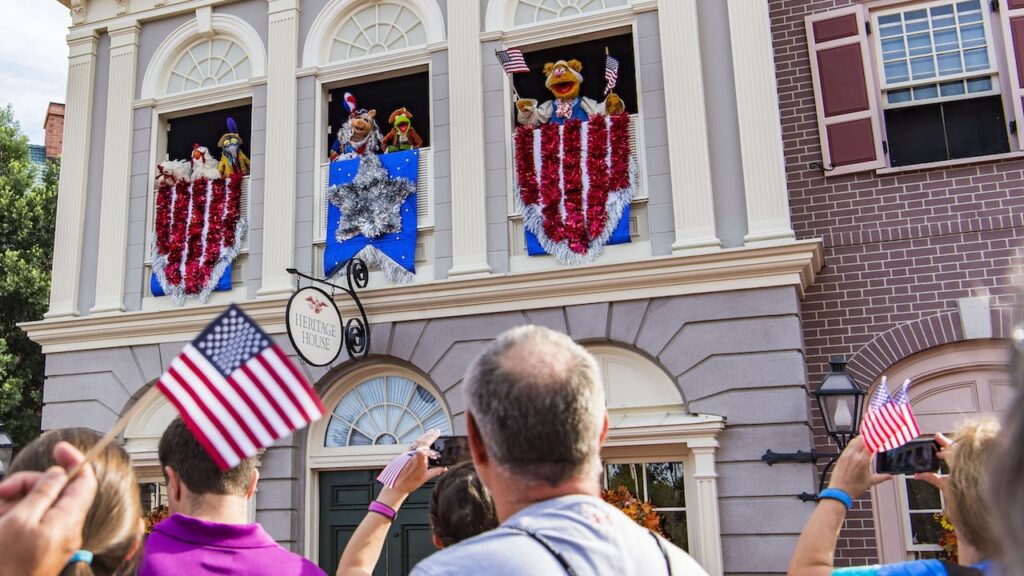
Although the characters seemed to be ordinary television Muppets standing in open windows, Disney created specially adapted puppets for the attraction. Because the performers were positioned on the second floor and needed to remain visually readable to audiences below, the park versions were reportedly constructed about five percent larger than standard Muppets used for television and film.
The character dialogue was prerecorded using established Muppet performers, while Walt Disney World puppeteers physically performed the characters live in synchronization with the audio.
Steve Whitmire provided Kermit’s recorded dialogue for the original production, Eric Jacobson performed Miss Piggy, Fozzie, and Sam Eagle, and longtime Muppet performer Dave Goelz voiced Gonzo.
That combination preserved the familiar voices and timing associated with the Muppets while allowing Disney’s in-park performers to manipulate the characters several times each day.
The physical puppetry gave the show an immediacy that would have been lost with screens or Audio-Animatronics.
Kermit could lean out of a window.
Piggy could react theatrically to another character.
Sam could glare down at the audience.
Fozzie could physically sell a bad joke.
The movement retained the loose, slightly chaotic quality that distinguishes traditional Muppet performance from mechanical theme-park figures.
Disney developed the show beginning around 2014, with an early concept reportedly centered primarily on Sam Eagle presenting American history. Expanding the cast to include Kermit, Miss Piggy, Fozzie, and Gonzo transformed the idea from a straightforward patriotic character presentation into something much closer to a classic Muppet production.
That was the right decision for Liberty Square.
Sam Eagle has always been the Muppet most obsessed with patriotism, dignity, culture, and proper behavior, making him an obvious host for an American-history show. He is also funniest when surrounded by characters who refuse to behave according to his standards.
The format essentially gave him the most important presentation of his career-and then populated it with exactly the people least likely to let him complete it successfully.
The show’s human character was equally important.
James “J.J.” Jefferson, played by a live Cast Member, functioned as both town crier and historical interpreter. Before performances, he could interact directly with guests and discuss details around Liberty Square, including the Liberty Bell, Liberty Tree, colonial punishment practices, and other elements of the land.
That meant the attraction was not simply an outdoor prerecorded puppet performance.
J.J. could react to the crowd, speak directly with children, fill time, establish the setting, and provide historical context before the Muppets appeared. His live presence helped bridge the physical Magic Kingdom environment and the prerecorded Muppet material above.
The show also arrived at an important point in the history of the Muppets at Walt Disney World.
For decades, the characters had been most strongly associated with Disney’s Hollywood Studios, particularly through Muppet*Vision 3D. Great Moments gave them a significant recurring presence at Magic Kingdom for the first time and demonstrated that Muppet humor could fit naturally into an existing Disney land without requiring an entire dedicated Muppet area.
Liberty Square proved to be a particularly inspired match because the Muppets could parody educational historical entertainment while standing only steps from one of Disney’s most earnest historical attractions, The Hall of Presidents.
The contrast felt almost intentional.
Inside the Hall of Presidents, Audio-Animatronics figures solemnly explored the history of the American presidency.
Outside, Sam Eagle desperately attempted to maintain similar dignity while Miss Piggy changed costumes and Fozzie told jokes.
The production operated multiple times each day for approximately three years.
Disney ended its regular daily run on October 5, 2019, part of a broader series of entertainment changes at Walt Disney World. The closure generated substantial disappointment among fans because the production required relatively little physical space, had developed a dedicated following, and was one of the resort’s comparatively rare examples of live puppetry.
Fortunately, the October performance was not quite the final chapter.
The Muppets returned to Liberty Square for a limited December 23–31, 2019 holiday engagement. The show was again presented numerous times per day during the busy Christmas period.
A second limited return followed for Presidents Day weekend, February 15–17, 2020.
The February 17 performances became the show’s final presentations in its original form.
When Walt Disney World closed several weeks later during the COVID-19 pandemic, Great Moments did not return with the park.
The Muppets themselves did briefly reappear in those same Liberty Square windows during the 2020 holiday season, when Kermit, Miss Piggy, Fozzie, Gonzo, Sam Eagle, and other characters made physically distanced appearances above the street. Those encounters reused the architecture associated with Great Moments but were not performances of the historical show.
As of 2026, The Muppets Present… Great Moments in American History remains permanently discontinued.
Its relatively short lifespan has not diminished its reputation.
In some ways, the show represented the Muppets unusually well because it did not rely on sophisticated technology or a huge production budget. Its ingredients were remarkably simple: several windows, puppets, a live actor, prerecorded dialogue, music, costumes, and strong writing.
The comedy came from character.
Sam Eagle desperately wanted the show to be important.
Kermit tried to keep things moving.
Fozzie wanted to be funny.
Gonzo wanted everything to become stranger.
Miss Piggy wanted the production to revolve around Miss Piggy.
J.J. wanted the audience to leave knowing at least a little more American history than when they arrived.
Those competing ambitions created exactly the kind of controlled disorder on which the Muppets have always thrived.
The attraction also accomplished something valuable for Liberty Square itself. Most of the land’s major experiences are indoors, and much of its architecture functions primarily as atmosphere between attractions. Great Moments turned the upper stories of those buildings into active performance space.
For several times each day, guests looked upward instead of simply walking through.
That gave the square a sense that its buildings were genuinely inhabited.
For a production built around deliberately questionable history, The Muppets Present… Great Moments in American History ultimately fit Liberty Square remarkably well. It respected the basic events it portrayed while refusing to treat them as untouchable museum pieces. Children could learn who Paul Revere, Thomas Jefferson, John Adams, and Benjamin Franklin were while adults enjoyed the way the Muppets dismantled the solemn historical pageant around them.
Sam Eagle might not have approved of every detail.
But that was precisely the point.