
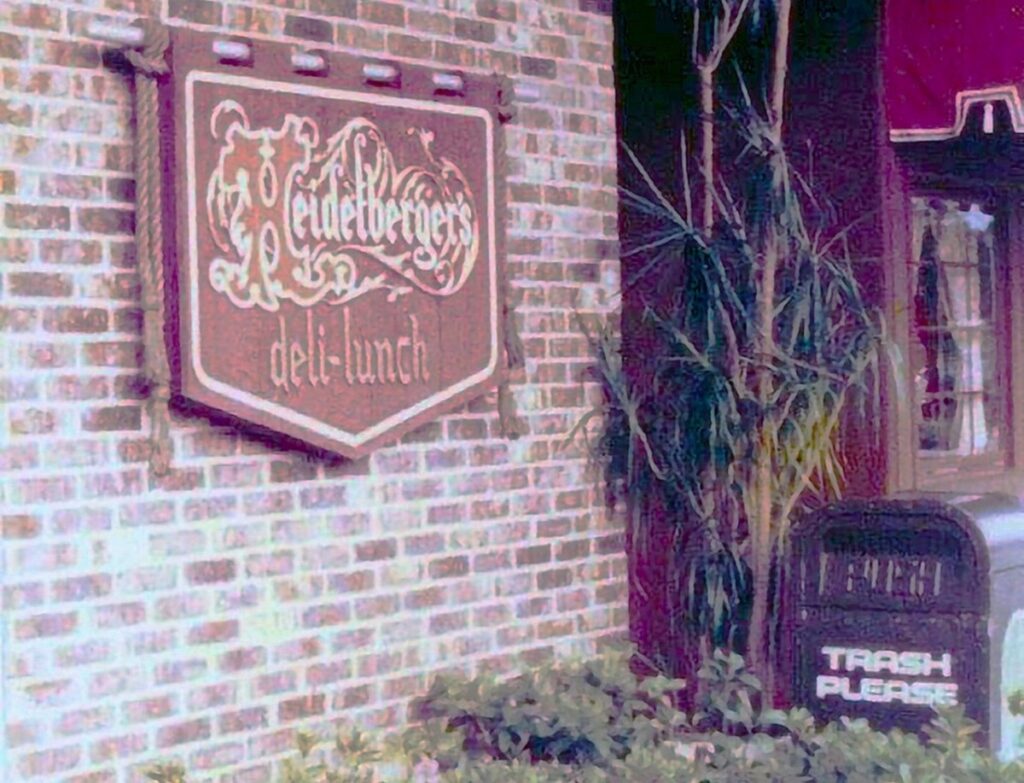
Heidelberger’s Deli, occasionally referred to in early Walt Disney World promotional materials as Der Heidelberger’s Deli, was a German-inspired delicatessen located at the Lake Buena Vista Shopping Village, the shopping and dining district now known as Disney Springs. Opening with the original shopping village on March 22, 1975, the restaurant specialized in generously portioned deli sandwiches, hot knockwurst, German-style side dishes, imported beer, and other casual meals. Its menu featured specialties such as the Heidelberger’s Special, Red Baron, and Zeppelin sandwiches. The restaurant remained in operation until approximately 1986, when it became All American Sandwich Shop. Its former location subsequently housed Minnie Mia’s Italian Eatery, Wolfgang Puck Express, and, most recently, eet by Maneet Chauhan.
Heidelberger’s was one of the original restaurants created for Lake Buena Vista Shopping Village, an ambitious development intended to expand Walt Disney World beyond its initial theme park and resort hotels.
When Walt Disney World opened on October 1, 1971, Magic Kingdom was the resort’s principal attraction. The Contemporary Resort and Polynesian Village Resort provided accommodations, while recreational facilities and transportation systems supported the new vacation destination.
However, Disney’s plans extended well beyond those original facilities.
The company envisioned a larger resort community around Lake Buena Vista, incorporating vacation accommodations, retail businesses, restaurants, recreational amenities, and other services.
Lake Buena Vista Shopping Village became an important part of that development.
Rather than constructing a conventional shopping mall, Disney created a landscaped waterfront village featuring small specialty stores, restaurants, and artisan workshops.
The buildings incorporated weathered brick, wood, pitched roofs, and other details intended to create a relaxed, traditional atmosphere.
The shopping district also included winding pedestrian pathways, gardens, and views of Buena Vista Lagoon.
Unlike the shops inside Magic Kingdom, many of the original Village businesses had no direct connection to Disney characters or films.
Their merchandise emphasized specialty products and experiences that guests might not encounter in conventional shopping centers.
Visitors could purchase handmade candles, pottery, clothing, imported foods, decorative home accessories, and other unusual items.
Some businesses featured craftspeople demonstrating their work.
Restaurants were incorporated throughout the development to encourage visitors to spend additional time exploring the shops.
Heidelberger’s Deli was one of four principal dining locations associated with the Village’s original opening.
The others included Lite Bite, the Village Restaurant, and Cap’n Jack’s Oyster Bar.
Each served a different purpose.
Lite Bite offered familiar American fast food, while the Village Restaurant provided a more substantial dining experience.
Cap’n Jack’s specialized in seafood and cocktails in a waterfront setting.
Heidelberger’s concentrated on deli sandwiches, German-style specialties, and beer.
This assortment gave the original shopping village a broader range of dining experiences than might be expected from a relatively small retail development.
The restaurant was located in a compact corner building near Michael’s, a men’s barbershop that was another of the Village’s original businesses.
The nearby Toys Fantastique shop also occupied space in the surrounding commercial area before relocating during the shopping village’s early expansion.
Historical photographs and descriptions identify Heidelberger’s as a relatively modest restaurant with a darker interior than many of the neighboring stores.
Its atmosphere was closer to a traditional delicatessen or European-style tavern than a conventional theme park counter-service restaurant.
The establishment’s name reinforced that identity.
Heidelberger is associated with Heidelberg, the historic German city known for its university, castle, and traditional architecture.
Some early promotional descriptions used the name Der Heidelberger’s Deli, incorporating the German definite article der.
However, surviving Disney menus use Heidelberger’s Deli.
The two names refer to the same restaurant rather than separate businesses.
Although the German-inspired name was prominent, the restaurant’s menu combined Central European influences with American delicatessen traditions.
Its offerings included hot knockwurst, sauerkraut, rye bread, pumpernickel, corned beef, pastrami, turkey, ham, roast beef, and salami.
The emphasis on substantial sandwiches was reflected in the restaurant’s early advertising.
Heidelberger’s promoted its unusually large creations as “palm-stretching sandwiches.”
The description conveyed the idea that guests would receive a generous meal rather than a small snack.
The restaurant’s offerings were also relatively distinctive for Walt Disney World during the 1970s.
While hamburgers, hot dogs, fried chicken, and conventional sandwiches were readily available elsewhere at the resort, Heidelberger’s offered a more varied selection of deli meats, breads, cheeses, and accompanying salads.
The availability of imported beer was another important feature.
At a time when the resort’s drinking establishments were comparatively limited, Heidelberger’s gave adult visitors a place to enjoy beer with a casual meal.
Its position outside Magic Kingdom was significant because the park itself did not sell alcoholic beverages to ordinary guests during its early decades.
Heidelberger’s provided a different dining experience within the broader resort.
The original deli menu
One of the most valuable surviving records of Heidelberger’s is an official Walt Disney World menu dated May 27, 1980.
Preserved in a historical Disney menu book, the document provides unusually detailed information about the restaurant’s actual offerings and prices.
The menu listed a selection of deli meats that guests could order as sandwiches.
Turkey cost $1.75.
Ham was priced at $2.20.
Corned beef and pastrami cost $2.50, while hot pastrami was available for the same price.
A hot corned beef sandwich cost $2.25.
Other options included roast beef for $2.10, salami for $2.25, tuna for $1.75, bologna for $1.50, and liverwurst for $1.50.
A Swiss or American cheese sandwich was available for $1.25.
The menu also offered bagels with cream cheese for $1.10.
Guests could order lox with cream cheese for $2.95, introducing another traditional delicatessen specialty.
The combination of lox, cream cheese, bagels, and assorted deli meats demonstrated that Heidelberger’s offered more than German sausages and beer.
Its menu incorporated recognizable Jewish-American deli influences as well as German and broader European flavors.
The sandwich offerings were unusually customizable.
Guests could choose from a variety of breads.
These included white, whole wheat, potato, rye, and pumpernickel bread.
Several rolls were also available, including onion rolls, Kaiser rolls, submarine rolls, pumpernickel rolls, and rye rolls.
The choice of bread was an important part of the deli experience.
A pastrami sandwich on rye created a very different meal from turkey on a Kaiser roll or roast beef on pumpernickel.
The restaurant also offered several side dishes.
Choices included potato salad, cottage cheese, cucumber salad, coleslaw, baked beans, sauerkraut, and applesauce.
These accompaniments reflected the restaurant’s combination of European and American deli traditions.
The standard sandwich meal included a choice of salad and bread along with a pickle spear.
Cheese could be added for an additional 25 cents.
The relatively extensive selection allowed guests to assemble a meal according to their preferences rather than choosing only from a few predetermined sandwiches.
Signature sandwiches
In addition to the customizable deli selection, Heidelberger’s offered several specialty sandwiches with distinctive names.
The Heidelberger’s Special was priced at $2.50 on the May 1980 menu.
It combined salami, provolone cheese, ham, and a salad mixture on a roll.
The sandwich was served with baked beans and a pickle spear.
Its combination of multiple meats and cheese was consistent with the restaurant’s reputation for substantial portions.
The Red Baron was another signature selection.
Priced at $2.25, it featured roast beef, American cheese, Swiss cheese, and sweet onion on a pumpernickel roll.
The sandwich was accompanied by potato salad and a pickle spear.
The name evoked the famous German aviator Manfred von Richthofen, whose nickname was the Red Baron.
Although the sandwich itself was primarily an American deli combination, the name reinforced the restaurant’s German-inspired identity.
Another distinctive offering was the Zeppelin.
The menu used a spelling resembling “Zepplin,” but the reference was clearly associated with the German airships.
Priced at $2.35, the sandwich included turkey, ham, Swiss cheese, and Thousand Island dressing.
It was served with coleslaw and a pickle spear.
The Zeppelin was another example of the restaurant incorporating German-themed names into sandwiches made with familiar American delicatessen ingredients.
Hot knockwurst was also available.
Priced at $1.95, the sausage was served with sauerkraut and baked beans.
This dish was one of the clearest examples of the restaurant’s German culinary influence.
Knockwurst is a traditional sausage associated with German cuisine, commonly prepared using pork, beef, or a combination of meats.
Its relatively mild seasoning and substantial texture made it well suited to a casual deli menu.
The sauerkraut provided a distinctly Central European accompaniment, while the baked beans reflected the American side of the restaurant’s culinary identity.
Together, the signature dishes demonstrate that Heidelberger’s was not simply a conventional sandwich counter with a German name.
Its menu incorporated specific references to German food and culture while maintaining broad appeal for American vacationers.
Sides, desserts, and beverages
The May 1980 menu also documented several inexpensive side dishes.
A fruit cup cost 75 cents.
A choice of salad was available for 50 cents.
A kosher pickle cost 50 cents, while a bag of chips was priced at 25 cents.
Desserts included marble cheesecake for 65 cents.
Regular cheesecake cost 50 cents, while other cakes and pies were listed at 60 cents.
These offerings were relatively straightforward, providing guests with a small dessert after a deli meal.
The beverage menu was more distinctive.
Soft drinks included Coca-Cola, Pepsi, Diet Pepsi, and Sprite.
The availability of both Coca-Cola and Pepsi products is particularly interesting because Walt Disney World later became much more closely associated with Coca-Cola as its principal soft-drink supplier.
The menu also listed grape drink, iced tea, coffee, and hot chocolate.
Coffee and hot chocolate cost 35 cents.
Soft drinks were available in different sizes, with prices generally ranging from 50 to 70 cents.
Beer was a significant part of the menu.
Draught Michelob and Heineken were both available.
A glass of either beer cost $1.
Pitchers were also offered, with Michelob priced at $3.25 and Heineken at $4.25.
Imported bottled beer cost $1.50.
Domestic bottled beer was priced at $1.25.
Wine by the glass was available for $1.25.
The availability of beer by the pitcher suggests that the establishment functioned partly as a casual gathering place rather than merely a place to purchase a sandwich.
Its atmosphere was consistent with the shopping village’s original emphasis on encouraging guests to relax and spend time outside the theme parks.
The combination of sandwiches, German-style sides, beer, and wine allowed visitors to enjoy a meal without the formal service or expense associated with some of Walt Disney World’s larger restaurants.
A changing shopping village
Heidelberger’s continued operating as the surrounding shopping district evolved.
In 1977, Lake Buena Vista Shopping Village was renamed Walt Disney World Village.
The change reflected its growing importance as a destination for vacationers from throughout the resort.
That same year, the Empress Lilly riverboat restaurant opened on the waterfront, introducing an elaborate dining complex with several restaurants and lounges.
The Empress Lilly became one of the shopping village’s most recognizable landmarks.
However, Heidelberger’s continued serving a different audience.
Its focus remained on accessible deli meals rather than fine dining or elaborate entertainment.
During the early 1980s, Walt Disney World continued adding attractions, resorts, and recreational facilities.
EPCOT Center opened in October 1982, bringing a second major theme park to the property.
The expansion increased the number of guests who might visit the shopping village during their vacations.
Disney also began changing some of the original retail concepts.
Several specialty shops were replaced by businesses emphasizing familiar merchandise, Disney branding, and products intended for a broader vacation audience.
Heidelberger’s was eventually affected by that process.
During the 1980s, the restaurant became associated with Hormel, the American food company known for packaged meats and other food products.
Historical shopping village records identify Heidelberger’s as a Hormel-sponsored location during this period.
The association was particularly appropriate because the restaurant specialized in ham, salami, deli meats, and sandwiches.
However, the surviving records do not establish exactly when the sponsorship began or which products were supplied under the arrangement.
It would therefore be inappropriate to assume that every meat served at Heidelberger’s came from Hormel.
The documented relationship is best understood as a restaurant sponsorship rather than proof of the precise origin of every ingredient.
By the middle of the decade, Disney was also reconsidering the restaurant’s name and identity.
The German-inspired delicatessen concept had been part of the shopping village since 1975.
However, a more broadly American sandwich restaurant was introduced as the replacement.
Around 1986, Heidelberger’s Deli became All American Sandwich Shop.
The change eliminated the German-inspired name while retaining the general idea of a restaurant specializing in sandwiches.
Historical accounts identify approximately 1986 as the transition year.
By 1987, contemporary descriptions confirm that All American Sandwich Shop had replaced Heidelberger’s.
The exact final operating day of Heidelberger’s has not been established.
No contemporary Disney closure announcement has been identified confirming a specific date.
For historical records, the most accurate operating period is March 22, 1975, through approximately 1986.
The restaurant did not relocate elsewhere at Walt Disney World.
Its former location continued operating as a dining establishment under a different name.
What replaced Heidelberger’s?
All American Sandwich Shop occupied the former deli location during the second half of the 1980s.
Its name emphasized traditional American sandwiches rather than European delicatessen specialties.
The restaurant remained in operation until approximately 1990.
That year, Minnie Mia’s Italian Eatery moved into the space.
Minnie Mia’s had originally opened as Minnie Mia’s Pizzeria in another Marketplace location in August 1986.
Its relocation into the former All American Sandwich Shop space introduced a new Italian-American dining identity to the building.
The menu emphasized pizza, pasta, and other familiar dishes.
This was a more substantial culinary change than the earlier conversion from Heidelberger’s to All American Sandwich Shop.
Rather than continuing a deli-oriented menu, the location became an Italian restaurant.
Minnie Mia’s remained in operation until 1997.
The next successor was Wolfgang Puck Express.
Opening in June 1997, the restaurant was associated with celebrity chef Wolfgang Puck.
It offered a fast-casual menu that included specialty pizzas, sandwiches, salads, pasta, and other contemporary American dishes.
The restaurant developed a following among guests visiting Downtown Disney because of its menu variety and made-to-order meals.
Wolfgang Puck Express remained in the Marketplace for more than two decades.
It closed permanently in October 2020, following the disruptions associated with the COVID-19 pandemic.
The former restaurant space remained vacant for approximately three years.
In December 2023, eet by Maneet Chauhan opened in the location.
Developed by chef Maneet Chauhan and restaurateur Vivek Deora, eet introduced a contemporary Indian-inspired menu to the Marketplace.
Its dishes include naan-based flatbreads, rice bowls, samosas, and other preparations combining Indian ingredients with familiar international foods.
The restaurant officially opened on December 4, 2023.
As of October 2026, eet continues operating in the former Heidelberger’s location.
The space is situated near Earl of Sandwich and Disney’s Days of Christmas, within the Marketplace section of Disney Springs.
Although the original deli building has undergone numerous renovations and restaurant conversions, the location has maintained a long history of food-service use.
The sequence of businesses is particularly noteworthy.
Heidelberger’s Deli operated from 1975 until approximately 1986.
All American Sandwich Shop followed from approximately 1986 until 1990.
Minnie Mia’s Italian Eatery occupied the space from 1990 until 1997.
Wolfgang Puck Express operated from 1997 until 2020.
eet by Maneet Chauhan opened in December 2023.
Each restaurant reflected a different period in the development of Walt Disney World’s shopping and dining district.
Historical significance
Heidelberger’s Deli is particularly important because it represents the original character of Lake Buena Vista Shopping Village.
The shopping district was initially conceived as a collection of specialty businesses rather than a large entertainment complex.
Its restaurants were intended to provide variety, convenience, and a relaxed atmosphere for resort guests.
Heidelberger’s fit that vision through its German-inspired name, substantial delicatessen sandwiches, specialty side dishes, and imported beer.
The menu was also more varied than the restaurant’s relatively small size might suggest.
Guests could choose among numerous meats, breads, cheeses, salads, and accompaniments.
They could order a simple turkey sandwich or select a specialty such as the Red Baron or Zeppelin.
The hot knockwurst provided a more explicitly German-inspired option, while bagels, lox, corned beef, and pastrami reflected American delicatessen traditions.
The restaurant’s beer selection further distinguished it from conventional quick-service food stands.
These details show that the original shopping village offered a comparatively sophisticated collection of dining experiences even before Walt Disney World developed the larger restaurant lineup associated with modern Disney Springs.
Heidelberger’s also illustrates the changing role of corporate sponsorship in Walt Disney World food service.
Its association with Hormel was well suited to a restaurant emphasizing deli meats and sandwiches.
Such partnerships became increasingly common as Disney expanded its dining operations.
The restaurant’s replacement by All American Sandwich Shop in the middle of the 1980s reflected another change.
As the shopping village attracted more vacationers and evolved toward a broader commercial identity, Disney increasingly adopted restaurant concepts with familiar, straightforward names.
The subsequent arrival of Minnie Mia’s, Wolfgang Puck Express, and eet by Maneet Chauhan continued that progression.
Each successor offered a different culinary experience, reflecting the changing tastes and expectations of Walt Disney World visitors.
For guests who remember the original Lake Buena Vista Shopping Village, Heidelberger’s was a place to enjoy an oversized deli sandwich, a German-style sausage, or an imported beer while exploring the quiet waterfront shopping district.
Its modest scale and European-inspired identity distinguished it from the larger restaurants that would eventually dominate Downtown Disney.
The surviving May 1980 menu provides an unusually detailed record of its offerings, preserving the names, ingredients, and prices of dishes that have not been served at the location for approximately four decades.
Although Heidelberger’s disappeared around 1986, its history remains connected to one of the oldest restaurant sites at Walt Disney World.
The former deli location continues serving guests today, even as the surrounding shopping district has evolved from Lake Buena Vista Shopping Village into Disney Springs.
Heidelberger’s Deli remains a noteworthy example of the distinctive specialty restaurants that helped establish the original Walt Disney World Village as a destination for shopping, dining, and recreation beyond the theme parks.