
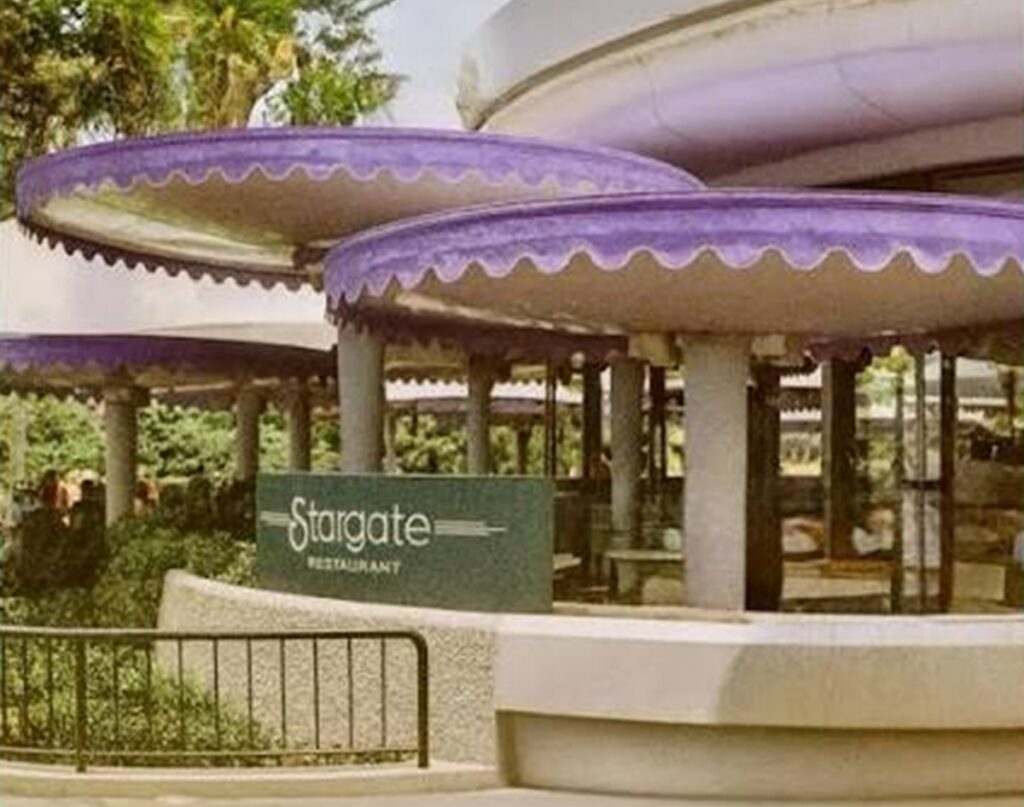
Stargate Restaurant was an original EPCOT Center counter-service restaurant located in CommuniCore East, near the center of Future World. Opened on October 1, 1982, the same day as EPCOT Center itself, Stargate served breakfast, lunch, and dinner in a large dining area distinguished by its futuristic décor, colorful interior, and convenient location along the main pedestrian route between Spaceship Earth and World Showcase. The restaurant operated until April 10, 1994, when it closed as part of the transformation of CommuniCore into Innoventions. Its successor, Electric Umbrella, opened in the same location on June 24, 1994.
Although Stargate is sometimes overshadowed by EPCOT Center’s larger pavilion restaurants, it was one of the park’s most important original dining facilities. Its central location, substantial seating capacity, and relatively familiar American menu made it a practical choice for guests who wanted a meal without committing to the more elaborate dining experiences available in World Showcase.
The restaurant also provides an interesting example of how Disney originally approached food service at EPCOT Center. Rather than placing every restaurant inside a major attraction pavilion, Disney incorporated dining, shopping, and guest services directly into the interconnected CommuniCore buildings that formed the heart of Future World.
CommuniCore East and CommuniCore West were among the most important architectural components of the original park. Positioned on opposite sides of the central plaza and Fountain of Nations, the two complexes connected the entrance area surrounding Spaceship Earth with the larger Future World pavilions and the walkway leading to World Showcase.
Their name was derived from the concept of a community core, emphasizing their role as a central gathering place and a hub for learning, shopping, dining, and information.
The buildings housed interactive exhibits that complemented the subjects explored in EPCOT Center’s major attractions. Rather than presenting lengthy ride experiences, CommuniCore offered smaller demonstrations and hands-on exhibits that allowed visitors to investigate computers, communications, energy technology, and other subjects associated with the future.
CommuniCore East was home to several notable facilities.
EPCOT Computer Central introduced guests to computer technology through interactive demonstrations. Energy Exchange explored electricity, alternative energy, and related technologies. TravelPort, sponsored by American Express, allowed visitors to explore vacation destinations and obtain travel information.
The building also contained Centorium, EPCOT Center’s original flagship merchandise store. Centorium occupied two levels and offered everything from Disney souvenirs and EPCOT-branded merchandise to electronics, books, educational products, and specialty collectibles.
Stargate was CommuniCore East’s principal restaurant.
Its location placed it near the park’s central circulation routes, making it convenient for guests exploring both sides of Future World. Visitors traveling from Spaceship Earth toward World Showcase could stop for a meal without making a substantial detour into another pavilion.
The restaurant’s name reflected the futuristic terminology used throughout early EPCOT Center. Stargate suggested a gateway to the stars or a passage into the future, fitting the broader themes of scientific discovery and technological advancement.
The name should not be confused with the later Stargate science-fiction franchise, which began with the 1994 theatrical film. EPCOT Center’s restaurant had already been operating for nearly twelve years when that movie was released.
Stargate’s interior was designed around a distinctive combination of blue, mauve, and magenta.
These colors were documented in the 1984 edition of Birnbaum’s Official Guide to Walt Disney World, which described the restaurant as a large fast-food establishment with an attractive interior and outdoor terrace seating.
The color scheme was typical of early Future World, where pastel tones, metallic architectural elements, geometric shapes, and illuminated surfaces helped establish a modern atmosphere.
Unlike restaurants that recreated historical settings or fictional environments, Stargate’s design was intended to complement the contemporary architecture of CommuniCore.
The dining area was relatively open and spacious, accommodating the large number of guests moving through Future World’s central complex.
Outdoor tables provided an alternative to the indoor seating when Florida’s weather permitted. The terrace allowed guests to remain connected to the activity of the surrounding plaza while enjoying their meals.
This arrangement was especially useful during the cooler months, when outdoor dining offered a pleasant alternative to the air-conditioned interior.
One of Stargate’s most distinctive features was its breakfast service.
When EPCOT Center opened in 1982, relatively few restaurants inside the park offered breakfast. Many dining facilities concentrated on lunch and dinner, particularly those located in World Showcase, where restaurants often operated around the national cuisines represented by their respective pavilions.
Stargate was one of the exceptions.
Its central location and morning operating hours made it a convenient option for guests entering EPCOT Center early in the day.
The breakfast menu included cold cereals, Danish pastries, fruit cups, blueberry muffins, and cheese omelets served with home-fried potatoes.
These selections were familiar American breakfast foods, reflecting the restaurant’s emphasis on accessibility rather than adventurous cuisine.
The most distinctive breakfast specialty was the Stellar Scramble.
Despite its futuristic name, the dish was essentially a breakfast pizza made with scrambled eggs, cheese, tomatoes, ham, onions, and green peppers.
The combination offered a substantial breakfast suitable for guests preparing to spend the day walking through EPCOT Center’s enormous pavilions.
The Stellar Scramble also demonstrated how the restaurant incorporated a small amount of thematic creativity into an otherwise conventional menu.
Rather than developing an elaborate science-fiction dining concept, Stargate used futuristic names to give familiar foods a connection to the surrounding Future World environment.
The dish was still being described as a restaurant specialty in the 1984 official guide, making it one of the best-documented menu items from Stargate’s early years.
Lunch and dinner offerings were similarly straightforward.
Guests could order hamburgers, cheese pizza, pepperoni pizza, chef’s salads, and other familiar quick-service meals.
Historical accounts also identify steak sandwiches among the restaurant’s offerings.
Desserts included cookies, with peanut butter cookies receiving particular attention in contemporary descriptions.
The menu was deliberately different from the more specialized international cuisine available around World Showcase.
Families traveling with children or guests who preferred familiar American food could eat at Stargate without having to search for suitable dishes among the park’s international restaurants.
That role was particularly important during EPCOT Center’s early years.
When the park opened, its dining program was unusually ambitious for a theme park. World Showcase featured restaurants representing cuisines from Mexico, China, Germany, Italy, Japan, France, the United Kingdom, and other countries.
Future World’s major pavilions also contained distinctive restaurants, including the rotating Good Turn Restaurant in The Land and the Coral Reef Restaurant in The Living Seas after that pavilion opened in 1986.
Stargate served a different purpose.
It was a high-capacity, centrally located restaurant offering conventional meals at counter-service prices.
Guests did not need reservations, and its menu required relatively little explanation.
The restaurant was therefore particularly well suited to families who wanted to eat quickly before continuing to the next attraction.
Another interesting aspect of Stargate’s history concerns its association with Disney character breakfasts.
Some historical accounts identify character breakfast experiences at Stargate, and surviving guest recollections describe meeting Disney characters while dining there.
However, contemporary official vacation-planning guides from the early 1990s do not consistently list Stargate among Walt Disney World’s established character breakfast locations.
The distinction is important.
The surviving recollections suggest that characters may have appeared at the restaurant during certain periods or special events, but the available documentation does not establish that Stargate operated a regularly scheduled character breakfast throughout its history.
It would therefore be misleading to describe character dining as a permanent feature without additional contemporary evidence.
Nevertheless, these accounts provide a reminder that EPCOT Center’s early character entertainment history was more varied than the park’s original educational identity might suggest.
Although Disney initially placed relatively little emphasis on animated characters within EPCOT’s attractions, character appearances and special entertainment gradually became more common.
Stargate’s central location would have made it a convenient setting for occasional character interactions.
During the latter half of the 1980s, another refreshment operation became associated with the Stargate area.
Beverage Base opened near Stargate in 1987, providing guests with drinks and small snacks such as popcorn, fresh fruit, and dessert cups.
The smaller facility complemented the larger restaurant by accommodating visitors who wanted refreshments without purchasing a complete meal.
Historical descriptions sometimes treat Beverage Base as part of the broader Stargate dining operation, while others identify it as a neighboring location.
The exact operational distinction between the two facilities is not entirely clear, but Beverage Base was separately named and had a more limited menu.
Its presence illustrates how Disney continued adjusting the food-service infrastructure of CommuniCore East after EPCOT Center opened.
The park’s first several years were a period of substantial development, with Disney adding new attractions, restaurants, exhibits, and operational facilities as attendance patterns and guest preferences became better understood.
Stargate remained one of the central dining locations throughout this period.
By the late 1980s, Future World had expanded considerably.
Horizons opened in October 1983, The Living Seas followed in January 1986, and Wonders of Life debuted in October 1989.
These additions broadened the park’s attraction lineup and increased the variety of experiences available in Future World.
As visitors moved among the expanding pavilion collection, Stargate continued serving as a convenient central dining stop.
Its location also placed it near Centorium, giving guests an opportunity to combine a meal with shopping in EPCOT Center’s largest original merchandise store.
The relationship between Stargate and Centorium reflected the original CommuniCore planning philosophy.
The central buildings were intended to function as a shared environment where visitors could move easily between exhibits, shopping, restaurants, and guest services.
This arrangement made the CommuniCore complexes fundamentally different from the self-contained pavilions that surrounded them.
Rather than presenting a single subject through one large attraction, the buildings served as a flexible central resource for the entire park.
By the early 1990s, however, EPCOT Center was entering a period of major change.
The original CommuniCore exhibits were becoming increasingly difficult to keep technologically current.
When the park opened in 1982, personal computers and interactive electronic displays were still relatively unfamiliar to many visitors. CommuniCore’s demonstrations of computing, communications, and information technology had helped introduce guests to developments that seemed genuinely futuristic.
During the following decade, however, computer technology advanced rapidly.
By the early 1990s, home computers, video game systems, and other consumer electronics had become much more common.
Some of CommuniCore’s original exhibits were losing their novelty, creating a challenge for a park dedicated to presenting the future.
Disney responded by developing Innoventions, a redesigned exhibition concept focusing on contemporary technology, consumer products, and interactive demonstrations.
The transformation required substantial changes to both CommuniCore buildings.
Existing exhibits closed, interior spaces were reconfigured, and the central complex received a new identity.
Stargate was among the facilities affected by this redevelopment.
The restaurant’s final operating day was April 10, 1994.
The following day, Stargate ceased normal operations as the site prepared for conversion into Electric Umbrella.
This was the end of Stargate as a separately named dining location after more than eleven years of service.
The restaurant’s closure coincided with a broader reorganization of EPCOT’s central dining facilities.
Across the plaza in CommuniCore West, Sunrise Terrace was being divided into Pasta Piazza Ristorante and Fountain View Espresso & Bakery.
On the eastern side, Stargate’s former space was redesigned for a new quick-service restaurant that would better complement the colorful, contemporary style of Innoventions.
Electric Umbrella opened on June 24, 1994, several days before Innoventions officially debuted on July 1.
The change represented a major shift in visual identity.
Where Stargate had employed the softer blue, mauve, and magenta tones associated with early Future World, Electric Umbrella adopted a more playful approach featuring vivid colors, illuminated decorative elements, and a distinctly 1990s interpretation of futuristic design.
Disney Legend Rolly Crump played an important role in developing the redesigned restaurant.
Crump had contributed to numerous Disney projects, including Disneyland’s Haunted Mansion and the original design of EPCOT Center’s World Showcase.
His involvement in Electric Umbrella added an interesting connection between the restaurant and Disney’s earlier generation of Imagineers.
The new restaurant’s name originated during a design discussion involving illuminated umbrellas.
Crump recalled that someone had proposed selling umbrellas equipped with electric lights. Although he was not enthusiastic about the actual product design, he liked the phrase Electric Umbrella and believed it would make an effective restaurant name.
Michael Eisner reportedly liked the name so much that he considered applying it to the larger Innoventions building.
Ultimately, the name was used for the restaurant, while the exhibition complex retained the Innoventions identity.
The anecdote provides an unusual example of how a seemingly minor idea could influence the naming of a major Walt Disney World dining facility.
Although Electric Umbrella introduced a new appearance and identity, it retained much of Stargate’s general location and dining function.
The original restaurant’s basic configuration remained recognizable after the remodeling.
Electric Umbrella continued offering American quick-service meals, including hamburgers and other familiar theme park foods.
A mezzanine was added several years after the opening to increase the restaurant’s seating capacity.
The expanded dining space made Electric Umbrella one of EPCOT’s principal counter-service restaurants, with both upper- and lower-level seating.
Its colorful décor and illuminated umbrella-inspired design became recognizable features of Future World during the 1990s and 2000s.
Electric Umbrella also developed its own memorable details.
Among them was an interactive talking trash can that responded when guests deposited their garbage.
The playful feature provided a small element of entertainment in an otherwise conventional dining environment.
Although the trash can had no direct connection to Stargate’s original theme, it continued the broader Disney tradition of incorporating unexpected entertainment into everyday guest facilities.
Electric Umbrella operated for more than twenty-five years, considerably longer than Stargate.
During that time, the surrounding Future World landscape continued evolving.
Centorium eventually gave way to MouseGear, while CommuniCore’s original exhibits were replaced by successive generations of Innoventions displays.
Electric Umbrella remained a relatively stable presence throughout these changes.
Its location near the central plaza made it convenient for guests visiting Spaceship Earth, Test Track, Mission: SPACE, and other nearby attractions.
In 2017, Electric Umbrella became one of the Walt Disney World quick-service restaurants offering mobile ordering through the My Disney Experience app.
This operational change reflected Disney’s growing use of digital technology to streamline food-service transactions.
However, the restaurant’s long history came to an end as Disney prepared for another major transformation of EPCOT.
During the late 2010s, Disney announced plans to substantially redevelop Future World.
The project involved replacing the original Future World designation with three new neighborhoods: World Celebration, World Discovery, and World Nature.
The central areas surrounding Spaceship Earth and the former Innoventions complexes were among the most extensively affected sections of the park.
Electric Umbrella’s final operating day was February 15, 2020, with the location closed beginning February 16.
The closure ended a nearly thirty-eight-year sequence of counter-service dining operations that had begun with Stargate on October 1, 1982.
Unlike the 1994 transition, however, the latest redevelopment involved much more extensive architectural changes.
The former Electric Umbrella location and adjacent Innoventions East space were reconfigured into a new dining complex called Connections Café and Eatery.
Connections officially opened on April 27, 2022.
The new facility incorporated two distinct dining experiences within a shared building.
Connections Eatery became the principal quick-service restaurant, serving burgers, pizza, salads, and dishes influenced by international cuisines.
Connections Café provided Starbucks coffee, specialty beverages, and baked goods.
The combination of a restaurant and café represented a different approach from Stargate’s original single-operation format.
Rather than offering breakfast, lunch, and dinner through one counter-service restaurant, the Connections complex separated coffee and pastry service from the larger food-service operation.
Its architectural style also marked a dramatic departure from both Stargate and Electric Umbrella.
Connections adopted a more contemporary appearance, incorporating open sightlines, bright interiors, large windows, and decorative elements emphasizing the relationship between food, people, and global culture.
A large mural celebrates culinary traditions and the ways that meals bring people together.
The restaurant’s design also includes references to Walt Disney’s original ideas for EPCOT as a place concerned with international cooperation, communication, and shared experiences.
That emphasis provides an interesting historical connection to the original CommuniCore concept.
Although Connections is architecturally very different from Stargate, both facilities occupy central positions within EPCOT’s principal gathering areas.
Both also serve a practical purpose by providing convenient dining near major attractions, shops, and pedestrian routes.
As of October 2026, Connections Café and Connections Eatery remain operating in EPCOT’s World Celebration neighborhood.
Connections Eatery continues to offer quick-service meals, while Connections Café serves coffee and pastries.
The modern dining complex occupies the redeveloped area associated with the former Electric Umbrella and Stargate Restaurant, although its footprint was expanded and reconfigured to incorporate additional former Innoventions East space.
Consequently, the current building should not be considered an exact architectural preservation of Stargate.
The original restaurant’s distinctive décor and interior arrangement have disappeared, and the present facility reflects a substantially redesigned environment.
Nevertheless, the historical lineage of the location remains clear.
Stargate Restaurant opened with EPCOT Center on October 1, 1982, and operated until April 10, 1994.
Electric Umbrella replaced it on June 24, 1994, and remained in operation until February 15, 2020.
Connections Café and Eatery opened in the redeveloped location on April 27, 2022.
This sequence makes Stargate part of one of EPCOT’s longest-running central dining locations, even though the names, menus, décor, and physical configuration have changed substantially.
Stargate also remains significant because of its relationship with the original CommuniCore concept.
The restaurant was not designed as a destination dining experience comparable to the elaborate restaurants of World Showcase.
Instead, it was integrated into EPCOT Center’s central infrastructure, supporting the movement of guests between major attractions while providing familiar food, breakfast service, and convenient seating.
Its menu reflected the practical needs of a theme park that encouraged visitors to spend considerable time exploring large, information-rich pavilions.
The Stellar Scramble, one of Stargate’s most distinctive original menu items, also illustrates Disney’s approach to thematic food naming during EPCOT Center’s early years.
Although the dish was essentially a breakfast pizza, its futuristic name connected it to the surrounding environment without requiring an elaborate themed presentation.
That approach was consistent with EPCOT’s original identity, where technology-oriented terminology and contemporary design helped distinguish even ordinary facilities from those found elsewhere at Walt Disney World.
Stargate’s history also captures a transitional period in Disney dining.
When EPCOT Center opened, providing breakfast inside the park was not as common as it would become in later decades.
Stargate’s morning menu, convenient location, and substantial capacity made it especially useful to early visitors.
Over time, however, Disney’s restaurant operations became increasingly specialized.
The 1994 transformation introduced Electric Umbrella’s new visual identity, while the 2022 redevelopment created separate café and restaurant operations under the Connections name.
The changes illustrate how EPCOT’s dining infrastructure has evolved alongside the park itself.
Despite its relatively conventional menu, Stargate was an important part of the original Future World experience.
Its interior colors, outdoor terrace, breakfast offerings, and location beside CommuniCore’s educational exhibits made it a recognizable feature of EPCOT Center during the 1980s and early 1990s.
For visitors who remember the original park, Stargate represents an era when the central Future World buildings were designed to function as a combined educational, commercial, and social environment.
Guests could explore computer technology, shop for EPCOT merchandise, purchase a meal, and continue toward World Showcase without leaving the interconnected CommuniCore complex.
Although the Stargate name disappeared in 1994, its former location continued serving EPCOT visitors under successive restaurant identities.
Today, Connections Café and Eatery carries forward that practical dining function within a very different architectural setting.
Stargate’s place in EPCOT history is therefore not defined solely by its menu or its eleven-year operating life. It is part of the larger story of how the park’s original central facilities evolved from CommuniCore to Innoventions and eventually to World Celebration.