Few pieces of Walt Disney World are as instantly recognizable as the monorail.
Its sleek white trains have been gliding above Seven Seas Lagoon since the resort opened in 1971, carrying generations of guests between Magic Kingdom, EPCOT and some of Disney World’s most famous hotels.
For many visitors, the monorail is more than transportation. Hearing the doors close, watching Cinderella Castle appear in the distance or passing directly through the middle of Disney’s Contemporary Resort can feel like the unofficial beginning of a Walt Disney World vacation.
That was always part of the idea.
Walt Disney did not view the monorail merely as an amusement-park novelty. He believed systems like the monorail and PeopleMover could help solve real transportation problems by separating mass transit from automobiles and pedestrians.
The Walt Disney World Monorail System ultimately became one of the clearest surviving examples of that philosophy.
More than 50 years after opening, the system still operates over roughly 15 miles of elevated guideway using a fleet of 12 Mark VI trains. Its three services connect six stations and remain a working part of Disney World’s transportation network rather than simply an attraction preserved for nostalgia.
Here is the history of Walt Disney World’s famous “highway in the sky,” from Walt’s discovery of ALWEG technology to the Mark VI trains still carrying guests in 2026.
Last updated: September 1, 2026.
Disney World Monorail History at a Glance
| Year | Milestone |
|---|---|
| 1958 | Walt Disney encounters ALWEG monorail technology near Cologne, Germany. |
| 1959 | Disneyland-Alweg Monorail System opens June 14. |
| 1966 | Walt presents his EPCOT city concept, with advanced mass transportation central to the plan. |
| 1971 | Walt Disney World Monorail System opens October 1 with Mark IV trains. |
| 1982 | The monorail extension to EPCOT Center begins operating before the new park opens. |
| 1988 | Disney’s Grand Floridian Resort opens and joins the Resort Monorail loop. |
| 1989–1991 | Bombardier-built Mark VI trains replace the original Mark IV fleet. |
| 2009 | A fatal collision between Monorails Pink and Purple leads to major operating changes. |
| 2014 | Disney begins installing automated train-control technology. |
| 2026 | The 12-train Mark VI fleet continues operating on three services across roughly 15 miles of guideway. |
Walt Disney Was Interested in Monorails Before Disneyland
The idea that Walt Disney simply stumbled across a monorail in Europe and immediately decided to put one in Disneyland oversimplifies the history.
Walt had already been thinking about futuristic transportation.
Disney Legend Bob Gurr later recalled that Walt included a monorail among ideas for a future amusement park as early as 1952, years before Disneyland opened.
What happened in Europe gave Walt a practical system to study.
1958: Walt Disney Encounters ALWEG
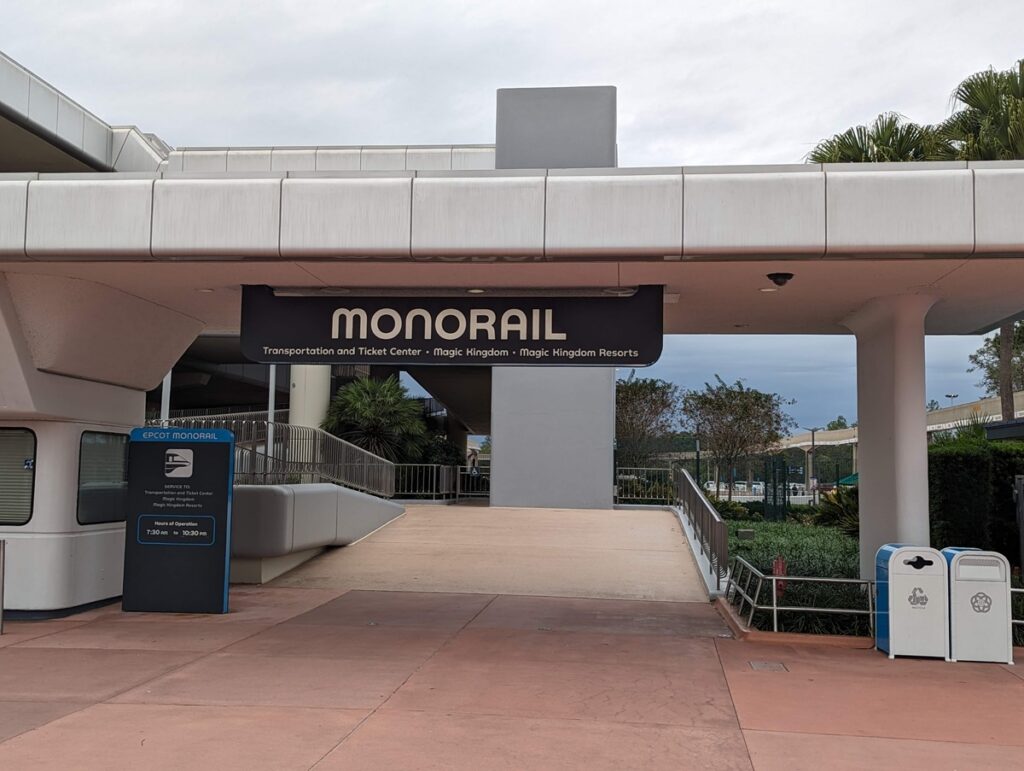
During a European trip in the summer of 1958, Walt and Lillian Disney were traveling near Cologne, West Germany, when they encountered an experimental monorail developed by the ALWEG Company.
ALWEG’s system used trains that straddled a single elevated concrete beam rather than running on conventional rails.
The design immediately caught Walt’s attention.
He obtained technical information about the system and sent representatives to discuss how the technology could be adapted for Disneyland.
Disney’s Imagineers did not simply purchase a finished train and install it.
Working with ALWEG technology as a starting point, Disney designers including Bob Gurr developed a streamlined vehicle specifically suited to Disneyland.
The schedule was extraordinarily aggressive.
Work began in earnest in late 1958.
The monorail opened the following June.
1959: The Disneyland-Alweg Monorail Opens
On June 14, 1959, Disneyland opened three major attractions that dramatically transformed Tomorrowland:
- The Matterhorn Bobsleds
- Submarine Voyage
- The Disneyland-Alweg Monorail System
Vice President Richard Nixon and his family joined Walt Disney for the dedication.
The Disneyland Monorail became the first daily operating monorail in the United States.
Initially, however, it was essentially an attraction.
The original Mark I trains traveled around a loop in Tomorrowland and returned guests to the same station.
That changed in 1961.
From Attraction to Transportation
Disney extended the monorail beyond Disneyland to the Disneyland Hotel and introduced Mark II trains.
The line now crossed a public roadway and allowed guests to use the system to actually travel between destinations.
Walt had turned what looked like a futuristic theme park ride into a real transportation system.
That distinction would become even more important in Florida.
Walt Disney’s EPCOT Was Built Around Transportation
By the middle of the 1960s, Walt’s ambitions had moved far beyond theme parks.
His Florida Project would eventually include a real experimental city: the Experimental Prototype Community of Tomorrow.
Transportation was one of the fundamental problems Walt wanted EPCOT to address.
He disliked the congestion, pollution and inefficiency he saw in American cities and wanted vehicles to move through his community without creating the usual conflicts between cars and pedestrians.
His solution used different transportation systems for different kinds of trips.
Automobile traffic and service vehicles would largely be separated from pedestrian areas.
PeopleMovers would provide continuous transportation for shorter trips within the city.
Monorails would handle longer-distance movement between major destinations.
Walt died in December 1966 before the city could be built.
But Disney did not abandon everything contained within that transportation philosophy.
When Walt Disney World opened five years later, the monorail was there on opening day.
1971: The Walt Disney World Monorail System Opens
Walt Disney World officially opened on October 1, 1971.
The new Florida monorail was dramatically larger than Disneyland’s system.
This was not simply a ride around Tomorrowland.
From the beginning, the Florida version was fundamental transportation infrastructure.
Its original stations served:
- Magic Kingdom
- Transportation and Ticket Center
- Disney’s Polynesian Village Resort
- Disney’s Contemporary Resort
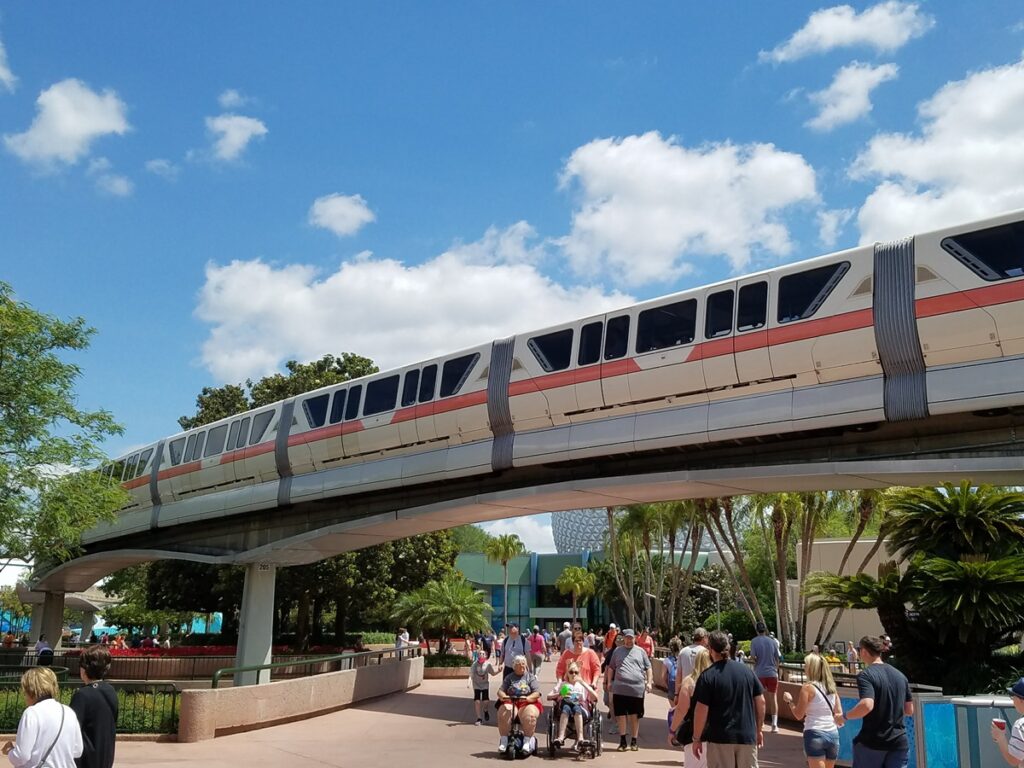
The system had two separate beams around Seven Seas Lagoon.
One provided direct express service between the Transportation and Ticket Center and Magic Kingdom.
The other served the Resort hotels as well.
That basic arrangement still exists today.
Why Magic Kingdom’s Parking Lot Is Across a Lagoon
The monorail makes much more sense when viewed as part of Magic Kingdom’s overall design.
Unlike Disneyland, guests arriving by automobile do not park immediately outside the park entrance.
Magic Kingdom’s enormous parking complex sits across Seven Seas Lagoon at the Transportation and Ticket Center.
From there, guests complete the final portion of their trip by monorail or ferryboat.
It creates a deliberate transition.
Your car is left behind.
The real world begins to recede.
Cinderella Castle gradually comes into view.
By the time you reach the entrance to Magic Kingdom, the transportation trip itself has helped establish the experience.
This is one of the reasons the monorail has always felt like more than a bus or parking-lot shuttle.
The Original Mark IV Monorails
Walt Disney World’s first trains were known as the Mark IV.
They were substantially larger than their Disneyland predecessors and were specifically developed for the much greater transportation demands of the Florida resort.
The trains retained the basic ALWEG straddle-beam concept while presenting the sleek, futuristic appearance that had already become associated with Disney monorails.
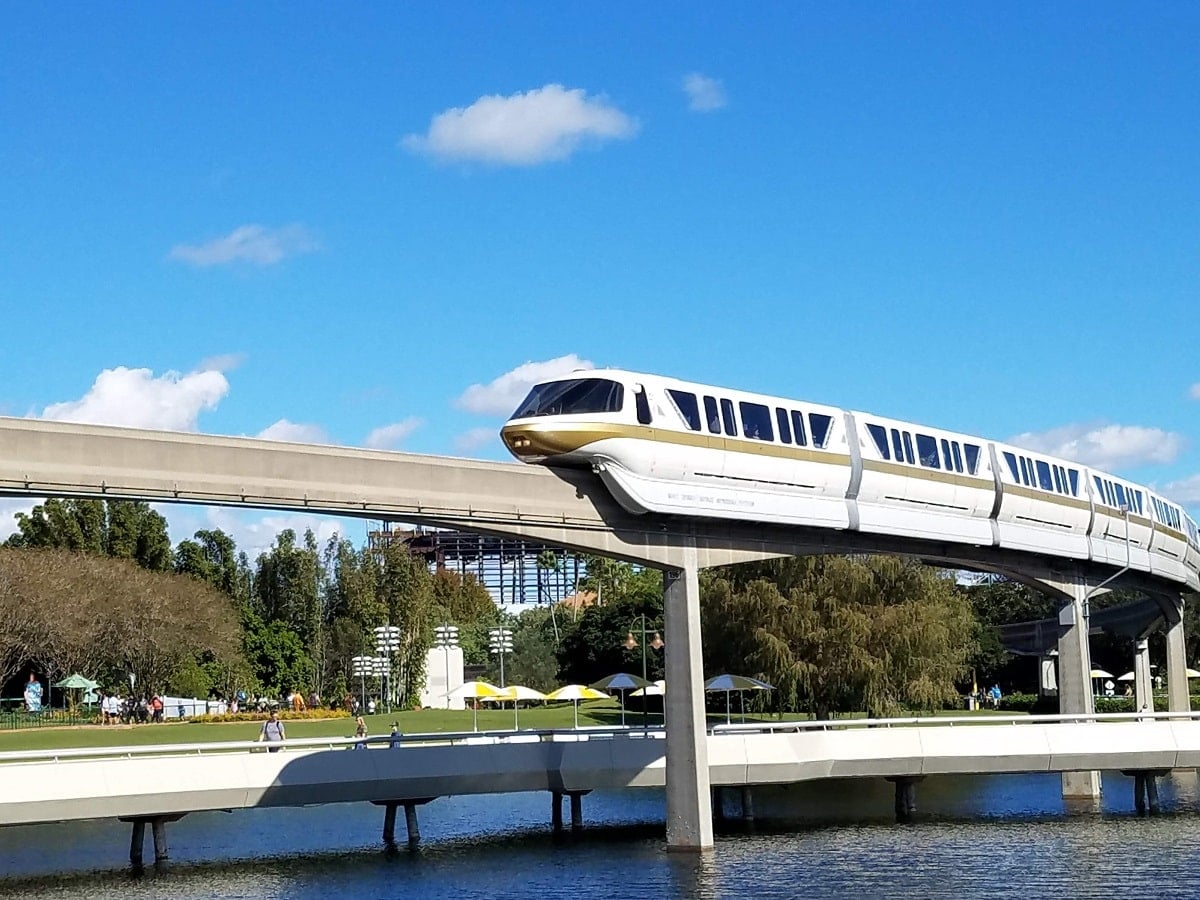
Instead of train numbers being the primary identity visible to guests, each Disney monorail was distinguished by a colored stripe running along its white body.
That tradition continues today.
The Mark IV trains became one of the visual signatures of early Walt Disney World.
They appeared in promotional photographs, postcards, television specials and advertising, frequently shown gliding past the Polynesian or entering the Contemporary.
 The Monorail Through Disney’s Contemporary Resort
Nothing better demonstrated Disney’s futuristic aspirations in 1971 than Disney’s Contemporary Resort.
The enormous A-frame hotel opened alongside Magic Kingdom on October 1.
Its guest-room modules were manufactured separately, transported to the construction site and lifted into the hotel’s steel structure.
Inside the building was a soaring atrium now known as the Grand Canyon Concourse.
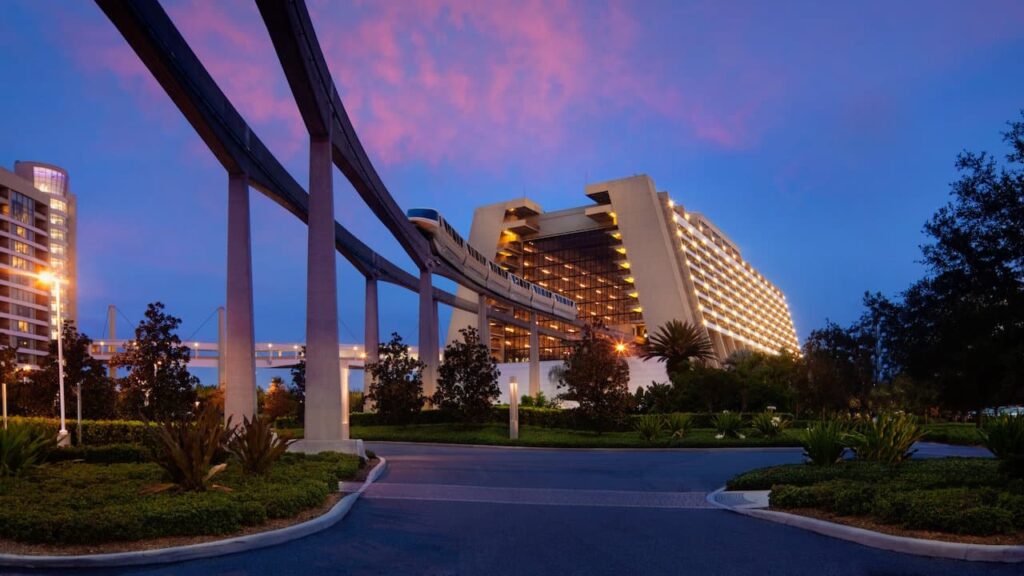
And running directly through that atrium was the monorail.
The effect remains remarkable more than half a century later.
Guests can eat, shop or walk through the hotel while full-size trains glide directly through the building.
The monorail beam was carefully engineered to minimize the transfer of vibration into the hotel structure, allowing transportation infrastructure and architecture to occupy essentially the same space.
This was much more than a visual gimmick.
It reflected the same basic philosophy Walt had imagined for EPCOT: transportation should be integrated directly into the places where people live, work and visit.
Julie Andrews Arrives by Monorail
The importance Disney placed on the monorail was obvious in the resort’s earliest publicity.
When NBC aired The Grand Opening of Walt Disney World in October 1971, host Julie Andrews arrived aboard a monorail.
Bob Hope also used the system during the special.
For millions of television viewers who had never visited Florida, one of their first images of the new Walt Disney World Resort was therefore not an attraction inside Magic Kingdom.
It was the train carrying guests there.
1982: The Monorail Reaches EPCOT
The most significant expansion in Walt Disney World Monorail history arrived with the development of EPCOT Center.
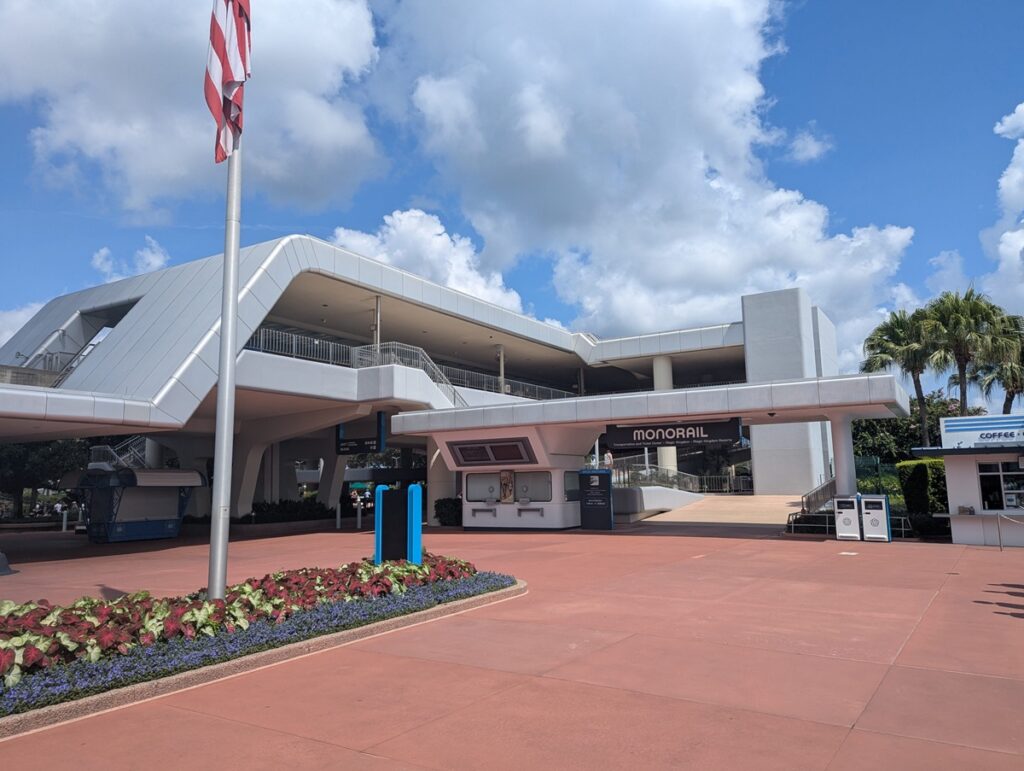
A completely separate line was constructed south from the Transportation and Ticket Center to the new theme park.
Disney’s archival history dates the extension to June 1, 1982—four months before EPCOT Center officially opened on October 1.
During the pre-opening period, some Walt Disney World guests and Florida residents were even able to ride the monorail toward the still-under-construction park as part of EPCOT preview experiences.
The completed route does something particularly unusual.
Rather than simply stopping outside EPCOT, the monorail enters the park itself.
The beam loops through what was originally Future World, providing elevated views of Spaceship Earth and surrounding pavilions before reaching the station outside the main entrance.
For first-time visitors, the journey effectively becomes an aerial preview of EPCOT before they enter.
The line also created the closest connection Walt Disney World ever achieved between Walt’s original EPCOT transportation concept and the theme park that inherited the name.

1988: The Grand Floridian Joins the Monorail Loop
The next new monorail station arrived with Disney’s Grand Floridian Resort & Spa.
The hotel—originally called Disney’s Grand Floridian Beach Resort—opened on June 28, 1988.
Its station was added to the Resort Monorail line between the Polynesian and Magic Kingdom.
That gave Walt Disney World the five-stop Resort loop guests know today:
- Magic Kingdom
- Disney’s Contemporary Resort
- Transportation and Ticket Center
- Disney’s Polynesian Village Resort
- Disney’s Grand Floridian Resort & Spa
The route then returns to Magic Kingdom and repeats the loop.
1989–1991: The Mark VI Era Begins
By the late 1980s, the Mark IV trains had carried Walt Disney World guests for nearly two decades.
Disney began replacing them with a new generation built by Bombardier Transportation of Canada.
The first Mark VI trains entered service in 1989.
The changeover took place gradually, meaning guests could see Mark IV and Mark VI trains operating during the transition period.
By 1991, the Mark VI fleet had completely replaced the original trains.
The newer design offered:
- Greater passenger capacity
- More standing room
- Improved air conditioning
- Updated doors
- Improved communications
- Modernized monitoring and safety systems
And remarkably, the Mark VI remains Walt Disney World’s monorail model in 2026.
 How Big Is a Disney World Monorail?
The Walt Disney World Mark VI is substantially larger than many guests realize.
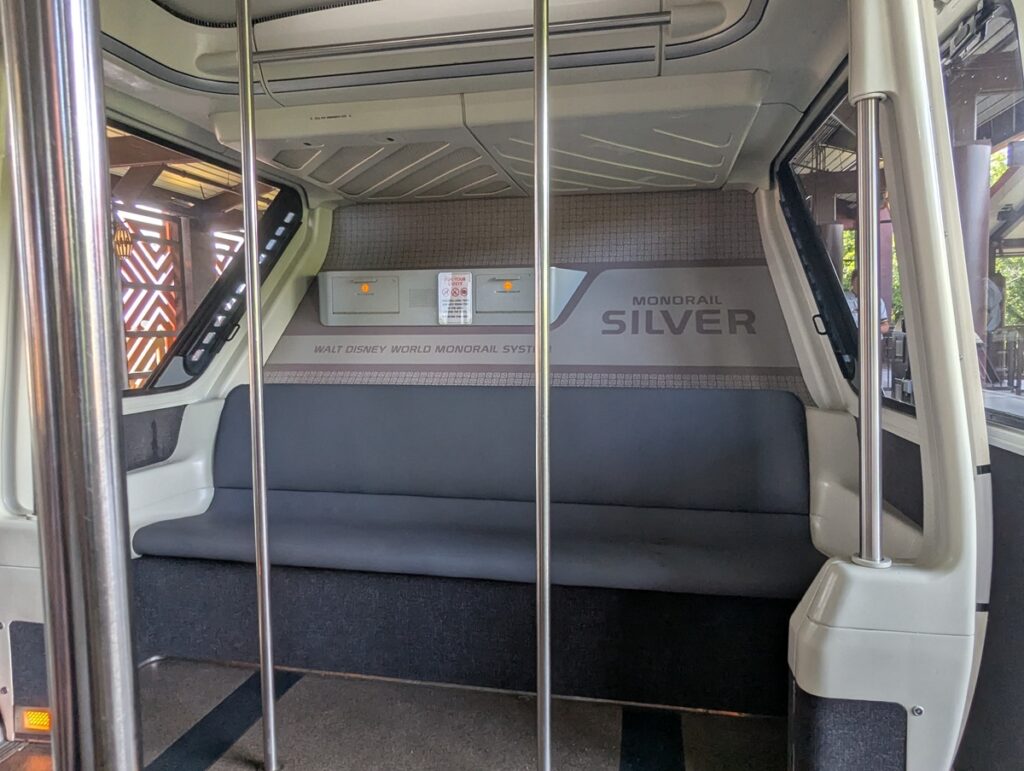
Each train contains six cars and measures roughly 203 feet long.
A full train can accommodate approximately 360 passengers between seated and standing guests.
The trains travel on a concrete straddle beam and use rubber load and guide tires rather than conventional steel railroad wheels.
Electrical power is supplied through contact rails mounted along the beam.
The Mark VI design is capable of speeds higher than Disney uses in normal service, but Walt Disney World operating speeds are limited to approximately 40 miles per hour.
As of 2026, the resort’s transportation planning documents list 12 monorail units operating across approximately 15 miles of guideway.
The Monorails Are Identified by Color
One of the system’s most charming traditions is that guests rarely refer to the trains by numbers.
Each is identified by the colored stripe running along its side.
The current fleet includes trains associated with colors such as:
- Red
- Blue
- Green
- Orange
- Yellow
- Gold
- Silver
- Black
- Coral
- Lime
- Teal
- Peach
This color identity has become such a part of Disney culture that fans routinely have a favorite monorail.
The Three Disney World Monorail Lines Today
Disney currently operates three separate monorail services.
1. Express Monorail
The Express Monorail operates between:
- Transportation and Ticket Center
- Magic Kingdom
It does not stop at the Resort hotels.
For guests arriving by automobile at Magic Kingdom, this is one of the two primary ways to cross from the parking area to the park, along with the ferryboats.
2. Resort Monorail
The Resort Monorail travels around Seven Seas Lagoon and serves:
- Magic Kingdom
- Disney’s Contemporary Resort
- Transportation and Ticket Center
- Disney’s Polynesian Village Resort
- Disney’s Grand Floridian Resort & Spa
Guests traveling from one of those hotels to EPCOT can ride to the Transportation and Ticket Center and transfer to the EPCOT line.
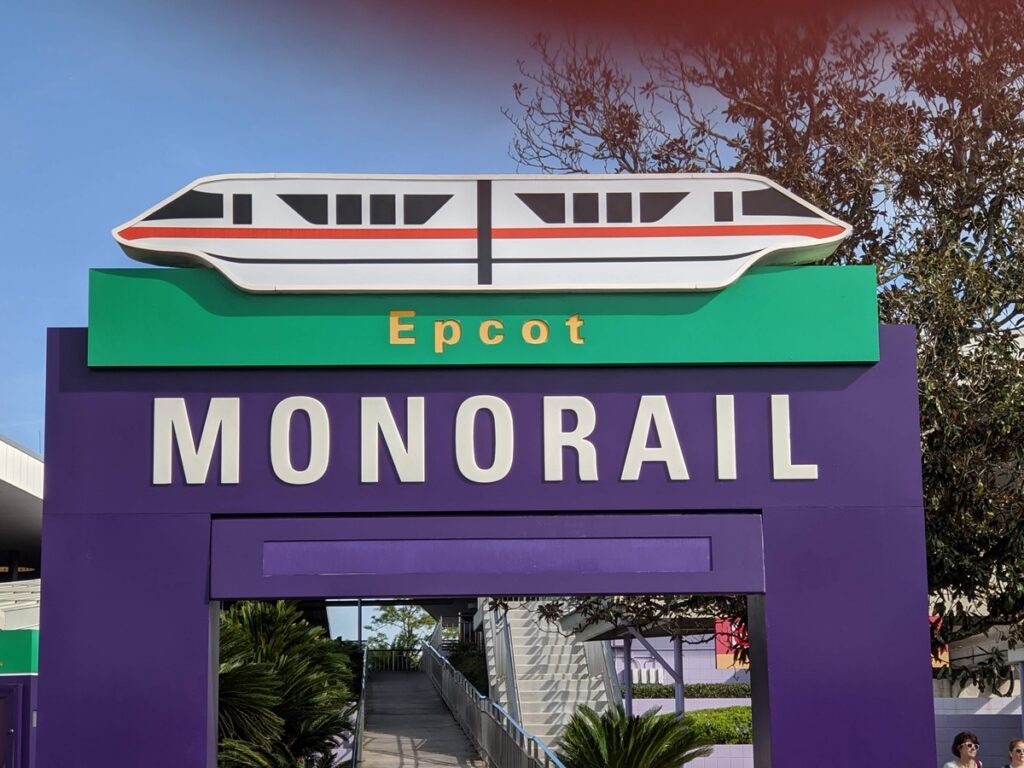
3. EPCOT Monorail
The EPCOT Monorail travels between:
- Transportation and Ticket Center
- EPCOT
There is no direct one-seat monorail ride between Magic Kingdom and EPCOT.
Guests must transfer at the Transportation and Ticket Center.
Can Anyone Ride the Disney World Monorail?
Yes.
You do not have to stay at a Disney Resort hotel to use the monorail.
Disney’s transportation network—including monorails, buses, boats and Disney Skyliner—is complimentary for Walt Disney World guests.
This means you can use the Resort Monorail to visit the Contemporary, Polynesian and Grand Floridian even if you are staying somewhere else.
Current Monorail Hours
As of September 2026, Disney’s published operating guidelines state:
- Resort and Express Monorails: Begin approximately 30 minutes before Magic Kingdom opens and continue until one hour after the park closes.
- EPCOT Monorail: Begins approximately 30 minutes before EPCOT opens and continues until two hours after EPCOT closes.
Operating hours can vary because of maintenance, weather, special events and other operational needs.
“Please Stand Clear of the Doors”
Few transportation announcements have achieved the cultural status of:
“Please stand clear of the doors. Por favor manténgase alejado de las puertas.”
The bilingual safety announcement has become almost inseparable from the Walt Disney World Monorail experience.
It appears on Disney merchandise, gets repeated by guests long after their vacations and has become one of the Resort’s most recognizable pieces of audio.
For many Disney fans, hearing it is almost as effective as seeing Cinderella Castle in signaling that they have arrived at Walt Disney World.
Guests Once Rode With the Monorail Pilot
For decades, one of Walt Disney World’s most unusual unofficial experiences was riding in the front cab.
A small number of guests could ask a Cast Member whether space was available and, when operations allowed it, sit up front with the monorail pilot.
The view was spectacular.
Instead of looking through the side windows, guests saw the concrete beam stretching directly ahead as the train traveled around Seven Seas Lagoon or toward EPCOT.
Children sometimes received honorary monorail pilot cards as souvenirs.
That tradition ended in 2009.
The 2009 Walt Disney World Monorail Accident
Any complete history of the system needs to acknowledge its darkest moment.
At approximately 2:00 AM on July 5, 2009, Monorail Pink and Monorail Purple collided near the Transportation and Ticket Center while trains were being repositioned after operations.
Monorail pilot Austin Wuennenberg, 21, was killed.
Six passengers aboard Monorail Purple were not injured.
The National Transportation Safety Board investigated the accident.
The NTSB concluded that Monorail Pink had been authorized to reverse through a switch that was not positioned correctly, causing it to strike Monorail Purple.
The investigation identified failures in switch verification, coordination and standard operating procedures.
Changes After the Accident
Disney made multiple operational changes following the collision.
Among the procedures documented by the NTSB were:
- Additional visual verification of switch-beam positions
- Dedicated observers when trains move in reverse
- Changes governing beam-switching operations
- Additional central-control requirements
- Stricter procedures involving manual system overrides
Disney also discontinued the practice of carrying guests in the front operating cab.
Monorails Pink and Purple were retired.
The accident remains the only fatal collision in Walt Disney World Monorail history.
Disney Begins Automating the Monorail
Another major technical modernization began in the 2010s.
In 2014, Disney altered monorail operating schedules while installing new automated train-control equipment.
The goal was not simply to remove a human driver.
The system was intended to improve:
- Train spacing
- Dispatching
- Switching efficiency
- Speed control
- Operational monitoring
- Safety
Automation testing continued for years.
Today’s Walt Disney World monorails still carry trained Cast Members in the operating cab, but many elements of normal train movement can be managed through the automated control system.
The pilot therefore remains part of operations rather than the Walt Disney World system becoming a completely unattended railway like some modern airport transit systems.
The Pandemic Temporarily Interrupts the Highway in the Sky
Walt Disney World’s March 2020 closure also brought monorail service to a halt.
When Magic Kingdom reopened in July 2020, monorail operations gradually returned as part of Disney’s modified transportation network.
The EPCOT line remained suspended considerably longer.
It finally returned in the summer of 2021, reconnecting EPCOT with the Transportation and Ticket Center.
The interruption was one of the rare periods since 1982 when the EPCOT beam existed without carrying ordinary park guests.
The Mark VI Fleet Is Now More Than 35 Years Old
Perhaps the most remarkable fact about the current Walt Disney World Monorail is simply its age.
Mark VI trains began entering service in 1989.
The fleet has been refurbished, modified, rewired, repainted and upgraded many times, so the trains operating today should not be thought of as mechanically untouched vehicles from the late 1980s.
But the basic Mark VI platform has now served Walt Disney World for more than 35 years.
That is substantially longer than the Mark IV generation it replaced.
Disney continues investing in the existing trains rather than publicly announcing a replacement fleet.
Recent visual enhancements have included colored undercarriage lighting originally introduced during Walt Disney World’s 50th Anniversary era and glowing Disney logos added to the trains in 2025.
As of September 2026, Disney has not announced a Mark VII, Mark VIII or other replacement fleet for Walt Disney World.
Will Disney World Ever Expand the Monorail?
This may be the most persistent Walt Disney World transportation rumor of all.
For decades, fans have speculated about monorail extensions to:
- Disney’s Hollywood Studios
- Disney’s Animal Kingdom
- Disney Springs
- Additional Resort hotels
The problem is that speculation frequently gets repeated online as though Disney actually announced such projects.
It did not.
Disney has explored transportation concepts and long-term development possibilities throughout Walt Disney World’s history, but there is currently no announced project extending the operating monorail to Hollywood Studios, Animal Kingdom or Disney Springs.
The last actual passenger station added to the existing system was the Grand Floridian station in 1988.
Since then, Disney has chosen other transportation technologies for resort expansion.
Why Disney Built Skyliner Instead of More Monorail
The arrival of Disney Skyliner in 2019 provides a useful look at how Disney now approaches mass transportation.
Skyliner connected EPCOT and Disney’s Hollywood Studios with several Resort hotels using an aerial gondola system.
It provides high-capacity continuous transportation while requiring much lighter infrastructure than a monorail system built on massive concrete guide beams.
Disney has also continued expanding bus networks, pedestrian routes, roadways, water transportation and other systems rather than relying on one universal technology.
In 2026, Disney even announced that it would expand Magic Kingdom’s ferry fleet for the first time since the 1970s.
That does not mean another monorail extension is technically impossible.
It means Disney now has several alternatives that can accomplish the same transportation goal without constructing miles of concrete monorail guideway.
How Large Is the Disney World Monorail System Today?
Current planning documents describe a system with approximately:
- 15 miles of guideway
- 12 Mark VI trains
- 3 monorail services
- 6 physical stations
- Capacity of approximately 360 passengers per train
The six stations are:
- Magic Kingdom
- Transportation and Ticket Center
- Disney’s Contemporary Resort
- Disney’s Polynesian Village Resort
- Disney’s Grand Floridian Resort & Spa
- EPCOT
Transportation research has estimated that the Walt Disney World system handles tens of millions of passenger trips in a typical year, making it one of the world’s most heavily used monorail systems.
Did Disney Ever Try to Sell Monorails to Cities?
Yes—and this part of the story demonstrates how seriously Disney once viewed its transportation technology.
During the 1970s, Disney created Community Transportation Services to market transportation systems such as monorails and PeopleMovers beyond Disney properties.
The idea was very much in keeping with Walt’s original belief that technologies demonstrated inside Disney parks could have practical applications in real cities.
The effort never turned Disney into a major municipal transit supplier.
The only system actually sold by the division was a WEDway PeopleMover installed at Houston Intercontinental Airport, which opened in 1981.
Disney later licensed transportation technology to Bombardier—the same company that built Walt Disney World’s Mark VI fleet.
Why the Monorail Still Matters
There is an irony in Walt Disney World’s monorail.
In 1959, it looked like the future.
In 1971, it looked like the future.
And in 2026, it is operating with a train design introduced during the first George H. W. Bush administration.
Yet it still feels remarkably futuristic.
Part of that is visual.
A streamlined train gliding silently above traffic is simply more dramatic than a bus.
But there is something deeper.
The system represents an era of Disney design when transportation itself was part of the show.
The monorail does not merely get guests to the Contemporary—it travels through the hotel.
It does not merely arrive at EPCOT—it circles through the park before stopping.
It does not simply connect a parking lot with Magic Kingdom—it carries guests across an artificial lagoon while Cinderella Castle approaches in the distance.
The journey has been deliberately designed.
Walt Disney World Monorail FAQ
When did the Walt Disney World Monorail open?
The Walt Disney World Monorail System opened on October 1, 1971, the same day as Magic Kingdom and the original Walt Disney World Resort hotels. The original system used Mark IV trains.
How many monorail lines are at Walt Disney World?
Walt Disney World currently operates three monorail services: the Resort Monorail around Seven Seas Lagoon, the Express Monorail between the Transportation and Ticket Center and Magic Kingdom, and the EPCOT Monorail between the Transportation and Ticket Center and EPCOT.
Which Disney World resorts are on the monorail?
The Resort Monorail directly serves Disney’s Contemporary Resort, Disney’s Polynesian Village Resort and Disney’s Grand Floridian Resort & Spa, in addition to Magic Kingdom and the Transportation and Ticket Center.
When did the EPCOT Monorail open?
Disney’s archival history dates the EPCOT monorail extension to June 1, 1982, several months before EPCOT Center officially opened on October 1, 1982.
What type of monorail trains does Disney World use?
Walt Disney World uses Bombardier-built Mark VI monorails. The Mark VI fleet began entering service in 1989 and fully replaced the original Mark IV trains by 1991.
Can guests still ride in the front of the Disney World Monorail?
No. Walt Disney World formerly allowed a small number of guests to ride in the front cab with the pilot, but the practice ended after the fatal monorail collision on July 5, 2009.
Is Disney World expanding or replacing the monorail system?
As of September 2026, Disney has not publicly announced a new Walt Disney World monorail route or a replacement for the Mark VI fleet. The current system continues to operate across three services and roughly 15 miles of guideway.
The Highway in the Sky
Walt Disney never lived to ride the monorail through his Florida resort.
But few elements of modern Walt Disney World connect so directly to the ideas that occupied him during the final decade of his life.
He believed transportation could be efficient without being ugly.
He believed technology could solve practical problems while also improving people’s surroundings.
And he believed that moving from one place to another could itself be an experience worth designing.
The experimental city of EPCOT was never built.
But every few minutes, another train still glides above Seven Seas Lagoon, passes directly through a hotel and carries hundreds of people toward a theme park.
More than half a century after Walt Disney World opened, the monorail remains simultaneously transportation, attraction, Disney icon and a surviving piece of Walt’s vision for the future.
And then, just before the doors close, comes the phrase generations of Disney fans know by heart:
Please stand clear of the doors. Por favor manténgase alejado de las puertas.