
Long before theme park guests could stand face-to-face with a nearly 10-foot-tall Na’vi shaman, watch Princess Tiana sing in a Louisiana bayou, or see an eerily lifelike Walt Disney sitting behind his desk, Walt Disney was fascinated by a much simpler idea: could animation be taken off the movie screen and brought into the real world?
That question ultimately helped produce one of Walt Disney Imagineering’s most important inventions: Audio-Animatronics.
Over more than six decades, Disney’s animated figures have progressed from relatively simple mechanical animals to enormously sophisticated characters capable of subtle facial expressions, fluid hand movements, rapid gestures, synchronized dialogue, and performances that can be surprisingly convincing even from only a few feet away.
The technology has also changed far beyond the hydraulically controlled figures many guests associate with classic Disney attractions. Modern Imagineers use electric motors, digital control systems, 3D printing, advanced materials, projection technology, robotics, and increasingly sophisticated programming to create characters that would have been almost unimaginable when Walt’s team began experimenting with three-dimensional animation.
And the story is still evolving. In 2025, Disneyland introduced the first Audio-Animatronics figure of Walt Disney himself. In 2026, EPCOT upgraded the figures in Frozen Ever After, Walt Disney World announced plans to bring Walt into Carousel of Progress, Disney promised to revive Expedition Everest’s legendary Yeti, and Imagineers revealed that the upcoming Indiana Jones attraction at Animal Kingdom will use a new generation of Audio-Animatronics technology.
Here is how Disney animatronics evolved from a mechanical bird to some of the most sophisticated figures ever built for themed entertainment.
What Are Disney Audio-Animatronics?
The word animatronic is now used generically throughout the entertainment industry, but Audio-Animatronics is Disney’s own term for the synchronized animated figures developed by Walt Disney and his Imagineers.
The basic concept is fairly straightforward: a figure performs a programmed sequence of movements synchronized with recorded audio and other elements of an attraction. A character’s mouth can move in time with dialogue, a hand can gesture at a specific word, eyes can shift toward another character, and lighting, music, scenery, and special effects can all be coordinated with the performance.
What makes the illusion convincing is the extraordinary amount of work required to translate a performance into mechanical movement. Modern Audio-Animatronics may contain numerous individually controlled functions for the head, face, hands, arms, torso, and other parts of the body.
Disney has continued to use the technology because it serves a purpose Walt valued from the beginning: it allows a character to perform consistently throughout the day while giving guests the illusion that someone—or something—is actually alive in front of them.
The Mechanical Bird That Helped Inspire Disney Animatronics
The story of Disney Audio-Animatronics begins before Disneyland.
During the late 1940s, Walt Disney encountered an antique mechanical singing bird while visiting New Orleans. Fascinated by the way the small mechanical figure created the illusion of life, Walt brought the bird back to California and asked members of his technical staff to take it apart and study how it worked.
Walt had already spent his career creating the illusion of movement through hand-drawn animation. Mechanical figures suggested another possibility: instead of making a drawing appear alive on film, perhaps Disney artists and engineers could create physical characters that moved in three dimensions.
Project Little Man
One of Disney’s most important early experiments became known as Project Little Man.
Imagineers Roger Broggie and Wathel Rogers worked on miniature human figures that could reproduce realistic movement. One version used actor and dancer Buddy Ebsen as a performance reference and was programmed with mechanical cams, cables, and tubes to reproduce elements of his dancing.
The figure was only about nine inches tall, but the experiment helped Disney’s engineers understand how complicated human motion really is.
A convincing person does not simply move an arm or turn a head. Shoulders react to arm movements, the torso shifts balance, the head anticipates a gesture, and dozens of subtle movements combine to create something the human eye instinctively recognizes as natural.
Those experiments laid important groundwork for the much larger figures that followed.
The First Generation: A-1 Figures
Disney’s first generation of Audio-Animatronics figures became known as A-1.
Early examples appeared in Disneyland attractions such as the Jungle Cruise and Mine Train Through Nature’s Wonderland, where animated animals helped populate environments that guests traveled through.
These figures were considerably more limited than today’s creations, but they established a principle that would become fundamental to Disney attraction design: physical animation could turn a themed environment into a living world.
Walt Disney’s Enchanted Tiki Room Changes Everything
The first major showcase for Audio-Animatronics arrived at Disneyland on June 23, 1963, when Walt Disney’s Enchanted Tiki Room opened in Adventureland.
The show featured more than 200 animated birds, flowers, and tiki figures performing together in a theater filled with synchronized music and effects.
Rather than simply repeating isolated movements, the characters could perform an entire scripted musical production. Magnetic tape carried multiple channels of audio and programming information that allowed movements to remain synchronized with the soundtrack.
The four macaw hosts—José, Michael, Pierre, and Fritz—could talk, sing, move their heads, open their beaks, blink, and interact with the larger ensemble around them.
The attraction demonstrated that Audio-Animatronics could do much more than decorate scenery. The figures themselves could become the stars of an attraction.

Disney Animatronics and the 1964–1965 New York World’s Fair
If the Enchanted Tiki Room proved the concept, the 1964–1965 New York World’s Fair demonstrated just how ambitious Disney’s new technology could become.
Walt Disney and his team designed four major attractions for corporate and government sponsors:
- Great Moments with Mr. Lincoln for the State of Illinois
- Progressland and the Carousel of Progress for General Electric
- Ford’s Magic Skyway
- it’s a small world for Pepsi-Cola and UNICEF
Each project allowed Disney to experiment with attraction technology on a scale that would have been extremely expensive to fund solely for Disneyland.
Abraham Lincoln
The greatest technical challenge was Abraham Lincoln.
Disney had already been experimenting with human figures when World’s Fair president Robert Moses saw the Lincoln prototype and pushed for it to become part of the Illinois pavilion.
The resulting Great Moments with Mr. Lincoln featured what Disney describes as the world’s first fully animated human Audio-Animatronics figure.
Lincoln could sit, stand, gesture, move his head, and deliver a speech while maintaining the illusion of a living human performer. Audiences were astonished by the effect.
It also exposed one of the fundamental difficulties that Imagineers still face today: people are far more difficult to reproduce convincingly than birds, monsters, or cartoon characters because audiences immediately notice even tiny movements that do not look human.
Carousel of Progress
General Electric’s Carousel of Progress used an entire family of Audio-Animatronics performers to tell a story about technological change across several eras of American life.
Rather than moving guests through scenes, the theater itself rotated around stationary stages containing the characters.
The attraction eventually moved to Disneyland and then to Magic Kingdom, where it became Walt Disney’s Carousel of Progress.
it’s a small world
Hundreds of stylized children, animals, and other figures populated it’s a small world, demonstrating that an attraction did not necessarily need highly realistic animation to create an effective performance.
Simple repeated motion, when combined with Mary Blair’s visual design and the Sherman Brothers’ famous song, created one of Disney’s most enduring attractions.
Pirates, Presidents, Bears, and Ghosts
After the World’s Fair, Audio-Animatronics rapidly became part of the visual language of Disney theme parks.
Pirates of the Caribbean, which opened at Disneyland in 1967, placed large numbers of animated human figures throughout elaborate theatrical environments. Pirates drank, sang, chased townspeople, fired weapons, and interacted with one another while guests sailed through the scenes.
The Haunted Mansion followed in 1969, combining physical figures with theatrical illusions, lighting, Pepper’s Ghost effects, projections, and elaborate scenery.
When Walt Disney World opened in 1971, Audio-Animatronics were everywhere. The Hall of Presidents expanded Walt’s original Lincoln idea into a stage filled with American presidents, while Country Bear Jamboree presented an entire musical revue starring animated bears.
The Florida versions of Pirates of the Caribbean, the Haunted Mansion, and the Enchanted Tiki Room further established Audio-Animatronics as one of the defining technologies of a Disney theme park.
EPCOT Pushes Animatronics Further
The opening of EPCOT Center in 1982 created another laboratory for Disney’s mechanical performers.
Attractions such as Spaceship Earth, World of Motion, Horizons, Journey Into Imagination, and The American Adventure used enormous casts of animated figures to tell stories about history, technology, transportation, creativity, and American culture.
The American Adventure was particularly ambitious. Benjamin Franklin appears to walk up a staircase and across a stage—an illusion created through sophisticated figure animation and moving show equipment.
The attraction demonstrated how far Imagineering had progressed from the miniature Project Little Man only a few decades earlier.
The Digital Age and the A-100 Generation
The technology behind Audio-Animatronics also changed dramatically backstage.
Earlier figures relied heavily on analog programming systems, mechanical components, and hydraulics. As digital technology improved, Disney developed increasingly sophisticated systems for programming and controlling figure movement.
Disney’s Digital Animation Control System and animation consoles allowed Imagineers to program increasingly precise performances.
A major milestone arrived in 1989 with the introduction of Disney’s A-100 generation.
A-100 figures incorporated what Imagineering calls compliance technology, allowing movements to absorb forces more naturally rather than stopping abruptly. The result was smoother, faster, and more convincing motion.
The technology became an important foundation for many of the highly sophisticated human and character figures that followed.
Electric Motors, 3D Printing, and Projection Technology
Another major transition came as Disney increasingly moved away from large hydraulic systems for certain figures and began developing sophisticated electrically powered Audio-Animatronics.
Electric figures can provide important advantages in size, maintenance, control, and precision, although Disney continues to select technology based on what a particular character needs to do.
Frozen Ever After, which opened at EPCOT in 2016, represented an important milestone. Disney says it was its first attraction to use entirely electric Audio-Animatronics figures and the first to combine that technology extensively with 3D printing.
The original Anna, Elsa, and Kristoff figures also used projected facial animation. Images were mapped onto relatively blank physical faces, allowing expressions to change rapidly and closely mimic the exaggerated animation of the film.
Projection-based faces were also used successfully in attractions such as Seven Dwarfs Mine Train, where the stylized characters and their large beards helped blend the projection into the physical figure.
But projection mapping did not become the inevitable future of Disney animatronics. It was simply another tool available to Imagineers.
Frozen Ever After Changes Direction in 2026
In fact, EPCOT’s Frozen Ever After illustrates how quickly Disney’s approach continues to evolve.
In early 2026, the attraction temporarily closed so Imagineers could substantially upgrade Anna, Elsa, and Kristoff.
The attraction reopened in February with new sculpted physical faces inspired by the highly advanced Frozen figures developed for World of Frozen at Hong Kong Disneyland. The older projection-mapped faces of the primary human characters were removed.
The update brought the nearly decade-old EPCOT figures closer to the character designs used in Disney’s newest international Frozen attractions while retaining the all-electric technology that made the original attraction historically significant.
It is a useful reminder that Imagineering rarely commits to one technological solution forever. Projection, physical animation, lighting, practical effects, and robotics are mixed and changed depending on which approach best supports the story.
The Shaman of Songs
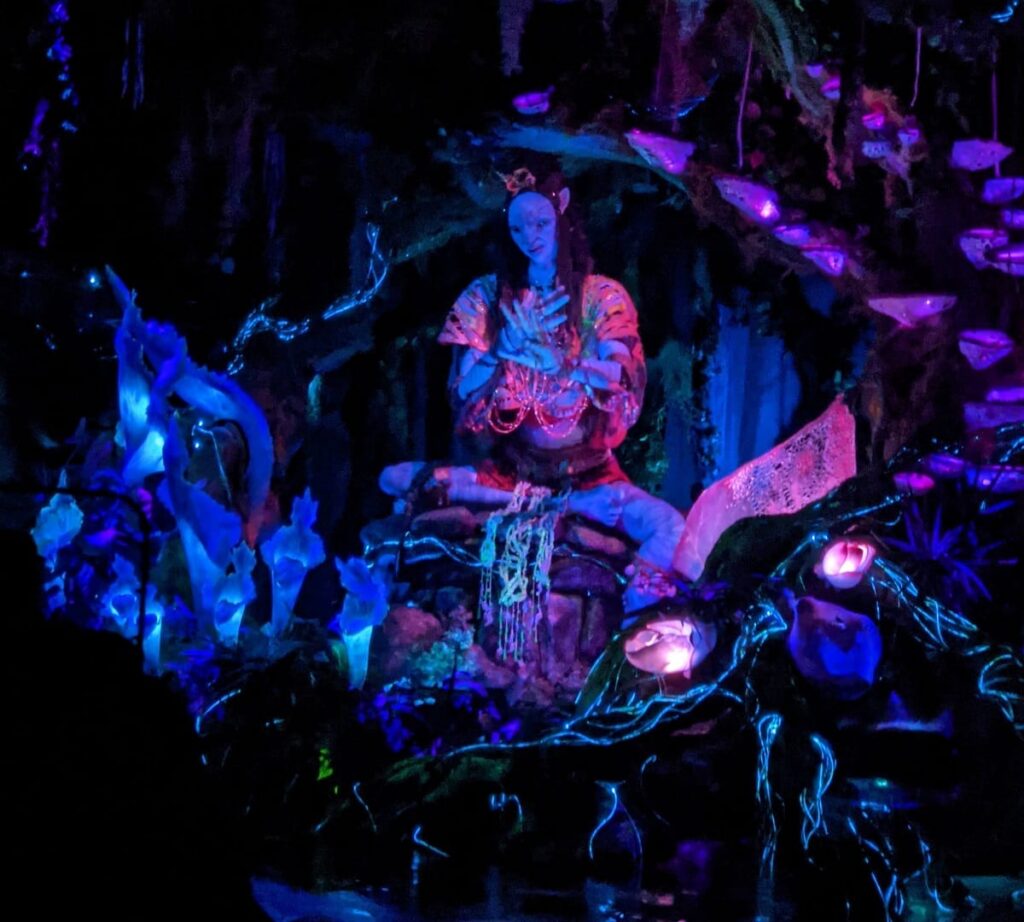
One of the most impressive Audio-Animatronics figures Disney has ever created debuted in 2017 inside Na’vi River Journey at Disney’s Animal Kingdom.
The Shaman of Songs stands nearly 10 feet tall and performs with remarkably fluid movements. Her hands and fingers gesture delicately, her upper body moves naturally with the music, and subtle facial motion helps create the impression of a living Na’vi musician.
Unlike a fast-moving thrill effect, the Shaman is placed close to passing guests and remains visible for an extended period, making the quality of her animation particularly important.
She became one of the clearest demonstrations of how far Audio-Animatronics had advanced since the mechanical birds and miniature figures of Walt’s earliest experiments.
A-1000 and Star Wars: Galaxy’s Edge
Another major technological generation arrived with Star Wars: Galaxy’s Edge.
When the land opened in 2019, Walt Disney Imagineering introduced the A-1000 Audio-Animatronics platform, which Disney says provides significant improvements in range of motion, speed, and overall performance.
Characters such as Hondo Ohnaka in Millennium Falcon: Smugglers Run demonstrate how modern figures can combine rapid movement with extremely subtle facial and body animation.
Star Wars: Rise of the Resistance pushes the idea further by blending Audio-Animatronics, projection, enormous physical sets, trackless ride vehicles, screens, practical effects, and moving scenery so seamlessly that it is often difficult to tell where one technology ends and another begins.
Tiana’s Bayou Adventure
When Tiana’s Bayou Adventure opened at Magic Kingdom in 2024, it brought another large generation of modern Audio-Animatronics figures to Walt Disney World.
The attraction contains dozens of animated characters, including Tiana, Louis, Mama Odie, and 19 newly created musical critters.
The figures combine modern electric animation, highly detailed sculpting, fabrics, lighting, and precisely programmed movements to recreate the visual style of The Princess and the Frog in physical form.
The attraction is especially notable because it uses modern Audio-Animatronics at large scale. Rather than relying on one technological showcase figure, the entire ride is populated with animated performers.
The First Walt Disney Audio-Animatronics Figure
One of the most symbolically important moments in the history of the technology arrived on July 17, 2025—Disneyland’s 70th anniversary.
Walt Disney – A Magical Life debuted at the Main Street Opera House and introduced the first Audio-Animatronics figure ever created of Walt Disney himself.
The show concludes in a recreation of Walt’s office, where the figure uses Walt’s own recorded words to discuss his career and philosophy.
Imagineers worked with the Walt Disney Archives and The Walt Disney Family Museum to study Walt’s appearance, gestures, expressions, and mannerisms.
Disney describes the result as the most lifelike human Audio-Animatronics figure it had created to that point. Innovations include exceptionally expressive eyebrows and eyelids, subtle facial animation, realistic hand gestures, and even details intended to recreate the characteristic sparkle in Walt’s eyes.
There is an obvious historical symmetry to the project. Walt and his Imagineers pushed Audio-Animatronics forward to create Abraham Lincoln in the 1960s. More than six decades later, Imagineers used generations of advancements in that same technology to recreate Walt himself.
Audio-Animatronics at Walt Disney World in 2026
Walt Disney World remains one of the best places to see the evolution of Audio-Animatronics because figures from several technological generations continue operating only a short distance from one another.
Magic Kingdom
- Pirates of the Caribbean – Large casts of classic pirate figures demonstrate the theatrical dark-ride style that helped define Disney animatronics.
- The Haunted Mansion – Combines animated figures with practical illusions, projections, lighting, and theatrical effects.
- Tiana’s Bayou Adventure – One of Walt Disney World’s largest collections of modern Audio-Animatronics figures.
- Seven Dwarfs Mine Train – Combines physical figures with animated facial projection technology.
- The Hall of Presidents – Continues the tradition that began with Walt’s Abraham Lincoln experiments.
EPCOT
- Frozen Ever After – Features historically important all-electric figures and newly updated Anna, Elsa, and Kristoff Audio-Animatronics introduced in 2026.
- Spaceship Earth – Uses numerous historical figures to tell the story of human communication.
- The American Adventure – Includes some of Disney’s most elaborate traditional theatrical staging and Audio-Animatronics.
- Gran Fiesta Tour Starring The Three Caballeros – Features José Carioca, Panchito Pistoles, and Donald Duck figures in its finale.
Disney’s Hollywood Studios
- Millennium Falcon: Smugglers Run – Hondo Ohnaka represents the A-1000 generation of Audio-Animatronics technology.
- Star Wars: Rise of the Resistance – Combines sophisticated animated figures with one of Disney’s most technologically complex attraction systems.
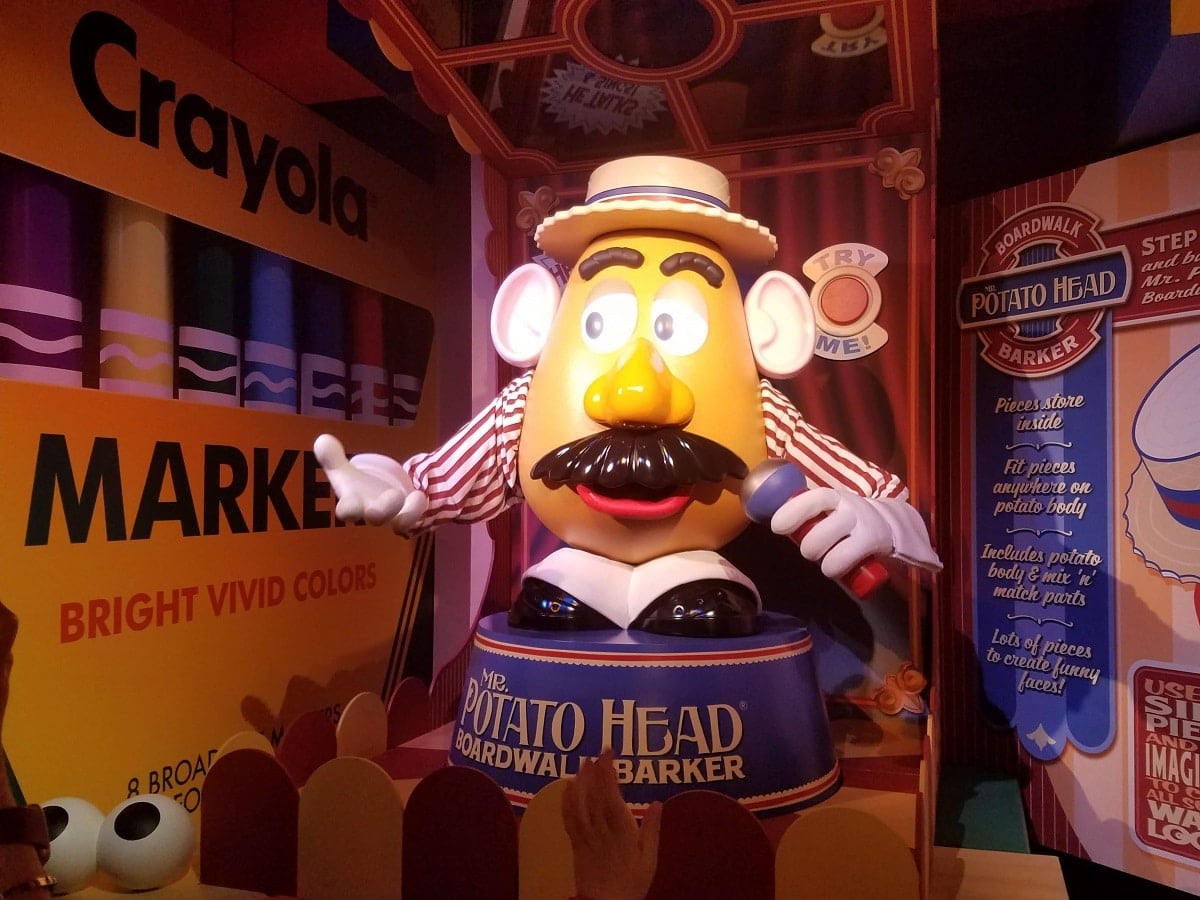
- Toy Story Mania – Mr. Potato Head remains a memorable example of an interactive animated figure in a queue environment.
Disney’s Animal Kingdom
- Na’vi River Journey – Home to the nearly 10-foot-tall Shaman of Songs.
- Zootopia: Better Zoogether! – Includes the modern Benjamin Clawhauser Audio-Animatronics figure.
- Expedition Everest – Contains one of Disney’s most famous—and most discussed—Audio-Animatronics figures: the enormous Yeti.
The Expedition Everest Yeti: An Animatronic Legend
Few Disney figures have developed a reputation quite like the Yeti inside Expedition Everest.
The enormous creature was originally designed to lunge dramatically toward passing trains. However, problems with the system eventually led Disney to stop operating the Yeti in its full-motion configuration.
For years, the figure has operated with lighting and other effects creating the illusion of movement—famously nicknamed “Disco Yeti” by fans.
That story is finally getting another chapter.
At D23 in August 2026, Disney announced that Imagineers are working to bring the Yeti back to life.
Disney has not yet announced exactly how the refurbishment will work or when the fully animated figure will return, but the announcement represents one of the most anticipated Audio-Animatronics restoration projects in Walt Disney World history.
The Next Generation Is Already Coming
Several upcoming Disney attractions are expected to push physical character technology forward again.
Walt Disney’s Carousel of Progress
Carousel of Progress temporarily closed at Magic Kingdom on July 6, 2026 for its largest transformation in decades.
When it reopens in late spring 2027, the attraction will include a new introductory scene featuring an Audio-Animatronics figure of Walt Disney.
The updated attraction will also move its American family into new historical eras and an imagined future, introducing new characters, scenery, technology, and animation while maintaining the show’s central theme of optimism and progress.
Indiana Jones and the Myth of the Jade Serpent
The Indiana Jones attraction under construction for Tropical Americas at Disney’s Animal Kingdom will feature what Disney has described as revolutionary Audio-Animatronics figures.
The attraction is scheduled to open in 2027 and will place guests inside an original Indiana Jones adventure involving an ancient Maya temple.
Piston Peak National Park
Disney is also taking animatronics in a very different direction for Magic Kingdom’s upcoming Cars-inspired Piston Peak National Park.
Miss Fritter’s Daredevil Spin-Along will feature a school-bus-sized animated Miss Fritter presiding over the demolition-derby-inspired attraction.
It is another reminder that Audio-Animatronics technology is not limited to human-sized figures—or even humanoid characters.
Beyond Audio-Animatronics: Disney’s Autonomous Robots
Audio-Animatronics are only one branch of Disney’s modern robotics research.
Traditional Audio-Animatronics generally perform programmed sequences from a fixed location. Imagineering is also developing robotic characters that can move through environments much more freely.
Disney has experimented with technologies such as autonomous Star Wars droids, stunt robots, and free-moving character figures.
In 2025, Imagineering publicly demonstrated a next-generation robotic Olaf capable of moving and performing in ways fundamentally different from a stationary attraction figure.
These technologies should not necessarily be called Audio-Animatronics simply because they are Disney robots. Instead, they represent parallel branches of Imagineering research that could eventually allow characters to walk, interact, react, and move through physical spaces with far greater independence.
Disney Animatronics Around the World
Some of Imagineering’s most advanced figures can now be found outside the United States.
- Disneyland Resort: Walt Disney – A Magical Life contains Disney’s first Audio-Animatronics Walt Disney, while classics including the Enchanted Tiki Room, Pirates of the Caribbean, and Great Moments with Mr. Lincoln preserve some of the technology’s earliest history.
- Hong Kong Disneyland: World of Frozen introduced highly expressive Anna, Elsa, Kristoff, Olaf, and Sven figures that helped inspire EPCOT’s 2026 Frozen Ever After update.
- Disney Adventure World at Disneyland Paris: A new version of Frozen Ever After opened with World of Frozen in March 2026 using state-of-the-art Audio-Animatronics, projection, lighting, and physical effects.
- Shanghai Disneyland: Pirates of the Caribbean: Battle for the Sunken Treasure demonstrates how animated figures can be blended with enormous screens, projection, physical scenery, and advanced ride technology. Zootopia also includes highly sophisticated animated characters.
- Tokyo DisneySea: Rapunzel’s Lantern Festival and other modern attractions feature recent generations of all-electric figure technology.
- Tokyo Disneyland: Enchanted Tale of Beauty and the Beast contains some of Disney’s most expressive modern character figures and uses them in combination with large, trackless ride vehicles and elaborate physical sets.
Projection Mapping Wasn’t the End Point
The original version of this article described projection mapping as the modern culmination of Disney animatronics, but the technology has evolved in a more complicated direction.
Projection remains extremely useful. Disney can project animation onto physical objects, blend moving imagery into sets, create facial expressions, and make scenery appear to transform.
But Imagineering increasingly combines projection with sophisticated physical figures rather than treating projection as a replacement for them.
Frozen Ever After is perhaps the clearest example. The original 2016 human figures used projected faces; a decade later, Disney intentionally replaced those faces with sophisticated physical ones.
The goal has never really been to use the newest technology simply because it exists. The goal is to choose whichever combination of mechanical animation, projection, lighting, sound, physical scenery, robotics, and digital effects makes the character feel most convincing.
A Timeline of Major Disney Audio-Animatronics Milestones
- Late 1940s: Walt Disney’s interest in a mechanical singing bird helps inspire experiments in three-dimensional animation.
- 1950s: Project Little Man explores realistic movement with miniature human figures.
- Early 1960s: First-generation A-1 animated figures appear at Disneyland.
- 1963: Walt Disney’s Enchanted Tiki Room opens as the first major Audio-Animatronics show.
- 1964: Great Moments with Mr. Lincoln introduces Disney’s first fully animated human figure at the New York World’s Fair.
- 1964: Carousel of Progress and it’s a small world dramatically expand the use of Audio-Animatronics.
- 1967: Pirates of the Caribbean opens at Disneyland.
- 1971: Walt Disney World opens with major Audio-Animatronics attractions including the Hall of Presidents and Country Bear Jamboree.
- 1982: EPCOT Center opens with large casts of advanced figures throughout Future World and World Showcase.
- 1989: Disney introduces the A-100 generation of Audio-Animatronics.
- 2016: Frozen Ever After becomes Disney’s first attraction using an entirely electric Audio-Animatronics cast and extensive 3D-printing technology.
- 2017: The Shaman of Songs debuts in Na’vi River Journey.
- 2019: Star Wars: Galaxy’s Edge introduces the A-1000 figure platform.
- 2024: Tiana’s Bayou Adventure opens with dozens of modern Audio-Animatronics characters.
- 2025: Walt Disney – A Magical Life introduces the first Audio-Animatronics Walt Disney.
- 2026: Frozen Ever After receives newly redesigned Anna, Elsa, and Kristoff figures at EPCOT.
- 2027: Walt Disney is scheduled to join the reimagined Carousel of Progress at Magic Kingdom.
Disney Animatronics FAQ
What are Disney Audio-Animatronics?
Audio-Animatronics is Disney’s term for animated physical figures whose programmed movement is synchronized with dialogue, music, lighting, scenery, and other attraction effects.
What was Disney’s first Audio-Animatronics attraction?
Walt Disney’s Enchanted Tiki Room, which opened at Disneyland in 1963, was the first major Disney attraction designed as a complete Audio-Animatronics show. Earlier Disneyland attractions had already used simpler animated figures.
What was the first human Disney Audio-Animatronics figure?
Abraham Lincoln was Disney’s first fully animated human figure. Great Moments with Mr. Lincoln debuted at the 1964–1965 New York World’s Fair before a version of the attraction opened at Disneyland.
What is one of Disney’s most advanced animatronics?
The nearly 10-foot Shaman of Songs in Na’vi River Journey remains one of Disney’s most celebrated advanced figures. More recently, Disney has described the Walt Disney figure created for Walt Disney – A Magical Life as its most lifelike human Audio-Animatronics figure.
Does Frozen Ever After still use projection-mapped faces?
The main Anna, Elsa, and Kristoff figures no longer do. In February 2026, EPCOT upgraded those characters with new sculpted physical faces inspired by the advanced Frozen figures developed for Hong Kong Disneyland. Some other figures and attraction effects continue to use projection technology.
Is there an animatronic Walt Disney?
Yes. The first Audio-Animatronics figure of Walt Disney debuted at Disneyland in Walt Disney – A Magical Life on July 17, 2025. A Walt Disney figure is also being added to Walt Disney World’s Carousel of Progress as part of the attraction’s reimagining scheduled to debut in late spring 2027.
Will the Expedition Everest Yeti move again?
Disney announced in August 2026 that Imagineers are working to bring the Expedition Everest Yeti back to life. Disney has not yet announced exactly when or how the restored animation will debut.
From Mechanical Birds to Living Characters
The history of Disney Audio-Animatronics is ultimately a history of increasingly sophisticated illusion.
The mechanical bird that fascinated Walt Disney did not look like a Na’vi shaman, Abraham Lincoln, Princess Tiana, Hondo Ohnaka, Elsa, or Walt himself. But the question behind it was the same question Imagineers continue asking today: how can we make an inanimate character seem alive?
The answer has changed repeatedly—from cams and cables to hydraulics, digital animation systems, electric motors, 3D printing, projection, advanced materials, and autonomous robotics.
What has not changed is the reason Disney keeps developing the technology. Audio-Animatronics allow a theme park attraction to do something a movie cannot: place a physical character in the same room as the audience.
More than 60 years after the Enchanted Tiki Room opened, Disney is still refining that illusion—and the figures currently under development suggest that the next chapter may be every bit as transformative as the ones that came before it.