
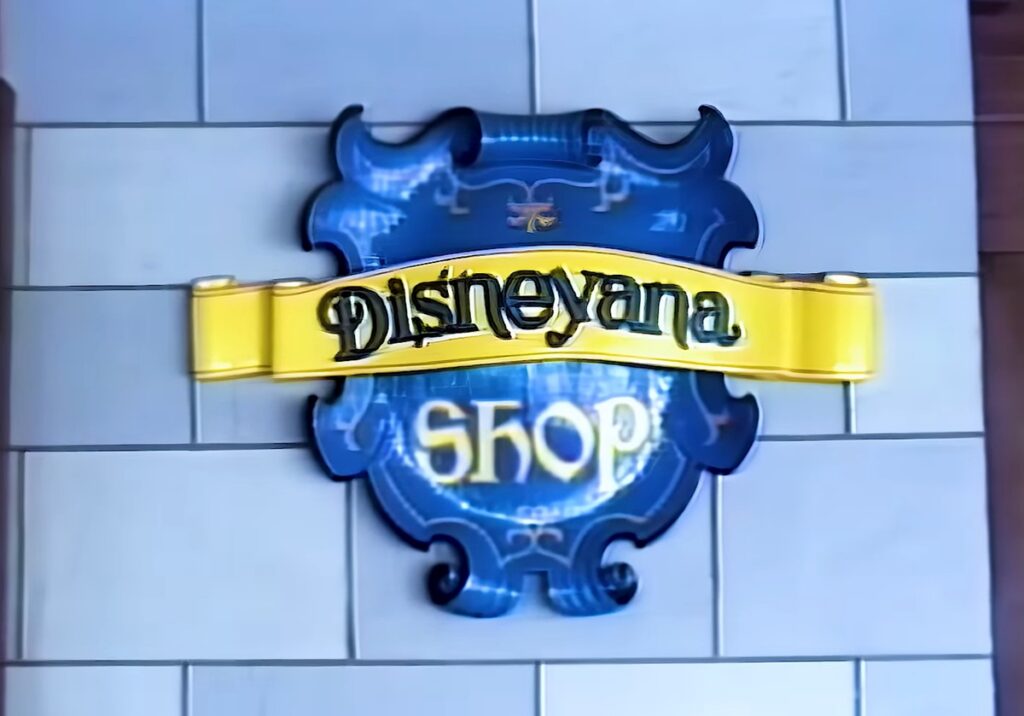
The Disneyana Shop was a specialty collectibles store at Magic Kingdom devoted to Disney history, artwork, animation, and memorabilia. It opened in Fantasyland on April 15, 1983, later relocated to the Town Square area of Main Street, U.S.A., and ultimately closed on October 1, 1996.
Unlike most Walt Disney World gift shops, Disneyana was aimed particularly at serious Disney enthusiasts and collectors.
Guests could find animation cels, decorative plates, artwork, limited-edition items, commemorative merchandise, figurines, and other collectibles connected with Disney films, characters, theme parks, and company history. During an era when most park stores still had sharply defined specialties, Disneyana effectively served as Walt Disney World’s shop for people who collected Disney itself.
Even the name reflected that purpose.
“Disneyana” is a general term for Disney memorabilia and collectibles, particularly older or historically significant material. Disney’s official historical archive notes that the word was already being used among collectors by the 1960s and became substantially more familiar following the 1974 publication of Cecil Munsey’s book Disneyana: Walt Disney Collectibles.
Disney recognized the growing collector market relatively early.
Disneyland opened its own Disneyana Shop on Main Street, U.S.A. on January 9, 1976. That store initially did something extraordinary: Disney itself purchased older Disney merchandise and memorabilia and then resold those vintage items to guests.
The idea eventually created an unexpected problem.
According to Disney’s official history, obtaining enough authentic old merchandise became increasingly difficult, and company buyers worried that Disney’s own purchasing activity might artificially increase market prices.
The Disneyland shop consequently shifted toward contemporary collectibles and limited editions rather than relying heavily on vintage merchandise.
Walt Disney World introduced its version seven years later.
On April 15, 1983, the Disneyana Shop opened in Fantasyland at Magic Kingdom.
Its location had previously housed the Castle Camera Shop.
Castle Camera had been one of Fantasyland’s original retail facilities, selling film, slides, photographic supplies, and information from 1971 until 1983.
Disneyana therefore represented a substantial departure from the previous concept.
Instead of helping guests document their Walt Disney World vacation, the new store sold pieces celebrating Disney history and creativity.
The shop stood near Cinderella Castle and across from Cinderella’s Golden Carrousel, in the cluster of retail spaces beside Peter Pan’s Flight and the Fantasyland theater complex.
For visitors familiar with the modern park, the general area is associated today with Fantasy Faire and Mickey’s PhilharMagic.
In the 1980s, however, the surrounding Fantasyland looked very different.
The Mickey Mouse Revue had already closed.
Magic Journeys would later occupy the nearby Fantasyland Theater.
The land still retained much of its colorful medieval-tournament architecture.
And Disneyana stood among more traditional Fantasyland retailers such as The Mad Hatter, Tinker Bell Toy Shop, The King’s Gallery, The AristoCats, and Mickey’s Christmas Carol.
Disneyana was unusual because its merchandise was not particularly tied to Fantasyland.
A guest might find collectibles connected with classic animated films, Mickey Mouse, Walt Disney World anniversaries, or Disney history generally.
A retrospective description of Magic Kingdom shopping during the 1980s specifically remembers Disneyana carrying animation cels, collectible plates, and other distinctive film-related items.
Animation cels were especially appropriate.
Before computer animation transformed the industry, traditional Disney animated films were photographed from hand-painted cels placed over painted backgrounds. By the 1980s, collecting production artwork had become an increasingly important part of Disney fandom.
Owning a genuine or specially prepared Disney animation cel offered fans something very different from purchasing a mass-produced plush toy.
It was closer to owning a piece of the filmmaking process.
Disneyana catered to that kind of customer.
The shop also sold newly manufactured collectibles designed specifically for enthusiasts.
One surviving recollection from 1987 describes purchasing a large Walt Disney World 15th Anniversary Coca-Cola commemorative pin collection there. The set contained 60 different pins, illustrating the increasingly sophisticated type of limited and commemorative merchandise Disney was offering collectors by the late 1980s.
That period was especially important in the development of modern Disney collecting.
Pins had not yet become the enormous trading phenomenon they would become around the turn of the millennium.
Online auctions did not exist.
Guests could not simply browse thousands of discontinued Disney items from their phones.
Finding unusual Disney merchandise often required visiting the parks, attending collector gatherings, reading newsletters, visiting specialty dealers, or knowing which particular Disney store carried the more unusual material.
Disneyana gave collectors a destination inside Magic Kingdom.
Disney’s relationship with the collector community continued expanding.
Unofficial Disneyana collector organizations and conventions had grown increasingly popular during the 1980s.
Disney eventually entered that world directly.
The first official Disneyana Convention was held at Walt Disney World’s Contemporary Resort from September 24 through September 27, 1992.
Approximately 750 attendees participated in merchandise sales, auctions, presentations, tours, meals, entertainment, and opportunities to purchase special limited-edition collectibles.
Later Disneyana Conventions became major events for serious collectors.
The Magic Kingdom shop therefore existed during the formative years of what would become an enormous Disney collectibles industry.
Its Fantasyland location did not remain permanent.
By the end of the 1980s, Disney reorganized the retail spaces beside Peter Pan’s Flight.
Historical Magic Kingdom maps show Disneyana disappearing from Fantasyland by approximately 1990, with the former Castle Camera/Disneyana area absorbed into neighboring retail operations.
The space ultimately became part of the larger Fantasy Faire shop.
Fantasy Faire still operates beside the exit of Mickey’s PhilharMagic in 2026.
Disneyana itself moved to Main Street, U.S.A.
The relocated operation is frequently identified as Disneyana Collectibles and occupied space in the Town Square complex associated with the former Hospitality House and The Walt Disney Story.
The move arguably gave Disneyana a more appropriate home.
Fantasyland had provided plenty of foot traffic, but Main Street’s Town Square was closely connected to Disney history.
The Walt Disney Story had long presented artifacts, awards, photographs, and exhibits chronicling Walt Disney’s life and career.
Placing a collectibles store nearby created a natural transition between experiencing Disney history and purchasing merchandise celebrating it.
The Town Square Disneyana location also became associated with one of Walt Disney World’s most memorable artist encounters.
Disney animator and sculptor Harry Holt began appearing there during the late 1980s.
Holt had joined Disney in the 1930s and worked on animated films before eventually moving into sculpture and other creative roles. After officially retiring from Disney in 1982, he returned to guest interaction work at Walt Disney World.
Beginning in 1987, at approximately 76 years old, Holt sat at an animator’s desk in the Disneyana Collectibles area and drew Disney characters for guests.
Originally, his presence was connected with promoting the upcoming Disney-MGM Studios and its working animation facility.
Guests loved him.
The assignment consequently continued for years.
Holt could sit at his desk drawing characters, talking about his Disney career, and demonstrating the skills he had developed over decades with the company.
For a store devoted to Disney collectibles and history, it was an extraordinary addition.
Guests were not merely buying memorabilia.
They could meet someone who had actually helped create Disney art.
That connection between merchandise and Disney heritage distinguished Disneyana from a conventional souvenir shop.
The store continued operating in Town Square through the first half of the 1990s.
By then, collectible Disney merchandise was becoming increasingly mainstream.
Limited editions, convention merchandise, watches, pins, artwork, figurines, animation art, and commemorative releases were expanding throughout Walt Disney World rather than remaining confined to one specialist store.
Disney was also reorganizing the Town Square complex.
The Walt Disney Story permanently stopped regular operation in 1992, and portions of the surrounding facility evolved into the Town Square Exposition Hall.
The Exposition Hall combined photography services, displays, entertainment, and merchandise in a much larger front-of-park facility.
Against those changes, the stand-alone Disneyana concept became less essential.
Disney’s official history gives October 1, 1996—Walt Disney World’s 25th anniversary—as the closing date for the Magic Kingdom Disneyana Shop.
The former Disneyana Collectibles space was subsequently incorporated into the evolving Town Square Exposition Hall complex.
Later retail operations in that general area included collectible and photography-oriented merchandise, while subsequent renovations eventually produced the Town Square Theater that operates there today.
Disneyana therefore disappeared as a named Walt Disney World shop, but the type of merchandise it pioneered certainly did not.
Disney collectibles became an enormous business.
Limited-edition pins evolved into an entire trading culture.
Art galleries appeared at Walt Disney World.
Animation artwork, sculptures, watches, figurines, commemorative merchandise, anniversary collections, attraction-specific collectibles, and high-end Disney artwork became routine parts of resort shopping.
In that sense, Disneyana was ahead of its time.
The shop recognized that some Walt Disney World visitors wanted something different from a standard vacation souvenir.
They wanted objects connected with Disney history.
They wanted artwork.
They wanted unusual releases.
They wanted limited editions.
They wanted collectibles that might remain in their homes long after the vacation itself had become a memory.
The physical Fantasyland shop lasted only about six years before moving, and the Walt Disney World Disneyana concept disappeared entirely in 1996.
Its legacy is much larger.
Disneyana helped establish the idea that Disney history itself could be collectible.
For fans browsing animation cels, anniversary merchandise, plates, artwork, and other treasures during the 1980s and 1990s, the shop was not simply somewhere to buy a Mickey Mouse souvenir.
It was a place where being a serious Disney fan was the entire point.